- Best-characterized GHRH analog available, with Phase 3 randomized data behind it rather than rodent studies
- Clean selectivity profile — the GHRH-only mechanism removes the endocrine cross-talk that complicates GHRP-based models
- Short half-life preserves pulsatile GH release, avoiding the sustained-elevation confound that affects DAC-conjugated compounds
- Daily administration required; no long-acting option exists
- Single-pathway stimulation produces lower GH pulse amplitude than dual-receptor approaches
- Documented effects on glucose tolerance and IGF-1 elevation that study designs need to account for
Tesamorelin is a synthetic analog of growth hormone-releasing hormone, built on the full 44-amino-acid GRF sequence with a trans-3-hexenoyl group attached at the N-terminus. That modification resists dipeptidyl peptidase-4 degradation while leaving receptor binding intact, giving the molecule stability without altering how it engages the GHRH receptor.
It occupies an unusual position among research peptides: developed by Theratechnologies and approved by the FDA in 2010 under the name Egrifta, it is the only GHRH analog to have completed Phase 3 trials and reached market. The published literature is correspondingly deep — randomized controlled data on visceral adipose tissue, IGF-1 response, and glucose parameters, rather than the animal work that supports most compounds in this class.
Mechanistically, tesamorelin activates GHRH receptors on pituitary somatotrophs, driving cAMP-dependent GH synthesis and release. Its short half-life means GH rises and falls in discrete pulses that mirror endogenous secretion, which makes it well suited to protocols where physiological pulse architecture matters.
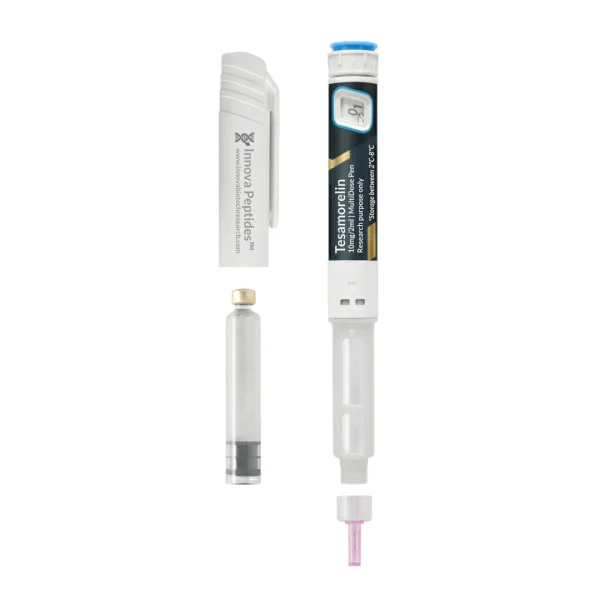
Supplied as 10 mg lyophilized powder, >98% purity by independent HPLC, batch-specific COA included. Reconstitute with bacteriostatic water; store lyophilized at -20°C.
For laboratory research use only. Not for human or veterinary use.