Quick answer: AOD-9604 is a synthetic 16-residue fragment of human growth hormone — hGH residues 177–191 with an added tyrosine — developed in Australia by Metabolic Pharmaceuticals as an oral obesity drug [4]. In animals it raised fat oxidation and slowed weight gain without the hyperglycaemia hGH causes (animal) [1][8]. Six randomised, double-blind, placebo-controlled human trials were run; in the last and largest, the earlier weight-loss effect did not appear (human RCT) [3][4]. No approved AOD 9604 medicine exists in the US (checked September 2026) [5][6].
| Spec | Detail |
|---|---|
| Also known as | AOD9604, Tyr-hGH 177–191 [4] |
| Class | Synthetic C-terminal fragment of hGH [4] |
| Sequence / length | 16 residues — hGH 177–191 plus an N-terminal tyrosine, cyclised by a disulphide bond [4] |
| Molecular weight | Not stated in the sources opened |
| Half-life | ~3 min after IV dosing in pigs, ~4 min in spiked rat serum; none published in humans [4] |
| Oral availability | ~40% in rats (animal) [4] |
| Regulatory status (US) | No approved drug product; nominated for compounding, category 2, then withdrawn (checked September 2026) [5][6] |
| Anti-doping status | Named under WADA S2 in a 2024 peer-reviewed review; the list itself was not retrievable (checked Sep 2026) [7] |
| Developer | Metabolic Pharmaceuticals Ltd, Melbourne, Australia [4] |
What is AOD-9604?
Human growth hormone is a 191-amino-acid protein, and work in Melbourne suggested its fat-mobilising activity sits in the C-terminal tail rather than the region binding the GH receptor. AOD-9604 is that idea made concrete: residues 177–191, an added tyrosine at the N-terminus for stability, and a disulphide bond closing the loop between the two cysteines [4]. The name is short for “anti-obesity drug”.
Metabolic Pharmaceuticals took it through preclinical work and a full human programme as an oral capsule and tablet, then stopped. Our explainer on what a peptide actually is covers why a 16-residue fragment behaves nothing like its parent. It is often sold interchangeably with hGH fragment 176–191, the unmodified parent fragment. They are not the same molecule: the trial programme, toxicology and regulatory record below belong to AOD-9604 [3][4][5].
How AOD-9604 works (mechanism)
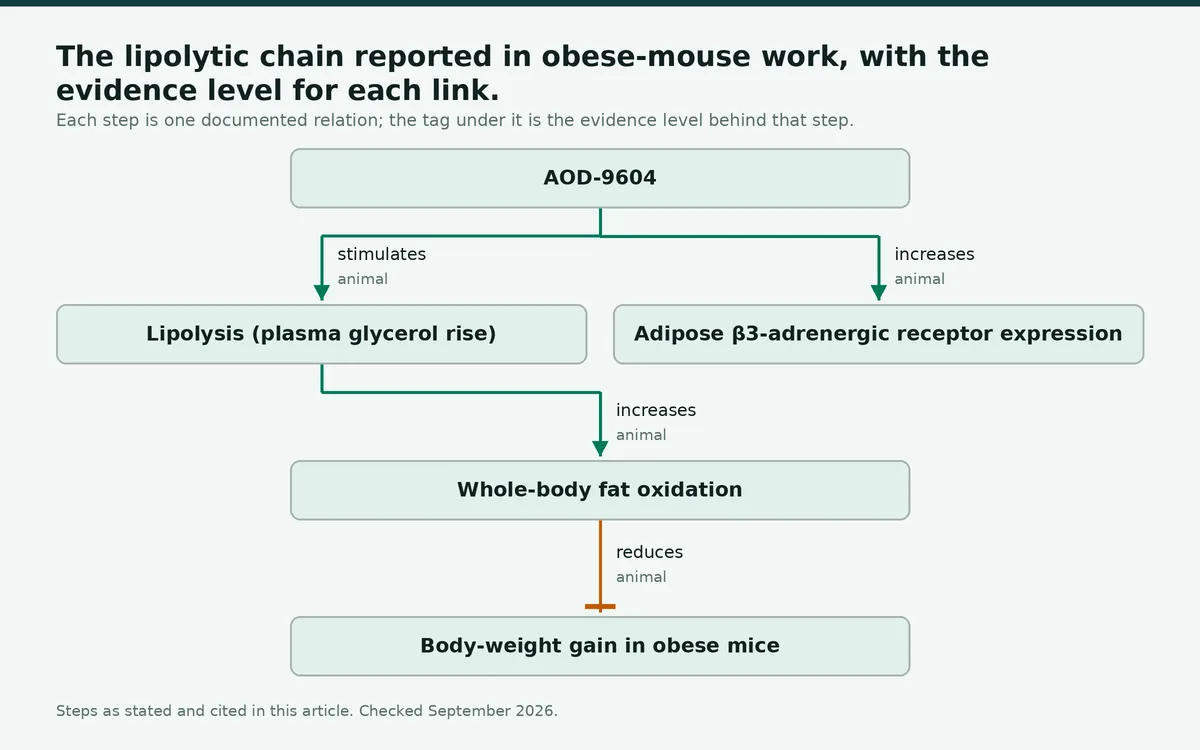
| Step | Relation | Target | Evidence |
|---|---|---|---|
| AOD-9604 | stimulates | Lipolysis (plasma glycerol rise) | animal [1] |
| AOD-9604 | increases | Adipose β3-adrenergic receptor expression | animal [2] |
| Lipolysis (plasma glycerol rise) | increases | Whole-body fat oxidation | animal [1] |
| Whole-body fat oxidation | reduces | Body-weight gain in obese mice | animal [1] |
Two points in that chain carry the marketing claims.
The first is what AOD-9604 does not do. In-vitro assays in the 2001 International Journal of Obesity study concluded it does not signal through the growth hormone receptor (in vitro) [1]. In the same obese-mouse work it did not induce hyperglycaemia or suppress insulin secretion, unlike hGH (animal) [1]; in obese Zucker rats it had “no adverse effect on insulin sensitivity” (animal) [8]; and in the human trials serum IGF-1 did not change (human RCT) [3]. The claim that it separates hGH’s fat effect from its metabolic baggage has data behind it — for the baggage half.
The second is that the receptor it does act on has never been identified. The β3-adrenergic receptor was the obvious candidate, and chronic treatment raised β3-AR expression in obese mice to lean-mouse levels — but in β3-AR knock-out mice, long-term treatment produced none of the weight or lipolytic changes seen in wild-type animals. The authors concluded the lipolytic action is “not mediated directly through the β3-AR” (animal) [2]. A documented effect with no identified receptor is a mechanism with a hole in it.
Key numbers
The most quoted figure in AOD-9604 marketing comes from a 19-day oral study in obese Zucker rats. It is a real result in a real journal — and an animal one.
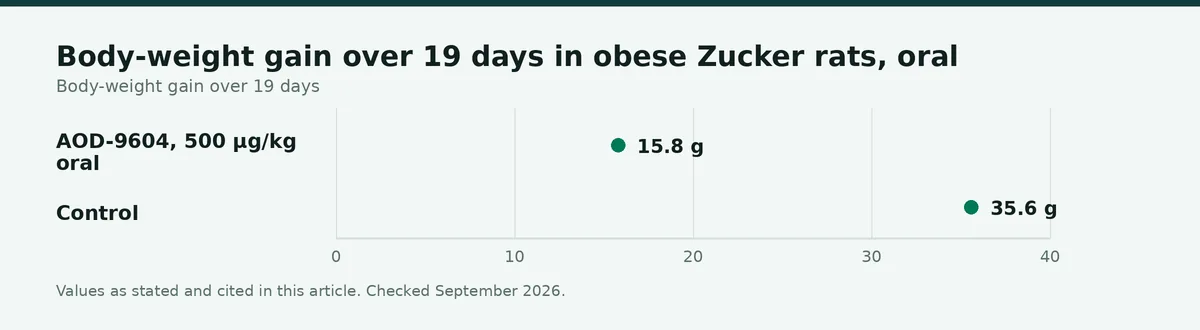
| Group | Body-weight gain over 19 days | Evidence level |
|---|---|---|
| AOD-9604, 500 µg/kg oral | 15.8 g | animal [8] |
| Control | 35.6 g | animal [8] |
Equivalent human numbers were never published. Both phase IIb trials measured body-mass reduction, but the peer-reviewed write-up is a safety paper, and the only efficacy statement in the literature opened for this page is one sentence: weight-loss effects “were seen in initial trials but were not seen in the last study in which an intensive diet and exercise regime was incorporated” [4].
What the research shows
Human studies
Six randomised, double-blind, placebo-controlled trials were run, all by one sponsor; their designs appear in the 2013 safety paper (human RCT) [3].
| Trial | Route | Participants | Design |
|---|---|---|---|
| METAOD001 | IV | 15 healthy men | Dose escalation, 25–400 µg/kg singles [3] |
| METAOD002 | IV | 23 obese men | Latin square, 25–100 µg/kg singles [3] |
| METAOD003 | Oral | 17 obese men | Latin square, 9/27/54 mg singles [3] |
| METAOD004 | Oral | 36 obese men | 9/27/54 mg daily for 7 days [3] |
| METAOD005 | Oral | 300 obese adults | 12 weeks, 1–30 mg daily or placebo [3] |
| METAOD006 | Oral | 502 obese adults | 24 weeks, 0.25–1 mg daily or placebo [3] |
What those trials establish is mostly negative and mostly about safety: IGF-1 did not move in either phase IIb study, oral glucose tolerance testing showed no significant change, and no anti-AOD9604 antibodies were detected [3]. What they did not establish is that the compound reduces body weight more than placebo. Note also the dose collapse between the two phase IIb studies — 1–30 mg daily, then 0.25–1 mg daily — which the published record does not explain.
Animal studies
In obese (ob/ob) mice given hGH, AOD-9604 or saline by osmotic pump for 14 days, both compounds significantly reduced body-weight gain, with increased in-vivo fat oxidation and raised plasma glycerol (animal) [1]. A separate 14-day study found both reduced body weight and fat mass and raised β3-AR expression toward lean levels (animal) [2].
The toxicology package is unusually substantial for this market. A 6-month rat study found no treatment-related differences in organ masses, macropathology, ophthalmology, histopathology or bone characteristics, NOAEL at or above 100 mg/kg/day; a 9-month cynomolgus monkey study gave a NOAEL of 50 mg/kg/day with only minor, non-dose-related liver findings (animal) [4].
In-vitro and preclinical
Ames testing, a chromosome aberration assay in CHO cells and a micronucleus assay showed no mutagenic or clastogenic activity (in vitro and animal) [4]. Cell assays indicated AOD-9604 neither interacts with the human GH receptor nor drives proliferation through it (in vitro) [1].
Side effects and risks
Adverse events were common, though the pattern did not separate AOD-9604 from placebo [3].
- Headache dominated: it was the most frequent of 29 adverse events across 12 subjects in METAOD001, and 69.6% of subjects reported it in METAOD002 [3].
- Gastrointestinal effects clustered at the top oral dose: the 54 mg group in METAOD004 showed increased headache, diarrhoea and flatulence, and one serious event of diarrhoea in METAOD003 was judged possibly related to 54 mg [3].
- Serious events in METAOD005: five patients — three in the 20 mg group (basal cell carcinoma, a moderate lipoma, squamous cell carcinoma), one in the 5 mg group (breast cancer), one in the 10 mg group (malignant melanoma). Investigators judged none related to medication [3]. That is their assessment in a 12-week study of 300 people with no placebo-arm malignancies reported — an imbalance only a longer trial could have interpreted, and none was run.
- METAOD006 recorded 18 serious adverse events across 502 patients (3.6%), similarly distributed across groups [3].
- Immunogenicity is FDA’s stated concern for compounded use, though no anti-drug antibodies were detected in the trials or animal studies [3][4][5].
Longer-term human safety is unknown: nothing ran past 24 weeks and every human study shares one sponsor. Material sold outside a licensed supply chain adds risks unrelated to the molecule — see how to spot a weak peptide vendor.
Regulatory and legal status (2026)
No US approval. A DailyMed search for AOD-9604 returns no drug package labels (checked September 2026) [6].
Compounding. FDA’s list of bulk drug substances that may present significant safety risks carries AOD-9604 under “Bulk drug substances nominated but withdrawn” — substances that sat in category 2 of the interim policies and were then withdrawn by their nominators. FDA’s entry says compounded drugs containing AOD-9604 “may pose significant risk for immunogenicity for certain routes of administration and may have complexities with regard to peptide-related impurities and API characterization”, that it “has identified no, or only limited, safety-related information”, and that it “has also identified serious adverse events that may be associated with AOD-9604, though causality is not clear” (page current 22 April 2026, checked September 2026) [5].
The GRAS question. The 2014 nutraceutical safety paper states AOD-9604 “received ‘generally recognized as safe’ (GRAS) status, conditional on publication of pre-existing safety data, for its intended use in foods, drinks and dietary supplements” [4]. Two cautions. FDA’s GRAS Notice Inventory returns no records for “AOD9604” (checked September 2026) [9], consistent with a self-affirmed determination rather than an FDA notification. And GRAS is a food-ingredient standard about a dietary use: not drug approval, silent on injectable use, not a finding of medical safety or effectiveness. Our guide to research-use, compounded and approved peptides sets out why those categories differ, and peptide legal status covers the wider picture.
Sport. A 2024 peer-reviewed banned-substance review lists “AOD-9604, hGH 176–191” under WADA Prohibited List section S2, growth hormone and its analogs and fragments [7]. WADA’s own list page could not be retrieved during this run, so this page rests on that report, not the primary list (checked September 2026).
Comparison Framework scores
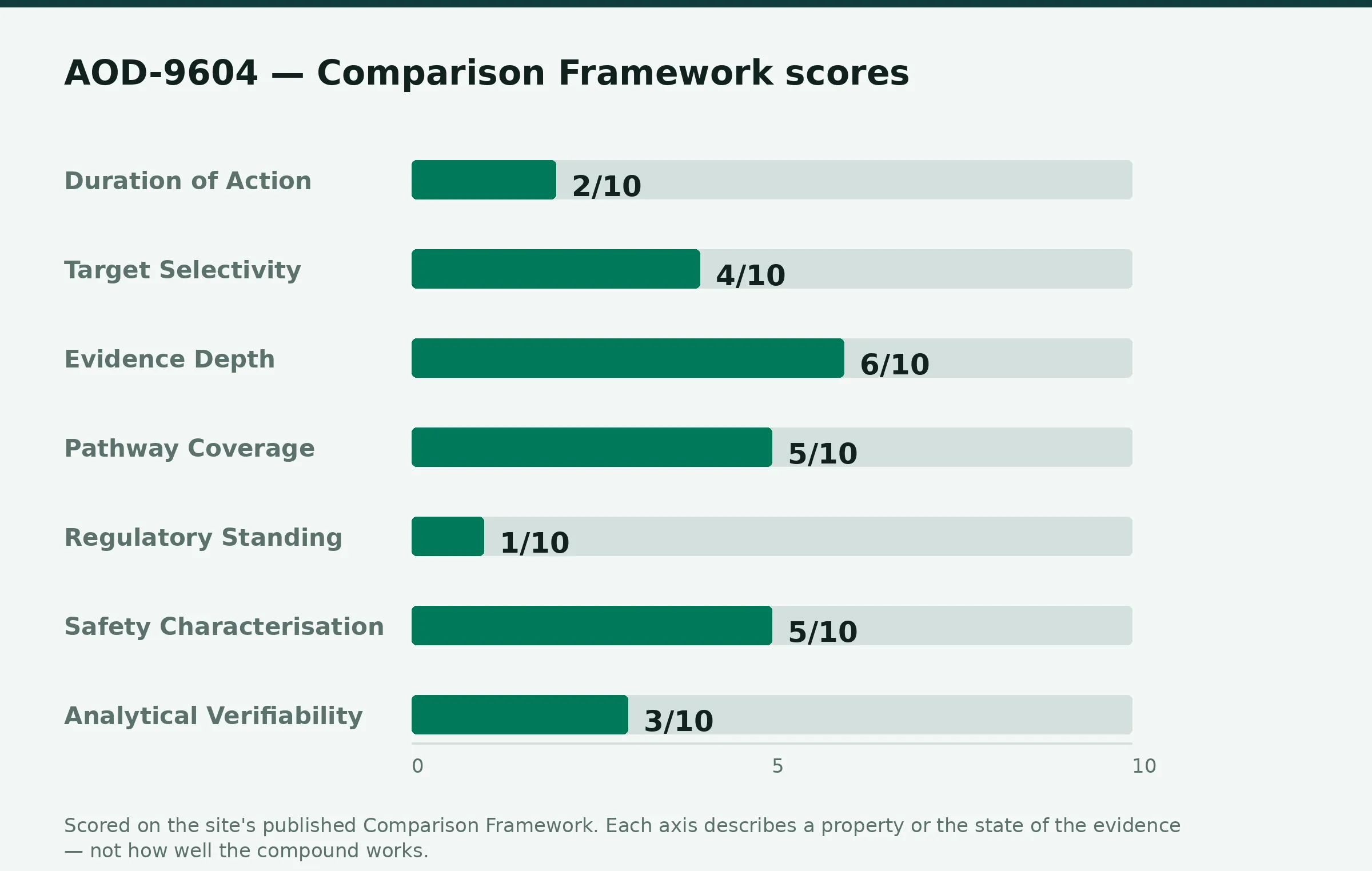
| Axis | Score | Why |
|---|---|---|
| Duration of Action | 2/10 | ~3 min half-life after IV dosing in pigs, ~4 min in spiked rat serum, no human value published; “under 30 min” anchors at 1–2 [4] |
| Target Selectivity | 4/10 | No band published, so interpolated: documented not to signal through the hGH receptor [1] or raise IGF-1 [3], but no receptor is identified and the β3-AR was ruled out as direct mediator [2] — an absent off-target, not a demonstrated on-target |
| Evidence Depth | 6/10 | Six randomised placebo-controlled trials, two phase IIb in 300 and 502 adults [3] — nominally the 7–8 RCT band, interpolated down because only safety data were published and the efficacy record is one sentence [4] |
| Pathway Coverage | 5/10 | One pathway — adipocyte lipid metabolism via lipolysis and fat oxidation [1][2]; the framework sets one pathway at 5 |
| Regulatory Standing | 1/10 | No approved US product (checked September 2026) [6]; FDA lists it as nominated for compounding, placed in category 2, then withdrawn, citing immunogenicity [5]. Category 2 anchors at 1 |
| Safety Characterisation | 5/10 | Interpolated, no bands published. Adverse-event, IGF-1, OGTT and antibody data across six RCTs to 24 weeks [3] plus 6-month rat and 9-month monkey toxicology with NOAELs [4]; against that, one sponsor, nothing longer, and FDA reporting only limited safety information [5] |
| Analytical Verifiability | 3/10 | Interpolated between the “no public method” (1–2) and “compendial monograph” (9–10) anchors: no monograph and no public validated identity or purity method were found this run, and FDA notes complexities with peptide impurities and API characterisation [5] |
One caveat belongs under that table: a trial programme that never published its efficacy results is weaker evidence than its size suggests, and the animal chain drawn above is mechanistic plausibility, not clinical proof. No composite score is given — see the Comparison Framework for the anchors.
How AOD-9604 compares
Against the approved weight-management peptides this is a different evidence universe. Semaglutide and tirzepatide have published phase III programmes whose body-weight endpoints were met and reported, and the GLP-1 peptide class acts on well-characterised receptors. AOD-9604 has neither an identified receptor nor a published human efficacy result.
Against the GH-axis compounds the contrast is what is being manipulated. Growth hormone secretagogues raise endogenous GH and therefore IGF-1; AOD-9604 was designed to do the opposite, and the trials confirm IGF-1 does not move [3]. Tesamorelin is the reference point: a GH-axis peptide with an approved indication and published trial data, exactly what AOD-9604 lacks.
Sourcing and quality: what to look for
With no approved product and no pharmacopoeial monograph, anything on sale is unverified against a public standard. FDA’s note about “complexities with regard to peptide-related impurities and API characterization” applies to a research vial as much as a compounded one [5].
For laboratory material, the document to demand is a batch-specific certificate of analysis with an identity method, a purity method and a date — how to read a peptide COA covers what a real one contains, and HPLC and mass-spec purity testing what those methods show. A supplier publishing a percentage with no chromatogram, method or batch number has told you nothing.
FAQ
Is AOD-9604 approved by the FDA?
No. A DailyMed search returns no drug package labels containing AOD-9604, so there is no FDA-approved medicine with this ingredient (checked September 2026) [6]. FDA separately lists it among bulk substances nominated for compounding, placed in category 2, then withdrawn by the nominator, citing immunogenicity risk and limited safety information [5].
Did the AOD-9604 obesity trials show weight loss?
Not in the decisive study. Six randomised, double-blind, placebo-controlled trials were run, including 12 weeks in 300 obese adults and 24 weeks in 502 obese adults [3]. The only published efficacy statement says weight-loss effects were seen in initial trials but “were not seen in the last study in which an intensive diet and exercise regime was incorporated” [4]. Full phase IIb results were never published, and the programme was discontinued.
Does AOD-9604 raise IGF-1 or blood sugar the way growth hormone does?
The published data say no. Across the human trials serum IGF-1 did not change significantly in any group, and oral glucose tolerance testing showed no significant changes (human RCT) [3]. In obese mice, unlike hGH, it did not induce hyperglycaemia or reduce insulin secretion (animal) [1].
What does “GRAS” mean for AOD-9604, and does it mean it is safe?
A 2014 paper reports AOD-9604 received generally-recognised-as-safe status, conditional on publication of pre-existing safety data, for intended use in foods, drinks and supplements [4]. FDA’s GRAS Notice Inventory returns no records for AOD9604 (checked September 2026) [9], pointing to a self-affirmed determination rather than an FDA notification. GRAS is a food-ingredient standard: not drug approval, silent on injectable use, not a finding of medical safety or effectiveness.
Is AOD-9604 banned in sport?
A 2024 peer-reviewed banned-substance review lists AOD-9604 and hGH 176–191 as examples under WADA Prohibited List section S2, growth hormone and its analogs and fragments [7]. WADA’s own list page could not be opened during this run, so that report is the basis here (checked September 2026). Athletes in tested sport should treat the primary list as authoritative.
References
- Heffernan MA, Thorburn AW, Fam B, Summers R, Conway-Campbell B, Waters MJ, Ng FM. Increase of fat oxidation and weight loss in obese mice caused by chronic treatment with human growth hormone or a modified C-terminal fragment. International Journal of Obesity. 2001;25(10):1442–1449. https://www.nature.com/articles/0801740
- Heffernan M, Summers RJ, Thorburn A, Ogru E, Gianello R, Jiang WJ, Ng FM. The Effects of Human GH and Its Lipolytic Fragment (AOD9604) on Lipid Metabolism Following Chronic Treatment in Obese Mice and β3-AR Knock-Out Mice. Endocrinology. 2001;142(12):5182–5189. https://academic.oup.com/endo/article-abstract/142/12/5182/2988749
- Stier H, Vos E, Kenley D. Safety and Tolerability of the Hexadecapeptide AOD9604 in Humans. Journal of Endocrinology and Metabolism. 2013;3(1–2):7–15. https://www.jofem.org/index.php/jofem/article/view/157/194
- Moré MI, Kenley D. Safety and Metabolism of AOD9604, a Novel Nutraceutical Ingredient for Improved Metabolic Health. Journal of Endocrinology and Metabolism. 2014;4(3):64–77. https://jofem.org/index.php/jofem/article/view/213/278
- US Food and Drug Administration. Certain Bulk Drug Substances for Use in Compounding that May Present Significant Safety Risks. Content current as of 22 April 2026; checked September 2026. https://www.fda.gov/drugs/human-drug-compounding/certain-bulk-drug-substances-use-compounding-may-present-significant-safety-risks
- DailyMed, US National Library of Medicine. Search results for “AOD-9604” — no drug package labels found. Checked September 2026. https://dailymed.nlm.nih.gov/dailymed/search.cfm?labeltype=all&query=AOD-9604
- Thevis M, Kuuranne T, Geyer H. Annual Banned-Substance Review 17th Edition — Analytical Approaches in Human Sports Drug Testing 2023/2024. Drug Testing and Analysis. 2024;17(8):1417–1442. https://pmc.ncbi.nlm.nih.gov/articles/PMC12319490/
- Ng FM, Sun J, Sharma L, Libinaka R, Jiang WJ, Gianello R. Metabolic Studies of a Synthetic Lipolytic Domain (AOD9604) of Human Growth Hormone. Hormone Research. 2000;53(6):274–278. https://karger.com/hrp/article/53/6/274/371690/Metabolic-Studies-of-a-Synthetic-Lipolytic-Domain
- US Food and Drug Administration. GRAS Notice Inventory — basic search for “AOD9604”: 0 records found. Checked September 2026. https://hfpappexternal.fda.gov/scripts/fdcc/index.cfm?set=GRASNotices&sort=GRN_No&order=DESC&type=basic&search=AOD9604