Quick answer: Semax is a synthetic heptapeptide, Met-Glu-His-Phe-Pro-Gly-Pro — the ACTH(4–7) fragment of adrenocorticotropic hormone with Pro-Gly-Pro attached “to ensure the resistance of Semax to peptidases” [1]. Almost all of its literature is Russian and largely in rats; the human record amounts to a pooled analysis of three small trials totalling 181 patients [10]. There is no FDA-approved Semax product and no US drug label (checked September 2026) [15].
| Spec | Detail |
|---|---|
| Also known as | ACTH(4-7)PGP |
| Class | Synthetic melanocortin-derived neuroprotective and nootropic peptide [1] |
| Sequence / length | Met-Glu-His-Phe-Pro-Gly-Pro; 7 residues [2,12] |
| Structural basis | ACTH(4–7) plus C-terminal Pro-Gly-Pro, added for peptidase resistance [1] |
| Route studied | Intranasal in most rodent and human work; intraperitoneal in ischaemia models [2,9,10] |
| Half-life | None published in any species; rapid degradation, Pro-Gly-Pro the main metabolite [9] |
| Regulatory status (US) | No FDA-approved product; zero DailyMed labels (checked September 2026) [15] |
| WADA status | Not established here — the Prohibited List could not be retrieved this run |
What is Semax?
Semax is a seven-residue peptide built from the fourth-to-seventh amino acids of adrenocorticotropic hormone — Met-Glu-His-Phe — with Pro-Gly-Pro added at the C-terminal end [6]. Older work calls it an “ACTH(4–10) analogue” [2,5], because 4–10 is the hormone’s classical neurotropic region; both labels describe the same molecule. New here? Start with what a peptide actually is.
Two design choices define it. The Pro-Gly-Pro tail exists to slow enzymatic breakdown: it “was included to ensure the resistance of Semax to peptidases” [1]. And the truncation is the point — a 2025 paper from the originating network states the drug “does not exhibit any hormonal activity” [13], the neurotropic fragment without full ACTH’s action on the adrenal cortex. No steroid-measurement study supporting that was retrievable here, so treat it as the literature’s position, not a demonstrated fact.
It was synthesised at the Institute of Molecular Genetics of the Russian Academy of Sciences [11], under the academicians I. P. Ashmarin and N. F. Myasoedov [12] — an origin that runs through everything below: Myasoedov authored nearly every paper cited here.
How Semax works (mechanism)
There is no single accepted receptor mechanism, only observations at different evidence levels, mostly in rats:
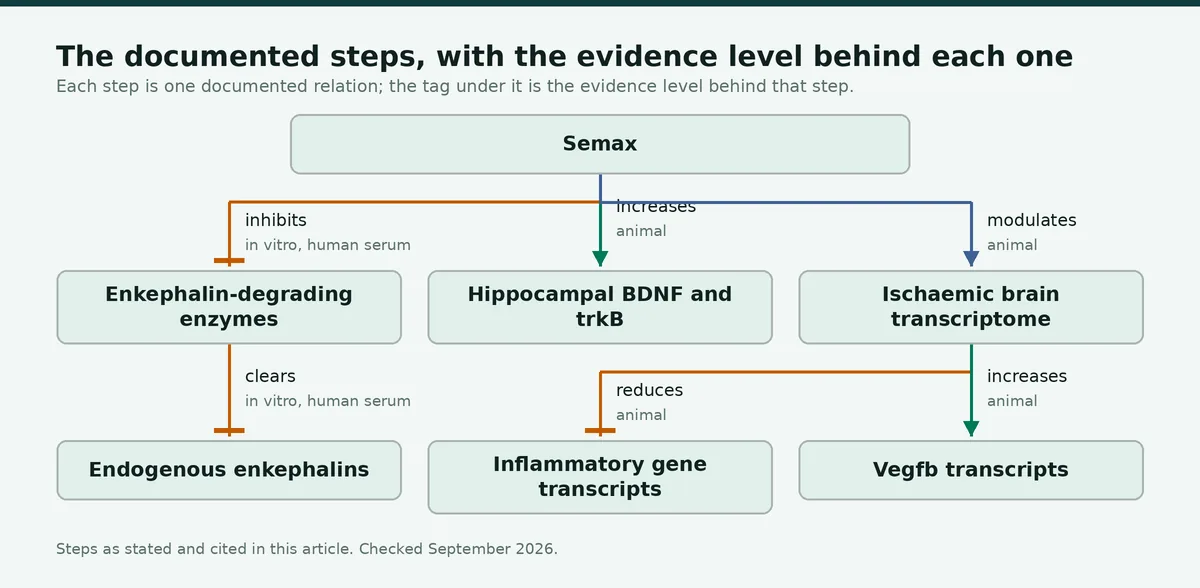
| Step | Relation | Target | Evidence |
|---|---|---|---|
| Semax | inhibits | Enkephalin-degrading enzymes | in vitro, human serum [4] |
| Semax | increases | Hippocampal BDNF and trkB | animal [2] |
| Semax | modulates | Ischaemic brain transcriptome | animal [1] |
| Enkephalin-degrading enzymes | clears | Endogenous enkephalins | in vitro, human serum [4] |
| Ischaemic brain transcriptome | reduces | Inflammatory gene transcripts | animal [1] |
| Ischaemic brain transcriptome | increases | Vegfb transcripts | animal [7] |
The enkephalinase step is a test-tube result in human serum. Kost and colleagues reported dose-dependent inhibition of enkephalin hydrolysis by Semax at a half-maximal concentration of 10 µM, against 20 µM for Selank [4]. Biochemistry in a tube, not a measurement in a treated person.
The neurotrophin step is animal and region-specific. A single intranasal 50 µg/kg dose in rats produced a maximal 1.4-fold rise in hippocampal BDNF protein, a 1.6-fold rise in trkB tyrosine phosphorylation, and roughly 3-fold and 2-fold rises in exon III BDNF and trkB mRNA [2]. At the same dose, another rat study found Ngf decreased in frontal cortex while both neurotrophin genes rose in hippocampus, brainstem and cerebellum [3]. “Increases BDNF” is true of some regions, not all.
The transcriptome steps are animal ischaemia models. In rats given 10 µg per 100 g intraperitoneally after middle cerebral artery occlusion, 394 genes differed by over 1.5-fold from controls at 24 hours, immune and inflammatory categories predominantly down-regulated and synaptic categories up-regulated [1]. In a permanent-occlusion model, immune-response genes made up over half of all altered genes [6], and a VEGF-family analysis found Vegf-b increased and Vegf-d decreased by 72 hours, opposite to ischaemia alone [7]. All animal.
The monoamine step is animal and partly indirect. At 0.15 mg/kg intraperitoneally in rodents, striatal 5-HIAA rose 25% at two hours; Semax alone did not change dopamine, but given before d-amphetamine it markedly enhanced that drug’s dopamine and locomotor effects [5].
One in-vitro result, with a caveat. In primary rat hippocampal cultures, ACTH(4–7)PGP raised VEGF levels [8] — in vitro. The melanocortin system is often invoked to explain all of this, and one paper calls Semax a “synthetic melanocortin derivative” [1], but no study establishing affinity at a named melanocortin receptor could be opened here, so the diagram carries no binding step.
Key numbers, and the ones that do not exist
No pharmacokinetic half-life for Semax in humans or animals could be retrieved. The closest measurement is tritium tracing in rats: two minutes after a 50 µg/kg intranasal dose, 0.093% of the introduced radioactivity per gram was in brain, 80% of it still intact Semax, with Pro-Gly-Pro the predominant metabolite [9] — animal. Fast, but no elimination constant to quote.
One quantity does exist in comparable form across two subjects.
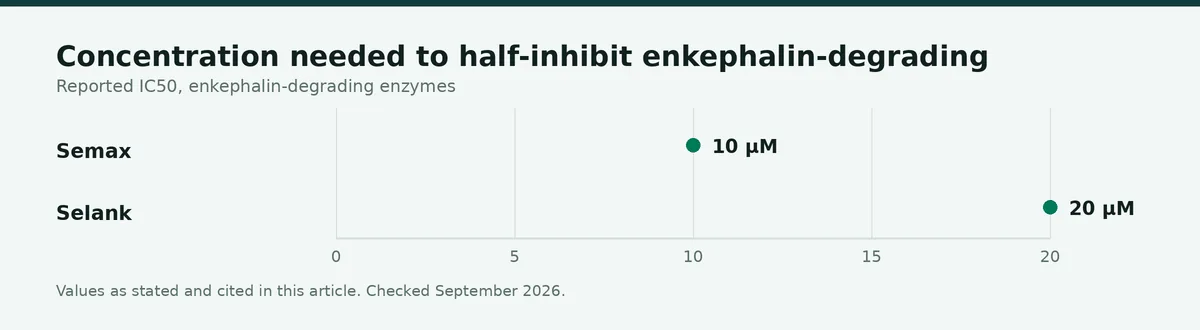
| Peptide | Reported IC50, enkephalin-degrading enzymes | Evidence |
|---|---|---|
| Semax | 10 µM | in vitro, human serum [4] |
| Selank | 20 µM | in vitro, human serum [4] |
Semax half-inhibited the enzymes at about half the concentration Selank needed [4]. Puromycin, the reference inhibitor, required 10 mM — and is left off the chart rather than converted onto a shared axis [4].
What the research shows
Human studies
The human record is small, Russian, and not independently replicated. A 2018 systematic review screened 364 articles, found 8 studies with 654 patients, and could pool only 3, totalling 181 patients, because only those shared identical endpoints [10]. In the pooled studies investigators gave a 1% intranasal solution at 12–18 mg per day for 10–14 days after ischaemic stroke, and reported reduced NIHSS scores at days 10–14 and 21 in the moderate-to-severe subgroups, better modified Rankin outcomes at day 21 in those subgroups only, and better Rivermead mobility scores across all subgroups [10]. Human, pooled from small studies — and the review’s own authors called that evidence base inadequate and asked for multicentre double-blind trials [10].
That caveat matters: the pooled sample is smaller than one arm of a typical Western stroke trial. The optic-neuropathy work cited alongside it sits in Russian ophthalmology journals that could not be opened from an allowed source this run, so nothing about eye outcomes is asserted. A 2022 review states Semax “is used to treat ischemic stroke” in Russia on that record [12] — a statement about use, not a replicated demonstration of effect.
Animal studies
The animal literature is broader and more internally consistent. Beyond the work above, a 2025 study in APPswe/PS1dE9 transgenic mice gave 50 µg/kg intranasally every other day for a month and reported improved behavioural test performance with a 2.8-fold reduction in cortical amyloid plaque burden [13] — animal.
Route and strain both change the answer. In BALB/c mice given 0.6 mg/kg per day, anxiolytic-type efficacy was higher after intraperitoneal injection and nootropic-type efficacy higher after intranasal administration; in C57BL/6 mice neither route produced beneficial behavioural effects [14] — animal. A result that reverses between two inbred strains does not extrapolate confidently to people.
In-vitro and ex-vivo work
The enkephalinase inhibition in human serum [4] and the VEGF response in rat hippocampal cultures [8] are the substantive non-animal results, both in vitro.
Side effects and risks
The risk picture is defined by missing data. No randomised safety study, no dose-ranging study and no long-term human exposure dataset could be retrieved, and the pooled human analysis reports efficacy endpoints without an adverse-event table [10]. A review asserts “low toxicity and safety” [12]; that is not a safety dataset.
- Uncharacterised tolerability. With no retrievable adverse-event data at any dose or duration, there is nothing to weigh against an approved comparator. Absence of reported harms is not evidence of safety.
- Direction of effect is not fixed. In mice the same dose was anxiolytic by one route and anxiogenic in another strain [14]; in rats Ngf fell in frontal cortex while neurotrophin genes rose in hippocampus [3]. Hormonal separation, too, is asserted [13] rather than measured in any source opened here.
- Interaction plausibility. Semax amplified d-amphetamine’s dopamine and locomotor effects in rodents [5], making interactions with dopaminergic drugs plausible without saying what happens in a person.
- Product risk too. Material sold as Semax is not made under drug-manufacturing rules, and its breakdown yields Pro-Gly-Pro [9] — itself active in the ischaemia models [7] — so degradation is not neutral.
Regulatory and legal status (2026)
United States. There is no FDA-approved Semax product, and a DailyMed search for “semax” returns zero drug labels (checked September 2026) [15]. A Drugs@FDA search timed out this run. Semax is sold as a research chemical rather than a medicine — our guide to the US position on research peptides sets out what that framing permits, and the difference between research, compounded and approved peptides is what most product copy blurs.
European Union. No EMA authorisation could be confirmed; the EMA search endpoint returned an authentication error this run, so nothing is asserted from it.
Russia. Vendor copy routinely overstates this. The peer-reviewed literature describes Semax as in clinical use in Russia for ischaemic stroke [1,12], and a 2025 paper states it appears on Russia’s List of Vital and Essential Drugs for Medical Application [13]. This page asserts no specific Russian marketing authorisation, registration year or indication: no state-register entry could be retrieved from a primary or peer-reviewed source this run.
Sport. The WADA Prohibited List could not be retrieved this run — the request was blocked by the site’s robots policy — and no other source opened here states Semax’s status, so no claim is made either way.
Comparison Framework scores
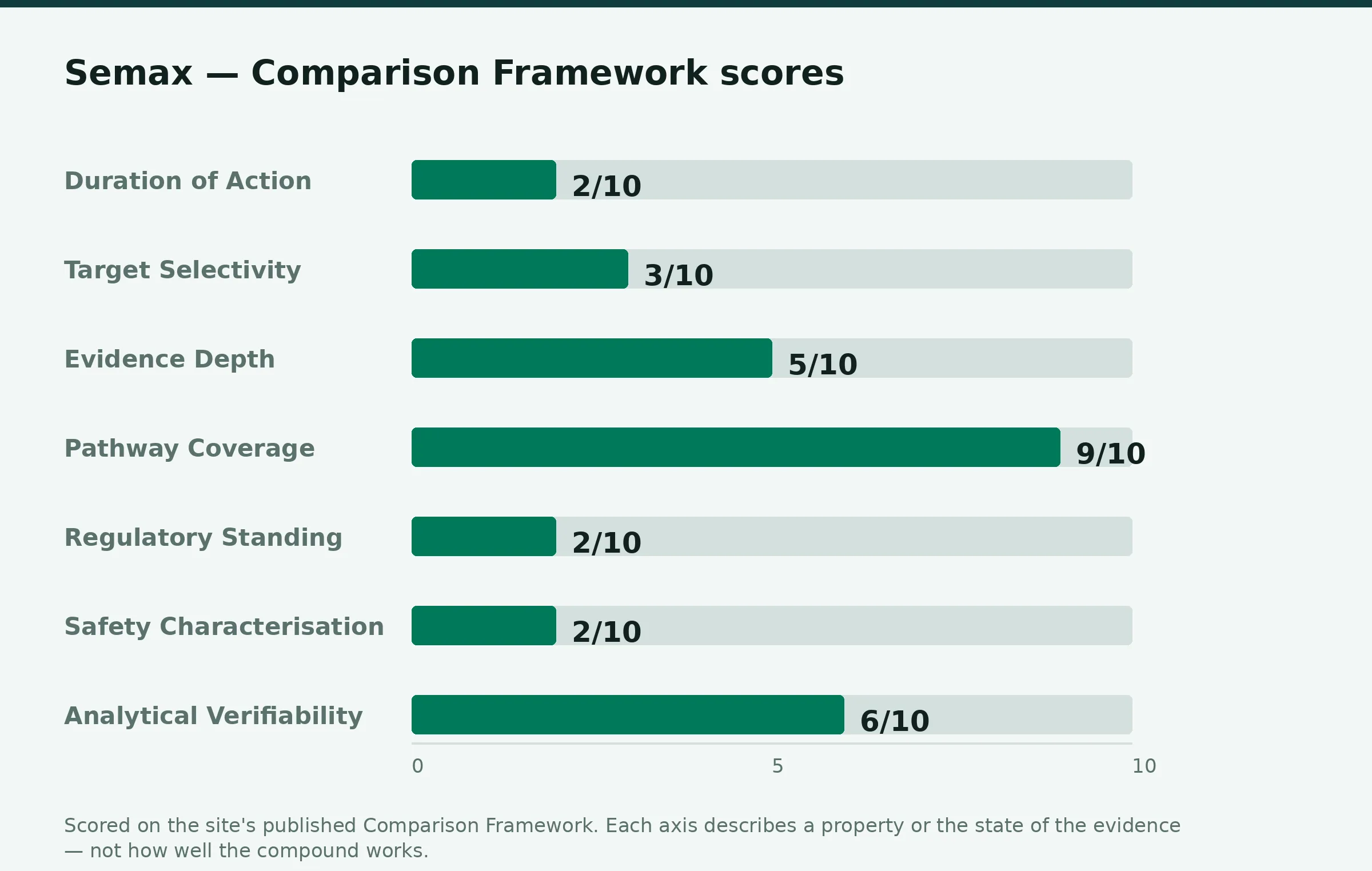
| Axis | Score | Why |
|---|---|---|
| Duration of Action | 2/10 | No published half-life in any species; tracing shows rapid degradation to Pro-Gly-Pro [9]. Sub-30-minute action bands at 1–2, taken at its top since no source measures longer. |
| Target Selectivity | 3/10 | No band published, so interpolated. No named-receptor affinity established here; actions span enkephalinase inhibition [4], monoamine turnover [5] and 394 genes [1]. Diffuse, not clean. |
| Evidence Depth | 5/10 | Ladder: animal 3–4, small human 5–6. Human data amount to 3 pooled studies, 181 patients, whose reviewers called that base inadequate [10]; the rest is animal [1,2,3,5,6,7,13,14] and in vitro [4,8]. Bottom of that band. |
| Pathway Coverage | 9/10 | Three or more pathways bands at 9–10: enkephalinergic [4], neurotrophic [2,3], monoaminergic [5], vascular/VEGF [6,7], inflammatory [1] — pathways implicated, nearly all in animals. |
| Regulatory Standing | 2/10 | Research-use-only bands at 2–3. No FDA-approved product, zero DailyMed labels, checked September 2026 [15]; no EMA authorisation confirmable. Bottom of the band. |
| Safety Characterisation | 2/10 | No band published, so interpolated. No randomised safety data, no dose-ranging study, no adverse-event table [10]; a review asserts low toxicity with no retrievable dataset [12]. A low score means the risks are poorly documented, not small. |
| Analytical Verifiability | 6/10 | Interpolated between 1–2 for no public method and 9–10 for a compendial monograph. Sequence published [2,12] and metabolites characterised [9] — but no monograph. |
Semax sits mid-scale on evidence depth and low on everything regulatory, so the obvious is worth saying: mechanistic plausibility is not clinical proof. A 1.4-fold change in rat hippocampal BDNF can be real and say nothing about a person. No axis measures how well Semax works — the rules are in our Comparison Framework.
How Semax compares
The natural comparator is Selank, the other heptapeptide from the same institute. Both extend a natural fragment with the same C-terminal Pro-Gly-Pro motif, both are studied mainly intranasally, and both inhibit the same enkephalin-degrading enzymes in human serum, Semax at roughly twice Selank’s potency [4]. The difference is the parent molecule: Selank derives from the immunopeptide tuftsin and is tied to anxiety endpoints, Semax from ACTH(4–7) and tied to ischaemic stroke and cognition [1,10]. Compared head to head in mice, route decided which effect predominated and one strain responded to neither [14]. We separate them in Selank vs Semax.
Sourcing and quality: what to look for
With no pharmacopoeial monograph for Semax, batch quality rests on what a supplier publishes. A useful certificate names the method, the batch, the date and the identity confirmation rather than a bare purity percentage — our guide to reading a peptide certificate of analysis separates informative fields from decorative ones. Because Semax degrades to Pro-Gly-Pro [9], mass spectrometry is the meaningful identity check and HPLC the purity check, both covered in HPLC and mass-spec purity testing.
One pattern is specific to this compound: vendor copy cites the Russian stroke literature as though it were controlled multicentre evidence, when the pooled dataset is 181 patients and its own authors asked for better trials [10]. Treat that as a signal, alongside the patterns in our vendor red flags.
FAQ
Is Semax the same thing as ACTH?
No. Semax is a seven-residue synthetic peptide made from the ACTH(4–7) fragment with Pro-Gly-Pro added to resist peptidases [1]. Full ACTH is a much longer hormone acting on the adrenal cortex; the Semax literature states the shortened molecule “does not exhibit any hormonal activity” [13], though no study demonstrating that could be opened here.
Is Semax approved by the FDA?
No. A DailyMed search for “semax” returns zero drug labels, checked September 2026 [15], and no FDA-approved Semax product exists. In the US it circulates as a research chemical for laboratory use rather than as a medicine.
How strong is the human evidence for Semax?
Weaker than most summaries imply. A 2018 systematic review found 8 human studies totalling 654 patients but could pool only 3, 181 patients in all; investigators reported reduced NIHSS scores and better mobility after a 1% intranasal solution at 12–18 mg per day for 10–14 days in acute ischaemic stroke [10]. The reviewers called that base inadequate and asked for multicentre double-blind trials [10].
Is Semax registered as a medicine in Russia?
This page does not assert that. Peer-reviewed papers describe Semax as in clinical use in Russia for ischaemic stroke [1,12], and a 2025 paper states it appears on Russia’s List of Vital and Essential Drugs for Medical Application [13] — but no state-register entry could be retrieved from a primary or peer-reviewed source this run, so no registration year or indication is claimed.
Is Semax banned in sport?
This page cannot answer that. The WADA Prohibited List could not be retrieved this run — the request was blocked by the site’s robots policy — and no other source opened here states Semax’s status. Anyone competing under anti-doping rules should check the current list.
References
- Filippenkov IB, Stavchansky VV, Denisova AE, Yuzhakov VV, Sevan’kaeva LE, Sudarkina OY, Dmitrieva VG, Gubsky LV, Myasoedov NF, Dergunova LV. Novel Insights into the Protective Properties of ACTH(4-7)PGP (Semax) Peptide at the Transcriptome Level Following Cerebral Ischaemia–Reperfusion in Rats. Genes. 2020;11(6):681. https://www.mdpi.com/2073-4425/11/6/681
- Dolotov OV, Karpenko EA, Inozemtseva LS, Seredenina TS, Levitskaya NG, Rozyczka J, Dubynina EV, Novosadova EV, Andreeva LA, Alfeeva LY, Kamensky AA, Grivennikov IA, Myasoedov NF, Engele J. Semax, an analog of ACTH(4–10) with cognitive effects, regulates BDNF and trkB expression in the rat hippocampus. Brain Research. 2006;1117(1):54–60. https://www.sciencedirect.com/science/article/abs/pii/S0006899306022955
- Agapova TY, Agniullin YV, Shadrina MI, Shram SI, Slominsky PA, Lymborska SA, Myasoedov NF. Neurotrophin gene expression in rat brain under the action of Semax, an analogue of ACTH4–10. Neuroscience Letters. 2007;417(2):201–205. https://www.sciencedirect.com/science/article/abs/pii/S0304394007002108
- Kost NV, Sokolov OY, Gabaeva MV, Grivennikov IA, Andreeva LA, Myasoedov NF, Zozulya AA. Semax and Selank Inhibit the Enkephalin-Degrading Enzymes of Human Serum. Russian Journal of Bioorganic Chemistry. 2001;27:156–159. https://link.springer.com/article/10.1023/A:1011373002885
- Eremin KO, Kudrin VS, Saransaari P, Oja SS, Grivennikov IA, Myasoedov NF, Rayevsky KS. Semax, an ACTH(4-10) Analogue with Nootropic Properties, Activates Dopaminergic and Serotoninergic Brain Systems in Rodents. Neurochemical Research. 2005;30:1493–1500. https://link.springer.com/article/10.1007/s11064-005-8826-8
- Medvedeva EV, Dmitrieva VG, Povarova OV, Limborska SA, Skvortsova VI, Myasoedov NF, Dergunova LV. The peptide semax affects the expression of genes related to the immune and vascular systems in rat brain focal ischemia: genome-wide transcriptional analysis. BMC Genomics. 2014;15:228. https://link.springer.com/article/10.1186/1471-2164-15-228
- Medvedeva EV, Dmitrieva VG, Povarova OV, Limborska SA, Skvortsova VI, Myasoedov NF, Dergunova LV. Effect of Semax and its C-terminal Fragment Pro-Gly-Pro on the Expression of VEGF Family Genes and their Receptors in Experimental Focal Ischemia of the Rat Brain. Journal of Molecular Neuroscience. 2013;49:328–333. https://link.springer.com/article/10.1007/s12031-012-9853-y
- Glazova NY, Manchenko DM, Sebentsova EA, Andreeva LA, Grivennikov IA, Dolotov OV, Myasoedov NF, Levitskaya NG. The Effect of ACTH/MSH N-Terminal Fragment Analogs on the Anxiety Level, Pain Sensitivity and Levels of Neurotrophic Factors BDNF and VEGF in Primary Neuronal Cultures of Rats. Journal of Evolutionary Biochemistry and Physiology. 2024;60(5):2086–2097. https://link.springer.com/article/10.1134/S0022093024050326
- Shevchenko KV, Nagaev IY, Alfeeva LY, Andreeva LA, Kamenskii AA, Levitskaya NG, Shevchenko VP, Grivennikov IA, Myasoedov NF. Kinetics of semax penetration into the brain and blood of rats after its intranasal administration. Russian Journal of Bioorganic Chemistry. 2006;32:57–62. https://link.springer.com/article/10.1134/s1068162006010055
- Shmonin AA, Verbickaya EV, Soloveva LN, Malceva MN, Melnikova EV. Meta-analysis: Semax effectiveness in the acute period of stroke. Bulletin of Rehabilitation Medicine. 2018;17(2):81–88. https://journals.eco-vector.com/2078-1962/article/view/609445
- Koroleva SV, Myasoedov NF. Semax as a Universal Drug for Therapy and Research. Biology Bulletin. 2018;45:589–600. https://link.springer.com/article/10.1134/S1062359018060055
- Deigin VI, Poluektova EA, Beniashvili AG, Kozin SA, Poluektov YM. Development of Peptide Biopharmaceuticals in Russia. Pharmaceutics. 2022;14(4):716. https://www.mdpi.com/1999-4923/14/4/716
- Radchenko AI, Kuzubova EV, Apostol AA, Mitkevich VA, Andreeva LA, Limborskaya SA, Stepenko YV, Shmigerova VS, Solin AV, Korokin MV, Pokrovskii MV, Myasoedov NF, Makarov AA. The potential of the peptide drug Semax and its derivative for correcting pathological impairments in the animal model of Alzheimer’s disease. Acta Naturae. 2025;17(4):110–120. https://actanaturae.ru/2075-8251/article/view/27808
- Vasileva EV, Kondrakhin EA, Abdullina AA, Salimov RM, Kovalev GI. Predominance of Nootropic or Anxiolytic Effects of Selank, Semax, and Noopept Peptides Depending on the Route of Administration to BALB/c and C57BL/6 Mice. Neurochemical Journal. 2020;14:268–278. https://link.springer.com/article/10.1134/S1819712420030113
- DailyMed. Search results for “semax” — 0 results. US National Library of Medicine. Checked September 2026. https://dailymed.nlm.nih.gov/dailymed/search.cfm?labeltype=all&query=semax