Quick answer: MOTS-c is a 16-amino-acid peptide encoded inside the 12S rRNA region of mitochondrial DNA rather than in the nucleus [1][2]. Laboratory work links it to AMPK activation, nuclear stress-response signalling and direct binding of the kinase CK2 [2][3][5]. Every study in which it was administered to a living organism is a rodent study; the human literature is observational [1][6][7]. There is no FDA-approved MOTS-c product and no MOTS-c labelling in DailyMed (checked September 2026) [8].
| Spec | Detail |
|---|---|
| Also known as | Mitochondrial ORF of the 12S rRNA type-c |
| Class | Mitochondrial-derived peptide (MDP) |
| Sequence / length | MRWQEMGYIFYPRKLR — 16 amino acids [2] |
| Molecular weight | 2,174.7 Da [2] |
| Encoded by | Small ORF within MT-RNR1 (12S rRNA), mitochondrial genome [2][5] |
| Half-life | No published human or animal half-life in the sources opened for this page |
| Regulatory status (US) | No approved product; no DailyMed labelling; not on FDA’s 503A bulks lists, but nominated and reviewed by FDA’s compounding advisory committee in July 2026 (checked September 2026) [8][9][11] |
| WADA status | Not verifiable from an accessible primary source during this run — see the regulatory section |
What is MOTS-c?
MOTS-c is a short peptide the mitochondrion encodes itself. Most proteins working inside a mitochondrion are transcribed from nuclear DNA and imported; MOTS-c is one of a small family of mitochondrial-derived peptides read from a small open reading frame inside the 12S ribosomal RNA gene (MT-RNR1) [2][5]. Its published sequence is MRWQEMGYIFYPRKLR — sixteen residues, about 2,175 Da [2].
That origin is why it is interesting and why the evidence is thin: a peptide encoded in mtDNA is a candidate messenger from mitochondrion to cell, but it has barely a decade of study behind it and no completed intervention trial in people [3][4]. Our primer on what peptides are covers the vocabulary below. Commercially it sits beside longevity-marketed research compounds such as epitalon and GHK-Cu, though the mechanisms have nothing in common.
How MOTS-c works (mechanism)
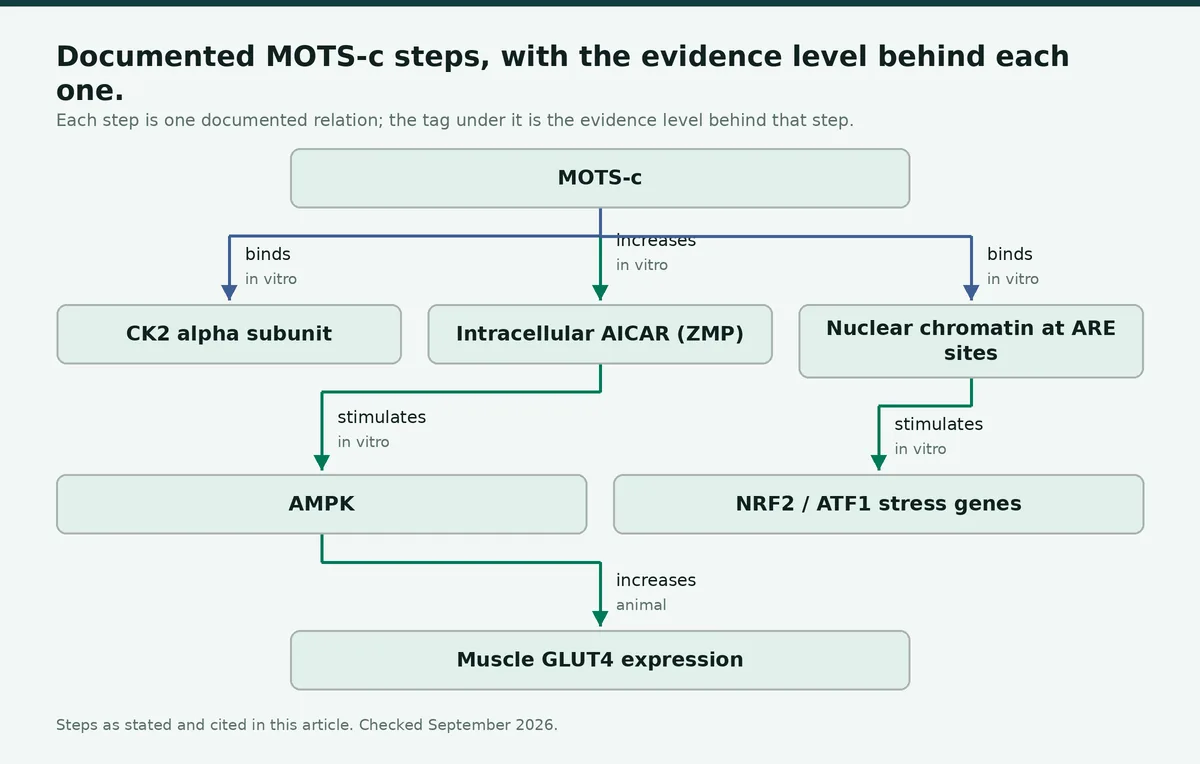
| Step | Relation | Target | Evidence |
|---|---|---|---|
| MOTS-c | binds | CK2 alpha subunit | in vitro [5] |
| MOTS-c | increases | Intracellular AICAR (ZMP) | in vitro [2] |
| Intracellular AICAR (ZMP) | stimulates | AMPK | in vitro [2] |
| AMPK | increases | Muscle GLUT4 expression | animal [1] |
| MOTS-c | binds | Nuclear chromatin at ARE sites | in vitro [3] |
| Nuclear chromatin at ARE sites | stimulates | NRF2 / ATF1 stress genes | in vitro [3] |
Three partly separate strands have been described, on different evidence.
The metabolic strand. MOTS-c is reported to raise intracellular AICAR, an endogenous AMPK agonist, and so activate AMP-activated protein kinase, the cell’s low-energy sensor [2]. Downstream, the diabetes literature describes increased GLUT4 expression in skeletal muscle of mice on a high-fat diet [1][3]. That is animal and in vitro evidence; no study has shown the same chain in a human given MOTS-c.
The nuclear strand. Under metabolic stress MOTS-c reportedly enters the nucleus within about 30 minutes in an AMPK-dependent manner, binds chromatin, and interacts with stress-response transcription factors including NFE2L2 (NRF2) and ATF1 — a retrograde signal from mitochondrion to nucleus [3]. That work is in vitro.
The kinase-binding strand. A 2024 iScience study reported that MOTS-c binds the CK2 alpha subunit directly, with a dissociation constant around 1 nM by surface plasmon resonance, and activates CK2 in a cell-free system [5]. That paper does not route its effects through AMPK, a reminder the mechanism is still argued over.
Key numbers
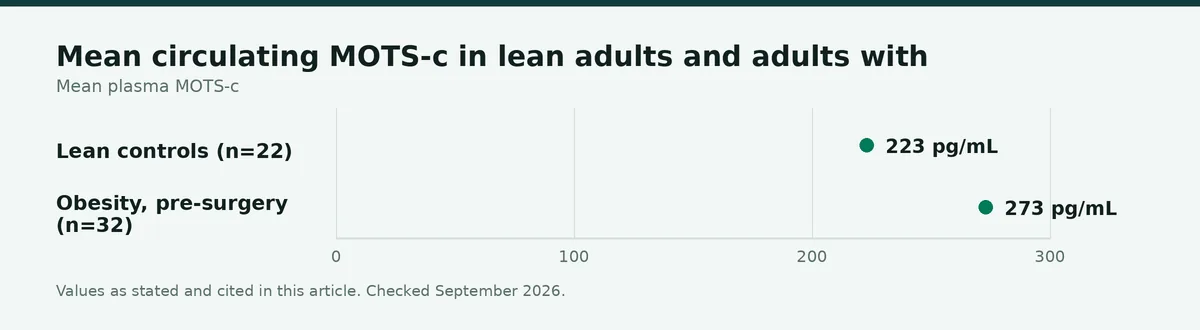
| Group | Mean plasma MOTS-c | Evidence level |
|---|---|---|
| Lean controls (n=22) | 223 pg/mL | human observational [7] |
| Obesity, pre-surgery (n=32) | 273 pg/mL | human observational [7] |
Those are the only absolute human concentrations in the sources opened for this page, and both come from one 2026 cohort using a single assay [7]. Cross-study comparison of MOTS-c ELISA values is unsafe — the meta-analysis below reports standardised mean differences because raw values are not comparable across laboratories [6].
What the research shows
Human studies
Exercise response (small, acute). Ten sedentary healthy young men (mean age 24.5 years, BMI 24.1) cycled, with muscle and blood sampled before, during, after and four hours into recovery [1]. Skeletal-muscle MOTS-c rose about 11.9-fold and stayed elevated at four hours; plasma MOTS-c rose about 1.6-fold during exercise and 1.5-fold immediately after, back to baseline by four hours [1]. That is a human observation about an endogenous peptide, not a trial of anything given to anyone.
Circulating levels in metabolic disease. A 2024 systematic review and meta-analysis pooled seven studies (six case–control, one cross-sectional; 602 participants) [6]. Across diabetes and obesity combined, circulating MOTS-c was lower than in controls (SMD −0.37, 95% CI −0.53 to −0.20), with a larger reduction in type 2 diabetes (SMD −0.89, 95% CI −1.12 to −0.65). In obesity the direction flipped once overweight participants were excluded: above a BMI of 28 kg/m², MOTS-c was higher (SMD +0.51, 95% CI 0.21 to 0.81). Heterogeneity was severe (I² = 97.2%), and the authors list small samples and language-restricted searching among the limitations [6]. All human observational.
A 2026 cohort matches the obesity direction: 32 adults with a BMI of at least 35 had higher plasma MOTS-c than 22 lean controls (273 ± 56 versus 223 ± 50 pg/mL, P < 0.01), and in ten followed six months after bariatric surgery the level did not change despite BMI falling from about 44 to about 32 (P = 0.913) [7]. The authors call their own work preliminary and exploratory [7].
Genetics. The m.1382A>C variant substitutes glutamine for lysine at residue 14 of MOTS-c (the “K14Q” variant) and is largely East Asian [4][10]. In 683 Korean adults aged 65 and over, male C-allele carriers had higher appendicular skeletal muscle mass, lean mass and handgrip strength than A-allele carriers, and carriers overall had higher total cholesterol (P = 0.014) and LDL-C (P = 0.038); no difference appeared on mental-health measures [10]. The design is cross-sectional and the authors state it “precludes any causal explanation” [10]. A separate report tying the same variant to exceptional longevity in a Japanese cohort is often cited, but we could not retrieve it from an accessible source during this run, so nothing about it is asserted.
Animal studies
The 2021 Nature Communications paper that supplied the human exercise data ran its interventional half in mice [1]. Young (2 months), middle-aged (12 months) and old (22 months) animals received MOTS-c by intraperitoneal injection at 5 or 15 mg/kg per day for two weeks, with a late-life arm given three times weekly from roughly 23.5 months. Treated old mice ran about twice as long and 2.16 times as far on a treadmill as untreated controls, and 17% reached the highest sprint speed versus none of the untreated; rotarod, grip strength, gait and metabolic flexibility were also measured [1].
Other rodent work includes ovariectomy-induced insulin resistance in mice, chronic aerobic exercise in rats [3], and bone-metabolism models using intraperitoneal MOTS-c at 5 mg/kg [2]. These doses are study facts, not recommendations for use in any species.
In-vitro / preclinical
Cell-based work includes osteoblast lines and bone-marrow mesenchymal stem cells at 1 µM [2], differentiated C2C12 muscle cells and 3T3-L1 adipocytes [5], and the cell-free CK2 assays above [5]. The chromatin-binding and NRF2/ATF1 work is also in vitro [3].
Side effects and risks
MOTS-c has essentially no human safety characterisation at all, and that is a risk statement, not a reassurance. None of the sources opened for this page describes a completed human trial in which MOTS-c was administered [3][4], so there is no published adverse-event dataset, no dose-ranging work in people, and no immunogenicity or interaction data. Absence of reported harm in a literature that has never looked is not evidence of safety. Three gaps are worth naming:
- No human pharmacokinetics. No half-life, clearance or bioavailability figure for administered MOTS-c appeared in any source opened here. Rodent studies injected daily or three times weekly [1] — what the experimenters chose, not what the peptide does in a person.
- Direction of effect in humans is unsettled. Circulating MOTS-c runs lower in type 2 diabetes but higher in established obesity, and did not fall after major surgical weight loss [6][7]. A biomarker moving in opposite directions across related metabolic states is not understood well enough to be a target.
- Material risk, not just molecule risk. Research-grade peptides are not made to pharmaceutical standards. Identity, purity and endotoxin problems are properties of the supply chain rather than of MOTS-c itself, and are the failure mode most likely to matter in practice. See the vendor red-flag guide.
Regulatory and legal status (2026)
United States. A DailyMed search for MOTS-c returned zero drug package labels, meaning no FDA-approved product contains it (checked September 2026) [8]. MOTS-c also does not appear on FDA’s page for bulk drug substances used in compounding under section 503A — it is in no category there, including Category 2, which FDA describes as posing “significant safety risks relating to the use of these substances in compounding pending further evaluation” (page last updated 14 May 2026; checked September 2026) [9]. That places MOTS-c outside both the approved-drug and the recognised-compounding routes; it is sold as a research chemical. Our explainer on research, compounded and approved peptides sets out why those categories carry very different legal weight, and the US peptide legal status page covers the wider picture.
That position is being actively reconsidered. MOTS-c (free base and acetate) was nominated for the section 503A bulks list and was one of seven substances taken up by FDA’s Pharmacy Compounding Advisory Committee at its meeting on 23–24 July 2026, listed on the agenda for obesity and osteoporosis [11]. FDA’s own calendar entry for that meeting is the source for the agenda; we were not able to read an FDA record of how the committee voted, so we make no claim about the outcome, and a committee recommendation is advice to FDA rather than a decision by it. Nothing had changed on FDA’s published 503A pages as of September 2026 [9].
Anti-doping. We were unable to retrieve the current WADA Prohibited List from an accessible primary source during this run, and we do not assert a status we have not read. Anyone competing under an anti-doping code should check the current list directly with their national anti-doping organisation rather than rely on any third-party summary, including this one.
Comparison Framework scores
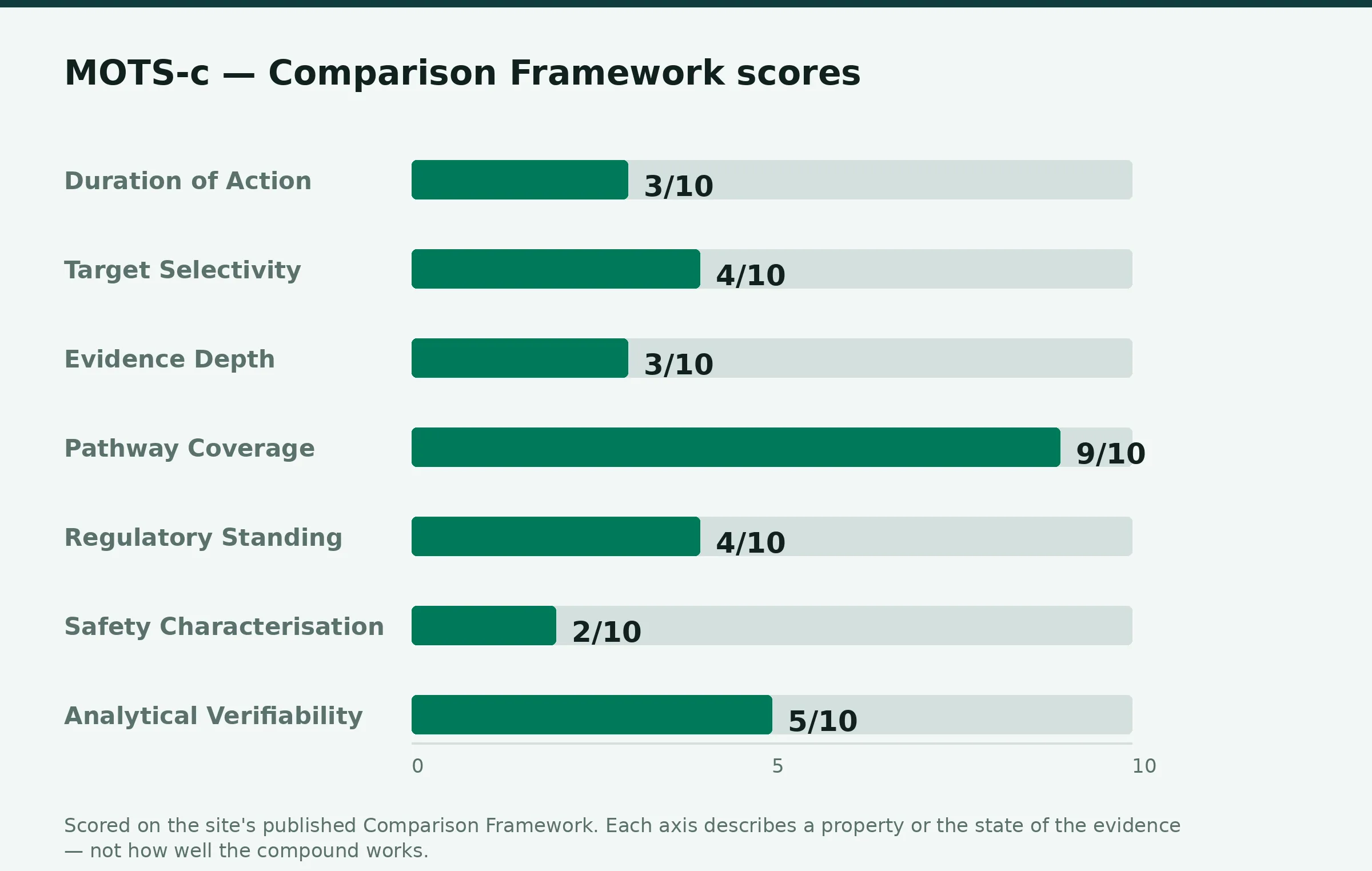
| Axis | Score | Why |
|---|---|---|
| Duration of Action | 3/10 | No published half-life for administered MOTS-c. Endogenous plasma MOTS-c returned to baseline within four hours of exercise and rodent studies injected daily or three times weekly, pointing to a short functional window; no mid-range band is published, so this is interpolated [1] |
| Target Selectivity | 4/10 | No single canonical receptor: reported partners include CK2 alpha (Kd about 1 nM, cell-free), the AICAR/AMPK axis and nuclear chromatin. No bands are published on this axis, so this is interpolated [2][3][5] |
| Evidence Depth | 3/10 | Intervention data is rodent and in vitro; human data is observational only — an n=10 exercise study, cohort blood levels, a genotype association [1][6][7][10] |
| Pathway Coverage | 9/10 | Three documented pathways: AICAR-driven AMPK activation, nuclear NRF2/ATF1 stress-response signalling, direct CK2 binding. The axis counts pathways, not evidence strength [2][3][5] |
| Regulatory Standing | 4/10 | Research-use-only today — no DailyMed labelling and no listing in any FDA 503A bulks category — but formally nominated and taken up by FDA’s compounding advisory committee in July 2026, which is the published “under review = 4–5” band; scored at its floor because the review has produced no change to any FDA list (checked September 2026) [8][9][11] |
| Safety Characterisation | 2/10 | Low means poorly documented, not dangerous or safe. No completed human administration trial is described in the reviews opened here, so there is no adverse-event dataset to score [3][4] |
| Analytical Verifiability | 5/10 | A defined 16-residue sequence at 2,174.7 Da is checkable by HPLC and mass spectrometry and ELISAs exist for the endogenous peptide, but no compendial monograph was found; interpolated between the published end anchors [2][7] |
Evidence Depth is 3, so this needs saying explicitly: mechanistic plausibility is not clinical proof. A coherent story about AMPK, CK2 and retrograde mitochondrial signalling is a reason to run trials, not a substitute for having run them.
How MOTS-c compares
Against SS-31, MOTS-c is endogenous and gene-encoded whereas SS-31 is a synthetic mitochondria-targeting tetrapeptide; they are not variations on one idea. Humanin is the closer relative, another mitochondrial-derived peptide from the same genome, and the two are usually discussed together [3]. Against the longevity-marketed compounds it shares shelf space with, MOTS-c is mechanistically better defined than epitalon but no better supported in humans. Our scoring framework explains what each axis does and does not measure — notably that none rates efficacy or safety.
Sourcing and quality: what to look for
Because MOTS-c is not an approved drug, no regulator vouches for the material, and verification falls on documentation. A 16-residue peptide is straightforward to characterise, so vague paperwork has no excuse. Look for a batch-specific certificate of analysis with identity confirmed by mass spectrometry against the expected 2,174.7 Da and purity by HPLC, with method, date and batch number present — our guide to reading a peptide COA walks through each section, and the purity-testing explainer covers why an HPLC number alone is not identity. A COA naming no independent laboratory is the weaker evidence.
FAQ
What is MOTS-c and where does it come from?
MOTS-c is a 16-amino-acid peptide, sequence MRWQEMGYIFYPRKLR, encoded by a small open reading frame inside the 12S ribosomal RNA gene of mitochondrial DNA rather than by nuclear DNA [2][5]. That makes it a mitochondrial-derived peptide, a class thought to signal from the mitochondrion to the rest of the cell [3].
Has MOTS-c been tested in humans?
Not as an administered compound. The human literature is observational: ten young men in whom muscle and plasma MOTS-c rose with cycling [1], cohort studies of blood levels in metabolic disease [6][7], and genotype associations for the K14Q variant [10]. No completed trial giving MOTS-c to people is described in the reviews opened for this page [3][4].
Does MOTS-c activate AMPK?
The published mechanism is that MOTS-c raises intracellular AICAR, an endogenous AMPK agonist, and so activates AMPK [2] — a chain characterised in cell systems and rodents, not humans [2][3]. A 2024 study complicates it by reporting that MOTS-c also binds and activates the kinase CK2 directly, with a dissociation constant near 1 nM in a cell-free assay [5].
Do MOTS-c blood levels change with exercise or obesity?
Yes, in observational human data. Skeletal-muscle MOTS-c rose roughly 11.9-fold and plasma about 1.6-fold with acute cycling in ten young men, plasma returning to baseline four hours later [1]. In metabolic disease the picture is mixed: pooled analysis found lower circulating MOTS-c in type 2 diabetes but higher levels above a BMI of 28 kg/m² [6], and a 2026 cohort found levels unchanged six months after bariatric surgery [7].
Is MOTS-c approved or legal in the United States?
There is no FDA-approved MOTS-c product: a DailyMed search returned zero labels, and MOTS-c appears in no category on FDA’s 503A bulk drug substances page (both checked September 2026) [8][9]. It is sold as a research chemical, a different legal position from an approved drug as explained here.
References
- Reynolds JC, Lai RW, Woodhead JST, et al. MOTS-c is an exercise-induced mitochondrial-encoded regulator of age-dependent physical decline and muscle homeostasis. Nature Communications. 2021;12:470. https://www.nature.com/articles/s41467-020-20790-0
- Yi X, Hu G, Yang Y, Li J, Jin J, Chang B. Role of MOTS-c in the regulation of bone metabolism. Frontiers in Physiology. 2023;14:1149120. https://www.frontiersin.org/journals/physiology/articles/10.3389/fphys.2023.1149120/full
- Wu Y, Sun L, Zhuang Z, Hu X, Dong D. Mitochondrial-Derived Peptides in Diabetes and Its Complications. Frontiers in Endocrinology. 2022;12:808120. https://www.frontiersin.org/journals/endocrinology/articles/10.3389/fendo.2021.808120/full
- Bobylev AG, Nekrasov PV. Mitochondrial Peptide MOTS-c: Regulation of Metabolism and Prospects for Clinical and Sports Medicine Applications. Human Physiology. 2026;52(2):280–294. https://link.springer.com/article/10.1134/S0362119726700520
- Kumagai H, et al. MOTS-c modulates skeletal muscle function by directly binding and activating CK2. iScience. 2024. https://www.sciencedirect.com/science/article/pii/S2589004224024374
- Zhou Q, Yin S, Lei X, et al. The correlation between mitochondrial derived peptide (MDP) and metabolic states: a systematic review and meta-analysis. Diabetology & Metabolic Syndrome. 2024;16:200. https://link.springer.com/article/10.1186/s13098-024-01405-w
- Yoon SH, Yuan F, Zhu X, et al. Systemic MOTS-c levels are increased in adults with obesity in association with metabolic dysregulation and remain unchanged after weight loss. Journal of Clinical & Translational Endocrinology. 2026;43:100429. https://www.sciencedirect.com/science/article/pii/S221462372500047X
- DailyMed. Search results for “MOTS-c” (0 results). US National Library of Medicine. Checked September 2026. https://dailymed.nlm.nih.gov/dailymed/search.cfm?labeltype=all&query=MOTS-c
- US Food and Drug Administration. Bulk Drug Substances Used in Compounding Under Section 503A of the FD&C Act. Page last updated 14 May 2026; checked September 2026. https://www.fda.gov/drugs/human-drug-compounding/bulk-drug-substances-used-compounding-under-section-503a-fdc-act
- Kim S. The Relationship Between MOTS-c K14Q Polymorphism and Sarcopenia, Blood Lipids, and Mental Health in Older Korean Adults. Biomedicines. 2024;12(10):2384. https://www.mdpi.com/2227-9059/12/10/2384
- US Food and Drug Administration. July 23-24, 2026: Meeting of the Pharmacy Compounding Advisory Committee. FDA Advisory Committee Calendar. 2026; checked September 2026. https://www.fda.gov/advisory-committees/advisory-committee-calendar/july-23-24-2026-meeting-pharmacy-compounding-advisory-committee-07232026