Quick answer: BPC-157 vs TB-500 compares two unapproved research peptides, and the honest headline is how little separates them on evidence. A 2025 systematic review of BPC-157 in orthopaedic sports medicine included 36 studies, 35 of them preclinical [4]. Reviewing TB-500 for compounding in July 2026, FDA found no articles in which the substance had been administered to humans at all [2]. Neither is FDA-approved, FDA proposed adding neither to the 503A bulk drug substances list, and both are named on FDA’s page of bulk substances that may present significant safety risks (checked September 2026) [1][2][3].
At a glance
| BPC-157 | TB-500 | |
|---|---|---|
| Class | Synthetic 15-amino-acid peptide [1] | Synthetic 7-amino-acid fragment of thymosin β-4, residues 17–23 [2] |
| Sequence | H-Gly-Glu-Pro-Pro-Pro-Gly-Lys-Pro-Ala-Asp-Asp-Ala-Gly-Leu-Val-OH [1] | Ac-Leu-Lys-Lys-Thr-Glu-Thr-Gln-OH [2] |
| Molecular weight | 1419.5 g/mol, C62H98N16O22 (free base) [1] | 889.01 g/mol, C38H68N10O14 (free base) [2] |
| Reported half-life | 5.27–15.2 min intravenously, rats and dogs only [5] | None published, any species or route [2] |
| Human evidence | One 12-patient retrospective series; one 53-subject abstract-only trial [4][1] | None identified by FDA for the fragment [2] |
| US regulatory status | Not approved; FDA advised against 503A listing, July 2026 [1] | Not approved; FDA advised against 503A listing, July 2026 [2] |
The two are routinely sold and discussed as interchangeable “recovery peptides”, and the spec box already shows why that is wrong: different sizes, different chemistries, different — though uniformly thin — evidence. Our wiki pages cover each on its own: BPC-157 and TB-500.
One naming problem runs through the whole TB-500 side of this comparison. FDA states that “TB-500 is a common name and not a United States Adopted Name (USAN)”, and treats naming that departs from INN, IUPAC or USAN conventions as a safety risk in its own right [2]. A 2026 scoping review pooling 80 studies had to treat “TB-500” as “a commercially used designation for synthetic peptide products marketed as related to TB4”, because the literature does not use the label consistently [7]. Almost every repair study cited for TB-500 actually used full-length thymosin β-4, a 43-amino-acid protein [6] — a different molecule.
Mechanism: how they differ
The two act through unrelated biochemistry, and both mechanisms come from animal or cultured-cell work.
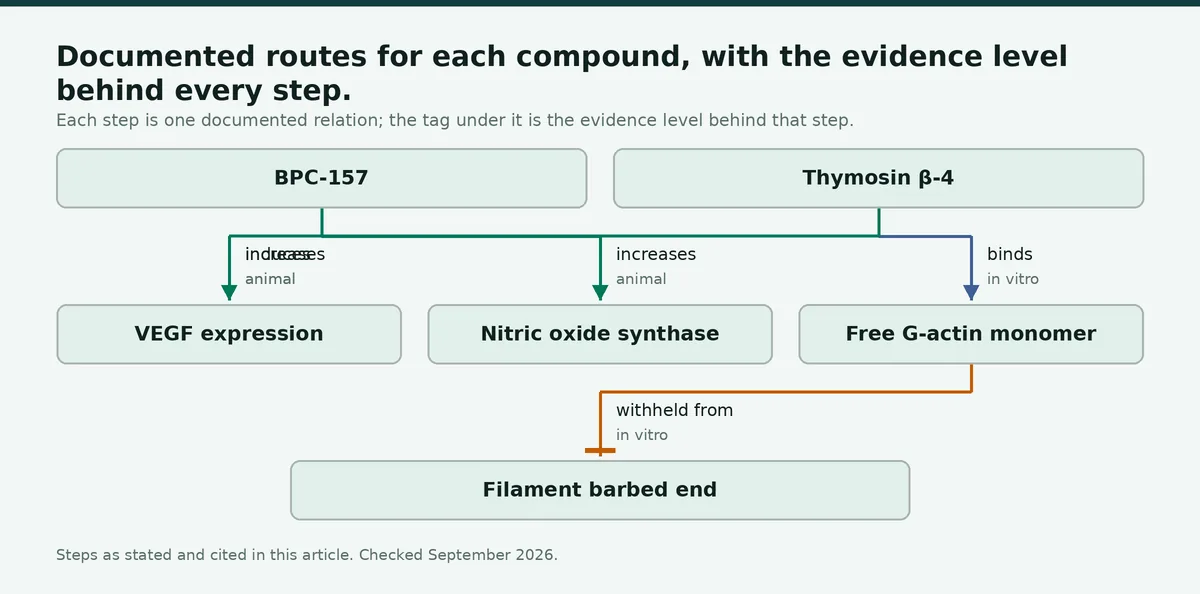
| Step | Relation | Target | Evidence |
|---|---|---|---|
| BPC-157 | increases | VEGF expression | animal [4] |
| BPC-157 | increases | Nitric oxide synthase | animal [4] |
| Thymosin β-4 | binds | Free G-actin monomer | in vitro [6] |
| Free G-actin monomer | withheld from | Filament barbed end | in vitro [6] |
| Thymosin β-4 | induces | VEGF expression | animal [6] |
BPC-157 has no identified receptor. The 2025 systematic review describes it as stimulating vascular endothelial growth factor protein and gene expression (animal) [4], and as upregulating nitric oxide synthase gene and protein expression with downstream vasodilatory effects (animal) [4]. A third route sits in cell culture only: in rat tendon fibroblasts, BPC-157 was associated with increased focal adhesion kinase and paxillin gene expression, and with increased growth hormone receptor expression (in vitro) [4].
Thymosin β-4 works the other way round — one well-defined biochemical job with several downstream consequences. It binds free G-actin monomers, and the actin held in that complex is not available for filament assembly until a profilin-dependent dissociation releases it (in vitro) [6]. Sequestering the monomer pool changes how readily a cell remodels its cytoskeleton, which is the plausible route to cell migration. Separately, thymosin β-4 upregulated VEGF expression when transplanted into infarcted rat hearts, and increased coronary vessel growth through Akt-mediated signalling in mice and pigs (animal) [6].
The two converge on angiogenesis from different directions and by different means. They are not variants of one mechanism, and no published human work establishes either chain in a person.
The critical asymmetry: every thymosin β-4 step above was demonstrated with the full-length 43-residue protein [6], not with the seven-residue fragment sold as TB-500. FDA’s review of the fragment found no human administration data of any kind [2], and the 2026 scoping review reported that direct TB-500 evidence was “limited to a single included study” [7].
Head-to-head and trial evidence
There is no head-to-head study. In the sources opened for this page, nobody has compared BPC-157 and TB-500 against each other in humans or in animals, so any ranking rests on comparing separate literatures of different design and quality.
Human evidence
BPC-157 has two human datasets, both weak. The 2025 systematic review identified one clinical study among 36: a retrospective series in which 7 of 12 patients reported subjective improvement in knee symptoms for more than six months after an intraarticular injection (human observational) [4]. Twelve patients, no control arm, no blinding and a self-reported outcome is a hypothesis, not a result.
The second is a trial FDA identified while evaluating the substance for compounding: 53 subjects with mild to moderate ulcerative colitis randomised 1:1 to a BPC-157 enema or placebo for two weeks, with a mean Disease Activity Index change of −3.2 points against −1.6 on placebo (human RCT) [1]. FDA’s assessment is the part that matters — the study was available only as a meeting abstract, and the agency concluded the data were “inadequate to support the efficacy and safety” of the substance [1].
TB-500 has none. FDA’s briefing document states that “the nomination did not include, and FDA did not find information on products containing TB-500 (free base) or TB-500 acetate administered in humans”, and that “no articles were found in which TB-500 was administered to humans” [2]. The human trial record that exists belongs to full-length thymosin β-4: a review of the protein lists completed phase 1 and phase 2 studies, including a phase 1 study in 54 healthy volunteers and phase 2 work in pressure and venous ulcers enrolling 143 patients (human) [6]. Those results say nothing certain about a seven-residue fragment.
Animal and in-vitro evidence
This is where both reputations were built. For BPC-157, 35 of the 36 included studies were preclinical, spanning tendon, ligament, muscle and gastrointestinal healing models (animal and in vitro) [4]. The review adds a methodological point worth carrying: the foundational work comes repeatedly from one research group, which means limited independent verification [4].
For thymosin β-4, the 2026 scoping review classified its 80 included studies as 23 in vitro, 11 animal, 27 mixed and 19 human, with angiogenesis and cell migration dominating the mechanistic literature [7]. Its conclusion was that the mapped literature “remains unevenly distributed and largely preclinical, with limited human evidence directly relevant to musculoskeletal applications” [7].
Pharmacokinetics is the one axis where BPC-157 is clearly ahead, and it is still animal data. In rats, elimination half-life was 15.2 minutes intravenously and 7.87–29.7 minutes intramuscularly; in dogs, 5.27 minutes intravenously and 20.0–29.3 minutes intramuscularly (animal) [5]. Intramuscular bioavailability was 14.49–19.35% in rats against 45.27–50.56% in dogs — a roughly threefold species difference in a basic exposure parameter, and a reminder of how poorly animal exposure predicts human exposure [5]. Tissue concentrations peaked about an hour after administration, highest in kidney [5]. TB-500 has no comparable figure published for any species, so there is no second row to set beside it and this page does not estimate one.
What is documented for each
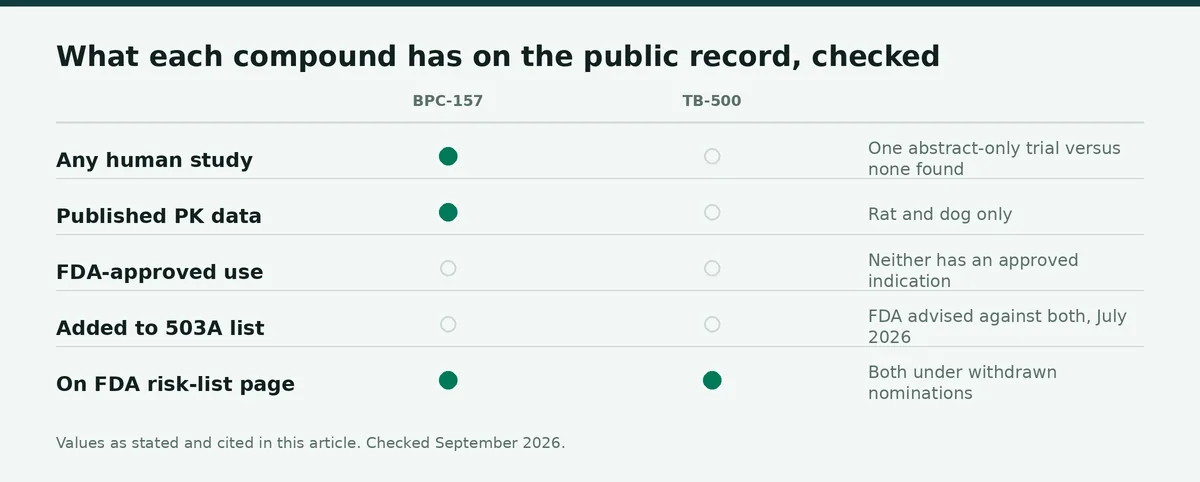
| Attribute | BPC-157 | TB-500 | Note |
|---|---|---|---|
| Any human study | yes | no | One abstract-only trial versus none found [1][2] |
| Published PK data | yes | no | Rat and dog only [5] |
| FDA-approved use | no | no | Neither has an approved indication [1][2] |
| Added to 503A list | no | no | FDA advised against both, July 2026 [1][2] |
| On FDA risk-list page | yes | yes | Both under withdrawn nominations [3] |
The informative part of that table is the rows that are empty all the way across. On the questions that decide whether a compound is ready for people — approval, human exposure data, a characterised safety profile — both answer no.
Side effects and risks compared
Neither compound has a documented human safety profile, and the two agency statements are near-identical.
For BPC-157, FDA’s evaluation flagged that the substance is “not well-characterized from the physical and chemical characterization perspective”, citing inconsistent naming conventions and missing data on peptide impurities, microbial quality and particle size [1]. It stated that BPC-157 “may pose a significant risk for immunogenicity, potentially amplified by aggregation as well as potential peptide-related impurities” [1]. The systematic review found that “no study assessed the safety or adverse events of BPC-157 in humans”, while reporting no acute toxicity across liver, spleen, lung, kidney, brain and thymus in rat and dog models over six weeks (animal) [4].
For TB-500, FDA used the same immunogenicity language and added that specific tests “are not available… such as tests for impurities, aggregates, microbiological quality, and bacterial endotoxin” [2]. Its risk-list entry warns that compounded drugs containing thymosin beta-4 fragment “may pose risk for immunogenicity for certain routes of administration due to the potential for aggregation as well as peptide-related impurities” [3].
An absent safety signal is not a clean safety record. For BPC-157 there is narrow animal toxicology and nothing human; for TB-500 there is nothing at all. Both also sit in a grey market where the identity, purity and sterility of the material in the vial are unverified — a risk layer separate from the molecule itself.
Regulatory and sport status
Both went before the same FDA advisory committee on the same day. The Pharmacy Compounding Advisory Committee considered BPC-157, KPV, TB-500 and MOTS-c on 23 July 2026, with semax, epitalon and emideltide the following day [8]. Committee recommendations are not binding on FDA [8].
FDA’s briefing documents recommended against both. For BPC-157, the agency wrote that the evaluation criteria “weigh against placing both BPC-157 (free base) and BPC-157 acetate” on the list [1]. For TB-500: “we propose not adding TB-500 (free base) or TB-500 acetate to the 503A Bulks List”, against a nomination for a 3 mg/mL lyophilised powder for wound healing [2].
Both also appear on FDA’s page of bulk drug substances that may present significant safety risks, current as of 22 April 2026, under the heading “Bulk drug substances nominated but withdrawn” — BPC-157 by name, and TB-500 as “thymosin beta-4, fragment” [3] (checked September 2026). BPC-157 carries the older designation of the two: the 2025 systematic review records that it was placed in Category 2, bulk drug substances that raise significant safety concerns, in 2023 [4]. Our guide to US peptide legal status sets out how these categories work.
In sport, the 2026 WADA Prohibited List came into force on 1 January 2026, with clarifications added to section S2 on peptide hormones and growth factors [9]. The 2026 scoping review records that “the World Anti-Doping Agency also classifies TB4 and its derivatives, including TB-500, as prohibited substances under the 2026 Prohibited List” [7], and the 2025 systematic review records a WADA ban on BPC-157 dated to 2022, alongside bans by the UFC, NFL, NCAA, NBA, NHL, MLB and PGA [4] (checked September 2026). WADA’s own List document blocked automated retrieval during this run, so both classifications are reported here on peer-reviewed authority rather than from the primary text.
Comparison Framework scores
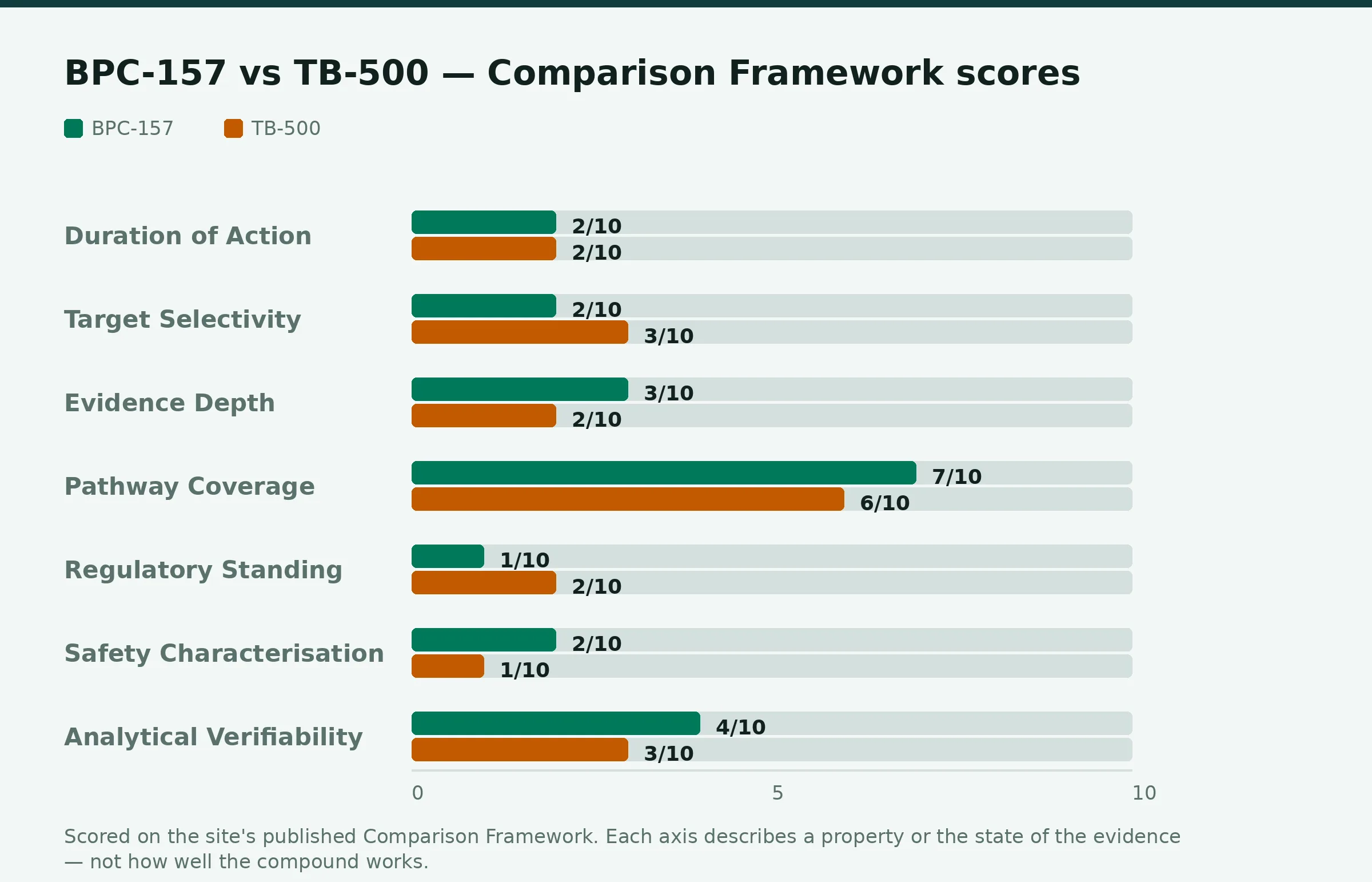
| Axis | BPC-157 | TB-500 | Notes |
|---|---|---|---|
| Duration of Action | 2/10 | 2/10 | 5.27–15.2 min intravenously in rats and dogs, under 30 min intramuscularly [5][4]; no published half-life for TB-500 in any species [2] |
| Target Selectivity | 2/10 | 3/10 | Neither has an identified receptor; BPC-157 effects span three unrelated pathways [4], while the TB-500 parent protein has one defined actin-binding activity [6][2] |
| Evidence Depth | 3/10 | 2/10 | 35 of 36 BPC-157 studies preclinical, human record a 12-patient series plus one abstract [4][1]; FDA found no human TB-500 data at all [2] |
| Pathway Coverage | 7/10 | 6/10 | Three reported BPC-157 routes, all animal or cultured-cell [4]; two documented routes for full-length thymosin β-4, neither shown for the fragment [6][2] |
| Regulatory Standing | 1/10 | 2/10 | BPC-157 designated Category 2 in 2023 [4]; both named on FDA’s significant-safety-risks page and refused 503A listing [3][1][2] |
| Safety Characterisation | 2/10 | 1/10 | Narrow animal toxicology but no human adverse-event study for BPC-157 [4][1]; FDA states specific tests for TB-500 are unavailable and human risks unknown [2] |
| Analytical Verifiability | 4/10 | 3/10 | Formula and mass published for both [1][2], no compendial monograph for either; TB-500 additionally has no USAN name and no available impurity or endotoxin tests [2] |
Both compounds score 3 or below on Evidence Depth, so this needs stating plainly: mechanistic plausibility is not clinical proof. A pathway that moves in the expected direction in a rat model tells you what to test next — not what happens in a person, at what exposure, or with what risk. The anchors behind each axis are published in our Comparison Framework, and no axis measures how well either compound works or whether anyone should use it.
The low Safety Characterisation scores are not a claim that either compound is dangerous. They mean nobody has measured, a different and often worse position than knowing a risk precisely. The Pathway Coverage numbers are the highest on the table and the least meaningful: breadth of reported mechanism is not depth of evidence, and here it is breadth built entirely on preclinical work.
Which is studied for what?
The two occupy different research literatures. BPC-157 studies cluster in tendon, ligament, muscle and gastrointestinal healing models, plus the one ulcerative colitis trial FDA reviewed [4][1]. Thymosin β-4 research concentrates in wound and skin repair, corneal work and cardiac models, with its human evidence sitting in ocular and wound settings rather than musculoskeletal ones [7][6].
That matters for anyone reading marketing copy. The musculoskeletal claims made for TB-500 are the part of the thymosin β-4 literature with the least human support: the scoping review found no human interventional musculoskeletal studies at all [7]. For a wider view of the category, see our guide to healing and recovery peptides.
Sourcing and verification
Neither compound has a legal human supply chain in the US, so nothing here is a route to lawful human use.
For laboratory work, both have a concrete identity target published by FDA: 1419.5 g/mol and C62H98N16O22 for BPC-157 free base [1], and 889.01 g/mol and C38H68N10O14 for TB-500 free base [2]. That makes a mass spectrometry result checkable rather than decorative. TB-500 is the harder of the two to verify, because the name is a commercial designation rather than a standardised chemical identity [2][7] — a certificate should state the sequence tested, not the marketing name. FDA’s finding that endotoxin, aggregate and impurity tests are not available for the fragment [2] is worth carrying into any certificate review, since an endotoxin result is the line most often missing. Our walkthrough of how to read a peptide certificate of analysis covers what a usable one contains.
FAQ
Is BPC-157 or TB-500 better supported by evidence?
Neither is well supported, but BPC-157 has marginally more on the record. A 2025 systematic review found 36 BPC-157 studies, 35 preclinical, with one 12-patient retrospective clinical series [4], and animal pharmacokinetic data exists in rats and dogs [5]. For TB-500, FDA reported in July 2026 that it found no articles in which the substance had been administered to humans [2]. No study has compared the two directly.
Is TB-500 the same thing as thymosin beta-4?
No. FDA describes TB-500 as a seven-amino-acid synthetic fragment of thymosin beta-4 spanning residues 17 to 23, weighing 889.01 g/mol [2]. Thymosin β-4 itself is a 43-amino-acid protein [6]. Because most published repair research used the full-length protein, its results do not transfer automatically to the fragment.
Are BPC-157 and TB-500 legal in the United States?
Neither is an FDA-approved drug and neither has an approved human indication (checked September 2026). FDA’s briefing documents for the July 2026 Pharmacy Compounding Advisory Committee meeting proposed against adding either to the 503A bulk drug substances list [1][2], and both appear on FDA’s page of bulk substances that may present significant safety risks under the withdrawn-nominations heading [3].
Are they banned in sport?
Both are reported as prohibited. A 2026 peer-reviewed scoping review records that WADA classifies thymosin β-4 and its derivatives, including TB-500, as prohibited under the 2026 Prohibited List [7], and a 2025 systematic review records a WADA ban on BPC-157 dated to 2022 plus bans by several major US leagues [4]. The 2026 List came into force on 1 January 2026 [9]. Athletes under anti-doping rules should check the current List at source, as it is revised annually.
What did FDA say about their safety?
For both compounds FDA flagged the same core concern: a synthetic peptide given by injectable routes “may pose a significant risk for immunogenicity, potentially amplified by aggregation as well as potential peptide-related impurities” [1][2]. It added that BPC-157 is not well characterised chemically [1], and that specific tests for TB-500 impurities, aggregates, microbiological quality and bacterial endotoxin are not available [2].
Has anyone studied them together?
Not in the sources opened for this page. No published study administered both compounds, in humans or in animals, and neither has a characterised human safety profile on its own [1][2][4].
References
- FDA Briefing Document, Pharmacy Compounding Advisory Committee Meeting, July 23–24, 2026: BPC-157 (free base) and BPC-157 acetate. US Food and Drug Administration. 2026. https://www.fda.gov/media/193343/download
- FDA Briefing Document, Pharmacy Compounding Advisory Committee Meeting: TB-500 (free base) and TB-500 acetate. US Food and Drug Administration. 2026. https://www.fda.gov/media/193349/download
- Certain Bulk Drug Substances for Use in Compounding that May Present Significant Safety Risks. US Food and Drug Administration. Content current as of 22 April 2026. https://www.fda.gov/drugs/human-drug-compounding/certain-bulk-drug-substances-use-compounding-may-present-significant-safety-risks
- Vasireddi N, Hahamyan H, Salata MJ, Karns M, Calcei JG, Voos JE, Apostolakos JM. Emerging Use of BPC-157 in Orthopaedic Sports Medicine: A Systematic Review. HSS Journal. 2025;21(4):485–495. https://pmc.ncbi.nlm.nih.gov/articles/PMC12313605/
- He L, Feng D, Guo H, et al. Pharmacokinetics, distribution, metabolism, and excretion of body-protective compound 157, a potential drug for treating various wounds, in rats and dogs. Frontiers in Pharmacology. 2022;13:1026182. https://www.frontiersin.org/journals/pharmacology/articles/10.3389/fphar.2022.1026182/full
- Xing Y, Ye Y, Zuo H, Li Y. Progress on the Function and Application of Thymosin β4. Frontiers in Endocrinology. 2021;12:767785. https://pmc.ncbi.nlm.nih.gov/articles/PMC8724243/
- McGuire F, Hughes E, Maak T, Cushman DM. Thymosin Beta-4 and TB-500 in Tissue Healing, Regeneration, and Musculoskeletal Repair: A Scoping Review. Applied Sciences. 2026;16(12):6202. https://www.mdpi.com/2076-3417/16/12/6202
- July 23–24, 2026: Meeting of the Pharmacy Compounding Advisory Committee. US Food and Drug Administration. 2026. https://www.fda.gov/advisory-committees/advisory-committee-calendar/july-23-24-2026-meeting-pharmacy-compounding-advisory-committee-07232026
- WADA’s 2026 Prohibited List is now in force. World Anti-Doping Agency. 2026. https://www.wada-ama.org/en/news/wadas-2026-prohibited-list-now-force