Quick answer: Asking “are peptides legal” has no single answer, because “peptide” is a chemistry word, not a legal category. A handful of peptide drugs are FDA-approved and lawful to prescribe and dispense. Some others can be compounded by pharmacies under narrow statutory conditions. The large gray market of vials sold online as “research use only” is not lawful to sell for human use, and FDA said so directly in warning letters dated 24 August 2026 (checked September 2026).
Are peptides legal? It depends which of three buckets a compound sits in
US law does not regulate “peptides” as a class. It regulates each product by what it is intended to do and how it is marketed. That produces three practical buckets, and almost every question about whether peptides are legal resolves into: which bucket is this vial in?
Bucket one: FDA-approved drugs. A peptide drug that has been through an FDA new drug application is lawful to market for its approved use, on prescription, by the approval holder and its licensed distribution chain.
Bucket two: compounded preparations. Under sections 503A and 503B of the Federal Food, Drug, and Cosmetic Act, licensed pharmacies and registered outsourcing facilities may prepare drugs that FDA has not approved, but only under conditions Congress wrote into the statute [6].
Bucket three: everything else. This includes the vials sold by online vendors under research-use-only labels. These sit outside both of the first two buckets, and FDA’s position is that selling them for human use violates the FD&C Act [8][9].
If you are trying to weigh compounds against each other rather than weigh their legal status, our Comparison Framework covers how we score evidence depth and selectivity separately from regulatory standing.
The FD&C Act framework: approved drug versus unapproved new drug
The starting point is the statutory definition of a drug. Section 201(g)(1) of the FD&C Act defines drugs partly by intended use: articles intended for use in the diagnosis, mitigation, treatment or prevention of disease, and articles intended to affect the structure or any function of the body. FDA applied exactly this definition to seven injectable peptides in its August 2026 letter to Royal Peptides LLC, concluding they were drugs because of how they were marketed [8].
Once a product is a drug, section 505(a) requires an approved application before it can be introduced into interstate commerce, and section 301(d) makes introducing an unapproved new drug a prohibited act. FDA cited both sections against peptide sellers in 2026 [8][9].
Note what this framework does not turn on. It does not turn on the molecule being “natural,” on the vendor’s purity being high, or on the buyer’s intentions. It turns on intended use as established by the evidence, and FDA reads that evidence from the seller’s own marketing.
Why “research use only” labeling does not make a sale lawful
This is the single most misunderstood point in the peptide market. A research-use-only disclaimer is a statement on a label. Intended use is a legal conclusion FDA draws from the whole record, and a disclaimer does not override the rest of that record.
FDA said this plainly in the Peak Performance Peptides letter dated 24 August 2026: “Despite statements on your product labeling marketing your products for ‘research use only’ and ‘not for human consumption,’ evidence obtained from your website establishes that your products are intended to be drugs for human use” [9].
In the parallel Royal Peptides letter of the same date, FDA pointed to the same pattern — the same “not for human or animal consumption” phrasing on the labels, alongside website claims about insulin sensitivity, body weight reduction, neuroprotection and treatment of a named sexual dysfunction disorder [8]. FDA also treated the sale of injection diluent and a dose calculator alongside the vials as evidence that human injection was the intended use [8][9].
FDA’s broader GLP-1 statement makes the same point about the whole category: companies have “illegally sold unapproved drugs containing semaglutide, tirzepatide, retatrutide, survodutide or mazdutide that are falsely labeled ‘for research purposes’ or ‘not for human consumption’” (page last updated 1 September 2026) [10]. We go deeper on this three-way split in research-grade versus compounded versus approved peptides.
Compounding: sections 503A and 503B
Compounded drugs are a real and lawful category, but a narrow one. FDA is explicit that “compounded drugs are not FDA-approved. This means that FDA does not verify the safety, effectiveness or quality of compounded drugs before they are marketed” [6].
Section 503A covers compounding by a licensed pharmacist in a state-licensed pharmacy, or by a licensed physician, for an identified individual patient pursuant to a prescription. Products compounded under 503A are not subject to current good manufacturing practice requirements [6].
Section 503B covers outsourcing facilities, a category created in 2013 by the Drug Quality and Security Act. FDA describes them as “inspected by FDA according to a risk-based schedule and are subject to increased quality standards,” and drugs they compound must meet CGMP requirements [6].
Neither section is a general license to compound anything. Both attach conditions, and one of the most consequential is which bulk drug substances may be used as starting material.
The 503A bulk drug substances list and the Category 1/2/3 framework
When a substance has no USP or NF monograph and is not a component of an FDA-approved drug, it can only be used in 503A compounding if it appears on a list FDA establishes by regulation under section 503A(b)(1)(A)(i)(III) [4].
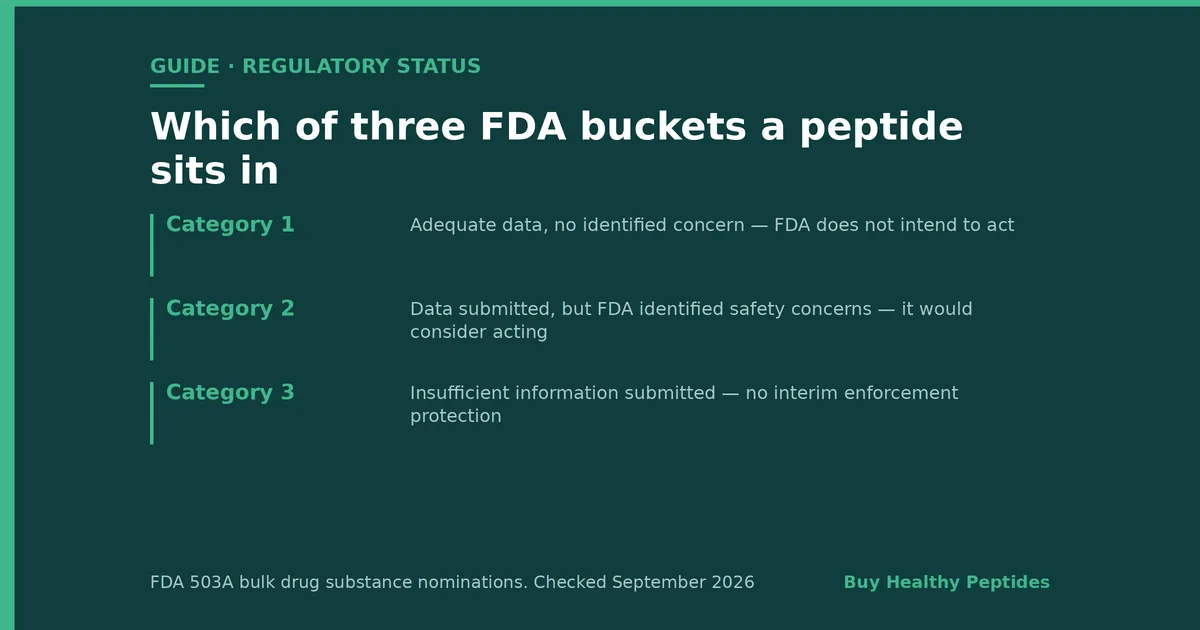
While nominations are pending, FDA sorts them into three interim categories [5]:
| Category | What it means | Enforcement posture |
|---|---|---|
| Category 1 | Nominated with adequate supporting information and no identified concern | FDA “does not intend to take action” against compounders using it, if the guidance conditions are met [5] |
| Category 2 | Sufficient data submitted, but FDA identified safety concerns | FDA “would consider taking action” against compounders using it [5] |
| Category 3 | Insufficient supporting information submitted | No interim enforcement protection; the substance must be re-nominated with complete data [5] |
Two things get lost in vendor marketing here. First, these categories are an interim enforcement policy, not the list itself — the final list is set by regulation. Second, Category 1 placement is about FDA’s enforcement intentions toward a compounding pharmacy. It says nothing about whether a website may sell the raw substance to the public.
What actually happened at the July 2026 PCAC meeting
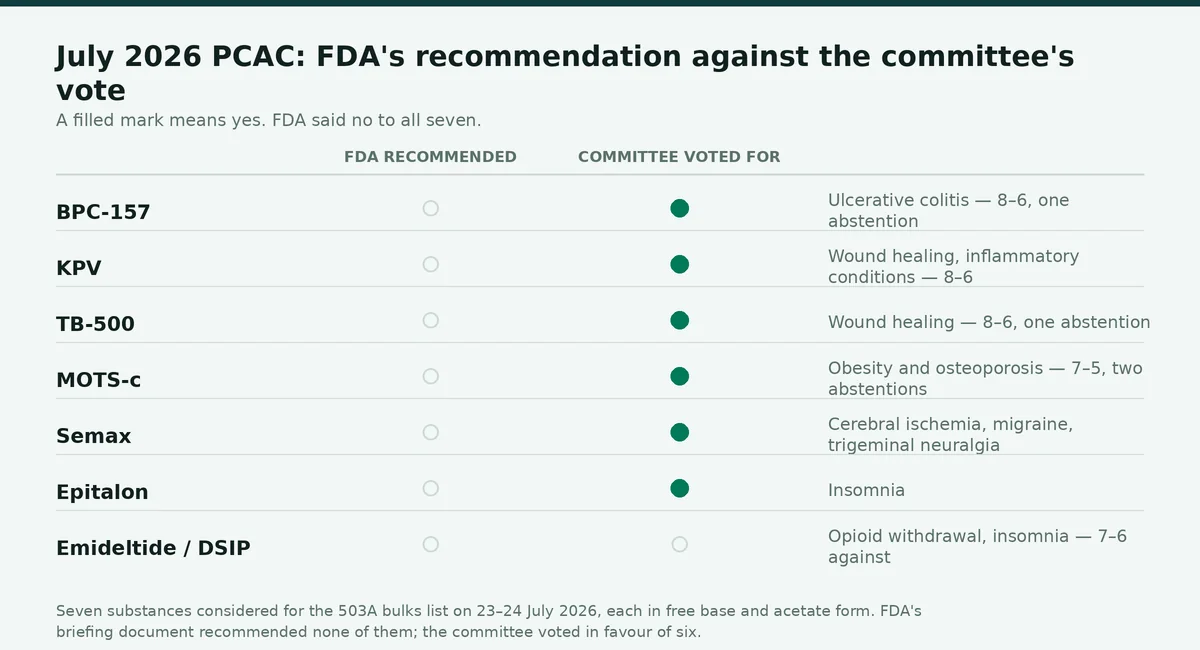
FDA’s Pharmacy Compounding Advisory Committee met on 23–24 July 2026 to consider seven peptide substances, each in free base and acetate form, for the 503A bulks list [1]. The Federal Register notice of 16 April 2026 established docket FDA-2025-N-6895 and set out the agenda [4].
The substances and the conditions they were nominated for were: BPC-157 (ulcerative colitis), KPV (wound healing and inflammatory conditions), TB-500 (wound healing) and MOTS-c (obesity and osteoporosis) on 23 July; and emideltide/DSIP (opioid withdrawal, chronic insomnia, narcolepsy), Semax (cerebral ischemia, migraine, trigeminal neuralgia) and Epitalon (insomnia) on 24 July [1][4]. FDA’s published draft voting questions asked the committee to vote on each substance in both chemical forms — fourteen votes in total [3].
FDA’s own briefing document for the meeting recommended that none of the seven be included on the 503A bulks list, in either form [2]. FDA evaluates these nominations using four factors it applies as a balancing test: “physical and chemical characterization of the substance; any safety issues raised by the use of the substance in compounded drug products; available evidence of effectiveness or lack of effectiveness; and historical use of the substance in compounded drug products” [2].
The committee did not follow that recommendation. On narrow margins it voted in favor of six of the seven substances — BPC-157, KPV and TB-500 (reported 8–6 with one abstention), MOTS-c (7–5 with two abstentions), and Semax and Epitalon on the second day — while declining emideltide/DSIP (7–6 against, one abstention) [16]. As of this check (September 2026) FDA had not posted summary minutes or an official vote record for the meeting, so those tallies are as reported by trade press rather than confirmed in the FDA record [1][16].
Two caveats matter more than the tallies. First, an advisory committee recommendation is explicitly non-binding: FDA must still decide whether to accept it and, if it does, amend the 503A list through notice-and-comment rulemaking [4][5][16]. Second, nothing changed on the day of the vote. As of September 2026 none of these peptides is an FDA-approved drug, none is on the 503A bulks list, and a favorable advisory vote gives a website no authority to sell the substance to the public. Compound-level detail lives on our BPC-157 wiki page.
FDA enforcement against peptide sellers in 2026
FDA issued a cluster of warning letters to peptide sellers dated 24 August 2026. Royal Peptides LLC of Boynton Beach, Florida was cited over seven injectable peptides — tirzepatide, semaglutide, retatrutide, SS-31 (elamipretide), PT-141, tesamorelin and bimorelin — as unapproved new drugs under sections 301(d) and 505(a) [8]. Peak Performance Peptides was cited the same day over six products on the same statutory basis [9].
FDA quoted the sellers’ own marketing back at them: claims of “up to 22.5% body weight reduction,” “up to 24.2% body weight reduction in just 48 weeks,” and a peptide described as a “treatment for hypoactive sexual desire disorder” [8]. That marketing is what converted the vials from articles into drugs.
FDA also stated the underlying safety rationale: injectable products carry particular risk because they “bypass some of the body’s key defenses against toxins and microorganisms” [9]. If you are assessing sellers, our guides on spotting fake peptide vendors and reading a certificate of analysis cover the quality side of the same question.
GLP-1 peptides: FDA’s stated position
The GLP-1 category has drawn the most regulatory attention. FDA’s standing page on unapproved GLP-1 drugs reports, as of 31 May 2026, “990 reports of adverse events associated with compounded semaglutide” and “more than 730 reports of adverse events associated with compounded tirzepatide” — human observational data from spontaneous post-market reporting, which FDA notes is likely an undercount because state-licensed pharmacies are not required to submit reports [10].
FDA has flagged dosing errors with compounded injectable semaglutide, “some requiring hospitalization,” and has raised a separate concern about salt forms: semaglutide sodium and semaglutide acetate “are different active ingredients than are used in the approved drugs” [10].
On the regulatory side, FDA announced on 6 February 2026 that it intends to use “all available compliance and enforcement tools” against mass-marketed non-FDA-approved GLP-1 drugs, warning that violators could face seizure and injunction without further notice [12]. On 30 April 2026, FDA proposed to exclude semaglutide, tirzepatide and liraglutide from the 503B bulks list, on the basis that there is no clinical need for outsourcing facilities to compound them from bulk substances; Commissioner Marty Makary stated that “when FDA-approved drugs are available, outsourcing facilities cannot lawfully compound using bulk drug substances unless there is a clear clinical need” [11]. Background on the class is in our GLP-1 peptides guide and the semaglutide wiki page.
Are injectable peptides lawful dietary supplements?
No, and the reason is structural rather than discretionary. FDA states that “dietary supplements are products that are ingested – specifically, they must be swallowed – so, for example, topical or inhaled products are not supplements” [13]. An injectable product is not swallowed and therefore cannot meet the definition.
A second exclusion often applies independently. FDA notes that “generally, the dietary supplement definition excludes ingredients that are approved as new drugs, licensed as biologics, or authorized for clinical investigation under an investigational new drug application (IND) that has gone into effect, unless the ingredient was previously marketed as a dietary supplement or as a food” [13]. Many peptides of interest have been the subject of an IND, which closes the supplement route even for an oral formulation.
Orally ingested collagen peptides are a genuinely different case and are regulated as food or supplement ingredients — see our collagen peptides hub.
Evidence level is what drives regulatory status
Regulatory categories are downstream of evidence, which is why legal status and scientific support tend to move together. Approval under section 505 requires substantial evidence from adequate and well-controlled investigations — in practice, human RCT data. The GLP-1 adverse-event counts above are human observational. Where a compound’s published record consists mainly of animal or in vitro work, there is no route to approval-level status, and the compounding route depends on FDA’s four-factor assessment, which explicitly weighs “available evidence of effectiveness or lack of effectiveness” [2].
This is why we grade evidence depth separately from popularity. A compound can be widely sold and still sit near the bottom of the evidence scale.
WADA: peptides in competitive sport
For anyone subject to anti-doping rules, the analysis is separate from FDA law and usually stricter. The WADA 2026 Prohibited List was approved by WADA’s Executive Committee on 11 September 2025 and came into force on 1 January 2026 [15].
Two categories matter most. S0 Non-Approved Substances covers substances with no current approval by any governmental regulatory health authority for human therapeutic use — WADA’s athlete guide gives “experimental or designer drugs” as the example. S2 Peptide Hormones, Growth Factors and Mimetics covers the named category directly, with EPO and human growth hormone as listed examples. Both S0 and S2 are banned at all times, in and out of competition [14].
WADA noted that for 2026 “further examples or clarifications have been added to” S2 [15]. The practical consequence: a research peptide with no regulatory approval anywhere is captured by S0 even if it is not named anywhere on the List, and growth hormone secretagogues sit squarely in S2 regardless of how they are sold (checked September 2026). Our review of tesamorelin notes the same status.
State law, personal possession, and the limits of this guide
Everything above concerns federal law on marketing and distribution. State law adds another layer: pharmacy practice, telehealth prescribing rules, and controlled-substance scheduling are all set at state level, and they vary. Some peptides also fall under separate federal statutes — notably, certain growth hormone products are addressed outside the FD&C Act entirely.
Personal possession is a different legal question from commercial distribution, and it is not the question FDA’s warning letters answer. We are not going to guess at it.
This page is a research summary, not legal advice, and it is a snapshot dated September 2026. Regulatory positions in this area moved several times during 2026 alone. Anyone with an actual exposure — a pharmacy, a clinic, a seller, or an athlete under a testing pool — should take advice from a qualified professional rather than rely on a web page.
FAQ
Is it legal to buy peptides online for research?
Selling is the regulated act, and that is where FDA has focused. In its 24 August 2026 letters, FDA held that research-use-only labeling did not stop the products from being unapproved new drugs, because the sellers’ own websites established an intended human use [8][9]. FDA’s position is that these sales violate sections 301(d) and 505(a).
Does a research-use-only label protect the seller?
FDA’s answer in 2026 was no. It stated that “despite statements on your product labeling marketing your products for ‘research use only’ and ‘not for human consumption,’ evidence obtained from your website establishes that your products are intended to be drugs for human use” [9].
Did FDA approve BPC-157 or TB-500 in July 2026?
No. The July 2026 meeting was an advisory committee considering whether those substances could be used as starting material for pharmacy compounding under section 503A — a different question from drug approval. FDA’s own briefing document recommended against including any of the seven peptides [2], and the committee voted in favor of six of them anyway, BPC-157 and TB-500 among them [16]. That vote is non-binding: FDA still has to decide whether to accept it and then amend the list by rulemaking [4][16]. As of September 2026 neither compound is FDA-approved and neither is on the 503A list.
What is the difference between 503A and 503B compounding?
503A covers a licensed pharmacist or physician compounding for an individual patient pursuant to a prescription, without CGMP requirements. 503B covers registered outsourcing facilities, which are FDA-inspected on a risk-based schedule and must meet CGMP [6]. Neither produces an FDA-approved drug [7].
Can peptides be sold as dietary supplements?
Injectable peptides cannot, because supplements must be swallowed [13]. Ingredients approved as new drugs or authorized for investigation under an effective IND are also generally excluded from the supplement definition unless previously marketed as a supplement or food [13].
Are peptides banned in sport?
Peptide hormones, growth factors and mimetics are prohibited at all times under S2 of the WADA Prohibited List, and any substance without approval from a governmental health authority for human therapeutic use is captured by S0, also at all times [14][15].
References
- July 23-24, 2026: Meeting of the Pharmacy Compounding Advisory Committee. US Food and Drug Administration. 2026. https://www.fda.gov/advisory-committees/advisory-committee-calendar/july-23-24-2026-meeting-pharmacy-compounding-advisory-committee-07232026
- FDA Briefing Document, Pharmacy Compounding Advisory Committee (PCAC) Meeting, July 23–24, 2026. US Food and Drug Administration. 2026. https://www.fda.gov/media/193342/download
- July 23-24, 2026 Pharmacy Compounding Advisory Committee — Draft Voting Questions. US Food and Drug Administration. 2026. https://www.fda.gov/media/193711/download
- Pharmacy Compounding Advisory Committee; Notice of Meeting; Establishment of a Public Docket; Request for Comments — Bulk Drug Substances Nominated for Inclusion on the Section 503A Bulk Drug Substances List (Docket FDA-2025-N-6895). Federal Register. 16 April 2026. https://www.federalregister.gov/documents/2026/04/16/2026-07361/pharmacy-compounding-advisory-committee-notice-of-meeting-establishment-of-a-public-docket-request
- Bulk Drug Substances Used in Compounding Under Section 503A of the FD&C Act. US Food and Drug Administration. 2026. https://www.fda.gov/drugs/human-drug-compounding/bulk-drug-substances-used-compounding-under-section-503a-fdc-act
- Compounding and the FDA: Questions and Answers. US Food and Drug Administration. 2026. https://www.fda.gov/drugs/human-drug-compounding/compounding-and-fda-questions-and-answers
- Human Drug Compounding. US Food and Drug Administration. 2026. https://www.fda.gov/drugs/guidance-compliance-regulatory-information/human-drug-compounding
- Warning Letter: Royal Peptides LLC — 734884. US Food and Drug Administration. 24 August 2026. https://www.fda.gov/inspections-compliance-enforcement-and-criminal-investigations/warning-letters/royal-peptides-llc-734884-08242026
- Warning Letter: Peak Performance Peptides — 735127. US Food and Drug Administration. 24 August 2026. https://www.fda.gov/inspections-compliance-enforcement-and-criminal-investigations/warning-letters/peak-performance-peptides-735127-08242026
- FDA’s Concerns with Unapproved GLP-1 Drugs Used for Weight Loss. US Food and Drug Administration. Updated 1 September 2026. https://www.fda.gov/drugs/drug-alerts-and-statements/fdas-concerns-unapproved-glp-1-drugs-used-weight-loss
- FDA Proposes to Exclude Semaglutide, Tirzepatide, and Liraglutide on 503B Bulks List. US Food and Drug Administration. 30 April 2026. https://www.fda.gov/news-events/press-announcements/fda-proposes-exclude-semaglutide-tirzepatide-and-liraglutide-503b-bulks-list
- FDA Intends to Take Action Against Non-FDA-Approved GLP-1 Drugs. US Food and Drug Administration. 6 February 2026. https://www.fda.gov/news-events/press-announcements/fda-intends-take-action-against-non-fda-approved-glp-1-drugs
- Questions and Answers on Dietary Supplements. US Food and Drug Administration. 2026. https://www.fda.gov/food/information-consumers-using-dietary-supplements/questions-and-answers-dietary-supplements
- Athlete and Athlete Support Personnel Guide to the 2026 Prohibited List. World Anti-Doping Agency. 2025. https://www.wada-ama.org/sites/default/files/2025-12/Athlete%20and%20Athlete%20Support%20Personnel%20Guide%20to%20the%202026%20Prohibited%20List.pdf
- WADA’s 2026 Prohibited List is now in force. World Anti-Doping Agency. 2026. https://www.wada-ama.org/en/news/wadas-2026-prohibited-list-now-force
- FDA Panel Backs 6 Peptides for Compounding. The American Journal of Managed Care (AJMC). 31 July 2026. https://www.ajmc.com/view/fda-panel-backs-6-peptides-for-compounding — vote tallies reported by trade press; FDA had not published official meeting minutes as of September 2026.