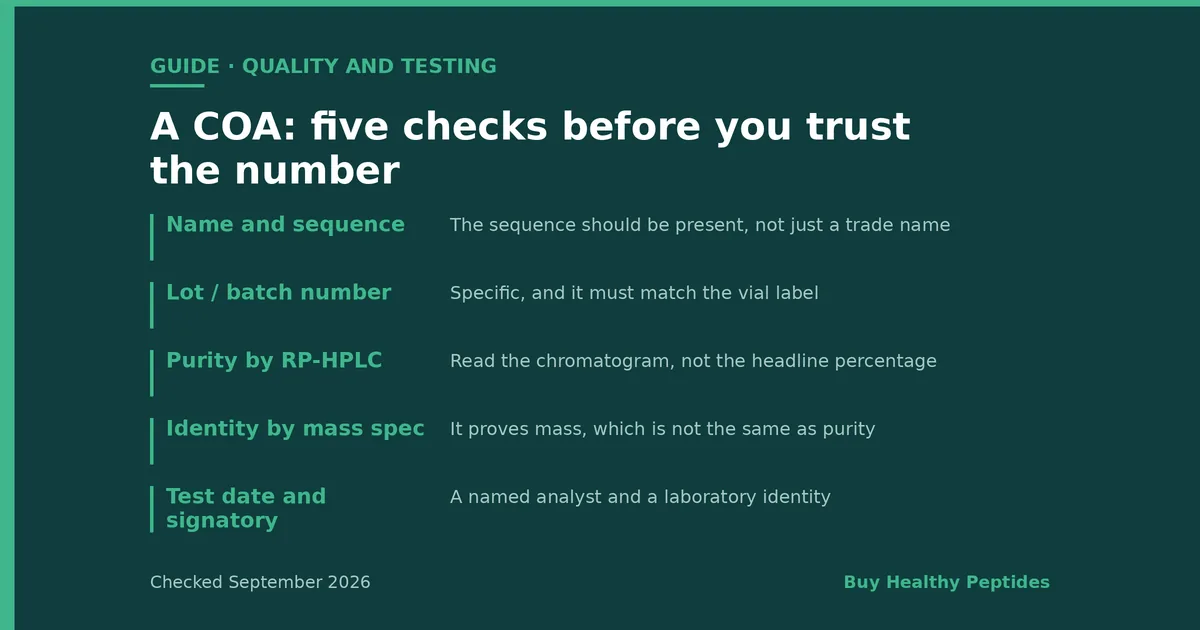
Quick answer: A peptide certificate of analysis is a one-page test report for a single batch of material. Read it in this order: does the header identify a real lot, does the purity figure come with an actual chromatogram, does the mass spectrum match the theoretical mass, and does the document say how much of the vial is peptide rather than salt and water. A COA with no lot number, no chromatogram and no named laboratory is a marketing graphic, not analytical data.
Most people look at a COA, find the number next to “Purity,” see 99.1%, and stop. That is the least informative line on the page. This guide walks the document top to bottom and explains what each field is actually measuring, what it cannot measure, and which omissions should end your interest in a batch.
What a peptide certificate of analysis is, and who issues it
A certificate of analysis is the record of a batch being tested against a specification. In regulatory language, a specification is “a list of tests, references to analytical procedures, and appropriate acceptance criteria that are numerical limits, ranges, or other criteria for the tests described” [2]. The COA is the evidence that one particular batch was tested and where it landed against those criteria.
The tests worth expecting on a peptide COA are not improvised; the US Pharmacopeia maintains a general chapter devoted to the quality attributes of synthetic peptide drug substances [9]. That definition of a specification also carries a quiet requirement: a real result is a value with a limit next to it. A line that reads “Bacterial endotoxin — conforms” tells you nothing, because you cannot see the limit it conformed to or the number it produced.
Two kinds of organization issue these documents, and the distinction matters more than anything printed on them.
In-house COAs are produced by the manufacturer’s own quality-control laboratory. They are normal and legitimate in pharmaceutical manufacturing, where the lab operates under inspected quality systems. In the research-peptide market there is usually no inspection, so an in-house COA is a supplier grading its own homework.
Third-party COAs come from an independent contract laboratory that received a sample and reported what it found. These are more useful, but only if the laboratory is named, reachable, and the sample is traceable to the lot you are being offered. An independent report on a sample the vendor chose and sent is still the vendor’s choice of sample.
Neither type is a statement about safety or legality. US regulators have been explicit that products of this kind — including compounds sold under “research purposes” or “not for human consumption” labels — have not been reviewed for safety, effectiveness or quality [8]. A COA is a quality document, not a permission slip. Our guide to peptide legal status covers that separation in detail.
The header block: check this before you read a single result
The top of the document should let you tie the paper to the physical vial. Work through these fields in order.
| Header field | What you are checking |
|---|---|
| Product name and sequence | The one-letter or three-letter sequence should be present, not just a trade name |
| Molecular formula and MW | Should be internally consistent with the sequence, and stated as free base or as a salt |
| CAS number | Present for well-characterized compounds; absent or “N/A” for many research peptides |
| Lot / batch number | Must be specific, and must match the vial label |
| Manufacture date | Should sit before the test date, which should sit before today |
| Retest or expiry date | A date with a storage condition attached, not a bare month |
| Test date and signatory | A named analyst or QC manager, with a laboratory identity |
The single most useful tell is whether this is a lot-specific document or a template. A template repeats the same values for every batch a vendor has ever sold: the same purity to the same decimal place, the same water content, the same retention time. Real batches vary. If you can obtain COAs for two different lots of the same product and the numbers are identical, you are looking at a form, not a measurement.
Also check that the molecular weight is labeled. Peptides are usually isolated as salts, so the “MW” of the free peptide and the mass of the powder in the vial are different quantities. A COA that gives one number with no basis stated has already made the vial’s contents ambiguous.
Purity by RP-HPLC: read the chromatogram, not the number
Reversed-phase HPLC is the workhorse purity method for synthetic peptides, typically with UV detection around 220 nm, where the peptide bond absorbs [3]. The reported purity is almost always an area-normalized figure: the area of the main peak divided by the total area of all integrated peaks, expressed as a percentage.
Three consequences follow, and they are the reason the chromatogram matters more than the percentage.
Area normalization only counts what the detector sees. Anything that does not absorb at the detection wavelength, does not elute in the gradient window, or stays on the column contributes zero area — and therefore cannot reduce the purity figure. Salts, water and many inorganic residues are invisible to this measurement. A 99% area-normalized result is a statement about the UV-absorbing organic profile, not about what fraction of the powder is peptide.
Co-elution hides impurities. Synthesis-related impurities in peptides include deletion and truncated sequences, insertions, oxidation products, and diastereomers formed by racemization during coupling [3]. Some of these differ from the target by a single residue and can sit under the main peak in a shallow gradient. A single chromatographic method is one dimension of separation; orthogonal methods exist precisely because one is not enough.
Integration is a choice. Where the analyst sets the baseline, and whether small early- or late-eluting peaks are integrated at all, moves the number. You cannot audit that from a percentage. You can audit it from a chromatogram.
So look for the trace itself, and on it: a labeled x-axis with a time scale, a visible baseline, the main peak’s retention time, and the smaller peaks. Then look for the method conditions — column chemistry and dimensions, mobile phases, gradient, flow rate, injection volume and detection wavelength. Without those, the purity figure is not reproducible by anyone, which is the practical definition of an unverifiable claim.
A missing chromatogram is not a formatting oversight. It is the removal of the only part of the purity section that can be independently checked. We go deeper into the methods themselves in our guide to HPLC and mass spectrometry purity testing.
Identity by mass spectrometry: what it proves, and what it does not
The identity section usually reports an observed mass from ESI-MS or MALDI-TOF against the theoretical mass calculated from the sequence. For ESI, you may see a series of multiply charged ions rather than a single number; the deconvoluted mass is what should be compared to theory.
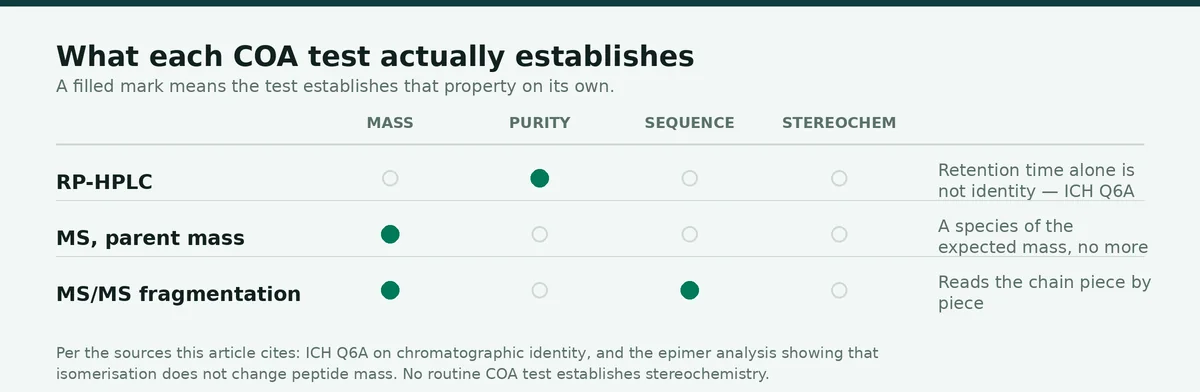
What a matching mass establishes is real but narrow: the material contains a species of the expected molecular mass. Regulatory guidance is blunt that chromatographic behavior alone is not identity: ICH Q6A states that “identification solely by a single chromatographic retention time, for example, is not regarded as being specific” [2]. Mass data is therefore a genuine addition.
What a matching mass does not establish:
- Sequence order. Two peptides with the same amino acid composition in a different order have the same molecular mass. Confirming the actual sequence requires MS/MS fragmentation, which reads the chain piece by piece [3]. A COA that shows only a parent mass has not confirmed sequence.
- Stereochemistry. A D-amino acid substituted for its L counterpart produces an epimer with an identical molecular mass. An analytical study of liraglutide epimers put it directly: isomerization “does not result in any change in peptide mass,” so conventional MS cannot separate these species by mass at all, and the authors needed higher-energy collisional dissociation fragmentation patterns to distinguish and localize them (in vitro, analytical) [4]. Leucine and isoleucine are a related problem, which is one reason amino acid analysis remains useful [3].
- Quantity. MS identity is qualitative. It says a species is present, not how much.
A reasonable COA states the theoretical mass, the observed mass, and the instrument. Tolerances depend on the instrument class, so a document that reports an observed mass without saying what produced it has left out the context needed to judge whether the agreement is meaningful.
Peptide content versus purity: two different questions
This is where most COAs go quiet, and where the most consequential misunderstanding lives.
“Purity” answers: of the peptide-related material present, what fraction is the target peptide?
“Peptide content” answers: of the total mass in the vial, what fraction is peptide at all?
A batch can be 99% pure by HPLC and still be well under 99% peptide by weight, because the rest of the mass is counterion, water and residual solvent. The published approach for assigning content is a mass-balance calculation: measure the non-peptide components — counterions, water, residual solvents, inorganic residue — as weight/weight percentages and subtract them from 100% [3].
Counterions and the TFA question
Synthetic peptides are typically purified by RP-HPLC using trifluoroacetic acid in the mobile phase, and basic residues end up paired with trifluoroacetate. TFA and acetic acid residues are recognized process-related impurities for synthetic peptides, and counterion content is measured as a weight/weight percentage and subtracted when assigning peptide content [3].
For a peptide with several basic residues, the counterion and water together can account for a substantial share of the powder’s weight. That is ordinary chemistry, not misconduct — but it means a vial labeled “10 mg” may contain meaningfully less than 10 mg of peptide unless the COA specifies which basis the label uses.
The question to ask of any COA is therefore: is the stated milligram figure gross weight, or net peptide content? If the document does not say, and reports no water content and no counterion figure, the answer is unknowable from the paperwork.
Karl Fischer water content
Karl Fischer titration measures residual moisture, and that value is used to convert purity and content figures between an anhydrous and an “as-is” basis [3]. Lyophilized peptides are hygroscopic, so water content also moves with handling and storage — which is why it pairs naturally with the storage conditions discussed in our peptide storage and stability guide.
The supporting tests, and what each one is for
Appearance. Description is one of the universal tests in regulatory specifications, and a change in appearance during storage is itself a signal worth investigating [2]. On a COA it is usually “white to off-white lyophilized powder.”
Solubility. Some COAs record that the material dissolved clearly in a named solvent at a stated concentration. This is a QC observation about the batch’s behavior in the laboratory. It is not, and should not be read as, preparation guidance.
Residual solvents. Solvents left over from synthesis and purification are controlled under ICH Q3C, which sets toxicologically based acceptable amounts and groups solvents into classes with different treatment [6]. Acetonitrile, DMF, methanol and dichloromethane are the ones that commonly appear in peptide manufacturing. A COA that reports residual solvents by name with limits is unusual in this market, and is a meaningful signal when present.
Elemental impurities / heavy metals. ICH Q3D applies a risk-based framework with permitted daily exposure values for elements including cadmium, lead, arsenic and mercury, and the limits differ by route of administration — parenteral limits are not the same as oral limits [7]. A generic “heavy metals — pass” line does not tell you which elements were measured or against what limit.
Bacterial endotoxin. Endotoxins are lipopolysaccharides released from the outer membrane of gram-negative bacteria when the cells die and lyse, and they are pyrogenic — fever-producing in humans (human, established regulatory science). The critical property is that they are not removed by sterilizing or microbiological filters, so a sterile-filtered product can still carry endotoxin [5]. The Limulus amebocyte lysate assay replaced the older rabbit pyrogen test (animal) and is reported in endotoxin units, EU, with limits derived from a dose-based formula [5]. If a COA reports endotoxin at all, it should give an EU value and the assay method, not a word.
What level of evidence is a COA?
It is worth being precise about what kind of claim a COA supports, because the site grades evidence elsewhere and the same discipline applies here.
A COA is analytical evidence about one batch of material — measurements made on a sample in a laboratory. It is not human clinical evidence, not animal data, and not an in vitro biological result. It says nothing about whether a compound does anything in a living system, and nothing about safety.
That separation is the whole point of how we score compounds in the Comparison Framework: purity documentation and evidence depth are independent axes. A compound with excellent analytical paperwork and no human trials is still a compound with no human trials.
Red flags on a peptide certificate of analysis
Any single item below should slow you down. Two or more together mean the document is not doing the job it claims to do.
- No lot or batch number, or a lot number that does not match the vial.
- No chromatogram — a purity percentage with no trace behind it.
- No method conditions: no column, no gradient, no detection wavelength.
- An image with no laboratory identity — a screenshot or JPEG with no letterhead, address, contact details or signatory.
- A laboratory that cannot be found. If the named lab has no verifiable existence, the independence the document is trading on does not exist either.
- Results reported as “conforms” or “pass” with no value and no limit. Under the standard definition, a specification carries numerical limits or ranges [2]; a word is not a result.
- Identical results across every batch, including identical retention times and identical purity to the decimal.
- Dates that do not line up — a test date before the manufacture date, a COA older than the lot, or an expiry with no storage condition.
- Only a parent mass, presented as sequence confirmation.
- A milligram figure with no basis — no water content, no counterion, no statement of net peptide content.
- Purity above 99.9% with no supporting data, particularly for long or difficult sequences.
Our guide to spotting unreliable peptide vendors covers the wider pattern these documents usually sit inside.
The honest limits of a COA
Even a well-made certificate of analysis is narrower than people assume, and it is worth stating the limits plainly.
It describes one batch. It says nothing about the next lot, or about the vial you receive if the vendor ships a different lot than the one tested.
It describes the sample that reached the laboratory — chosen, packaged and sent by whoever commissioned the test. Chain of custody is the unstated assumption in every third-party report.
It is only as good as the method. Analytical procedures are supposed to be validated for specificity, accuracy, precision, detection and quantitation limits, range and robustness before their results mean anything [1]. Almost no research-market COA states whether any validation was done.
And it is signed by someone. Analytical chemistry is reproducible in principle, which is exactly why the method details, the chromatogram and the laboratory’s identity are the parts worth reading. Everything else on the page is a number you are being asked to take on trust.
If you are new to the underlying chemistry, our overview of what peptides are is the place to start before returning to this document. (Regulatory references checked September 2026.)
FAQ
What purity percentage should a peptide COA show?
Most research-grade synthetic peptides are offered at 95–99% by area-normalized RP-HPLC. The percentage matters less than whether the chromatogram and method conditions are shown, because area normalization only counts UV-absorbing species that elute within the gradient window [3]. A documented 96% is more informative than an undocumented 99.9%.
Does a COA mean a peptide is safe or approved?
No. A COA is an analytical record for a batch. FDA has stated that unapproved products in this market have not undergone review for safety, effectiveness or quality before being marketed, including products labeled for research purposes [8]. Quality documentation and regulatory approval are separate things.
Why is “99% pure” different from “how many mg of peptide are in the vial”?
Purity is the fraction of peptide-related material that is the target sequence. Peptide content is the fraction of the total powder mass that is peptide at all. The gap is counterion, water and residual solvent, which are quantified separately and subtracted in a mass-balance calculation [3].
Can mass spectrometry prove a peptide is the right sequence?
A parent mass shows a species of the expected mass is present, but not the order of residues, and not stereochemistry — a D-amino acid epimer has an identical mass [4]. MS/MS fragmentation is what reads the sequence [3]. A COA showing only a parent mass has confirmed mass, not sequence.
What does bacterial endotoxin testing add?
Endotoxins are heat-stable lipopolysaccharides from gram-negative bacteria that are not removed by sterilizing filtration, so sterility and low endotoxin are different properties [5]. A meaningful result is a numerical EU value with the assay named, not a “pass.”
How can I tell a lot-specific COA from a generic template?
Compare two lots of the same product. Genuine batch data varies in purity, retention time and water content; a template repeats identical values. Also check that the lot number on the document matches the vial, and that the test date falls after the manufacture date.
References
- Q2(R2) Validation of Analytical Procedures — Guidance for Industry. U.S. Food and Drug Administration. 2024. https://www.fda.gov/regulatory-information/search-fda-guidance-documents/q2r2-validation-analytical-procedures
- Q6A Specifications: Test Procedures and Acceptance Criteria for New Drug Substances and New Drug Products: Chemical Substances — Guidance for Industry. U.S. Food and Drug Administration. 2000. https://www.fda.gov/regulatory-information/search-fda-guidance-documents/q6a-specifications-test-procedures-and-acceptance-criteria-new-drug-substances-and-new-drug-products
- McCarthy D, Han Y, Carrick K, Schmidt D, Workman W, Matejtschuk P, Duru C, Atouf F. Reference Standards to Support Quality of Synthetic Peptide Therapeutics. Pharmaceutical Research. 2023. https://link.springer.com/article/10.1007/s11095-023-03493-1
- Chen YC, Wu HY, Lin LC, Chang CW, Liao PC. Characterizing the D-Amino Acid Position in Peptide Epimers by Using Higher-Energy Collisional Dissociation Tandem Mass Spectrometry: A Case Study of Liraglutide. International Journal of Molecular Sciences. 2024. https://www.mdpi.com/1422-0067/25/3/1379
- Bacterial Endotoxins/Pyrogens — Inspection Technical Guide. U.S. Food and Drug Administration. 1985. https://www.fda.gov/inspections-compliance-enforcement-and-criminal-investigations/inspection-technical-guides/bacterial-endotoxinspyrogens
- ICH Q3C (R9) Residual Solvents — Scientific Guideline. European Medicines Agency. 2024. https://www.ema.europa.eu/en/ich-q3c-r9-residual-solvents-scientific-guideline
- ICH Q3D Elemental Impurities — Scientific Guideline (Step 5, Revision 2). European Medicines Agency. 2022. https://www.ema.europa.eu/en/ich-q3d-elemental-impurities-scientific-guideline
- FDA’s Concerns with Unapproved GLP-1 Drugs Used for Weight Loss. U.S. Food and Drug Administration. 2026. https://www.fda.gov/drugs/drug-alerts-and-statements/fdas-concerns-unapproved-glp-1-drugs-used-weight-loss
- General Chapter 〈1503〉 Quality Attributes of Synthetic Peptide Drug Substances. United States Pharmacopeia (USP–NF). 2021. https://doi.usp.org/USPNF/USPNF_M12935_02_01.html