Quick answer: There is no public registry of legit peptide vendors, so the only workable approach is elimination: look for the failures that regulators and published test-buys have already documented. A 2024 JAMA Network Open test-buy of no-prescription online sellers found delivered samples at 7–14% purity against an advertised 99%, with measured content 29–39% above the labelled amount [1]. FDA has written to peptide sellers repeatedly through August 2026 and has said plainly that a “research use only” label does not change what a product legally is [4,5,6]. Everything below is a check you can run yourself before money moves.
Nothing on this page is buying advice for human use. These compounds are sold for laboratory research, most are not approved for human use in the US, and the point of the checks below is to tell you whether a seller is describable at all — not whether anything in their catalogue is safe.
What testing of online peptide sellers has actually found
Two lines of published evidence matter here, and both are product analysis rather than clinical data.
The first is a 2024 test-buy study published in JAMA Network Open. Researchers screened roughly 1,080 search-engine hyperlinks, identified 317 as online pharmacies, and classified 134 of those 317 as operating illegally. They then attempted purchases from six sellers already rated “not recommended” or “rogue” by pharmacy verification services. Only three of the six orders arrived. The other three were non-delivery scams in which the seller demanded a further $650–$1,200 to supposedly clear customs [1].
The three delivered samples were then analysed. Purity came back at 7–14% against an advertised 99%. Measured active content ran 29–39% above the labelled dose. One sample carried an endotoxin level of 8.95 EU/mg, consistent with contamination. Scored against the International Pharmaceutical Federation’s authenticity checklist, the products hit 8–9 of 22 criteria, where the genuine reference product scores 22 of 22 [1].
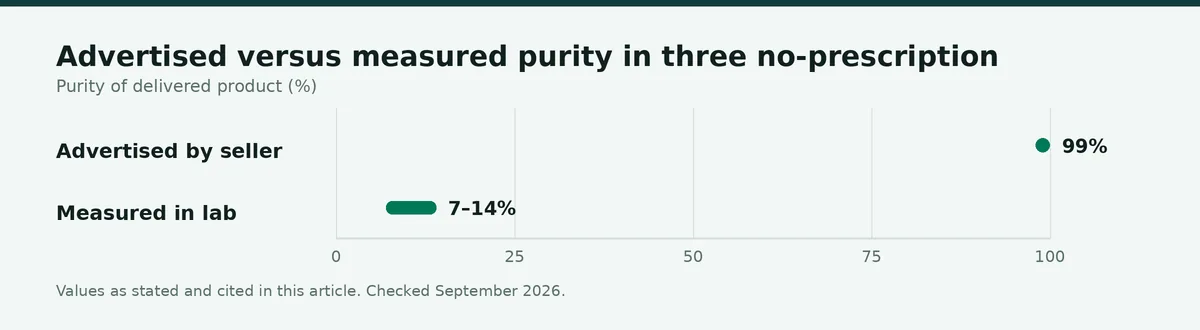
| Purity claim | Purity of delivered product (%) | Source |
|---|---|---|
| Advertised by seller | 99% | test-buy analysis [1] |
| Measured in lab | 7–14% | test-buy analysis [1] |
The second line is older and comes from anti-doping analytical chemistry. Krug and colleagues analysed growth-promoting products advertised on the internet black market using high-resolution mass spectrometry. What they found in the vials was not what the labels said: growth hormone releasing peptides carrying an extra N-terminal glycine — Gly-GHRP-6, Gly-GHRP-2 and Gly-ipamorelin — alongside a growth hormone analogue with 192 amino acids rather than the expected 191 [2]. These are not impurities in the ordinary sense. They are different molecules sold under a familiar name, and no purity percentage on a certificate would have revealed them, because a purity assay measures how much of something is present, not what that something is.
Taken together: the number on the label and the number on the certificate are both claims, and both have been shown to be wrong in the same direction — flattering to the seller.
Why “research use only” is not a quality signal
A recurring misreading is that a “research use only” or “not for human consumption” label marks a seller as careful, or places the product in a legal category of its own. FDA’s enforcement correspondence says the opposite, consistently and in near-identical language.
In a February 2025 letter to USApeptide.com, FDA wrote that despite statements such as “research use only,” “not for human consumption” and “lab purposes only,” evidence from the website established that the products were drugs intended for human use — and cited the site’s own product copy describing semaglutide as an approved injectable for weight loss [4]. In March 2026, FDA told Gram Peptides the same thing, quoting website text about appetite suppression and insulin sensitivity [6]. In August 2026, letters went to Royal Peptides LLC and Peptide Partners LLC covering semaglutide, tirzepatide, retatrutide, SS-31, PT-141 and tesamorelin, again finding that the disclaimer did not survive contact with the site’s own marketing [5,7].
Two details from those letters are worth carrying into your own checks. First, FDA treats the whole site as evidence of intended use — product descriptions, guides, calculators. Second, FDA has noted that selling injection-preparation supplies next to the vials is itself part of the picture, because it supplies the means to prepare an injectable product for human administration [5,6].
So the disclaimer tells you nothing about the vendor’s quality systems. It is boilerplate, and regulators read past it. For the broader picture of which compounds sit in which US category, see the US legal status guide.
The 10 red flags
1. Therapeutic claims sitting beside a research-use disclaimer
If the same page says “not for human or animal consumption” and also describes weight loss, appetite suppression or recovery benefits, the seller is doing exactly what FDA has cited in every letter above [4,5,6,7]. It signals a business built on the human market with a disclaimer bolted on.
2. A certificate of analysis with no named laboratory
A certificate that does not name the testing laboratory cannot be checked. You want the lab’s name, its accreditation body and its accreditation number. ISO/IEC 17025:2017 is the standard that testing laboratories demonstrate competence against; it exists so that results can be trusted across borders [8]. A vendor that will not say who ran the test has made the document unfalsifiable.
3. A purity figure with no identity test
Purity and identity are separate questions answered by separate methods. The Krug findings are the clean illustration: a vial can be highly pure and contain a glycine-extended analogue rather than the peptide named on the label [2]. A certificate showing an HPLC purity percentage and nothing else has answered only half the question. Our guide to reading a peptide certificate of analysis walks through what a complete one contains, and the purity-testing guide covers what each method can and cannot see.
4. No batch or lot number linking the certificate to your vial
A certificate for “BPC-157” is a marketing asset. A certificate for a specific lot, matching the lot printed on the vial you received, is evidence. Without that link, one favourable test can be reused indefinitely across batches that were never tested.
5. Silence on endotoxin and sterility
Purity and identity say nothing about bacterial endotoxin. The 2024 test-buy found 8.95 EU/mg in one sample [1], and that is the kind of finding that only a bacterial endotoxin test surfaces. A vendor that publishes purity data and never mentions endotoxin has published the easy test and skipped the one that speaks to contamination.
6. Reviews that exist only on the vendor’s own site
Since 21 October 2024, the FTC’s Trade Regulation Rule on the Use of Consumer Reviews and Testimonials (16 CFR Part 465) has prohibited fake or misrepresented reviews, incentivised reviews conditioned on sentiment, undisclosed insider reviews, purportedly independent review sites that are in fact controlled by the business being reviewed, suppression of negative reviews, and the sale or purchase of fake social-media indicators [3]. A wall of five-star testimonials with no independent trace, and no negative reviews at all, is now a compliance question as well as a credibility one.
7. Irreversible payment methods and “customs” top-ups
Crypto-only checkout, bank transfer, or gift cards remove the chargeback that would otherwise be your only recourse. The escalation to watch for is the one the JAMA test-buy documented: the order is taken, nothing arrives, and the seller asks for another $650–$1,200 to release a shipment from customs [1]. Half the orders in that study ended this way.
8. A catalogue that ignores US regulatory categories
FDA maintains a list of bulk drug substances for use in compounding that may present significant safety risks — the “category 2” list. As of the page’s 22 April 2026 update, the active category 2 table includes GHRP-2, GHRP-6, ibutamoren mesylate, ipamorelin acetate and kisspeptin-10, while substances such as BPC-157, CJC-1295, epitalon, GHK-Cu, MOTS-c, selank, semax, thymosin alpha-1 and thymosin beta-4/TB-500 appear under nominations that were withdrawn (checked September 2026) [9]. Those are three different positions, not one. A vendor whose site collapses them into “FDA-cleared” or “not on any FDA list” either has not read the page or is counting on you not to.
9. Nothing verifiable about where the active ingredient came from
FDA established an import alert for GLP-1 active pharmaceutical ingredients from foreign facilities lacking appropriate quality controls, and in September 2025 added a “green list” of API sources it had inspected or evaluated, with other sources subject to detention without physical examination [10]. A vendor that cannot say which facility made its API, in which country, is asking you to take the most consequential part of the supply chain on faith.
10. No physical address, licence or returns policy you can test
FDA’s standing consumer guidance on unapproved GLP-1 products is to buy only from state-licensed pharmacies [11]. Research-use sellers are outside that frame entirely, which is the point: there is no licence to check, so the substitutes are a real street address, a named legal entity, and a written refund policy. If all three are missing, there is no party to hold to anything.
What each trust signal actually establishes
Most “trust badges” answer a narrower question than buyers assume. This is the single most useful thing to internalise: none of these documents is a general warrant of quality, and several answer nothing about your vial at all.
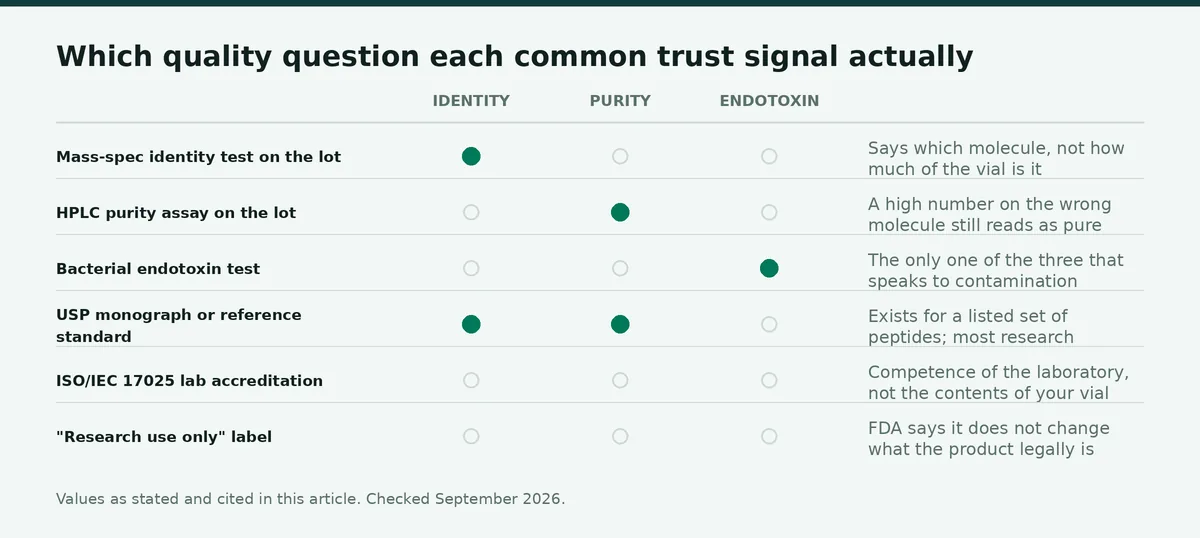
| Trust signal | Identity | Purity | Endotoxin | What it leaves open |
|---|---|---|---|---|
| Mass-spec identity test on the lot | yes | no | no | Says which molecule, not how much of the vial is it [2] |
| HPLC purity assay on the lot | no | yes | no | A high number on the wrong molecule still reads as pure [2] |
| Bacterial endotoxin test | no | no | yes | The only one of the three that speaks to contamination [1] |
| USP monograph or reference standard | yes | yes | no | Exists for a listed set of peptides; most research peptides are outside it [12] |
| ISO/IEC 17025 lab accreditation | no | no | no | Competence of the laboratory, not the contents of your vial [8] |
| “Research use only” label | no | no | no | FDA says it does not change what the product legally is [4,5,6] |
Two of those rows are worth stating plainly. ISO/IEC 17025 accreditation is a statement about a laboratory’s competence and the validity of its results [8] — it is not a statement about any product, and a vendor citing it without a lot-specific report from that lab has cited nothing. And USP publishes documentary standards and reference materials for a defined list of peptides, including bivalirudin, calcitonin salmon, desmopressin, exenatide, glucagon, gonadorelin, leuprolide, octreotide, oxytocin, teriparatide and vasopressin [12]. Most compounds in the research-peptide market have no compendial monograph at all, which means there is no official method and no official acceptance criteria for a certificate to be measured against.
A ten-minute verification pass
None of this requires equipment. It requires being willing to close the tab.
- Read the product page as FDA would. Does the copy make a human health claim? If yes, the research-use framing is decoration [4,5,6].
- Ask for a lot-specific certificate before ordering. Match the lot number to the vial when it arrives. A vendor that sends a generic PDF has answered a different question.
- Look for three tests, not one: identity by mass spectrometry, purity by HPLC, and a bacterial endotoxin result [1,2].
- Name the lab and check the accreditation. Accreditation numbers are verifiable with the accreditation body [8].
- Search the seller’s name against FDA’s warning letter database. The letters above were all published there [4,5,6,7].
- Check the compound against FDA’s category 2 page yourself rather than trusting the vendor’s summary of it [9].
- Look for the reviews off-site. Under the FTC rule, an on-site-only review wall with no dissent is a flag [3].
- Pay by a method with recourse, and treat any post-payment “customs fee” as the end of the transaction [1].
When you have run this on several sellers, the comparison is easier to hold side by side — that is what our vendor comparison is for.
What this guide cannot tell you
It cannot tell you that any particular vendor is honest. Passing every check above means a seller has not yet failed a documented failure mode; it is not a positive finding. The published test-buys covered semaglutide sold without prescription [1] and black-market growth-promoting products [2] — informative, but neither is a random sample of the research-peptide market, and no comparable survey of that market exists in the peer-reviewed literature that we could open.
It also cannot tell you anything about safety in humans. Most of these compounds have little or no human data, and the FDA letters cited here concern marketing and approval status, not toxicology. For what the compounds themselves are, start with the plain-English introduction.
FAQ
Does “research use only” mean a peptide vendor is operating legally?
No. FDA has stated in multiple warning letters that despite labelling such as “research use only,” “not for human consumption” or “not for human or animal use,” evidence from the seller’s own website established that the products were drugs intended for human use, and therefore unapproved new drugs [4,5,6]. The disclaimer is boilerplate that regulators read past; it carries no information about the vendor’s quality systems.
What did laboratory testing of online peptide sellers actually find?
In a 2024 JAMA Network Open study, three semaglutide samples bought from no-prescription online sellers were analysed and came back at 7–14% purity against an advertised 99%, with active content 29–39% above the labelled amount and one sample showing 8.95 EU/mg of endotoxin [1]. Separately, mass-spectrometry analysis of internet black-market growth-promoting products identified glycine-extended analogues of GHRP-2, GHRP-6 and ipamorelin rather than the peptides named on the labels [2].
Is a certificate of analysis enough to verify a peptide vendor?
Not on its own. A certificate answers only the questions its methods cover: an HPLC purity assay measures how much of one species is present but does not establish which molecule it is, and neither test says anything about bacterial endotoxin [1,2]. A certificate is only usable if it names the testing laboratory, carries a lot number that matches the vial, and reports identity, purity and endotoxin separately.
Does ISO/IEC 17025 accreditation mean a peptide is high quality?
No. ISO/IEC 17025:2017 sets general requirements for the competence of testing and calibration laboratories, so that a laboratory can demonstrate it operates competently and generates valid results [8]. It is a statement about the laboratory, not about any product. A vendor citing 17025 without a lot-specific report from that accredited laboratory has provided no evidence about the vial you would receive.
Are fake reviews on a peptide vendor’s site against the law in the US?
The FTC’s Trade Regulation Rule on the Use of Consumer Reviews and Testimonials, 16 CFR Part 465, took effect on 21 October 2024 and prohibits fake or misrepresented consumer reviews, reviews incentivised on the basis of sentiment, undisclosed insider reviews, company-controlled sites presented as independent review platforms, suppression of negative reviews, and buying or selling fake social-media indicators [3]. A review wall with no independent trace and no negative entries is worth treating as unverified.
Which peptides are on FDA’s category 2 compounding list?
As of the page’s 22 April 2026 update, checked September 2026, FDA’s list of bulk drug substances that may present significant safety risks includes GHRP-2, GHRP-6, ibutamoren mesylate, ipamorelin acetate and kisspeptin-10 in the active category 2 table, while BPC-157, CJC-1295, epitalon, GHK-Cu, MOTS-c, selank, semax, thymosin alpha-1 and thymosin beta-4/TB-500 appear under nominations that were withdrawn [9]. Withdrawn nomination, active category 2 and approved for compounding are three different positions, and a vendor that blurs them is misrepresenting the page.
References
- Ashraf AR, Mackey TK, Schmidt J, et al. Safety and Risk Assessment of No-Prescription Online Semaglutide Purchases. JAMA Network Open. 2024;7(8):e2428280. https://jamanetwork.com/journals/jamanetworkopen/fullarticle/2821882
- Krug O, Thomas A, Malerød-Fjeld H, Dehnes Y, Laussmann T, Feldmann I, Sickmann A, Thevis M. Analysis of new growth promoting black market products. Growth Hormone & IGF Research. 2018;41:1–6. https://doi.org/10.1016/j.ghir.2018.05.001
- Federal Trade Commission. Trade Regulation Rule on the Use of Consumer Reviews and Testimonials (16 CFR Part 465), final rule, 89 FR 68034; effective 21 October 2024. https://www.federalregister.gov/documents/2024/08/22/2024-18519/trade-regulation-rule-on-the-use-of-consumer-reviews-and-testimonials
- US Food and Drug Administration. Warning Letter: USApeptide.com (MARCS-CMS 696885). 26 February 2025. https://www.fda.gov/inspections-compliance-enforcement-and-criminal-investigations/warning-letters/usapeptidecom-696885-02262025
- US Food and Drug Administration. Warning Letter: Royal Peptides LLC (MARCS-CMS 734884). 24 August 2026. https://www.fda.gov/inspections-compliance-enforcement-and-criminal-investigations/warning-letters/royal-peptides-llc-734884-08242026
- US Food and Drug Administration. Warning Letter: Gram Peptides (MARCS-CMS 721806). 31 March 2026. https://www.fda.gov/inspections-compliance-enforcement-and-criminal-investigations/warning-letters/gram-peptides-721806-03312026
- US Food and Drug Administration. Warning Letter: Peptide Partners LLC (MARCS-CMS 735063). 24 August 2026. https://www.fda.gov/inspections-compliance-enforcement-and-criminal-investigations/warning-letters/peptide-partners-llc-735063-08242026
- International Organization for Standardization. ISO/IEC 17025:2017 — General requirements for the competence of testing and calibration laboratories. https://www.iso.org/ISO-IEC-17025-testing-and-calibration-laboratories.html
- US Food and Drug Administration. Certain Bulk Drug Substances for Use in Compounding That May Present Significant Safety Risks. Content current as of 22 April 2026; checked September 2026. https://www.fda.gov/drugs/human-drug-compounding/certain-bulk-drug-substances-use-compounding-may-present-significant-safety-risks
- US Food and Drug Administration. FDA Launches Green List to Protect Americans from Illegal Imported GLP-1 Drug Ingredients. 5 September 2025. https://www.fda.gov/news-events/press-announcements/fda-launches-green-list-protect-americans-illegal-imported-glp-1-drug-ingredients
- US Food and Drug Administration. FDA’s Concerns with Unapproved GLP-1 Drugs Used for Weight Loss. Content current as of 1 September 2026; checked September 2026. https://www.fda.gov/drugs/drug-alerts-and-statements/fdas-concerns-unapproved-glp-1-drugs-used-weight-loss
- United States Pharmacopeia. Peptide Standards (Biologics). Checked September 2026. https://www.usp.org/biologics/peptides