Quick answer: GHK-Cu is the copper(II) complex of glycyl-L-histidyl-L-lysine, a three-residue peptide found naturally in human plasma, falling from roughly 200 ng/mL at age 20 to about 80 ng/mL by 60 [1]. Almost all of its human evidence is topical and cosmetic, including a randomised, double-blind split-face trial in 40 women [2]. Injected use is a separate question: FDA’s 503A nomination excludes injectable routes [9], and no human trial of injected GHK-Cu was found in September 2026.
| Spec | Detail |
|---|---|
| Also known as | Copper tripeptide-1; copper peptide [8] |
| Class | Copper(II) complex of a human tripeptide [1][8] |
| Sequence / length | Gly-His-Lys, three residues [1] |
| CAS numbers | 89030-95-5 (copper tripeptide-1); 1269107-24-5 (tripeptide-1) [8] |
| Human plasma level | ~200 ng/mL at age 20, ~80 ng/mL at 60 [1] |
| Half-life | No published human value |
| Regulatory status (US) | Not approved; a cosmetic ingredient, and on FDA’s 503A category 1 list “except for injectable routes” (checked September 2026) [9][10][13] |
| WADA status | Not named in the 2026 Prohibited List materials reviewed (checked Sep 2026) [15][16] |
What is GHK-Cu?
GHK-Cu is not a designed drug. It is a copper-carrying form of a peptide the body already makes: glycyl-L-histidyl-L-lysine, described by Pickart and Margolina as “a small, naturally occurring tri-peptide present in human plasma that also can be released from tissues in case of an injury,” known since 1973 [1].
The copper is the point. The Cosmetic Ingredient Review panel put it this way: the peptide “has an amino acid structure that is similar to the copper ion transport site on human albumin, and, thus, has an affinity for copper(II) that is equivalent to that of the copper transport site on albumin” [8]. It is a copper shuttle, not a receptor ligand. The much-quoted decline with age is real [1], but what it causes in a person has not been established, and a correlation is not a mechanism of ageing.
Two names describe one molecule in different worlds: copper tripeptide-1, the INCI ingredient assessed by the CIR panel [8], and GHK-Cu, the name in compounding filings [9]. Our primer on what peptides are covers why that split matters.
How GHK-Cu works (mechanism)
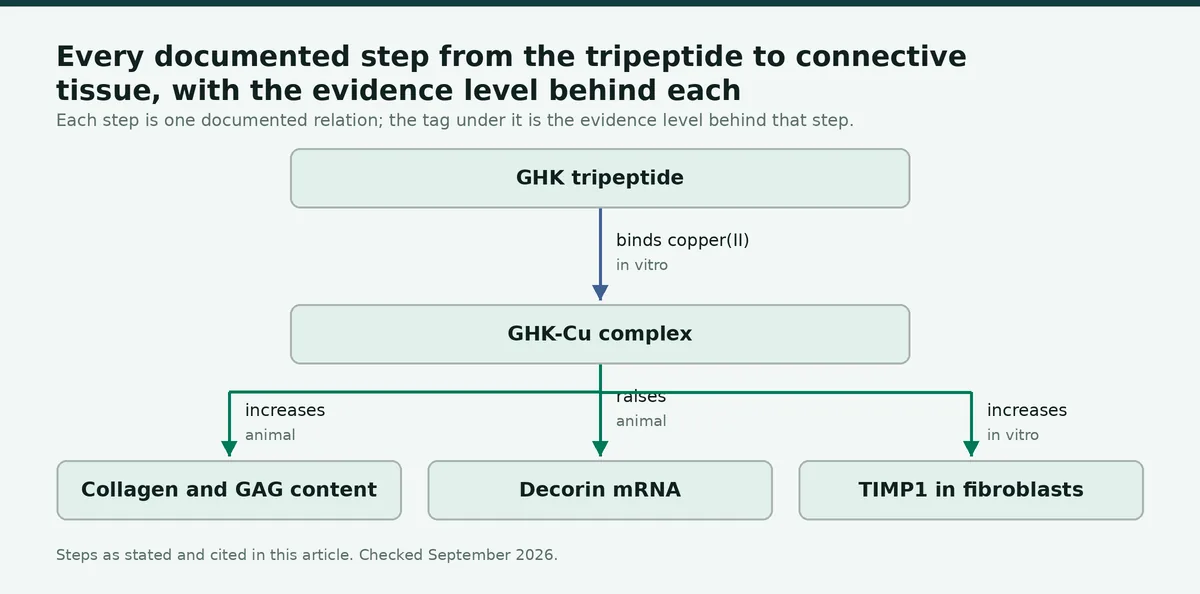
| Step | Relation | Target | Evidence |
|---|---|---|---|
| GHK tripeptide | binds copper(II) | GHK-Cu complex | in vitro [8] |
| GHK-Cu complex | increases | Collagen and GAG content | animal [3] |
| GHK-Cu complex | raises | Decorin mRNA | animal [4] |
| GHK-Cu complex | increases | TIMP1 in fibroblasts | in vitro [2] |
Note what the evidence tags say: not one step in that chain rests on human data.
The best-documented activity is fibroblast stimulation of connective tissue. In rat wound chambers, GHK-Cu produced “a concentration-dependent increase of dry weight, DNA, total protein, collagen, and glycosaminoglycan contents,” collagen rising at roughly twice the rate of non-collagen proteins (animal) [3].
Decorin, the proteoglycan that organises collagen fibrils, is a second strand. Siméon and colleagues gave 2 mg of GHK-Cu per injection into rat wound chambers twice weekly for three weeks: decorin mRNA rose to day 22, biglycan fell, and chondroitin sulfate reached 3.1-fold above controls (animal) [4].
Third, matrix turnover. Human dermal fibroblasts exposed to GHK-Cu at 0.01, 1 and 100 nM showed increased TIMP1 at all concentrations, increased MMP1 and MMP2 at the lowest, decreased TIMP2 at the two higher ones, with more collagen throughout and roughly 30% more alpha-elastin (in vitro) [2]. The direction depends on concentration — worth knowing before anyone calls this “anti-degradation”.
Fourth, gene expression. Against the Broad Institute’s Connectivity Map, “the number of human genes stimulated or suppressed by GHK with a change greater than or equal to 50% is 31.2%,” rising in 59% of those and falling in 41% (in vitro / computational) [1]. That describes breadth, not benefit, and the authors concede such profiling “often lack[s] supporting biological data” [1].
Key numbers
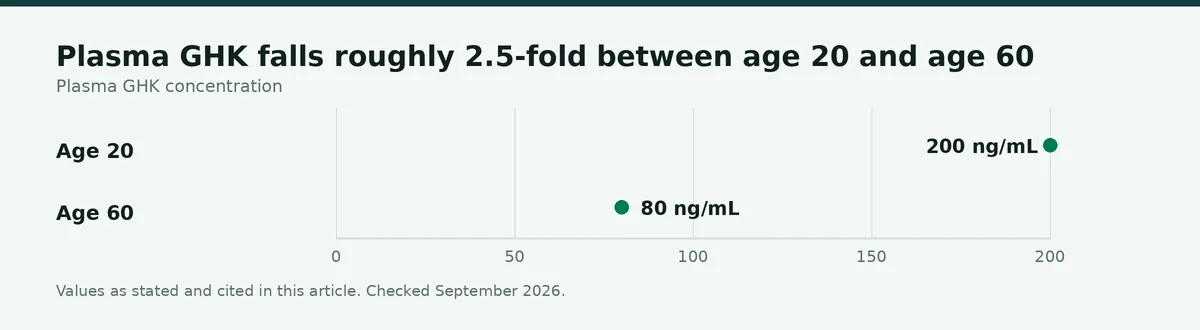
| Age | Plasma GHK concentration |
|---|---|
| Age 20 | 200 ng/mL |
| Age 60 | 80 ng/mL |
Both figures are from Pickart and Margolina [1]. No published human half-life exists to place beside them, so that row stays empty rather than estimated. The nearest measurement is a stability one: under oxidative stress “only 84.2% of GHK-Cu remained after one hour” [6] — the molecule in a vial, not in a person.
What the research shows
Human studies
The strongest dataset is a randomised, double-blind, split-face trial in 40 women aged 40–65, applying a GHK-Cu serum in a lipid-based nano-carrier twice daily for eight weeks against a vehicle serum and a commercial Matrixyl 3000 comparator, wrinkle depth and volume measured by 3D optical imaging (human RCT) [2]. Wrinkle volume fell 31.6% more than with Matrixyl (p=0.004) and 55.8% more than with control (p<0.001); depth fell 32.8% more than control (p=0.012) [2].
Older controlled work reaches us through peer-reviewed reviews rather than in full. A 2017 review in Cosmetics describes a placebo-controlled study in 20 women over one month in which copper-GHK increased collagen in 70% of subjects against 50% for vitamin C and 40% for retinoic acid, plus 12-week studies in 71 and 67 women reporting improved skin density, elasticity and dermal thickness (human, as reported in review) [5]. A 2025 review reproduces the same figures [6].
All of it is topical, cosmetic in endpoint and small: none tested a disease outcome or an injection.
Animal studies
The rat wound-chamber work above is the core: concentration-dependent gains in collagen, DNA, protein and glycosaminoglycan content (animal) [3], plus the decorin and chondroitin sulfate findings at 2 mg per injection (animal) [4]. Pickart and Margolina add that in healthy rats a peptide-incorporated collagen preparation increased wound collagen 9-fold, and report tumour suppression in mouse sarcoma models (animal) [1][7].
In-vitro / preclinical
Beyond the fibroblast and gene work above, GHK has been reported to reactivate apoptosis at 1 to 10 nanomolar in neuroblastoma and lymphoma cell lines (in vitro) [7]. Fibroblast viability stayed between 86% and 96% [8]. None of it has been tested as a human outcome.
Topical versus injected: two evidence bases
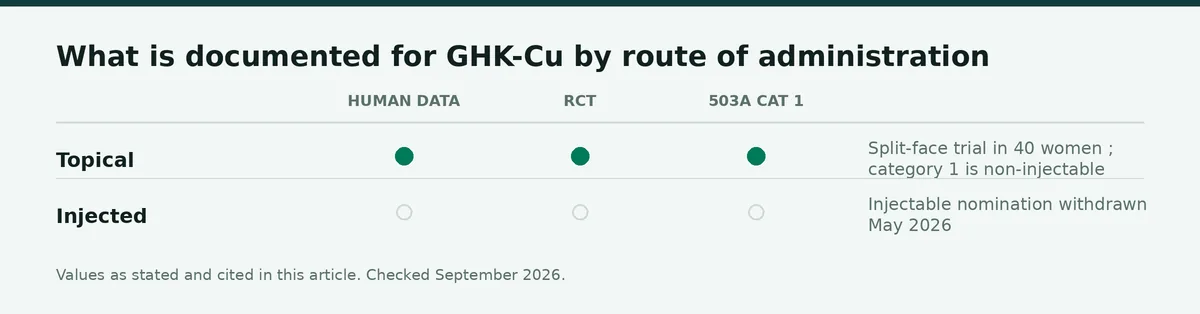
| Route | Human data | RCT | 503A cat 1 | Note |
|---|---|---|---|---|
| Topical | yes | yes | yes | Split-face trial in 40 women [2]; category 1 is non-injectable [9] |
| Injected | no | no | no | Injectable nomination withdrawn May 2026 [9] |
The injected column is empty, and that emptiness is the most informative thing here. Even on the skin, delivery is unsettled: GHK “is a charged molecule at physiological pH,” which with its size “restrict[s] the permeability of GHK through the stratum corneum” [6].
Side effects and risks
Tolerability in the eight-week split-face trial was good: well tolerated in 39 of 40 subjects, the one participant with minor skin reactions having them on both sides of the face after applying both the GHK-Cu serum and the comparator, and resolving without intervention (human RCT) [2].
That is the extent of the controlled safety record. A 2025 review states it bluntly: “no studies have been published on the possible side effects of these peptides” [6]. The CIR Expert Panel concluded copper tripeptide-1 is “safe in the present practices of use and concentration in cosmetics” [8] — a conclusion tied to cosmetic exposure, with concentrations unspecified in its survey data [8].
Copper itself is the risk worth naming. It is an essential nutrient with a tolerable upper intake level of 10,000 mcg daily for adults, and NIH’s Office of Dietary Supplements records that “high levels of copper can result in liver damage and gastrointestinal symptoms (e.g., abdominal pain, cramps, nausea, diarrhea, and vomiting)” [17]. People with Wilson disease, an autosomal recessive disorder of copper clearance, accumulate abnormally high tissue copper and can develop neurologic and liver damage progressing to cirrhosis [17]. Systemic copper exposure from GHK-Cu products has not been quantified, so that risk is unmeasured rather than excluded. And because cosmetic ingredients “do not require FDA approval before they go on the market” [13], market presence is not evidence of review.
Regulatory and legal status (2026)
GHK-Cu is not an FDA-approved drug and has no approved human indication (checked September 2026).
Its position in compounding law moved twice in 2026. FDA’s nominations list, updated 14 May 2026, carries “GHK-Cu (except for injectable routes of administration)” under category 1, substances under evaluation [9]. The attached note records that the entry was removed on 22 April 2026 when the nominations were withdrawn, then restored after a nominator “clarified that it intended to withdraw only its nomination of the injectable route”; FDA “intends to consult the Pharmacy Compounding Advisory Committee (PCAC) before the end of February 2027” on possible inclusion in the bulks list [9]. Category 1 is an interim posture, not an approval: FDA “does not intend to take action against a compounder” using such a substance under the guidance conditions [10].
GHK-Cu did not appear at the July 2026 PCAC meeting: the Federal Register notice, docket FDA-2025-N-6895 of 16 April 2026, lists seven substances — BPC-157, KPV, TB-500, MOTs-C, emideltide/DSIP, semax and epitalon — and GHK-Cu is not among them [12]. Nor is it on FDA’s category 2 list of substances that may present significant safety risks, current as of 22 April 2026 [11].
Separately, the molecule is sold lawfully as the cosmetic ingredient copper tripeptide-1 [8]. The boundary is claim-dependent: FDA defines a drug to include articles “intended to affect the structure or any function of the body,” and warns that “certain claims may cause a product to be considered a drug, even if the product is marketed as if it were a cosmetic” [13]. A “research use only” label does not settle it either — FDA has written that evidence from a seller’s own website can establish that such products “are intended to be drugs for human use” [14]. See our guide to peptide legal status.
In sport, the 2026 WADA Prohibited List entered into force on 1 January 2026 [15]. GHK, GHK-Cu and copper peptides are not named in WADA’s athlete guide to it, which describes S2 only as “Peptide Hormones, Growth Factors, and Mimetics (e.g., EPO, Human Growth Hormone)” and notes the categories are non-exhaustive [16].
Comparison Framework scores
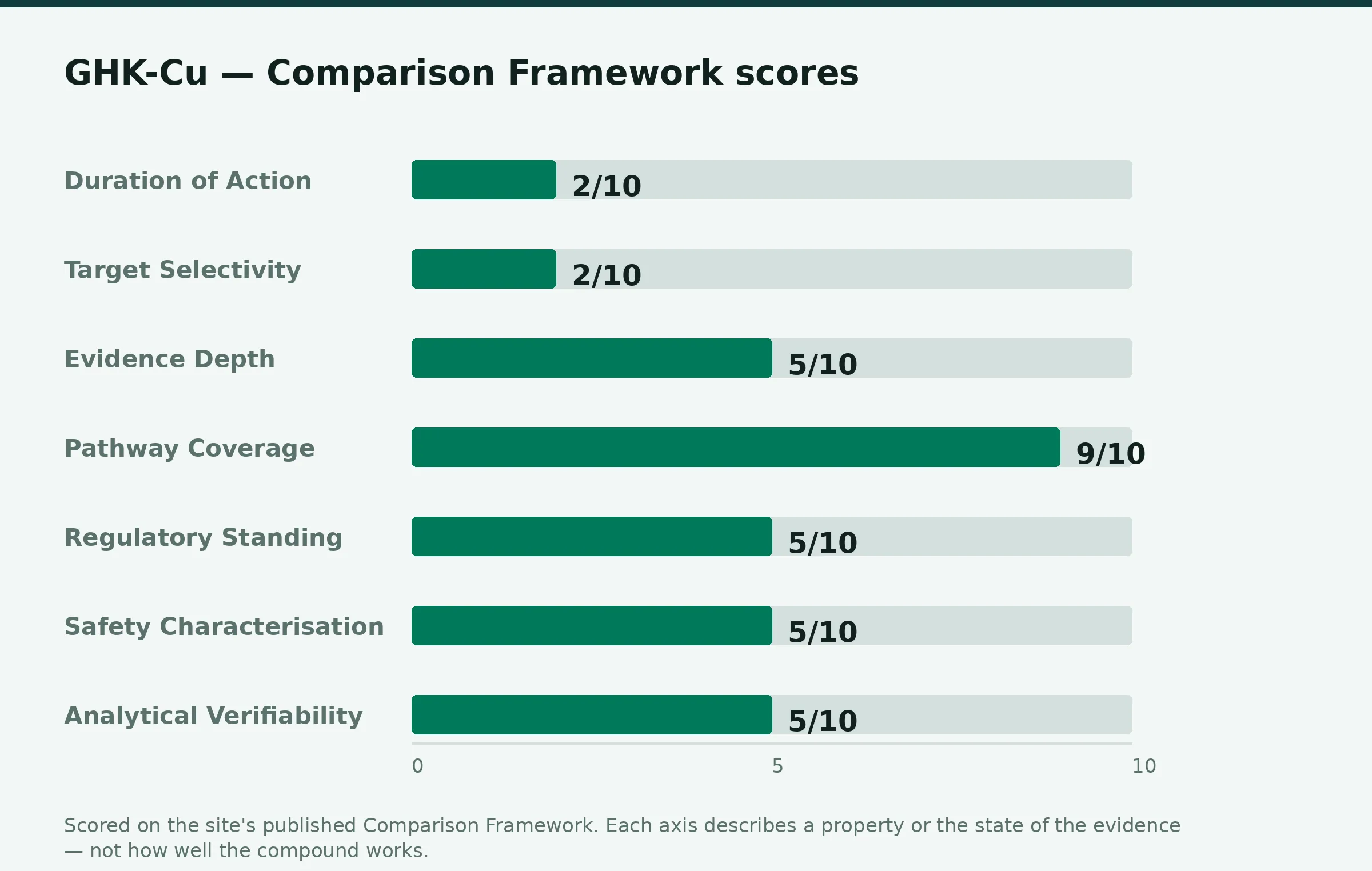
| Axis | n/10 | justification [n] |
|---|---|---|
| Duration of Action | 2/10 | No published human half-life; charged at physiological pH, degraded by skin proteases, 84.2% surviving an hour of oxidative stress [6] |
| Target Selectivity | 2/10 | A copper carrier, not a receptor ligand [8]; ≥50% change in 31.2% of human genes on Connectivity Map [1] |
| Evidence Depth | 5/10 | Small topical human studies, one a randomised split-face trial in 40 women [2], plus controlled studies of 20, 71 and 67 women in review [5]; none injected [9] |
| Pathway Coverage | 9/10 | Copper transport [8], fibroblast collagen and glycosaminoglycan synthesis [3], decorin regulation [4], MMP/TIMP modulation [2], transcriptional breadth [1] |
| Regulatory Standing | 5/10 | Under FDA consideration: category 1 except injectable routes as of 14 May 2026, PCAC consultation due before March 2027 [9][10] |
| Safety Characterisation | 5/10 | One eight-week tolerability dataset [2] and a CIR cosmetic-use conclusion [8], against a review finding no published side-effect studies [6] and no systemic copper data [17] |
| Analytical Verifiability | 5/10 | CAS numbers assigned [8], stability-indicating chromatography published [6]; no compendial monograph found (checked September 2026) |
Evidence Depth reaches 5/10 only because a topical cosmetic literature exists; read against injected use the same axis sits at the bottom of the scale. So it is worth saying plainly that mechanistic plausibility is not clinical proof: a molecule can have well-mapped biochemistry, decades of laboratory work and an appealing story about ageing, and still no evidence it does anything by a route nobody has studied. The anchors are in our Comparison Framework.
The mid-range Safety Characterisation score is not reassurance either. It records that short-duration topical data exist, and that everything past that is unmeasured.
How GHK-Cu compares
The nearest neighbour is oral collagen peptides: same target tissue, a quite different regulatory position, and a trial base reviewed in collagen peptides and skin.
Epitalon is the opposite contrast: it reached the July 2026 PCAC agenda [12] while GHK-Cu did not, with a thinner human record. The wider pattern of heavy laboratory literature and sparse human trials is quantified in the UCLA peptide evidence review, and the repair-focused members of the class in our healing and recovery peptides guide.
Sourcing and quality: what to look for
The paperwork differs by channel: a cosmetic lists copper tripeptide-1 among its INCI ingredients and carries no certificate for the buyer, while a bulk powder sold to researchers should carry one.
Worth checking: identity by mass spectrometry against the stated CAS number [8], purity by HPLC with the method named, copper content stated rather than implied, and a lot number, date and named laboratory. The oxidative instability seen in stability testing [6] also makes storage conditions and a retest date more meaningful here than for a plain peptide — see reading a peptide certificate of analysis.
FAQ
Is GHK-Cu approved by the FDA?
No. GHK-Cu has no FDA-approved human indication (checked September 2026). It sits in category 1 of FDA’s list of bulk substances nominated for compounding under section 503A, entered as “GHK-Cu (except for injectable routes of administration)” as of 14 May 2026, with a Pharmacy Compounding Advisory Committee consultation announced for before the end of February 2027 [9]. Category 1 is an interim enforcement position, not an approval [10].
Is GHK-Cu the same thing as copper tripeptide-1 in skincare?
Yes — copper tripeptide-1 is the cosmetic ingredient name for the copper complex of glycyl-L-histidyl-L-lysine, CAS 89030-95-5 [8]. The Cosmetic Ingredient Review Expert Panel concluded it is safe in the present practices of use and concentration in cosmetics [8]. Cosmetic ingredients need no FDA premarket approval, so that is a panel review, not a clearance [13].
Is there human evidence for injected GHK-Cu?
None was found while researching this page in September 2026. The published human literature is topical [5][6], and the regulatory record points the same way: the nomination on FDA’s category 1 list excludes injectable routes, after a nominator withdrew that part in May 2026 [9]. Topical results say nothing about what an injected route would do.
What are the known risks of GHK-Cu?
For topical cosmetic use the controlled data are limited but unremarkable: 39 of 40 participants tolerated an eight-week serum without issue [2]. Beyond that, a 2025 peer-reviewed review found “no studies have been published on the possible side effects of these peptides” [6]. Copper has its own considerations — excess copper is associated with liver damage and gastrointestinal symptoms [17] — and systemic copper exposure from these products is unmeasured.
Is GHK-Cu banned in sport?
GHK, GHK-Cu and copper peptides are not named in WADA’s athlete guide to the 2026 Prohibited List, in force since 1 January 2026 [15][16]. That guide notes its categories are non-exhaustive [16], so athletes under anti-doping rules should check the current List itself rather than rely on absence from a summary.
References
- Pickart L, Margolina A. Regenerative and Protective Actions of the GHK-Cu Peptide in the Light of the New Gene Data. International Journal of Molecular Sciences. 2018. https://www.mdpi.com/1422-0067/19/7/1987
- Badenhorst T, Svirskis D, Merrilees M, Bolke L, Wu Z. Effects of GHK-Cu on MMP and TIMP Expression, Collagen and Elastin Production, and Facial Wrinkle Parameters. Journal of Aging Science. 2016. https://www.walshmedicalmedia.com/open-access/effects-of-ghkcu-on-mmp-and-timp-expression-collagen-and-elastin-production-and-facial-wrinkle-parameters-2329-8847-1000166.pdf
- Maquart FX, Bellon G, Chaqour B, Wegrowski J, et al. In vivo stimulation of connective tissue accumulation by the tripeptide-copper complex glycyl-L-histidyl-L-lysine-Cu2+ in rat experimental wounds. Journal of Clinical Investigation. 1993;92(5):2368–2376. https://www.jci.org/articles/view/116842
- Siméon A, Wegrowski Y, Bontemps Y, Maquart FX. Expression of Glycosaminoglycans and Small Proteoglycans in Wounds: Modulation by the Tripeptide–Copper Complex Glycyl-L-Histidyl-L-Lysine-Cu2+. Journal of Investigative Dermatology. 2000;115(6):962–968. https://www.sciencedirect.com/science/article/pii/S0022202X1541067X
- Schagen SK. Topical Peptide Treatments with Effective Anti-Aging Results. Cosmetics. 2017. https://www.mdpi.com/2079-9284/4/2/16
- Mortazavi SM, Mohammadi Vadoud SA, Moghimi HR. Topically applied GHK as an anti-wrinkle peptide: advantages, problems and prospective. BioImpacts. 2025. https://bi.tbzmed.ac.ir/Inpress/bi-30071.pdf
- Pickart L, Margolina A. Skin Regenerative and Anti-Cancer Actions of Copper Peptides. Cosmetics. 2018. https://www.mdpi.com/2079-9284/5/2/29
- Cosmetic Ingredient Review Expert Panel. Safety Assessment of Tripeptide-1, Hexapeptide-12, their Metal Salts and Fatty Acyl Derivatives, and Palmitoyl Tetrapeptide-7 as Used in Cosmetics. Cosmetic Ingredient Review. 2014. https://www.cir-safety.org/sites/default/files/tripep032014tent.pdf
- US Food and Drug Administration. Bulk Drug Substances Nominated for Use in Compounding Under Section 503A of the Federal Food, Drug, and Cosmetic Act. Updated 14 May 2026. https://www.fda.gov/media/94155/download
- US Food and Drug Administration. Bulk Drug Substances Used in Compounding Under Section 503A of the FD&C Act. FDA. Content current as of 14 May 2026. https://www.fda.gov/drugs/human-drug-compounding/bulk-drug-substances-used-compounding-under-section-503a-fdc-act
- US Food and Drug Administration. Certain Bulk Drug Substances for Use in Compounding That May Present Significant Safety Risks. FDA. Content current as of 22 April 2026. https://www.fda.gov/drugs/human-drug-compounding/certain-bulk-drug-substances-use-compounding-may-present-significant-safety-risks
- US Food and Drug Administration. Pharmacy Compounding Advisory Committee; Notice of Meeting; Establishment of a Public Docket; Request for Comments — Bulk Drug Substances Nominated for Inclusion on the Section 503A Bulk Drug Substances List (Docket FDA-2025-N-6895). Federal Register. 16 April 2026. https://public-inspection.federalregister.gov/2026-07361.pdf
- US Food and Drug Administration. Is It a Cosmetic, a Drug, or Both? (Or Is It Soap?). FDA. Content current as of 11 September 2024. https://www.fda.gov/cosmetics/cosmetics-laws-regulations/it-cosmetic-drug-or-both-or-it-soap
- US Food and Drug Administration. Warning Letter: Peak Performance Peptides (735127). FDA. 24 August 2026. https://www.fda.gov/inspections-compliance-enforcement-and-criminal-investigations/warning-letters/peak-performance-peptides-735127-08242026
- World Anti-Doping Agency. 2026 Prohibited List (in force 1 January 2026). WADA. 2026. https://www.wada-ama.org/en/resources/2026-prohibited-list
- World Anti-Doping Agency. Athlete and Athlete Support Personnel Guide to the 2026 Prohibited List. WADA. December 2025. https://www.wada-ama.org/sites/default/files/2025-12/Athlete%20and%20Athlete%20Support%20Personnel%20Guide%20to%20the%202026%20Prohibited%20List.pdf
- National Institutes of Health, Office of Dietary Supplements. Copper — Health Professional Fact Sheet. NIH ODS. Updated 18 October 2022. https://ods.od.nih.gov/factsheets/Copper-HealthProfessional