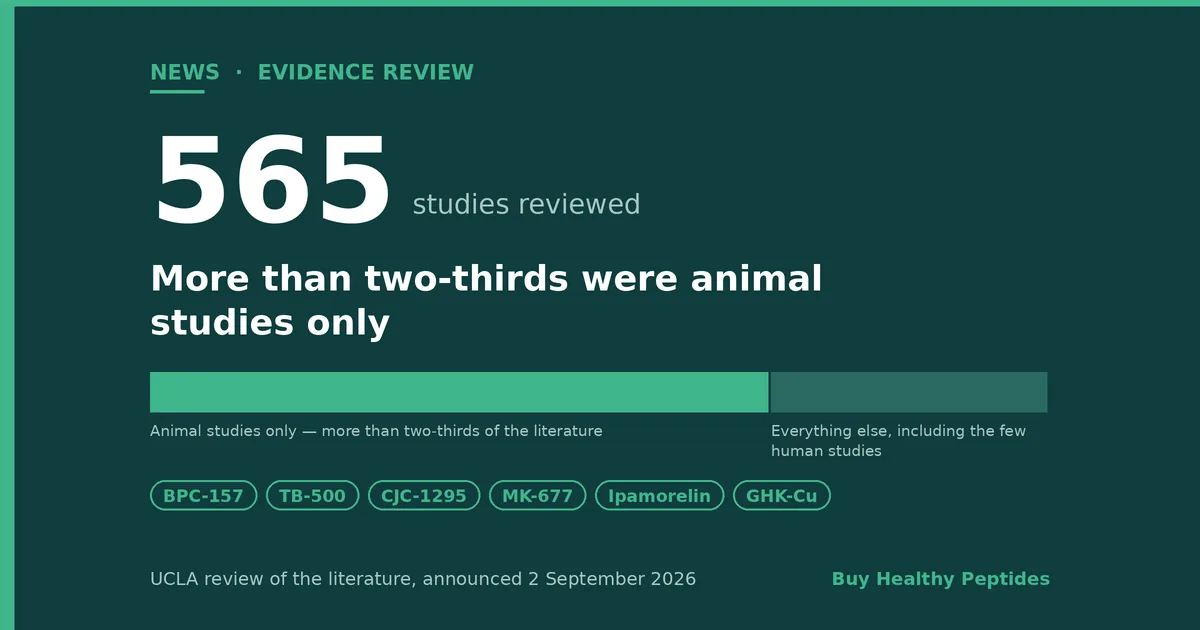
Summary: A UCLA peptide evidence review of 565 published studies on six unapproved peptides found that more than two-thirds of the literature is animal work only, and that the human studies which do exist are few and poorly designed. UCLA announced the findings on September 2, 2026, under a blunt headline: with peptide supplements, marketing outpaces the medicine [1].
What happened
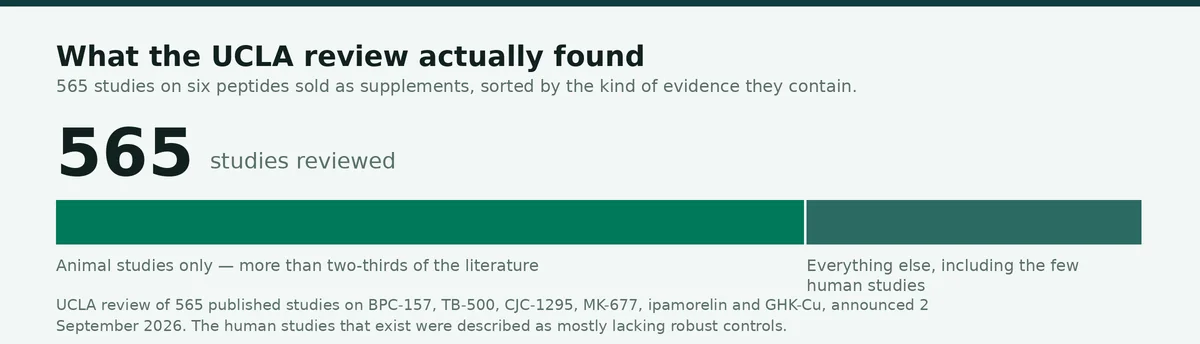
UCLA’s newsroom published the announcement on September 2, 2026, describing a review of the current scientific literature on six peptides widely sold as supplements: BPC-157, TB-500, CJC-1295, MK-677, ipamorelin and GHK-Cu [1]. UCLA Health carried its own version of the same announcement [2]. The author group includes UCLA orthopaedic surgeon Dr. Thomas Kremen and third-year medical student Kushagra Tewari, and the team analyzed 565 studies looking at the peptides’ effects on musculoskeletal treatment, tissue recovery or performance in animal or human models [1].
The headline number is the split between species. More than two-thirds of those studies were animal work only [1]. “It’s a lot of marketing and very little substance,” Kremen said. “The evidence that these peptides are effective is just not there” [1].
Where human data did exist, the reviewers were unimpressed by how it was produced. “Those clinical studies that did appear to show some positive clinical findings were done very poorly,” Kremen said. “Most lacked robust controls or rigorous study designs” [1]. Tewari raised a second problem — who funded the work. “We saw that with one of the biggest studies that was done with BPC-157. The group that did that study had a financial interest in the compound itself,” he said [2].
UCLA’s announcement links the review at DOI 10.1177/03635465261464420 [1]. The journal’s own page could not be opened during this run, so every finding reported here is attributed to the two UCLA announcements we did read, not to an abstract or full text.
Background
None of the six compounds is an FDA-approved drug, and that is the frame the announcement keeps returning to. “These supplements are not regulated or vetted by the FDA,” Kremen said [1]. Readers who want the fuller regulatory picture can start with our explainer on the legal status of peptides in the US and the breakdown of research-use versus compounded versus approved products.
The FDA’s own compounding list backs up one specific safety point. On the agency’s roster of bulk drug substances that “may present significant safety risks,” last updated April 22, 2026, ibutamoren mesylate — the chemical name behind MK-677 — sits in category 2 for both 503A and 503B compounding, with the agency citing “the potential for congestive heart failure” [3]. Ipamorelin acetate carries a category 2 entry as well, while BPC-157, CJC-1295, GHK-Cu and thymosin beta-4 fragment appear among nominations that were withdrawn, each with an FDA risk note attached [3].
That regulatory note matches the trial detail Kremen described: “In one of the documented trials for the peptide MK-677, they stopped the trial because of a higher rate of congestive heart failure in one of the groups” [1].
What it means
For this site, the finding is less a surprise than a confirmation of how we grade things. An animal result is a hypothesis about humans, not a human outcome, and an uncontrolled human series is weaker still than a human RCT. That hierarchy is the whole basis of the Evidence Depth score in our peptide comparison framework, and a literature that is two-thirds rodent studies is exactly what a low Evidence Depth score is supposed to signal before anyone reads a marketing page.
It also means the compound pages most affected are the ones people search for most. The recovery pair — BPC-157 and TB-500 — sits at the center of the recovery and tissue-repair cluster, and the growth-hormone secretagogues CJC-1295 and ipamorelin carry the same problem. GHK-Cu is also in the reviewed set; we will grade its evidence base on its own page rather than characterize it from the announcements alone.
Product quality is a separate issue from efficacy, and the review touches both. “Some tests show they contain dangerous substances, like arsenic or lead,” Kremen said of unregulated products [1], adding that buyers cannot be sure a bottle contains what the label claims. That is the case for reading a certificate of analysis properly — see our guide on how to read a peptide COA — though a clean purity assay still says nothing about whether a compound does anything useful in people.
What’s next
The review’s claim is narrow and worth repeating precisely: the evidence is missing, not that the compounds have been shown to fail. What would change the picture is registered, adequately controlled human trials with independent funding — the sort of work that currently does not exist for any of the six.
We will carry this review into the individual wiki entries for all six compounds as they are written, and we will note it wherever an Evidence Depth score is assigned. If the published paper becomes openly accessible, we will update this piece with its full citation and any numbers that differ from the university announcements.
References
- “With peptide supplements, marketing outpaces the medicine” — UCLA Newsroom, 2026. https://newsroom.ucla.edu/stories/with-peptide-supplements-marketing-outpaces-the-medicine
- “With peptide supplements, marketing outpaces the medicine” — UCLA Health News, 2026. https://www.uclahealth.org/news/article/with-peptide-supplements-marketing-outpaces-medicine
- “Certain Bulk Drug Substances for Use in Compounding that May Present Significant Safety Risks” — U.S. Food and Drug Administration, 2026 (page last updated April 22, 2026). https://www.fda.gov/drugs/human-drug-compounding/certain-bulk-drug-substances-use-compounding-may-present-significant-safety-risks