Quick answer: The research peptides vs compounded vs FDA-approved distinction is a legal one, not a chemical one. An FDA-approved drug has been reviewed for safety, effectiveness and quality before marketing. A compounded preparation has not: FDA states plainly that “compounded drugs are not FDA-approved” and that it “does not verify the safety, effectiveness or quality of compounded drugs before they are marketed” [3]. A vial labelled “research use only” sits outside both frameworks entirely — it is not a recognised regulatory category for a human drug, and FDA has repeatedly treated sellers using that label as marketing unapproved new drugs [8][9]. All regulatory facts below were checked on 22 September 2026 against the live FDA pages cited.
The same molecule can occupy all three positions at once. Semaglutide is the active ingredient in an approved prescription product [12], has been compounded by pharmacies and outsourcing facilities under shortage rules that have since lapsed [5], and has been sold by websites under research-use disclaimers that FDA has rejected in writing [9]. Nothing about the peptide changes across those three settings. What changes is who checked it, against what standard, and what happens if it fails.
Research peptides vs compounded vs approved: what actually differs
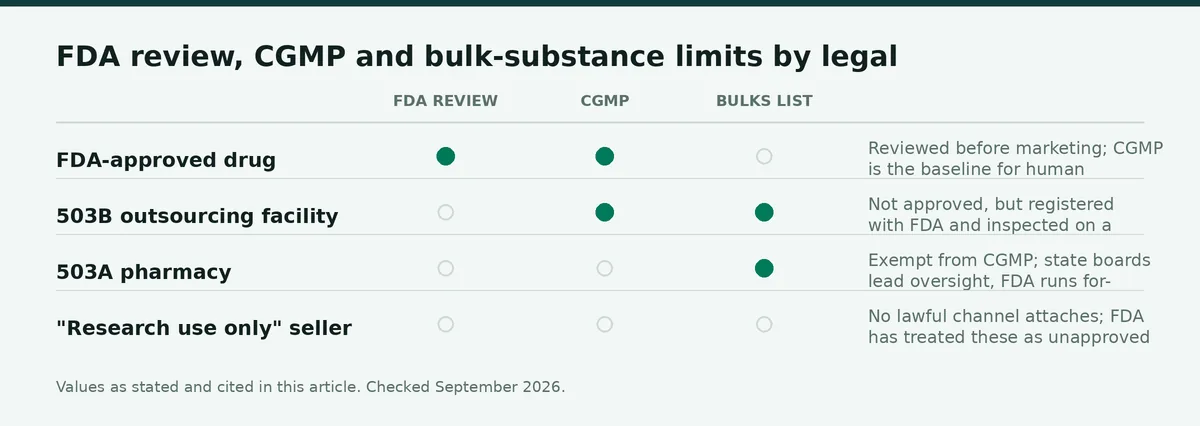
| Legal position | FDA review | CGMP | Bulks list | Note |
|---|---|---|---|---|
| FDA-approved drug | yes | yes | no | Reviewed before marketing; CGMP is the baseline for human pharmaceuticals [12][13] |
| 503B outsourcing facility | no | yes | yes | Not approved, but registered with FDA and inspected on a risk-based schedule [3][10] |
| 503A pharmacy | no | no | yes | Exempt from CGMP; state boards lead oversight, FDA runs for-cause inspections [3] |
| “Research use only” seller | no | no | no | No lawful channel attaches; FDA has treated these as unapproved new drugs [8][9] |
Three columns, three different things. FDA review is premarket review of safety, effectiveness and quality — only an approved product has it, and FDA says in terms that compounded drugs do not [3]. CGMP is the manufacturing standard: FDA’s position is that “adherence to the CGMP regulations assures the identity, strength, quality, and purity of drug products” and that a drug made outside it “is considered ‘adulterated’ under the law” [13], and 503A compounding is statutorily carved out of that requirement while 503B is not [3]. Bulks list records whether the active ingredient has to clear FDA’s bulk-substance rules before it can be used at all; those rules govern compounding, which is why the approved-drug row is a “no” rather than a gap.
The informative row is the bottom one, where every column is empty.
What “FDA-approved” means
Approval is a premarket decision. Before an approved peptide drug reaches the market, its sponsor has submitted a new drug application and FDA has reviewed the evidence behind it. The label carries the approval year — the semaglutide injection label lists “Initial U.S. Approval: 2017” — and it is filed as a human prescription drug label, meaning the product is dispensed on a prescription rather than sold directly [12].
Approval is also narrow. It covers a specific active ingredient, at specific strengths, made by a specific process, for specific uses. It does not transfer to the same molecule made somewhere else. This is the single most common misreading in peptide marketing: “semaglutide is FDA-approved” is true of a named product and false of an arbitrary vial of semaglutide powder. For the wider picture of which peptides hold approvals at all, see our guide to US peptide legal status and the class overview of GLP-1 and incretin peptides.
What “compounded” means: 503A and 503B
Compounding is the preparation of a medication tailored to an individual patient’s needs when an approved product is unsuitable [3]. Two sections of the Federal Food, Drug, and Cosmetic Act create the space for it, and they are not interchangeable.
503A: state-licensed pharmacies
Under section 503A, compounding is done by a licensed pharmacist in a state-licensed pharmacy or federal facility, or by a physician [3]. These pharmacies are not registered with FDA, are not subject to CGMP requirements, and are overseen primarily by state boards of pharmacy, with FDA conducting surveillance and for-cause inspections [3]. FDA’s shortage guidance is explicit that “all other conditions of section 503A must be met, including compounding based on a valid prescription” [4].
503B: outsourcing facilities
Outsourcing facilities registered under section 503B occupy the middle ground. They are registered with FDA, they are subject to CGMP requirements, and once registered a facility “will be added to the list of facilities FDA intends to inspect according to a risk-based schedule” [3][10]. Their output is still not FDA-approved — no premarket review takes place — but the manufacturing standard is a materially different one from a 503A pharmacy.
What a compounder may legally start from
This is where peptides get interesting. A bulk drug substance used in 503A compounding must meet one of three statutory conditions: it must “comply with an applicable United States Pharmacopeia (USP) or National Formulary (NF) monograph if one exists, and the USP chapter on pharmacy compounding”; or be a “component of FDA-approved drug products if an applicable USP or NF monograph does not exist”; or “appear on FDA’s list of bulk drug substances that can be used in compounding (the 503A bulks list)” where neither of the first two applies [1]. On top of that, the substance must be “accompanied by a valid certificate of analysis” and have “been manufactured by an establishment registered with FDA under section 510 of the FD&C Act” [1].
Most of the peptides marketed online meet none of the three. No USP monograph, not a component of any approved drug, not on the bulks list — which means there is no lawful 503A route to compounding them at all, whatever a seller implies. The certificate-of-analysis requirement is also a statutory condition here, not a courtesy; our guide on how to read a peptide certificate of analysis covers what one is actually supposed to show.
FDA’s bulk-substance lists: three positions that are easy to conflate
FDA’s page Certain Bulk Drug Substances for Use in Compounding that May Present Significant Safety Risks (content current as of 22 April 2026, checked 22 September 2026) carries two distinct tables, and the difference between them is where most summaries go wrong.
The active table is headed “Bulk drug substances under category 2 of the interim policies”, introduced with: “Bulk drug substances that may present significant safety risks have been placed in category 2 under the interim policies.” Its peptide entries include growth hormone releasing peptide-2 (GHRP-2), growth hormone releasing peptide-6 (GHRP-6), ibutamoren mesylate, ipamorelin acetate and kisspeptin-10 [2]. FDA’s stated posture toward category 2 is that it “would consider taking action against a compounder for compounding drug products with this bulk drug substance under its general enforcement policies” [1].
The second table is headed “Bulk drug substances nominated but withdrawn”, introduced with: “This list of bulk drug substances previously in category 2 of the interim policies were withdrawn by the nominators.” Its peptide entries include AOD-9604, BPC-157, cathelicidin LL-37, CJC-1295, dihexa acetate, emideltide (DSIP), epitalon, GHK-Cu, KPV, PEG-MGF, melanotan II, MOTS-c, selank acetate (TP-7), semax (heptapeptide), thymosin-alpha 1 and “Thymosin beta-4 fragment (TB-500)” [2].
A withdrawn nomination is not a clearance, and this is the trap. A sentence like “BPC-157 does not appear on FDA’s category 2 list” can be literally true and still leave a reader with exactly the wrong impression, because the substance sits one table lower on the same page — the page whose title is significant safety risks — with FDA’s published concern printed beside it. FDA’s entry for TB-500 states it “may pose risk for immunogenicity for certain routes of administration due to the potential for aggregation as well as peptide-related impurities”; for BPC-157, that it “may pose risk for immunogenicity for certain routes of administration and may have complexities regarding peptide-related impurities”; and for ipamorelin acetate, “serious adverse events including death when ipamorelin was administered intravenously for improving gastric motility” [2].
A third position exists and is separate again: the 503A bulks list itself, established by final rule, on which “FDA placed six substances on the list, identified and did not place four other substances on the list” [1]. Category 1 substances, by FDA’s definition, “may be eligible for inclusion on the 503A bulks list, were nominated with sufficient supporting information for FDA to evaluate them, and do not appear on any other list”; category 3 substances “were nominated with insufficient supporting information for FDA to evaluate them” [1]. Nothing on any of these pages amounts to an endorsement. There is no table that says a peptide is safe.
The shortage rule, and why the date stamp matters
For a while, shortage status was the mechanism that made compounded GLP-1 products lawful. Under section 503A, “a drug is not considered to be commercially available if it is on FDA’s drug shortages list”, which lifts the usual bar on compounding essentially-a-copy of an approved product; a parallel exception applies to outsourcing facilities [4].
Checked 22 September 2026, FDA’s compounding statements show those shortages as resolved, not active. FDA determined the tirzepatide shortage resolved (announced 2 October 2024, re-evaluated and reaffirmed 19 December 2024) and stated the semaglutide shortage “is resolved” on 21 February 2025. It then set the last dates compounders could rely on shortage status: 18 February 2025 for 503A pharmacies and 19 March 2025 for 503B facilities on tirzepatide, and 22 April 2025 and 22 May 2025 respectively on semaglutide [5]. That page was last updated 1 April 2026. Separately, on 30 April 2026 FDA proposed to exclude semaglutide, tirzepatide and liraglutide from the 503B bulks list, saying it “did not identify a clinical need for outsourcing facilities to compound” them, with comments open through 29 June 2026 [6].
Treat all of that as a snapshot. Shortage status is the variable that flips compounding from permitted to not, and it has flipped before. FDA’s drug shortage database is the live source; anything printed in an article, including this one, is only good as of its check date.
What the quality evidence shows
The strongest published comparison of compounded against originator peptide products is an analytical and in vitro study of follow-on and compounded semaglutide and liraglutide, published in Pharmaceutical Research in 2026 [11]. In follow-on semaglutide drug substances, the authors reported 57 impurities above 0.02% that were not present in the originator. In compounded injectable semaglutide products they identified 44 impurities, 34 of which were absent from the originator and 10 present at elevated levels. After light exposure, compounded product content fell from 1.01–1.02 mg/mL to 0.86–0.95 mg/mL, total impurities rose from 1.3–2.5% to 5.1–14.2%, and high-molecular-weight protein species rose from under 0.3% to 2.6–14.1% [11].
Two honest caveats. This is analytical and in vitro work using cultured dendritic cells — it is not a human or animal outcome study, and it does not show that anyone was harmed. And at least one author is affiliated with Novo Nordisk A/S, the originator’s manufacturer [11], which is a disclosed interest a reader should weigh.
Regulator-side numbers point the same direction without proving causation. As of 31 May 2026, FDA reported 990 adverse event reports associated with compounded semaglutide and more than 730 associated with compounded tirzepatide, plus “multiple reports of adverse events, some requiring hospitalization, that may be related to dosing errors” [7]. FDA also notes that some compounded products use salt forms — “semaglutide sodium and semaglutide acetate” — which “are different active ingredients than are used in the approved drugs” [7]. Adverse event reports are voluntary and unverified; they establish signals, not rates.
What “research use only” does and does not do
“Research use only” is a disclaimer, not a legal classification for a human drug. FDA’s position has been consistent and is written down. In an August 2026 warning letter to a peptide seller, FDA wrote: “Despite statements on your product labeling marketing your products ‘for research use only’ and ‘not for human or veterinary use,’ evidence obtained from your website establishes that your products are intended to be drugs for human use” [8]. The letter named products offered as semaglutide, tirzepatide, retatrutide, elamipretide (SS-31), tesamorelin and bremelanotide (PT-141), and warned that failure to address the violations “may result in legal action without further notice, including, without limitation, seizure and injunction” [8][14].
An earlier letter to a different seller set out the two statutory hooks. New drugs “may not be legally introduced or delivered for introduction into interstate commerce without prior approval from FDA, as described in section 505(a)”, and prescription drugs sold without directions “under which a layperson can use a drug safely” are misbranded under section 502(f)(1) [9]. The disclaimer is what FDA looks past, not what it defers to. Intended use is read from the whole marketing context.
For this site’s purposes the practical consequence is narrow and worth stating plainly: a research-use vial has had no premarket review, no compounding-specific CGMP obligation, no prescription in the loop and no statutory certificate-of-analysis requirement. Whatever quality it has is whatever its seller chose to provide.
Reading a product’s category, not its marketing
Three questions separate the categories without needing any insider knowledge. Is there an approved product with this active ingredient, by name, on a prescribing label? Is a licensed prescriber and a patient-specific prescription in the chain, or a registered outsourcing facility? And does the substance meet one of the three statutory bulk-substance conditions — monograph, component of an approved drug, or bulks-list entry [1]?
If the answer to all three is no, the product is in the bottom row of the table above, whatever the page says about purity. That is a statement about regulatory standing only; it is not a claim about what any of these compounds do, which is handled compound by compound in our semaglutide page and the rest of the wiki, and scored against the published Comparison Framework. If the underlying chemistry is new to you, start with what peptides are.
FAQ
Is a compounded peptide FDA-approved?
No. FDA states that “compounded drugs are not FDA-approved” and that the agency “does not verify the safety, effectiveness or quality of compounded drugs before they are marketed” [3]. That applies to preparations from both 503A pharmacies and 503B outsourcing facilities. The 503B route adds CGMP obligations and FDA registration and inspection [3][10], but it is still not premarket approval.
Does “research use only” make a peptide legal to sell?
It does not, once the marketing context shows human use is intended. In an August 2026 warning letter FDA wrote that “despite statements on your product labeling marketing your products ‘for research use only’ and ‘not for human or veterinary use,’ evidence obtained from your website establishes that your products are intended to be drugs for human use” [8]. FDA’s hooks are section 505(a) for unapproved new drugs and section 502(f)(1) for misbranding [9].
Can a pharmacy still compound semaglutide or tirzepatide?
Not on the basis of shortage status, checked 22 September 2026. FDA determined the tirzepatide shortage resolved in late 2024 and the semaglutide shortage resolved on 21 February 2025, with final compounding dates of 18 February and 19 March 2025 for tirzepatide and 22 April and 22 May 2025 for semaglutide, for 503A and 503B respectively [5]. In April 2026 FDA further proposed excluding both from the 503B bulks list [6]. Shortage status can change, so the live FDA drug shortage database is the only current answer.
What is the difference between a 503A pharmacy and a 503B outsourcing facility?
A 503A pharmacy is state-licensed, is not registered with FDA, is not subject to CGMP requirements, and is overseen primarily by state boards of pharmacy with FDA conducting surveillance and for-cause inspections. A 503B outsourcing facility is registered with FDA, is subject to CGMP requirements, and is inspected by FDA “according to a risk-based schedule” [3][10].
If a peptide is not on FDA’s category 2 list, does that mean FDA has cleared it?
No, and this is the most common misreading of FDA’s bulk-substances page. The same page (content current 22 April 2026, checked 22 September 2026) carries a separate table headed “Bulk drug substances nominated but withdrawn”, described as substances “previously in category 2 of the interim policies” that “were withdrawn by the nominators”, which includes BPC-157, CJC-1295, AOD-9604, GHK-Cu, epitalon, melanotan II and “Thymosin beta-4 fragment (TB-500)” [2]. FDA’s published safety concerns remain printed beside those entries. No table on the page clears anything.
Is a compounded peptide chemically the same as the approved drug?
Not necessarily. FDA notes that some compounded semaglutide products use salt forms — “semaglutide sodium and semaglutide acetate” — which “are different active ingredients than are used in the approved drugs” [7]. Separately, an analytical and in vitro study reported 44 impurities in compounded injectable semaglutide products, 34 of them absent from the originator, with total impurities rising to 5.1–14.2% after light exposure [11]. That work is laboratory characterisation, not a human outcome study.
References
- US Food and Drug Administration. Bulk Drug Substances Used in Compounding Under Section 503A of the FD&C Act. FDA.gov. Content current as of 14 May 2026; checked 22 September 2026. https://www.fda.gov/drugs/human-drug-compounding/bulk-drug-substances-used-compounding-under-section-503a-fdc-act
- US Food and Drug Administration. Certain Bulk Drug Substances for Use in Compounding that May Present Significant Safety Risks. FDA.gov. Content current as of 22 April 2026; checked 22 September 2026. https://www.fda.gov/drugs/human-drug-compounding/certain-bulk-drug-substances-use-compounding-may-present-significant-safety-risks
- US Food and Drug Administration. Compounding and the FDA: Questions and Answers. FDA.gov. Content current as of 16 September 2025; checked 22 September 2026. https://www.fda.gov/drugs/human-drug-compounding/compounding-and-fda-questions-and-answers
- US Food and Drug Administration. Compounding when Drugs are on FDA’s Drug Shortages List. FDA.gov. Content current as of 8 August 2025; checked 22 September 2026. https://www.fda.gov/drugs/human-drug-compounding/compounding-when-drugs-are-fdas-drug-shortages-list
- US Food and Drug Administration. FDA clarifies policies for compounders as national GLP-1 supply begins to stabilize. FDA.gov. Content current as of 1 April 2026; checked 22 September 2026. https://www.fda.gov/drugs/drug-alerts-and-statements/fda-clarifies-policies-compounders-national-glp-1-supply-begins-stabilize
- US Food and Drug Administration. FDA Proposes to Exclude Semaglutide, Tirzepatide, and Liraglutide on 503B Bulks List. FDA.gov, 30 April 2026; checked 22 September 2026. https://www.fda.gov/news-events/press-announcements/fda-proposes-exclude-semaglutide-tirzepatide-and-liraglutide-503b-bulks-list
- US Food and Drug Administration. FDA’s Concerns with Unapproved GLP-1 Drugs Used for Weight Loss. FDA.gov. Content current as of 1 September 2026; checked 22 September 2026. https://www.fda.gov/drugs/drug-alerts-and-statements/fdas-concerns-unapproved-glp-1-drugs-used-weight-loss
- US Food and Drug Administration. Warning Letter: Peptide Partners LLC (MARCS-CMS 735063), issued 24 August 2026; content current as of 1 September 2026; checked 22 September 2026. https://www.fda.gov/inspections-compliance-enforcement-and-criminal-investigations/warning-letters/peptide-partners-llc-735063-08242026
- US Food and Drug Administration. Warning Letter: USApeptide.com (MARCS-CMS 696885), issued 26 February 2025; content current as of 11 March 2025; checked 22 September 2026. https://www.fda.gov/inspections-compliance-enforcement-and-criminal-investigations/warning-letters/usapeptidecom-696885-02262025
- US Food and Drug Administration. Facilities Registered as Human Drug Compounding Outsourcing Facilities Under Section 503B of the FD&C Act. FDA.gov. Content current as of 8 September 2026; checked 22 September 2026. https://www.fda.gov/drugs/human-drug-compounding/registered-outsourcing-facilities
- Kopp KL, Lamberth K, Schelde O, Øgendahl AK, Wojcieszek M, Mogensen JE, Ramírez-Andersen HS, Schneider CL, Staby A, Hach M, et al. Impurities and Potential Immunogenicity Associated With Follow-on and Compounded Glucagon-like Peptide-1 Receptor Agonists. Pharmaceutical Research. 2026;43(8):2861–2886. Analytical and in vitro study. https://link.springer.com/article/10.1007/s11095-026-04146-9
- DailyMed (US National Library of Medicine). OZEMPIC (semaglutide) injection, solution — human prescription drug label; “Initial U.S. Approval: 2017”. Checked 22 September 2026. https://dailymed.nlm.nih.gov/dailymed/drugInfo.cfm?setid=fdf509ac-7ae5-49be-9a3e-8465c76f38e1
- US Food and Drug Administration. Facts About the Current Good Manufacturing Practice (CGMP). FDA.gov. Content current as of 21 November 2025; checked 22 September 2026. https://www.fda.gov/drugs/pharmaceutical-quality-resources/facts-about-current-good-manufacturing-practice-cgmp
- US Food and Drug Administration. FDA Intends to Take Action Against Non-FDA-Approved GLP-1 Drugs. FDA.gov, 6 February 2026; checked 22 September 2026. https://www.fda.gov/news-events/press-announcements/fda-intends-take-action-against-non-fda-approved-glp-1-drugs