Quick answer: Epitalon, also written Epithalon, is a synthetic tetrapeptide — Ala-Glu-Asp-Gly, abbreviated AEDG — built from the amino-acid composition of epithalamin, a bovine pineal gland extract [1]. Its headline claim, that it reactivates telomerase and lengthens telomeres, rests on in vitro work in cultured human cells, including a 2025 study across six cell lines [2][3]. There is no published randomized human trial of the peptide itself, no published pharmacokinetic data, and no FDA approval for any indication (checked September 2026) [10][11].
| Spec | Detail |
|---|---|
| Also known as | Epithalon, Epithalone, AEDG peptide [1] |
| Class | Synthetic linear tetrapeptide; pineal “peptide bioregulator” [1] |
| Sequence | Ala-Glu-Asp-Gly (AEDG) [1] |
| Molecular formula | C14H22N4O9, PubChem CID 219042 [13] |
| Half-life | No published human or animal pharmacokinetic study located [1] |
| Route in cited studies | Subcutaneous injection in rodents and primates; added to culture medium in cell work [3][4][5] |
| Regulatory status (US) | Not FDA-approved; absent from the Category 2 safety-risk list and from Categories 1–3 of the 503A nominated bulk substances list (checked September 2026) [10][11] |
| WADA status | Not named on the 2026 Prohibited List, in force 1 January 2026 (checked September 2026) [12] |
What is Epitalon?
Epitalon is four amino acids long: alanine, glutamic acid, aspartic acid, glycine. That is the whole molecule. It was designed in the Soviet Union and then Russia by V. Kh. Khavinson’s group as a synthetic stand-in for epithalamin, a crude peptide preparation extracted from bovine pineal glands, and was reportedly later detected in physiological pineal extract itself [1].
The distinction between the two matters more than almost anything else on this page, because the evidence is split across them. Epithalamin is the extract; Epitalon is the defined synthetic tetrapeptide. Most of the human data in the literature was generated with the extract, and most of the telomere data was generated with the synthetic peptide in cell culture. They are not interchangeable, and a claim proven for one is not proven for the other.
If you are new to this class of molecule, our primer on what a peptide actually is covers why chain length, sequence and stability drive almost everything that follows.
How Epitalon works (mechanism)
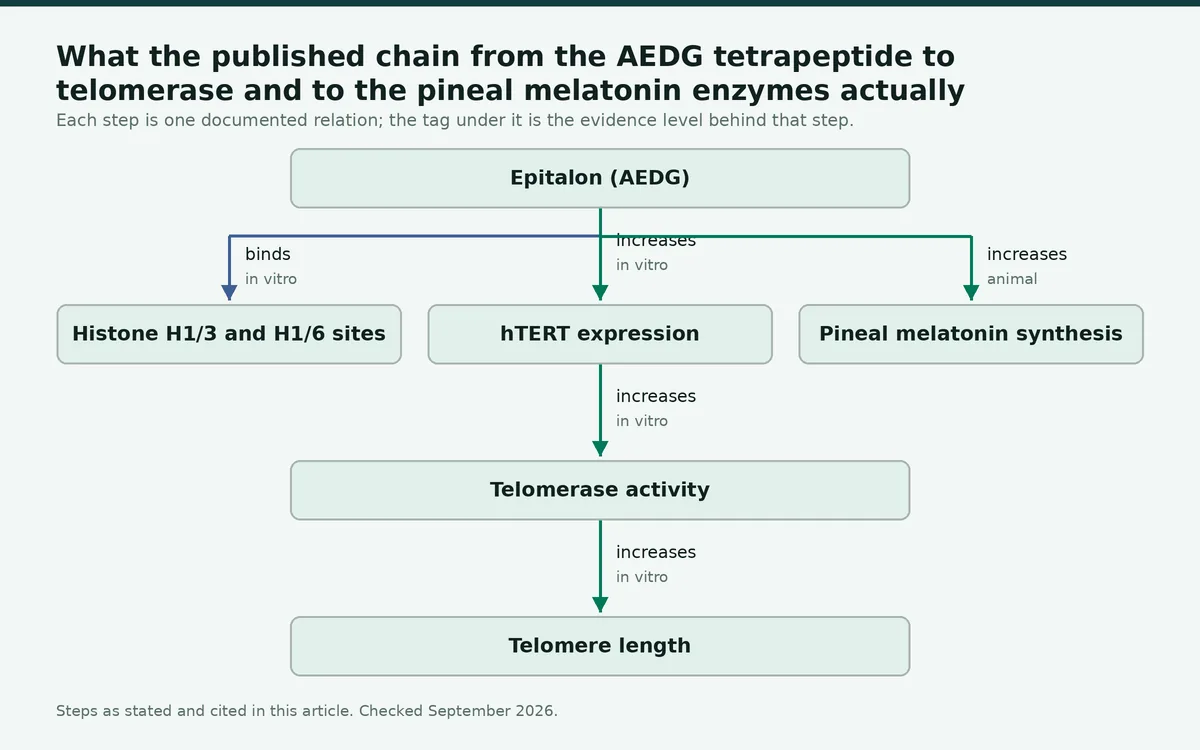
| Step | Relation | Target | Evidence |
|---|---|---|---|
| Epitalon (AEDG) | binds | Histone H1/3 and H1/6 sites | in vitro [8] |
| Epitalon (AEDG) | increases | hTERT expression | in vitro [3] |
| hTERT expression | increases | Telomerase activity | in vitro [2] |
| Telomerase activity | increases | Telomere length | in vitro [3] |
| Epitalon (AEDG) | increases | Pineal melatonin synthesis | animal [5] |
Read that diagram as a map of what has been measured, not a settled pathway. Epitalon has no identified receptor. The best-developed proposal is epigenetic: a 2020 study in human gingival mesenchymal stem cells combined cell work with molecular modelling and reported that the AEDG peptide “preferably binds with H1/6 and H1/3 histones”, at sites that contact DNA, which the authors argue raises the transcription probability of nearby genes [8]. The binding step is a docking prediction published alongside the cell data, not a measured affinity — worth saying out loud, because it is the first arrow in the chain.
Downstream of that, the 2003 experiment that started the telomere story added Epithalon to telomerase-negative human fetal fibroblast cultures and reported expression of the telomerase catalytic subunit, enzymatic activity and telomere elongation — in vitro throughout [2]. A 2025 study reproduced and extended the finding in six human cell lines, reporting up to 12-fold hTERT upregulation in the 21NT breast cancer line at 1 µg/mL and telomere extension from roughly 2.4 kb to 4 kb, with smaller increases in normal fibroblasts and epithelial cells after three weeks of exposure [3].
The pineal arm is separate. In senescent rhesus macaques, Epitalon was reported to stimulate evening melatonin synthesis and normalize the circadian rhythm of cortisol secretion — animal data [5]. The 2025 review notes that this is not uncontested: work on isolated rat pineal glands found no effect of Epitalon on melatonin release, so the pineal step is better described as reported-and-disputed than established [1].
Pharmacokinetics: the numbers that are not published
This is the shortest section on the page, and deliberately so. The 2025 review of Epitalon contains no pharmacokinetic parameters at all — no half-life, no clearance, no bioavailability figure — and the only claim in that territory it reports is other authors’ assertion that the peptide is poorly hydrolysable and might survive oral administration, which it presents without supporting data [1]. A literature search in September 2026 surfaced no published PK study for AEDG in humans or animals.
That absence is why this page carries no half-life chart. There is nothing to plot, and estimating a number to fill a row would be inventing the most quotable fact on the page. What the dosing schedules in the animal work imply is indirect: the mouse lifespan study used five consecutive daily subcutaneous injections every month rather than a single dose, which is consistent with short-lived activity but does not measure it [4].
What the research shows
Human studies
There is no published randomized controlled trial of the synthetic Epitalon tetrapeptide. The 2025 review is explicit that its evidence base is in vitro, in silico and animal — rodents, insects and primates — with no prospective clinical trials reporting enrollment, treatment or efficacy outcomes [1].
What does exist is human work on epithalamin, the pineal extract. A 2004 report studied circadian plasma melatonin in healthy elderly subjects before and after a course of epithalamin and found melatonin rose during darkness in those whose pineal activity was initially low, while it tended to fall in those with normal function — human observational, a before-and-after comparison with no placebo arm described in the published abstract [6]. A 2006 report described a 12-year randomized study of epithalamine in elderly patients with coronary disease and accelerated cardiovascular aging, reporting 28% lower all-cause mortality and roughly two-fold lower cardiovascular mortality against controls on the same background therapy — human, randomized as described [7].
Those numbers are striking, and they should be read with matching care. They come from a single research group, were published in one journal, describe an extract rather than the defined tetrapeptide, and the abstract reports neither the sample size nor whether outcome assessment was blinded. A 28% mortality reduction from a pineal extract is an extraordinary claim, and it has not been independently replicated outside that group. Treat it as a hypothesis-generating result, not as evidence that AEDG does anything in people.
Animal studies
The most quotable animal experiment is Anisimov’s 2003 mouse study. Fifty-four female Swiss-derived SHR mice per group received either saline or 1.0 µg per mouse (about 30–40 µg/kg) of Epitalon subcutaneously, on five consecutive days each month from three months of age until natural death [4]. The reported results are mixed in an instructive way: mean lifespan was not affected, while the lifespan of the last 10% of survivors rose 13.3% and maximum lifespan rose 12.3%. Total spontaneous tumor incidence was unchanged, though leukemia development was inhibited six-fold, and chromosome aberrations in bone marrow cells fell 17.1% [4]. The estrous function of treated animals switched off later with age.
The primate work is the monkey melatonin and cortisol study described above — animal [5]. Across the animal literature the 2025 review found no acute toxicity study, no LD50 and no organ toxicity data for Epitalon [1].
In-vitro and preclinical
Beyond the telomerase work, the cell literature is broader than it is deep. The 2020 neurogenesis study reported 1.6- to 1.8-fold increases in nestin, GAP43, β-tubulin III and doublecortin in human gingival mesenchymal stem cells — in vitro [8]. A 2025 Italian group, independent of the Russian lineage, exposed human ARPE-19 retinal pigment epithelial cells to high glucose and reported that Epitalon at 20–60 ng/mL restored impaired wound closure and reduced markers of epithelial-mesenchymal transition and fibrosis, concluding that “more mechanistic investigations are needed to confirm Epitalon’s benefits and safety” — in vitro [9].
The 2025 telomere study also examined the alternative lengthening of telomeres pathway, and reported that the two cancer lines showed roughly ten-fold and three-fold ALT increases while normal cells barely responded [3]. The authors state their principal limitation themselves: this was an in vitro study in two-dimensional culture [3].
Side effects and risks
There is no published human safety dataset for Epitalon — no controlled trial adverse-event table, no post-marketing surveillance, no case series. The 2025 review reports no acute toxicity work, no LD50 and no organ toxicity data [1]. Saying “the risks are unknown” is not a reassurance; it is the finding.
The specific theoretical concern that the mechanism raises is proliferative. Telomerase reactivation is one of the enabling characteristics of cancer, and the 2025 cell study found its largest effects in cancer lines: 12-fold hTERT upregulation in 21NT and 5-fold in BT474, against markedly smaller increases in the normal fibroblast and epithelial lines it tested [3]. That is a cell-culture observation, not a demonstration of tumor promotion in an animal or a person — and, in the opposite direction, the mouse lifespan study found no increase in total spontaneous tumor incidence over a full lifespan of monthly courses, plus a six-fold reduction in leukemia [4]. Both facts are real; neither resolves the question, and nobody has run the study that would.
A second, more mundane risk sits with the material rather than the molecule. Small synthetic peptides sold for research use carry aggregation and process-impurity risks that are only visible on analysis, which is why identity and purity documentation matters more here than for an approved drug. Our guide to reading a certificate of analysis covers what a usable certificate has to show.
Regulatory and legal status (2026)
Epitalon is not approved by the FDA for any indication, and no approved product contains it. Checked September 2026, it does not appear on FDA’s list of bulk drug substances that may present significant safety risks — the Category 2 list, whose 14 entries include GHRP-2, GHRP-6, ipamorelin acetate, ibutamoren mesylate and kisspeptin-10, page last updated 22 April 2026 [10]. It also does not appear in Categories 1, 2 or 3 of FDA’s list of bulk drug substances nominated for use in compounding under section 503A, last updated 14 May 2026 [11]. Absence from those lists is not permission: a substance with no approved product and no place on a bulks list is simply outside the compounding pathway altogether. In the US it is sold and shipped as a research chemical, not as a medicine.
For sport, Epitalon is not named on the WADA 2026 Prohibited List, which came into force on 1 January 2026 [12]. Athletes should note that the List’s S0 category covers non-approved substances — “e.g., experimental or designer drugs” — and is prohibited at all times, so absence from the List by name is not the same as permission to use it [12]. The broader US picture for compounds in this position is set out in our guide to peptide legal status.
Comparison Framework scores
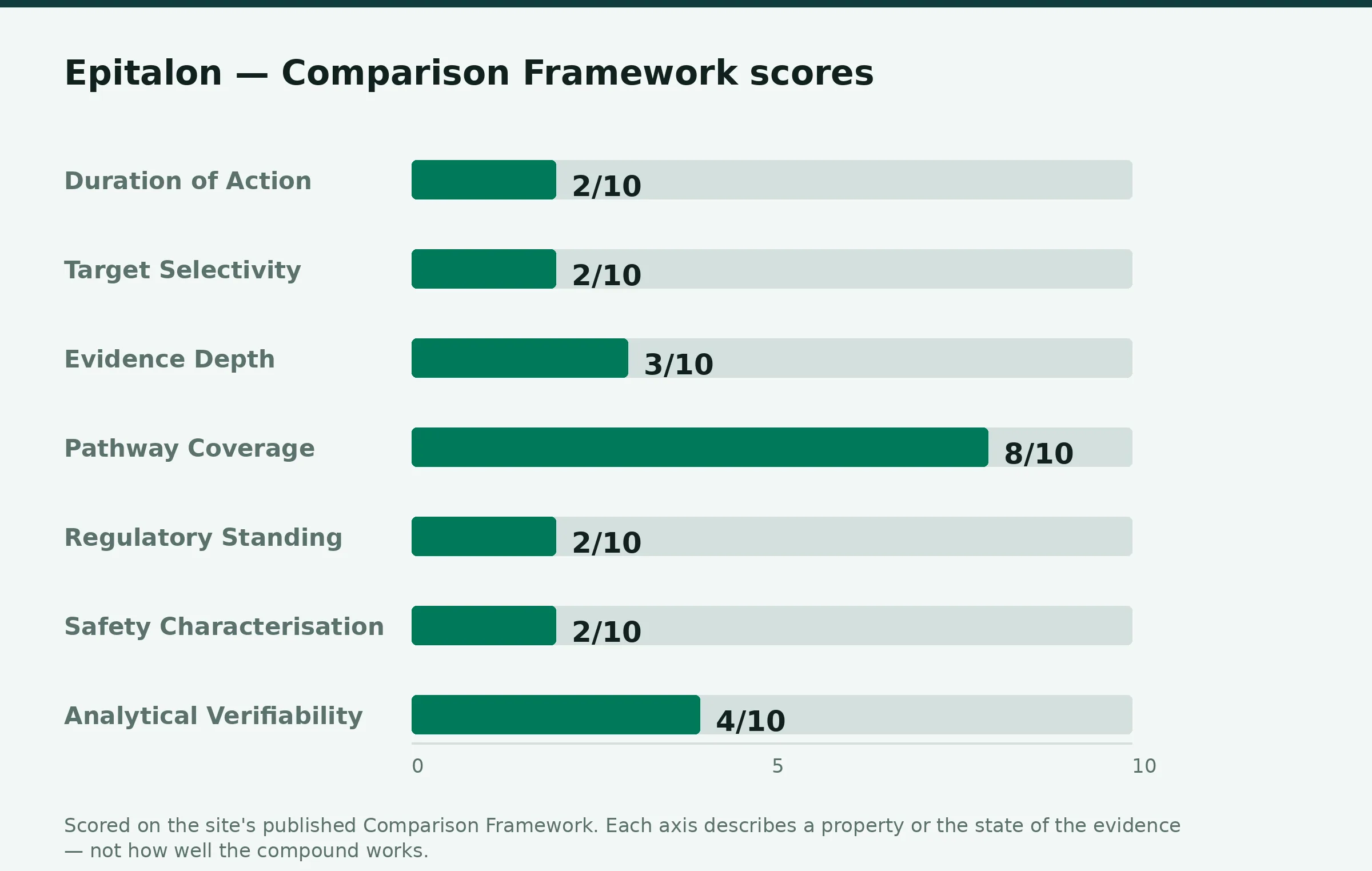
| Axis | Score | Why |
|---|---|---|
| Duration of Action | 2/10 | No published half-life in any species; the 2025 review reports no pharmacokinetic parameters, and the animal work relied on five consecutive daily injections per monthly course rather than single or sustained dosing [1][4] |
| Target Selectivity | 2/10 | No identified receptor at all; the leading proposal is non-specific histone binding, and reported readouts span telomerase, pineal enzymes and neuronal markers [1][8] |
| Evidence Depth | 3/10 | Animal studies plus cell work only; no randomized trial of the tetrapeptide, and the human mortality data belongs to the pineal extract, not to AEDG [1][3][4][7] |
| Pathway Coverage | 8/10 | Telomerase and telomere maintenance is the dominant documented pathway, with pineal melatonin synthesis as a documented secondary; a third neurogenic readout rests on one in vitro model [1][3][5][8] |
| Regulatory Standing | 2/10 | Research use only: no FDA approval, no approved product, and no place on the 503A bulks lists that would make it compoundable (checked September 2026) [10][11] |
| Safety Characterisation | 2/10 | No published human safety data of any kind; the review found no acute toxicity study, no LD50 and no organ toxicity data, leaving only lifespan-study endpoints in mice [1][4] |
| Analytical Verifiability | 4/10 | Identity is confirmable by mass — the formula and structure are indexed publicly — but no compendial monograph or validated public purity method for AEDG was located [1][13] |
Epitalon scores 3 on Evidence Depth, and the framework requires that to be said plainly: mechanistic plausibility is not clinical proof. A cited chain of arrows from a peptide to telomerase to telomere length is a description of what has been measured in dishes, and it tells you nothing about what happens in a person. The full anchors behind each of these numbers are published in our Comparison Framework.
Note too that Pathway Coverage at 8 is not a compliment. The framework treats breadth as a description, not a virtue, and here the breadth largely reflects the absence of a defined target rather than deliberate multi-target design.
How Epitalon compares
Against GHK-Cu, the contrast is instructive. GHK-Cu is also a short peptide with a long Russian-language research history, but it has a defined copper-binding chemistry, measurable plasma concentrations, and decades of cosmetic-ingredient use behind it. Epitalon has none of those anchors: no receptor, no PK, no approved use.
Against MOTS-c, another compound marketed on longevity grounds, the shared weakness is the same — the mechanism is interesting, the cell data is real, and the human trial that would settle anything has not been run. The difference is that MOTS-c is an endogenous mitochondrial-derived peptide with a defined metabolic pathway, whereas Epitalon’s proposed mechanism is a transcriptional nudge with no receptor to point at.
The honest summary is that within the longevity peptide category, Epitalon sits near the bottom of the evidence ladder and near the top of the marketing volume. That gap is the whole reason this framework exists.
Sourcing and quality: what to look for
Because Epitalon has no approved product, every sample in circulation is a research chemical whose identity depends entirely on the documentation that comes with it. A tetrapeptide of this size is straightforward to confirm by mass spectrometry, so a certificate that shows only a purity percentage with no method, no lot number and no named testing laboratory is telling you very little.
What a usable certificate shows is identity by mass, purity by a stated chromatographic method with the trace attached, the lot it applies to, the date and the party that ran it. Aggregation and process impurities are the failure modes FDA has flagged generally for compounded peptides, and they are exactly what a purity method is for. Our COA guide works through a real certificate line by line.
FAQ
Does Epitalon actually lengthen telomeres in humans?
No human study has measured telomere length after Epitalon administration. The telomere and telomerase findings are in vitro: human fetal fibroblasts in 2003 showed telomerase expression and telomere elongation after exposure [2], and a 2025 study across six human cell lines reported telomere extension and up to 12-fold hTERT upregulation, with the authors stating that the study’s main limitation is that it was in two-dimensional cell culture [3]. Cultured cells are not people, and nothing published to date closes that gap.
What is the difference between Epitalon and epithalamin?
Epithalamin is a crude peptide preparation extracted from bovine pineal glands; Epitalon is the defined synthetic tetrapeptide Ala-Glu-Asp-Gly that was designed from epithalamin’s amino-acid composition [1]. The distinction is not academic: the human data that gets quoted for “Epitalon” — including a 12-year study reporting 28% lower mortality in elderly coronary patients — was generated with the extract, not the synthetic peptide [7].
Is Epitalon legal in the United States?
Epitalon has no FDA approval for any indication. Checked September 2026, it does not appear on FDA’s Category 2 list of bulk drug substances that may present significant safety risks [10], nor in Categories 1, 2 or 3 of the bulk substances nominated for compounding under section 503A [11]. It is sold in the US as a research chemical only, and being absent from those lists means it sits outside the compounding pathway rather than being cleared for human use. Our guide to peptide legal status sets out the wider framework.
What is Epitalon’s half-life?
There is no published answer. The 2025 review of the Epitalon literature reports no pharmacokinetic parameters at all, and a literature search in September 2026 located no half-life, clearance or bioavailability study in humans or animals [1]. Claims of a specific half-life for AEDG circulating in vendor copy are not traceable to a published measurement, which is why this page’s specification table says so rather than quoting a number.
Is Epitalon banned in sport?
Epitalon is not listed by name on the WADA 2026 Prohibited List, which took effect on 1 January 2026 [12]. That is not the same as being permitted: the List’s S0 category prohibits non-approved substances — described in WADA’s own athlete guide as, for example, experimental or designer drugs — at all times, and a compound with no regulatory approval anywhere plausibly falls inside it [12]. Athletes subject to testing should check with their anti-doping organization rather than relying on the absence of a name.
What are the known risks of Epitalon?
The documented risk profile is essentially empty, and that is the point: no controlled human safety data exists, and the 2025 review found no acute toxicity study, no LD50 and no organ toxicity data in animals [1]. The mechanism raises a specific theoretical concern, because telomerase activation is a hallmark of cancer and the largest effects in the 2025 cell study were in breast cancer lines [3]; against that, a lifetime mouse study found no increase in total spontaneous tumor incidence and a six-fold reduction in leukemia [4]. Neither observation settles the question in humans.
References
- Araj SK, Brzezik J, Mądra-Gackowska K, Szeleszczuk Ł. Overview of Epitalon—Highly Bioactive Pineal Tetrapeptide with Promising Properties. International Journal of Molecular Sciences. 2025;26(6):2691. https://www.mdpi.com/1422-0067/26/6/2691
- Khavinson VKh, Bondarev IE, Butyugov AA. Epithalon peptide induces telomerase activity and telomere elongation in human somatic cells. Bulletin of Experimental Biology and Medicine. 2003;135(6):590–592. https://pubmed.ncbi.nlm.nih.gov/12937682/
- Al-dulaimi S, Thomas R, Matta S, Roberts T. Epitalon increases telomere length in human cell lines through telomerase upregulation or ALT activity. Biogerontology. 2025;26:178. https://doi.org/10.1007/s10522-025-10315-x
- Anisimov VN, Khavinson VKh, Popovich IG, et al. Effect of Epitalon on biomarkers of aging, life span and spontaneous tumor incidence in female Swiss-derived SHR mice. Biogerontology. 2003;4(4):193–202. https://link.springer.com/article/10.1023/A:1025114230714
- Khavinson V, Goncharova N, Lapin B. Synthetic tetrapeptide epitalon restores disturbed neuroendocrine regulation in senescent monkeys. Neuro Endocrinology Letters. 2001;22(4):251–254. https://pubmed.ncbi.nlm.nih.gov/11524632/
- Korkushko OV, Khavinson VKh, Shatilo VB, Magdich LV. Effect of peptide preparation epithalamin on circadian rhythm of epiphyseal melatonin-producing function in elderly people. Bulletin of Experimental Biology and Medicine. 2004;137(4):389–391. https://pubmed.ncbi.nlm.nih.gov/15452611/
- Korkushko OV, Khavinson VKh, Shatilo VB, Antonyuk-Shcheglova IA. Geroprotective effect of epithalamine (pineal gland peptide preparation) in elderly subjects with accelerated aging. Bulletin of Experimental Biology and Medicine. 2006;142(3):356–359. https://link.springer.com/article/10.1007/s10517-006-0365-z
- Sinjari B, Khavinson V, Diomede F, et al. AEDG Peptide (Epitalon) Stimulates Gene Expression and Protein Synthesis during Neurogenesis: Possible Epigenetic Mechanism. Molecules. 2020;25(3):609. https://www.mdpi.com/1420-3049/25/3/609
- Gatta M, Dovizio M, Milillo C, et al. The Antioxidant Tetrapeptide Epitalon Enhances Delayed Wound Healing in an in Vitro Model of Diabetic Retinopathy. Stem Cell Reviews and Reports. 2025;21(6):1822–1834. https://link.springer.com/article/10.1007/s12015-025-10911-x
- US Food and Drug Administration. Certain Bulk Drug Substances for Use in Compounding that May Present Significant Safety Risks. FDA.gov, page last updated 22 April 2026. https://www.fda.gov/drugs/human-drug-compounding/certain-bulk-drug-substances-use-compounding-may-present-significant-safety-risks
- US Food and Drug Administration. Bulk Drug Substances Nominated for Use in Compounding Under Section 503A of the Federal Food, Drug, and Cosmetic Act. FDA.gov, updated 14 May 2026. https://www.fda.gov/media/94155/download
- World Anti-Doping Agency. Athlete and Athlete Support Personnel Guide to the 2026 Prohibited List. WADA. 2025. https://www.wada-ama.org/sites/default/files/2025-12/Athlete%20and%20Athlete%20Support%20Personnel%20Guide%20to%20the%202026%20Prohibited%20List.pdf
- National Center for Biotechnology Information. PubChem Compound Summary for CID 219042, Epitalon. PubChem, National Library of Medicine. 2026. https://pubchem.ncbi.nlm.nih.gov/compound/Epitalon