Quick answer: PT-141 is bremelanotide, a synthetic melanocortin receptor agonist that FDA approved on 21 June 2019 under the brand name Vyleesi [2]. Its approved use is narrow: premenopausal women with acquired, generalized hypoactive sexual desire disorder (HSDD), and the label explicitly excludes postmenopausal women, men, and use to enhance sexual performance [1]. Two identical phase 3 randomized trials in 1,267 women found statistically significant but small improvements in desire and distress — differences of roughly a third of a point against placebo on both co-primary instruments — human RCT [3]. The same label carries a contraindication in uncontrolled hypertension or known cardiovascular disease, a transient blood-pressure warning, and a 40.0% nausea rate that drove 8% of participants to stop [1].
| Spec | Detail |
|---|---|
| Also known as | Bremelanotide; PT-141; brand name Vyleesi [1][5] |
| Class | Synthetic cyclic heptapeptide; melanocortin receptor agonist and analogue of α-melanocyte-stimulating hormone [5][12] |
| Relationship to melanotan II | Originally reported as the active metabolite of melanotan II [9] |
| Molecular formula | C50H68N14O10 [4] |
| Receptor profile | Non-selective melanocortin agonist, predominantly MC1R and MC4R; MC4R is the subtype linked to sexual desire [1][4] |
| Half-life | ~2.7 hours, range 1.9–4.0 hours; Tmax ~1.0 hour [1] |
| Regulatory status (US) | FDA-approved 21 June 2019 as Vyleesi, for acquired, generalized HSDD in premenopausal women (checked September 2026) [1][2] |
| Regulatory status (EU) | No centrally authorised EMA medicine containing bremelanotide located (checked September 2026) [11] |
| WADA status | Not named in the athlete guide to the 2026 Prohibited List, in force 1 January 2026 (checked September 2026) [14][15] |
What is PT-141?
PT-141 and bremelanotide are the same molecule under two names. It is a cyclic seven-amino-acid peptide built as an analogue of α-melanocyte-stimulating hormone, and it was originally reported in the literature as the active metabolite of melanotan II [5][9]. That parentage is the single most useful fact for orienting yourself: the tanning peptide came first, and the sexual-response effect was a downstream observation from it.
The distinction that matters most on this page is between the approved medicine and the research-chemical material. Vyleesi, the autoinjector FDA approved in 2019, is a specified drug product made under an approved application [2]. A vial labelled “PT-141” and sold for laboratory use is not that product and carries none of the identity, purity or content assurances an approved application requires. Same molecule name; entirely different regulatory object.
If you are new to this class of molecule, our primer on what a peptide actually is covers why chain length, cyclisation and receptor selectivity drive almost everything downstream.
How PT-141 works (mechanism)
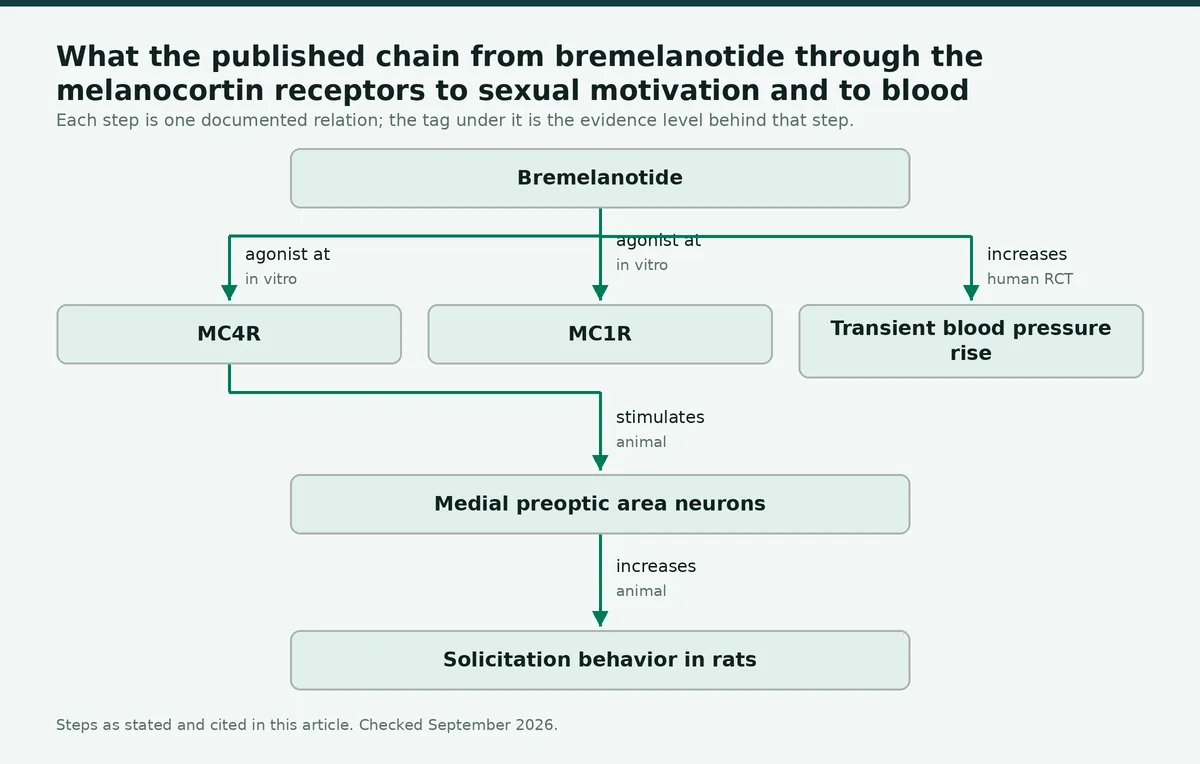
| Step | Relation | Target | Evidence |
|---|---|---|---|
| Bremelanotide | agonist at | MC4R | in vitro [1] |
| Bremelanotide | agonist at | MC1R | in vitro [4] |
| MC4R | stimulates | Medial preoptic area neurons | animal [7] |
| Medial preoptic area neurons | increases | Solicitation behavior in rats | animal [7] |
| Bremelanotide | increases | Transient blood pressure rise | human RCT [1] |
The FDA label’s own mechanism section is unusually candid. It describes bremelanotide as “a melanocortin receptor (MCR) agonist that nonselectively activates several receptor subtypes” [1]. LiverTox, NIH’s drug-injury reference, narrows that to the two subtypes that dominate: bremelanotide “engages several melanocortin receptors (MCR), predominantly MC1R and MC4R, the latter of which is believed to modulate sexual desire” [4].
The behavioral half of the chain is animal work and should be read as such. A 2007 review of the preclinical program in ovariectomized, hormone-primed female rats reported that bremelanotide “dramatically and selectively increased measures of solicitation” when given peripherally or injected into the lateral ventricles and the medial preoptic area — but not the ventromedial hypothalamus — while leaving pacing and lordosis unchanged — animal [7]. Solicitation is an appetitive measure, a proxy for motivation rather than performance, which is why the program was steered toward desire rather than arousal.
Two things the diagram does not show are worth saying out loud. No published receptor-affinity table across MC1R, MC3R and MC4R could be verified from a primary source during this run, so no binding numbers are plotted here rather than estimated. And the route from MC1R to the pigmentation seen in trials is a plausible inference, not a cited arrow — the label records the pigmentation as an adverse reaction without assigning it a receptor [1].
Key numbers
Bremelanotide is short-acting, which is why the approved product is an on-demand medicine rather than a daily one. The published human pharmacokinetics come from the FDA label [1].
| Property | Figure | Evidence level |
|---|---|---|
| Time to peak concentration (Tmax) | ~1.0 hour, range 0.5–1.0 h | human PK [1] |
| Terminal half-life | ~2.7 hours, range 1.9–4.0 h | human PK [1] |
| Peak concentration (Cmax) | 72.8 ng/mL | human PK [1] |
| Volume of distribution | 25.0 ± 5.8 L | human PK [1] |
| Plasma protein binding | 21% | human PK [1] |
| Absolute bioavailability | approximately 100% | human PK [1] |
For reference, the label’s official dosing for the approved product — quoted here as regulatory fact, not as guidance — is 1.75 mg subcutaneously via the autoinjector, at least 45 minutes before anticipated sexual activity, no more than one dose in 24 hours and no more than eight doses per month [1][10].
What the research shows
Human studies
The pivotal evidence is the RECONNECT program: two identical phase 3, randomized, double-blind, placebo-controlled multicenter trials, 24 weeks of treatment, 1,267 women randomized and 1,202 in the efficacy population — human RCT [3]. The co-primary endpoints were change in the Female Sexual Function Index desire domain (FSFI-D) and change in item 13 of the Female Sexual Distress Scale–Desire/Arousal/Orgasm (FSDS-DAO).
The results were statistically significant and small. On FSFI-D, the treatment-versus-placebo change was 0.30 in study 301 (P<.001), 0.42 in study 302 (P<.001) and 0.35 integrated (P<.001). On FSDS-DAO item 13, it was −0.37 (P<.001), −0.29 (P=.005) and −0.33 integrated (P<.001) — human RCT [3]. Those are fractions of a point on both instruments. The authors’ stated conclusion is that both studies “demonstrated that bremelanotide significantly improved sexual desire and related distress” [3]; the honest gloss is that significance here is a statement about the P value, not about the size of the change a participant felt.
Responder framing does not rescue the numbers, and this is where press coverage tends to overreach. A RECONNECT analysis presented in 2017 defined a responder by self-reported benefit — 5 or higher on a 7-point scale answering how much the participant thought she had benefited from the study drug — and reported 59% in study 301 and 58% in study 302 [8]. Those percentages combine treatment groups rather than splitting bremelanotide from placebo, so they cannot be read as a drug effect [8]. In a condition with a large placebo response, that distinction is the whole question.
Older human RCT evidence exists in men, from the intranasal formulation that preceded the approved product. A 2004 double-blind, placebo-controlled phase 1 program in healthy men and men with mild-to-moderate erectile dysfunction reported erectogenic responses on RigiScan at intranasal doses above 7 mg, with erection onset around 30 minutes, median Tmax of 0.50 h and mean half-life of 1.85–2.09 h; flushing and nausea were the most common adverse events [6]. That program did not lead to an approval, and the label that exists today covers premenopausal women only [1].
Animal studies
The preclinical CNS work described above is the main animal dataset: peripherally administered and centrally injected bremelanotide selectively raised solicitation behavior in female rats, localized to the medial preoptic area and not the ventromedial hypothalamus, without changing lordosis or pacing — animal [7]. The authors concluded the compound had the “behavioral, pharmacological, and neuroanatomical specificity” they were looking for in an HSDD candidate [7].
In-vitro and preclinical pharmacology
The receptor-level characterization is in vitro: bremelanotide activates several melanocortin receptor subtypes non-selectively, with MC1R and MC4R predominating [1][4]. FDA’s own review describes it as “a synthetic heptapeptide and melanocortin receptor (MCR) agonist” [12]. No verified public table of subtype affinities is cited here, for the reason given above.
Side effects and risks
This section is not an afterthought to the efficacy section, and on this compound it should probably be read first. The adverse-event burden in the trials was substantial relative to the size of the benefit.
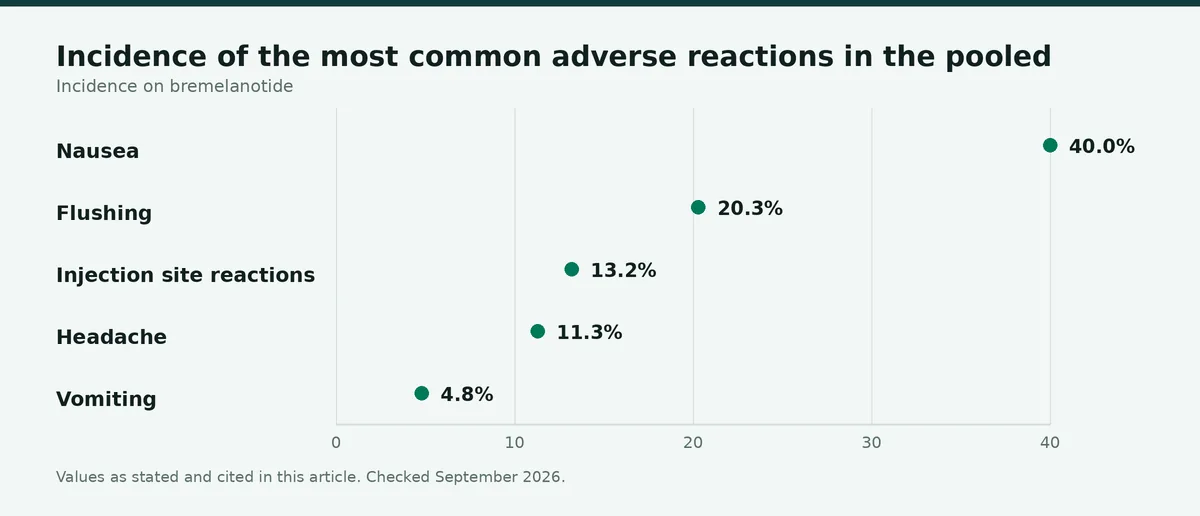
| Adverse reaction | Incidence on bremelanotide | Placebo |
|---|---|---|
| Nausea | 40.0% | 1.3% [1] |
| Flushing | 20.3% | 0.3% [1] |
| Injection site reactions | 13.2% | 8.4% [1] |
| Headache | 11.3% | 1.9% [1] |
| Vomiting | 4.8% | 0.2% [1] |
Nausea dominates, at roughly twice the rate of the next most common reaction — human RCT [1]. It was severe enough to matter: 18% of participants on bremelanotide discontinued because of an adverse reaction, against 2% on placebo, and nausea alone accounted for 8% discontinuing [1]. Nausea has its own Warnings and Precautions subsection on the current label [10]. LiverTox records the same profile: “Nausea (40%, particularly with the first injection), flushing (20%), injection site reactions (13%) and headache (11%)” [4].
Blood pressure is the risk that changes who can use it at all. The label states that bremelanotide “transiently increases blood pressure and reduces heart rate after each dose”, with maximal increases of 6 mmHg systolic and 3 mmHg diastolic, peaking 2–4 hours post-dose, heart-rate reductions of up to 5 beats per minute, and resolution usually within 12 hours — human RCT [1]. FDA’s review included a dedicated hemodynamic study with ambulatory blood-pressure monitoring [12]. The consequence is a hard contraindication: Vyleesi “is contraindicated in patients who have uncontrolled hypertension or known cardiovascular disease” [1][10]. Mean increases of 6 and 3 mmHg are modest in a screened trial population; they are not modest in a person with uncontrolled hypertension, which is exactly why the contraindication exists.
Focal hyperpigmentation is the melanocortin-family signal and it is dose-dependent. In the controlled trials it was reported in 1% of patients receiving up to eight doses per month, including involvement of the face, gingiva and breasts [1]. In a separate study using daily administration for eight days, 38% developed focal hyperpigmentation, risk was higher in people with darker skin, and resolution “was not confirmed in all patients” [1]. The eight-dose monthly cap on the label is not arbitrary.
One further signal sits outside the trials. LiverTox describes a single case of acute hepatitis in a patient who had received ten injections over a year, with marked aminotransferase elevations and mild jaundice that resolved after stopping, and assigns bremelanotide a likelihood score of D — a possible rare cause of clinically apparent liver injury [4]. One case is one case, and that is how the score reads it.
Regulatory and legal status (2026)
Bremelanotide is FDA-approved, and the approval is specific. The 21 June 2019 approval letter for NDA 210557, applicant AMAG Pharmaceuticals, covers Vyleesi (bremelanotide) subcutaneous injection for the treatment of premenopausal women with acquired, generalized HSDD (checked September 2026) [2]. The label’s indication adds the diagnostic qualifiers: low sexual desire causing marked distress or interpersonal difficulty, not due to a co-existing medical or psychiatric condition, relationship problems, or the effects of a medication or drug substance [1]. Its Limitations of Use are explicit — not indicated for HSDD in postmenopausal women or in men, and not indicated to enhance sexual performance [1]. The current structured product label on file is version 3, effective 17 February 2021, labelled by Palatin Technologies [10].
In the European Union the picture is different. A September 2026 check of EMA’s medicines database, which covers centrally authorised medicines, located no authorised product containing bremelanotide and no European Public Assessment Report for Vyleesi [11]. An FDA approval does not travel.
Bremelanotide does not appear on FDA’s Category 2 list of bulk drug substances that may present significant safety risks for compounding, a list of 14 entries last updated 22 April 2026 (checked September 2026) [13]. That absence is unremarkable for an approved drug — the compounding bulks lists exist mainly for substances without an approved product.
For sport, bremelanotide and PT-141 are not named in WADA’s athlete guide to the 2026 Prohibited List, which came into force on 1 January 2026 (checked September 2026) [14][15]. Note that the List’s S0 category covers non-approved substances, “e.g., experimental or designer drugs” [14]; because bremelanotide has an approved product in the US, an S0 argument is weaker for it than for the unapproved peptides in this category. Athletes should still confirm status with their anti-doping organization rather than rely on absence from a name list. The wider US framework is set out in our guide to peptide legal status.
Comparison Framework scores
| Axis | Score | Why |
|---|---|---|
| Duration of Action | 3/10 | Terminal half-life of about 2.7 hours with a Tmax near 1 hour; the approved product is dosed on demand at least 45 minutes before activity, not on a sustained schedule [1] |
| Target Selectivity | 3/10 | The label describes a melanocortin receptor agonist that “nonselectively activates several receptor subtypes”, and the off-target pigmentation signal is the visible consequence [1][4] |
| Evidence Depth | 9/10 | Two identical phase 3 randomized placebo-controlled trials in 1,267 women, plus earlier controlled human work in men, culminating in FDA approval in 2019 [1][2][3][6] |
| Pathway Coverage | 7/10 | Two well-documented pathways: central MC4R signalling in the medial preoptic area driving sexual motivation, and a hemodynamic pathway producing transient blood-pressure and heart-rate change; dermal pigmentation is a third observed effect without a cited receptor arm [1][7][12] |
| Regulatory Standing | 9/10 | An approved US product with a full prescribing information document and a defined indication; held back from 10 only because no EMA-authorised medicine containing bremelanotide was located (checked September 2026) [1][2][11] |
| Safety Characterisation | 9/10 | Risks are documented to an unusual depth: a quantified adverse-reaction table, discontinuation rates, a dedicated hemodynamic study, a dose-dependent hyperpigmentation dataset and a LiverTox hepatotoxicity entry [1][4][12] |
| Analytical Verifiability | 7/10 | An approved application means FDA-reviewed chemistry and manufacturing specifications exist for the drug product [12]; no public compendial monograph for bremelanotide was located in September 2026, and research-grade material inherits none of the approved product’s controls [1] |
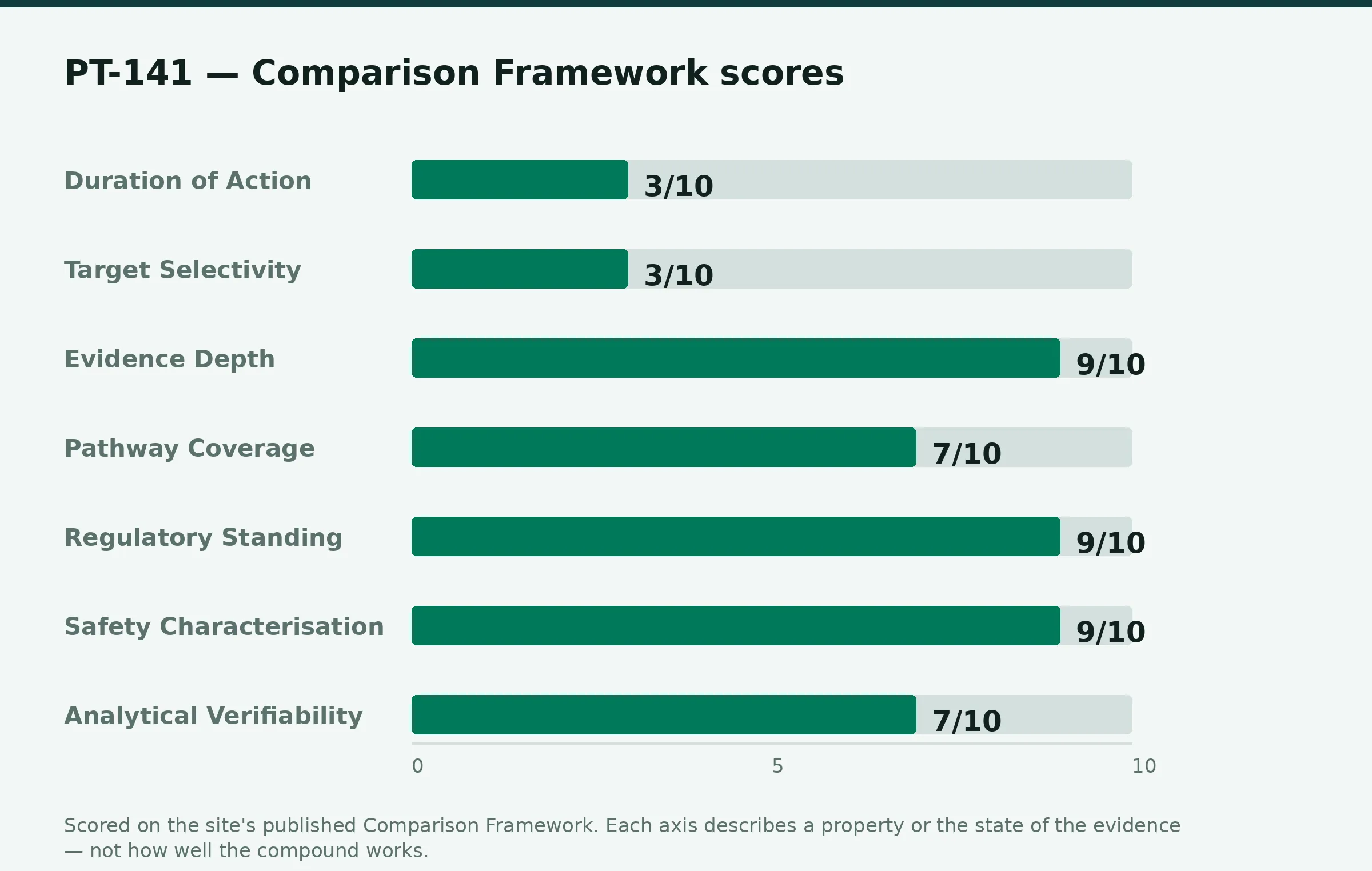
A high Safety Characterisation score is not reassurance, and on this page it would be easy to misread as one. It says the risks are well described, not that they are small — a 40.0% nausea rate and a cardiovascular contraindication are precisely what “well described” looks like [1]. The full anchors behind each of these numbers are published in our Comparison Framework.
Evidence Depth at 9 is the rarest thing on this site. Most compounds in the peptide wiki sit at 2 to 4 because their human data does not exist. Bremelanotide has two adequately powered randomized trials and a regulator that read them, and the framework should say so plainly — while noting, with equal plainness, that what those trials demonstrated was a small effect.
How PT-141 compares
Against melanotan II, the relationship is genealogical: bremelanotide was originally described as melanotan II’s active metabolite [9]. The two diverge sharply in status. Bremelanotide has an approved product and a label; melanotan II has neither, and its tanning-directed MC1R activity is the same activity that shows up here as the hyperpigmentation adverse reaction [1]. Our queued head-to-head at PT-141 vs melanotan II takes that contrast apart in detail.
Against kisspeptin and oxytocin, the contrast is regulatory rather than mechanistic. All three are peptides studied in relation to human sexual response, but kisspeptin-10 sits on FDA’s Category 2 list of bulk substances that may present significant safety risks for compounding [13], and oxytocin’s approved indications lie in obstetrics, so its sexual-response literature is off-label. Only bremelanotide’s sexual-response data is the basis of its own approval [2].
The category summary is unusual for this site: PT-141 is the rare sexual-health peptide where the honest criticism is not “there is no human evidence” but “the human evidence is good and the effect is small.”
Sourcing and quality: what to look for
Because an approved product exists, the sourcing question here is sharper than on most wiki pages. Vyleesi is an autoinjector manufactured under an approved application with FDA-reviewed specifications [2][12]. Material sold as “PT-141” for research use has no such file behind it, and the identity, purity and content of any given vial are knowable only from whatever analysis accompanies it.
For a cyclic heptapeptide, identity is confirmable by mass and purity by a stated chromatographic method. A certificate showing a bare purity percentage with no method, no lot number and no named laboratory tells you close to nothing. Our guide to reading a certificate of analysis works through a real one line by line.
One further point is specific to this compound. The blood-pressure effect and the cardiovascular contraindication are properties of the molecule, not of the brand [1], and they do not become less real because a vial is labelled for laboratory use.
FAQ
Is PT-141 FDA-approved?
Yes, and the scope matters. FDA approved bremelanotide on 21 June 2019 under NDA 210557, marketed as Vyleesi, for the treatment of premenopausal women with acquired, generalized hypoactive sexual desire disorder (checked September 2026) [2]. The label’s Limitations of Use state it is not indicated for HSDD in postmenopausal women or in men, and not indicated to enhance sexual performance [1]. Material sold online as “PT-141 research peptide” is not the approved product and has not been reviewed by any regulator.
How large was the effect in the phase 3 trials?
Small, and statistically significant. Across two identical 24-week randomized placebo-controlled trials with 1,267 women randomized, the integrated bremelanotide-versus-placebo difference was 0.35 points on the Female Sexual Function Index desire domain (P<.001) and −0.33 points on item 13 of the Female Sexual Distress Scale–Desire/Arousal/Orgasm (P<.001) — human RCT [3]. Individual study differences ranged from 0.30 to 0.42 on desire and −0.29 to −0.37 on distress [3]. A published responder analysis reported self-assessed benefit in 58–59% of participants, but those figures combine treatment groups and so cannot be attributed to the drug [8].
What are the main risks of PT-141?
The two that shape the label are blood pressure and nausea. Bremelanotide transiently raises blood pressure — maximal increases of 6 mmHg systolic and 3 mmHg diastolic, peaking 2–4 hours after a dose and usually resolving within 12 hours — and it is contraindicated in uncontrolled hypertension or known cardiovascular disease [1]. Nausea occurred in 40.0% of participants versus 1.3% on placebo, and 18% of the bremelanotide group discontinued for adverse reactions overall, 8% specifically for nausea [1]. Focal hyperpigmentation occurred in 1% at up to eight doses per month and in 38% with daily administration for eight days, and did not resolve in all patients [1].
Is PT-141 the same thing as melanotan II?
No, though they are closely related. Bremelanotide was originally reported as the active metabolite of melanotan II [9], and both are synthetic analogues of α-melanocyte-stimulating hormone acting at melanocortin receptors [5]. The difference that matters is regulatory and clinical: bremelanotide has an FDA-approved product with a full prescribing information document [2], while melanotan II does not, and the pigmentation that melanotan II is sought for appears on the bremelanotide label as an adverse reaction [1].
Is PT-141 banned in sport?
Bremelanotide and PT-141 are not named in WADA’s athlete guide to the 2026 Prohibited List, which came into force on 1 January 2026 (checked September 2026) [14][15]. The List’s S0 category prohibits non-approved substances at all times, described in the guide as, for example, experimental or designer drugs [14]. Because bremelanotide has an approved product in the United States, the S0 argument that catches most research peptides applies less straightforwardly to it — but absence from a name list is not a clearance, and athletes subject to testing should confirm status with their anti-doping organization.
Is bremelanotide approved in Europe?
Not as far as a September 2026 check could establish. EMA’s medicines database, which covers centrally authorised medicines evaluated by the agency, returned no authorised product containing bremelanotide and no European Public Assessment Report for Vyleesi [11]. The US approval from June 2019 has no automatic effect in the European Union [2], so European availability of anything sold under the PT-141 name should be assumed to fall outside the authorised-medicine route.
References
- US Food and Drug Administration. VYLEESI (bremelanotide injection), for subcutaneous use — full prescribing information, NDA 210557. accessdata.fda.gov. 2019. https://www.accessdata.fda.gov/drugsatfda_docs/label/2019/210557s000lbl.pdf
- US Food and Drug Administration, Center for Drug Evaluation and Research. Approval Package for NDA 210557, Vyleesi (bremelanotide) — approval letter dated June 21, 2019. accessdata.fda.gov. 2019. https://www.accessdata.fda.gov/drugsatfda_docs/nda/2019/210557Orig1s000Approv.pdf
- Kingsberg SA, Clayton AH, Portman D, et al. Bremelanotide for the Treatment of Hypoactive Sexual Desire Disorder: Two Randomized Phase 3 Trials. Obstetrics & Gynecology. 2019;134(5):899–908. https://pubmed.ncbi.nlm.nih.gov/31599840/
- LiverTox: Clinical and Research Information on Drug-Induced Liver Injury. Bremelanotide. National Institute of Diabetes and Digestive and Kidney Diseases, NCBI Bookshelf NBK573221. https://www.ncbi.nlm.nih.gov/books/NBK573221/
- Dhillon S, Keam SJ. Bremelanotide: First Approval. Drugs. 2019;79(14):1599–1606. https://link.springer.com/article/10.1007/s40265-019-01187-w
- Diamond LE, Earle DC, Rosen RC, et al. Double-blind, placebo-controlled evaluation of the safety, pharmacokinetic properties and pharmacodynamic effects of intranasal PT-141, a melanocortin receptor agonist, in healthy males and patients with mild-to-moderate erectile dysfunction. International Journal of Impotence Research. 2004;16(1). https://pubmed.ncbi.nlm.nih.gov/14963471/
- Pfaus J, Giuliano F, Gelez H. Bremelanotide: An Overview of Preclinical CNS Effects on Female Sexual Function. The Journal of Sexual Medicine. 2007;4(Suppl 4):269–279. https://academic.oup.com/jsm/article-abstract/4/Supplement_4/269/6889685
- Simon J, Portman D, Kingsberg S, et al. Bremelanotide (BMT) for Hypoactive Sexual Desire Disorder (HSDD) in the RECONNECT Study: Efficacy Analyses in Study Completers and Responders. The Journal of Sexual Medicine. 2017;14(Suppl 5):e356. https://academic.oup.com/jsm/article-abstract/14/Supplement_5/e356/7010804
- Elsevier. Bremelanotide — an overview. ScienceDirect Topics, drawing on European Journal of Medicinal Chemistry (2020), Privileged Scaffolds in Drug Discovery (2023) and Encyclopedia of Biological Chemistry (2013). https://www.sciencedirect.com/topics/pharmacology-toxicology-and-pharmaceutical-science/bremelanotide
- US Food and Drug Administration. VYLEESI (bremelanotide injection) structured product label, version 3, effective 17 February 2021. accessdata.fda.gov SPL archive. 2021. https://www.accessdata.fda.gov/spl/data/3dca0cf9-a278-4c25-af93-d65f1f523504/3dca0cf9-a278-4c25-af93-d65f1f523504.xml
- European Medicines Agency. Medicines database — centrally authorised medicines for human and veterinary use. EMA, checked September 2026. https://www.ema.europa.eu/en/medicines
- US Food and Drug Administration, Center for Drug Evaluation and Research. Multi-Discipline Review, NDA 210557 (bremelanotide). accessdata.fda.gov. 2019. https://www.accessdata.fda.gov/drugsatfda_docs/nda/2019/210557Orig1s000MultidisciplineR.pdf
- US Food and Drug Administration. Certain Bulk Drug Substances for Use in Compounding that May Present Significant Safety Risks. FDA.gov, page last updated 22 April 2026. https://www.fda.gov/drugs/human-drug-compounding/certain-bulk-drug-substances-use-compounding-may-present-significant-safety-risks
- World Anti-Doping Agency. Athlete and Athlete Support Personnel Guide to the 2026 Prohibited List. WADA. 2025. https://www.wada-ama.org/sites/default/files/2025-12/Athlete%20and%20Athlete%20Support%20Personnel%20Guide%20to%20the%202026%20Prohibited%20List.pdf
- World Anti-Doping Agency. WADA’s 2026 Prohibited List is now in force. WADA news. 2026. https://www.wada-ama.org/en/news/wadas-2026-prohibited-list-now-force