Quick answer: Thymosin alpha-1 (thymalfasin, trade name ZADAXIN) is a 28-amino-acid peptide sold as a prescription immunomodulator in more than 35 countries, mostly for chronic hepatitis B and C [9]. Its largest controlled test — the 1,089-patient TESTS phase 3 trial in sepsis — found no difference in 28-day mortality against placebo (23.4% vs 24.1%) [5]. The mechanism work is mostly in vitro and animal, and the supportive human data is largely observational. In the United States there is no approved product, and FDA has recorded a significant immunogenicity concern for it as a compounding ingredient (checked September 2026) [1][3].
| Spec | Detail |
|---|---|
| Also known as | Thymalfasin, Tα1, Ta1, ZADAXIN |
| Class | Synthetic thymic peptide / immunomodulator |
| Sequence / length | 28 amino acids, N-terminus acetylated [9] |
| Molecular weight | 3,108 Da [9] |
| Half-life | Plasma t½ under 3 h; Cmax at 1–2 h [9] |
| Regulatory status (US) | No FDA-approved product; no DailyMed label for “thymalfasin”; nomination for the 503A bulks list rejected by advisory vote 17–4 (checked September 2026) [4][12] |
| WADA status | Not verified during this run — see the regulatory section |
What is thymosin alpha 1?
Thymosin alpha-1 is a short peptide originally isolated from thymic tissue and now made synthetically: 28 residues, acetylated at the N-terminus, 3,108 Da [9]. Under the non-proprietary name thymalfasin it is an injectable prescription drug approved, a 2023 review states, in over 35 countries for hepatitis B and C [9].
It is not the same thing as TB-500, the thymosin beta-4 fragment: the two share a naming convention and almost nothing else. Our primer on peptides covers why “thymosin” is a family label rather than one molecule.
How thymosin alpha-1 works (mechanism)
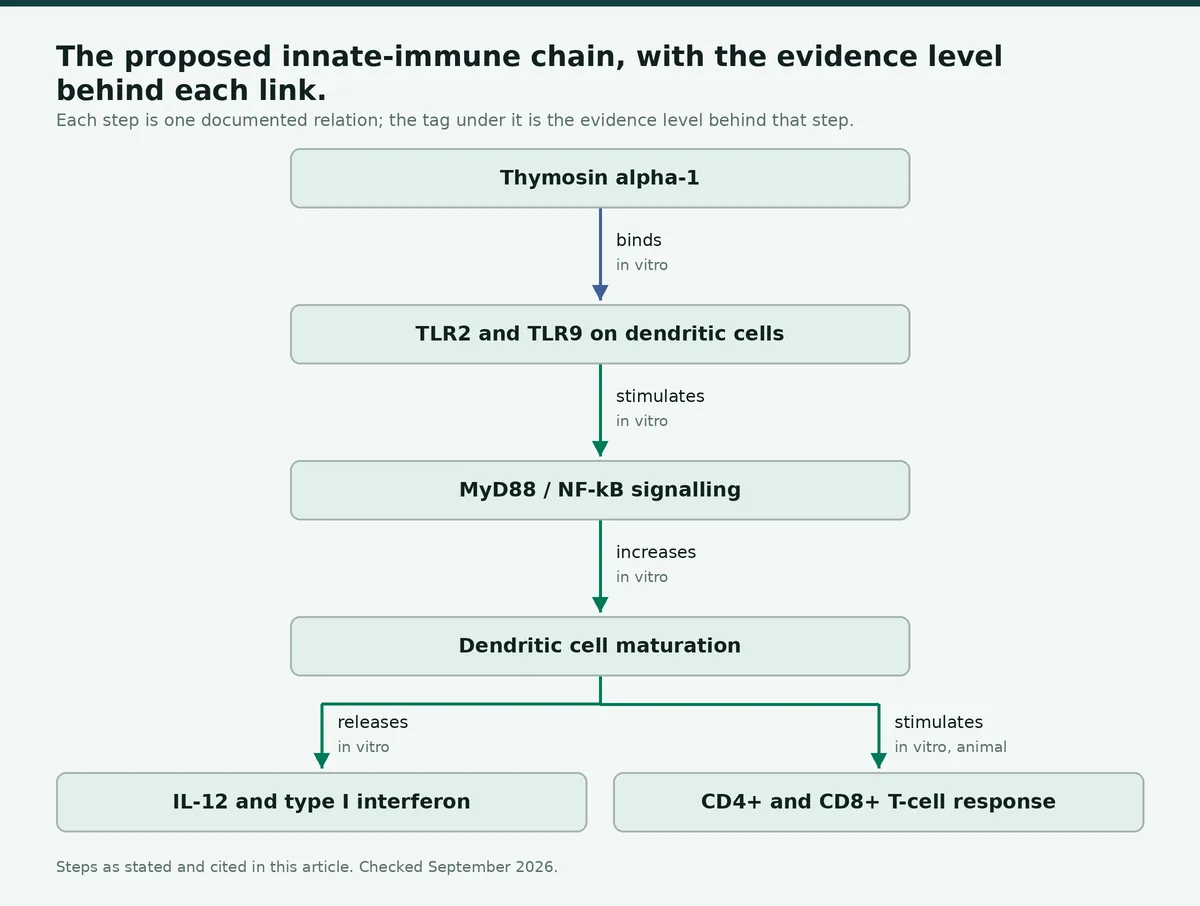
The proposed mechanism is innate-immune signalling, not direct antiviral or antibacterial action. In cell and animal models the peptide engages Toll-like receptors on dendritic cells, drives a MyD88-dependent cascade, and shifts those cells toward a mature, cytokine-producing state that supports T-cell responses.
| Step | Relation | Target | Evidence |
|---|---|---|---|
| Thymosin alpha-1 | binds | TLR2 and TLR9 on dendritic cells | in vitro [9] |
| TLR2 and TLR9 on dendritic cells | stimulates | MyD88 / NF-kB signalling | in vitro [9] |
| MyD88 / NF-kB signalling | increases | Dendritic cell maturation | in vitro [9] |
| Dendritic cell maturation | releases | IL-12 and type I interferon | in vitro [9] |
| Dendritic cell maturation | stimulates | CD4+ and CD8+ T-cell response | in vitro, animal [9][10] |
A separate branch of the same literature reports that the peptide expands plasmacytoid dendritic cells in a TLR9- and type I interferon receptor–dependent manner, and that those cells express indoleamine 2,3-dioxygenase and promote regulatory T cells — findings from animal models, not patients [10].
Nearly every arrow in that table is in vitro or animal, and a mechanism routed through general immune signalling is inherently broad — a reason to expect the inconsistent clinical results the trials show.
Key numbers
| Trial arm | 28-day all-cause mortality | Evidence |
|---|---|---|
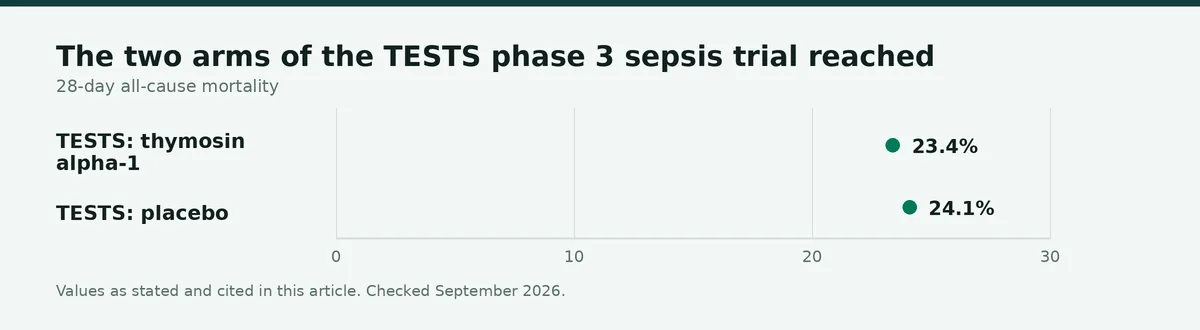
| TESTS: thymosin alpha-1 | 23.4% | human RCT [5] |
| TESTS: placebo | 24.1% | human RCT [5] |
TESTS randomised 1,106 adults with sepsis at 22 centres in China and analysed 1,089; the reported dose was 1.6 mg subcutaneously every 12 hours for seven days. The hazard ratio for 28-day all-cause mortality was 0.97 (95% CI 0.76–1.24, P = 0.82) [5].
What the research shows
Human studies
Sepsis (human RCT). TESTS is the largest placebo-controlled trial of the peptide published to date, and it was null on its primary endpoint. Secondary endpoints — SOFA score change, new infections, ventilator-free days, vasopressor-free days — showed no significant differences either. The authors’ own summary is that the trial “found no clear evidence to suggest that thymosin α1 decreases 28 day all cause mortality in adults with sepsis” [5].
Sepsis meta-analysis (human RCT, pooled). A 2025 systematic review pooled 11 RCTs and 1,927 patients and reported an odds ratio of 0.73 (95% CI 0.59–0.90, P = 0.003) for 28-day mortality. The detail that matters is what happened when the analysis was restricted: across five higher-quality studies (1,568 patients) the effect was no longer significant (OR 0.82, 95% CI 0.65–1.03, P = 0.09), and it was non-significant across multi-centre studies too (OR 0.86, 95% CI 0.68–1.08, P = 0.20). The authors reported publication bias (Egger test P = 0.01), noted all included studies were conducted in China, and concluded the current sample size is inadequate [6].
Severe acute pancreatitis (human RCT, pooled). A 2025 meta-analysis of five RCTs and 706 patients reported a lower rate of extrapancreatic infection (RR 0.56, 95% CI 0.40–0.78, P = 0.0005) and a lower APACHE II score (mean difference −1.52), with no significant reduction in hospital stay. Reported doses were 1.6–3.2 mg subcutaneously for 7–14 days. The authors flagged few studies, inconsistent dosing and one low-quality trial [11].
COVID-19 (human observational, conflicting). A 2020 retrospective cohort of 76 severe and critical patients in Wuhan reported mortality of 11.1% (4/36) in the treated group against 30% (12/40) in controls (P = .044), alongside improved CD4+ and CD8+ counts; the reported dose was 1.6 mg subcutaneously once daily for at least seven days. The authors listed retrospective design, small sample and unmeasured confounding among the limitations [7]. A larger retrospective series of 275 patients in Shanghai found the opposite on the immunological endpoint: no significant difference in CD4+ increase (286 vs 326 cells/µL, P = 0.851) or CD8+ increase (154 vs 170 cells/µL, P = 0.842), and a longer median virus shedding duration in the treated group [8]. Neither study was randomised, and the two disagree.
Animal studies
Animal work underpins the mechanistic claims rather than the clinical ones: restoration of immune competence in thymectomised mice, dendritic cell development from bone-marrow precursors, and TLR9- and type I interferon receptor–dependent expansion of plasmacytoid dendritic cells with induction of IDO1 and regulatory T cells [10].
In-vitro / preclinical
Receptor engagement (TLR2, TLR9 and others), MyD88-dependent signalling through NF-kB, and cytokine output including IFN-γ, IL-2 and IL-12 are reported from cell-culture systems [9] — the weakest evidence on this page.
Side effects and risks
The placebo-controlled TESTS trial gives the cleanest safety read available: 67% of participants had at least one adverse event, at a similar rate in both arms, and no unexpected serious adverse events were attributed to the peptide [5]. That covers the tested product, at the tested dose, in hospitalised adults under supervision — and says nothing about material bought elsewhere.
The more specific documented risk is immunogenicity. In its December 2024 review, FDA concluded that thymosin alpha-1 free base “is not well-characterized,” citing a lack of critical characterisation data such as impurities, aggregates and bioburden/bacterial endotoxin levels, and stated that it “may pose a significant risk for immunogenicity, potentially amplified by aggregation as well as potential peptide-related impurities” when formulated for subcutaneous injection [3]. FDA also found a lack of evidence supporting effectiveness for the uses it evaluated, and noted that no US clinical practice guideline recommends the peptide [3].
That risk is a property of the material as much as the molecule. HPLC and mass-spectrometry purity testing and reading a certificate of analysis are the relevant skills, and the usual vendor red flags apply with extra force where the named hazard is aggregation and peptide-related impurities.
Regulatory and legal status (2026)
United States (checked September 2026). There is no FDA-approved thymalfasin product: a DailyMed search for “thymalfasin” returned zero results [12]. The compounding route has also closed. FDA’s briefing materials proposed that thymosin alpha-1 free base and thymosin alpha-1 acetate not be included on the 503A bulks list, and at the Pharmacy Compounding Advisory Committee meeting of 4 December 2024 the committee voted 17 to 4 against inclusion for both substances, citing a lack of convincing effectiveness data [4][13]. FDA’s own summary weighed the four evaluation criteria and concluded that they “weigh against Ta1 (free base) and Ta1 acetate being added to the 503A Bulks List” [3].
On FDA’s page listing bulk drug substances that may present significant safety risks, thymosin alpha-1 appears in the table of substances nominated but withdrawn, with the recorded concern that compounded drugs containing it “may pose significant risk for immunogenicity” — not in the active category 2 table on the same page [1]. The distinction is worth stating precisely: FDA defines category 2 as substances it has evaluated and for which it “has identified significant safety risks relating to the use of these substances in compounding pending further evaluation” [2], while a withdrawn nomination simply never reaches the category 1 policy under which FDA says it does not intend to act.
Outside the United States. A 2023 review states the peptide is approved in over 35 countries as thymalfasin for hepatitis B and C [9]. Approval elsewhere is not US approval — our overview of US peptide legal status and research vs compounded vs approved peptides cover why that gap matters.
Anti-doping. The WADA Prohibited List could not be retrieved from a permitted source during this run, so no claim is made here about the peptide’s status in tested sport. Athletes should check the current list directly.
Comparison Framework scores
| Axis | Score | Why |
|---|---|---|
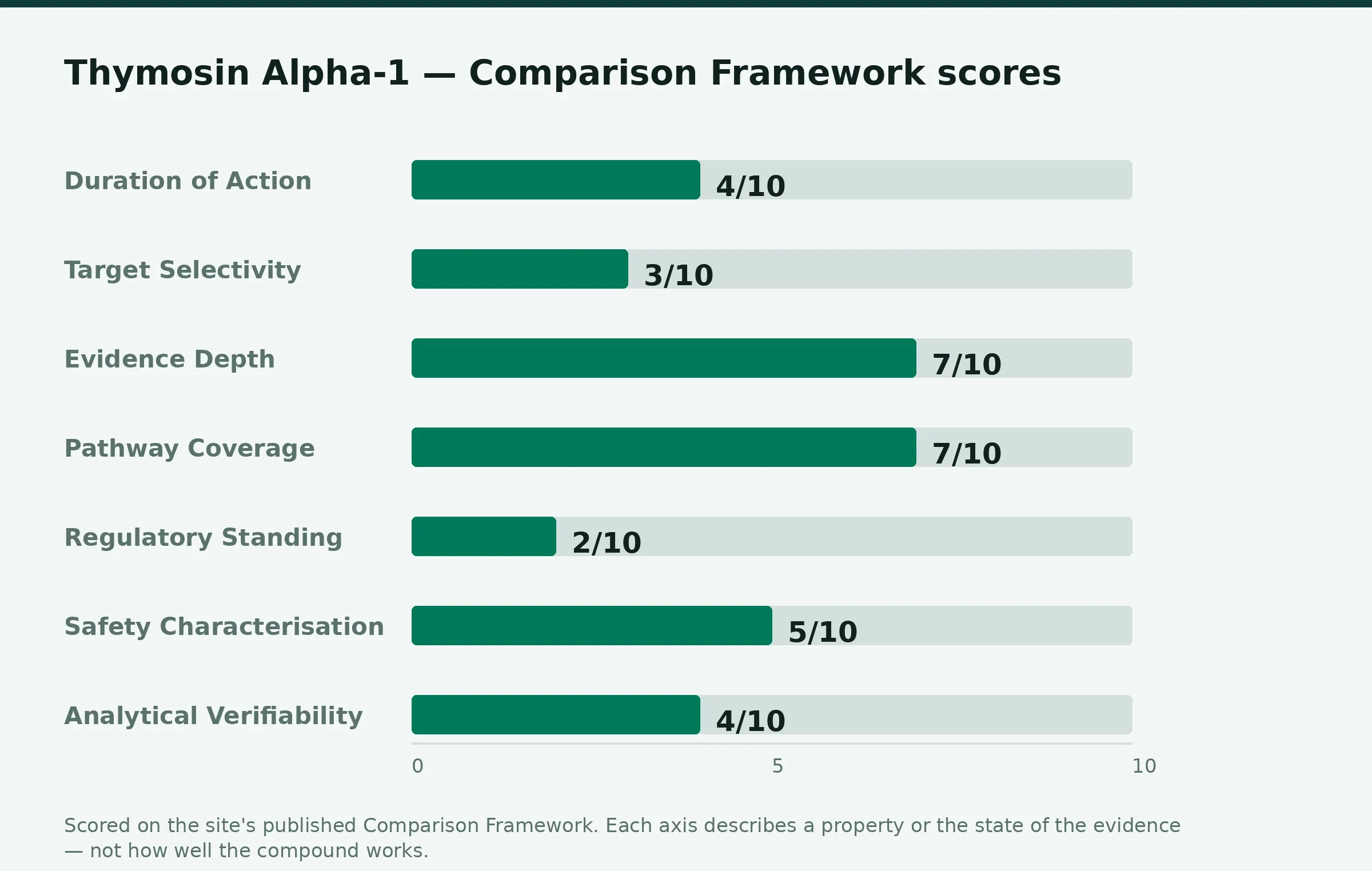
| Duration of Action | 4/10 | Plasma t½ under 3 h with Cmax at 1–2 h, and trials dosed every 12–24 h; the published bands jump from “under 30 min = 1–2” to “days/weekly = 9–10”, so a few hours is interpolated between them [9] |
| Target Selectivity | 3/10 | No bands are published for this axis. Reported binding spans several Toll-like receptors rather than one defined high-affinity target, which is the opposite of clean selectivity [9] |
| Evidence Depth | 7/10 | A 1,089-patient placebo-controlled phase 3 plus RCT-level meta-analyses puts it in the “RCTs = 7–8” band, at the bottom of it because the largest trial was null and the pooled effect disappears in higher-quality studies [5][6] |
| Pathway Coverage | 7/10 | Two documented limbs — MyD88/NF-kB innate signalling into dendritic cell maturation, and a TLR9 / type I interferon receptor–dependent plasmacytoid dendritic cell arm inducing IDO1 and regulatory T cells — which the published bands place at “two = 7–8” [9][10] |
| Regulatory Standing | 2/10 | No FDA-approved product and no DailyMed label, and the 503A bulks nomination was voted down 17–4 in December 2024. That is below the published “under review = 4–5” anchor and above “category 2 = 1”, so it is interpolated at research-use-only [4][12] |
| Safety Characterisation | 5/10 | Interpolated, and not a reassurance. Adverse events are documented for the trial product (67% of participants, similar in both arms), while FDA found the bulk substance lacks data on impurities, aggregates and endotoxin — half the risk picture is known and half explicitly is not [3][5] |
| Analytical Verifiability | 4/10 | Interpolated. Identity is checkable in principle against a defined 28-residue sequence and a 3,108 Da mass, but FDA judged the free base “not well-characterized” for impurities and aggregates, and no compendial monograph was verified during this run [3][9] |
No overall score is given: the framework scores properties of the molecule and the state of the evidence, not whether something works — see how we score compounds.
How thymosin alpha-1 compares
Against most peptides on this site, thymosin alpha-1 is unusual in having phase 3 data at all. BPC-157 rests almost entirely on animal work; thymosin alpha-1 has a 1,089-patient randomised trial, which is why its Evidence Depth score is higher and its headline result less flattering. A well-powered null is more informative than a promising rodent study.
Its nearest neighbours in the immune group are LL-37 and KPV, both further back in the evidence pipeline; for repair-oriented compounds see the healing and recovery overview.
Sourcing and quality: what to look for
Because FDA’s stated concern is immunogenicity driven by aggregation and peptide-related impurities [3], the analytical questions are not cosmetic. A useful certificate of analysis reports identity by mass spectrometry against the expected 3,108 Da, purity by HPLC with the method stated, plus batch number and test date; a bare purity percentage is not enough, and aggregation is not visible on a routine purity line.
Products sold without a prescription are research-use-only materials, and that framing does not change because a peptide is an approved drug somewhere else.
FAQ
Is thymosin alpha-1 FDA approved?
No. As of September 2026 there is no FDA-approved thymalfasin product in the United States and a DailyMed search for “thymalfasin” returns zero results [12]. It is approved as a prescription medicine in more than 35 countries under the name thymalfasin, mainly for chronic hepatitis B and C, according to a 2023 review [9].
Can a compounding pharmacy legally make thymosin alpha-1 in the US?
FDA proposed that thymosin alpha-1 free base and thymosin alpha-1 acetate not be added to the 503A bulks list, and on 4 December 2024 the Pharmacy Compounding Advisory Committee voted 17 to 4 against inclusion for each, citing a lack of convincing effectiveness data [4][13]. On FDA’s list of bulk substances that may present significant safety risks, the peptide appears under nominations that were withdrawn, with a recorded immunogenicity concern [1].
What did the largest trial of thymosin alpha-1 find?
The TESTS trial randomised 1,106 adults with sepsis across 22 centres and analysed 1,089. Twenty-eight-day all-cause mortality was 23.4% with thymosin alpha-1 and 24.1% with placebo, a hazard ratio of 0.97 (95% CI 0.76–1.24, P = 0.82), with no significant differences on the main secondary endpoints [5]. The authors reported no clear evidence of a mortality benefit in sepsis.
Is thymosin alpha-1 the same as TB-500?
No. TB-500 is a fragment related to thymosin beta-4, a different peptide with a different sequence and a different proposed mechanism. The shared “thymosin” label reflects a shared tissue of origin in the original naming, not shared pharmacology; the two have separate literatures and separate evidence bases [9].
What are the documented risks of thymosin alpha-1?
In the placebo-controlled TESTS trial, 67% of participants reported at least one adverse event, at a similar rate in both arms, and no unexpected serious adverse events were attributed to the peptide [5]. Separately, FDA concluded that the bulk substance is not well characterised for impurities, aggregates and endotoxin, and may pose a significant risk for immunogenicity when formulated for subcutaneous injection [3].
Is thymosin alpha-1 banned in sport?
This could not be verified from a permitted source during this run: the WADA Prohibited List was not retrievable, so nothing is asserted here about its status in tested sport. Athletes subject to testing should consult the current WADA Prohibited List or their national anti-doping organisation directly rather than rely on secondary summaries.
References
- Certain Bulk Drug Substances for Use in Compounding that May Present Significant Safety Risks. US Food and Drug Administration. Page last updated April 2026; checked September 2026. https://www.fda.gov/drugs/human-drug-compounding/certain-bulk-drug-substances-use-compounding-may-present-significant-safety-risks
- Bulk Drug Substances Used in Compounding Under Section 503A of the FD&C Act (interim policy categories 1–3). US Food and Drug Administration. Page last updated May 2026; checked September 2026. https://www.fda.gov/drugs/human-drug-compounding/bulk-drug-substances-used-compounding-under-section-503a-fdc-act
- Thymosin Alpha-1 (Ta1) Related Bulk Drug Substances. FDA presentation to the Pharmacy Compounding Advisory Committee, 4 December 2024. https://www.fda.gov/media/183892/download
- Pharmacy Compounding Advisory Committee Meeting, 4 December 2024 — voting record. US Food and Drug Administration. 2024. https://www.fda.gov/media/185642/download
- The efficacy and safety of thymosin α1 for sepsis (TESTS): multicentre, double blinded, randomised, placebo controlled, phase 3 trial. BMJ. 2025;388:e082583. https://www.bmj.com/content/388/bmj-2024-082583
- Efficacy of thymosin α1 for sepsis: a systematic review and meta-analysis of randomized controlled trials. Frontiers in Cellular and Infection Microbiology. 2025;15:1673959. https://www.frontiersin.org/journals/cellular-and-infection-microbiology/articles/10.3389/fcimb.2025.1673959/full
- Liu Y, et al. Thymosin Alpha 1 Reduces the Mortality of Severe Coronavirus Disease 2019 by Restoration of Lymphocytopenia and Reversion of Exhausted T Cells. Clinical Infectious Diseases. 2020;71(16):2150–2157. https://academic.oup.com/cid/article/71/16/2150/5842185
- Thymosin Alpha-1 Has no Beneficial Effect on Restoring CD4+ and CD8+ T Lymphocyte Counts in COVID-19 Patients. Frontiers in Immunology. 2021;12:568789. https://www.frontiersin.org/journals/immunology/articles/10.3389/fimmu.2021.568789/full
- Tao N, Xu X, Ying Y, Hu S, Sun Q, Lv G, Gao J. Thymosin α1 and Its Role in Viral Infectious Diseases: The Mechanism and Clinical Application. Molecules. 2023;28:3539. https://www.mdpi.com/1420-3049/28/8/3539
- Costantini C, Bellet MM, Pariano M, Renga G, Stincardini C, Goldstein AL, Garaci E, Romani L. A Reappraisal of Thymosin Alpha1 in Cancer Therapy. Frontiers in Oncology. 2019;9:873. https://www.frontiersin.org/journals/oncology/articles/10.3389/fonc.2019.00873/full
- Tang, et al. Thymosin alpha 1 alleviates inflammation and prevents infection in patients with severe acute pancreatitis through immune regulation: a systematic review and meta-analysis. Frontiers in Immunology. 2025;16:1571456. https://www.frontiersin.org/journals/immunology/articles/10.3389/fimmu.2025.1571456/full
- DailyMed search: “thymalfasin” — 0 results, no drug package labels found. US National Library of Medicine. Checked September 2026. https://dailymed.nlm.nih.gov/dailymed/search.cfm?labeltype=all&query=thymalfasin
- FDA Briefing Document, Pharmacy Compounding Advisory Committee Meeting, 4 December 2024. US Food and Drug Administration. https://www.fda.gov/media/183583/download