Quick answer: the comparison of tirzepatide vs retatrutide is not a contest between two similar drugs. Tirzepatide is a dual GIP/GLP-1 receptor agonist approved by the FDA and sold as Mounjaro and Zepbound, with phase 3 trials, a published label and a boxed warning [1][2]. Retatrutide (LY3437943) adds a third target, the glucagon receptor, and is investigational: its largest published trial is a 338-participant phase 2 study, and the FDA states plainly that it is not a component of any approved drug and cannot be used in compounding (checked September 2026) [5][9]. They differ in receptor count, in how much of their risk profile has been documented, and above all in the depth of evidence behind them.
At a glance
| Tirzepatide | Retatrutide (LY3437943) | |
|---|---|---|
| Class | Dual incretin receptor agonist | Triple (“GGG”) receptor agonist |
| Receptor targets | GIP receptor, GLP-1 receptor [1][4] | GIP receptor, GLP-1 receptor, glucagon receptor [5][7] |
| Reported half-life | ~5 days [1][2][4] | ~6 days [6] |
| Administration | Once-weekly subcutaneous injection [1] | Once-weekly subcutaneous injection in trials [5][6] |
| Largest published trial | SURMOUNT-1, phase 3, n=2,539, 72 weeks [3] | Phase 2 obesity trial, n=338, 48 weeks [5] |
| US regulatory status | FDA-approved, multiple indications (checked September 2026) [1][2] | Investigational; not approved, not compoundable (checked September 2026) [9] |
Both are peptide-based incretin analogues, and both belong to the family covered in our guide to GLP-1 and incretin peptides. If you are comparing the two approved incretin drugs instead, see semaglutide vs tirzepatide.
Mechanism: how they differ
The structural difference is one receptor. Tirzepatide is a 39-amino-acid linear peptide carrying a C20 fatty diacid attached through a linker at lysine 20, with two non-coded aminoisobutyric acid residues and an amidated C-terminus; that acylation is what gives it a multi-day half-life (in vitro and chemical characterisation) [4]. Retatrutide is built on the same general design principle but engineered to activate a third receptor, the glucagon receptor, alongside the two incretin receptors [5][7].
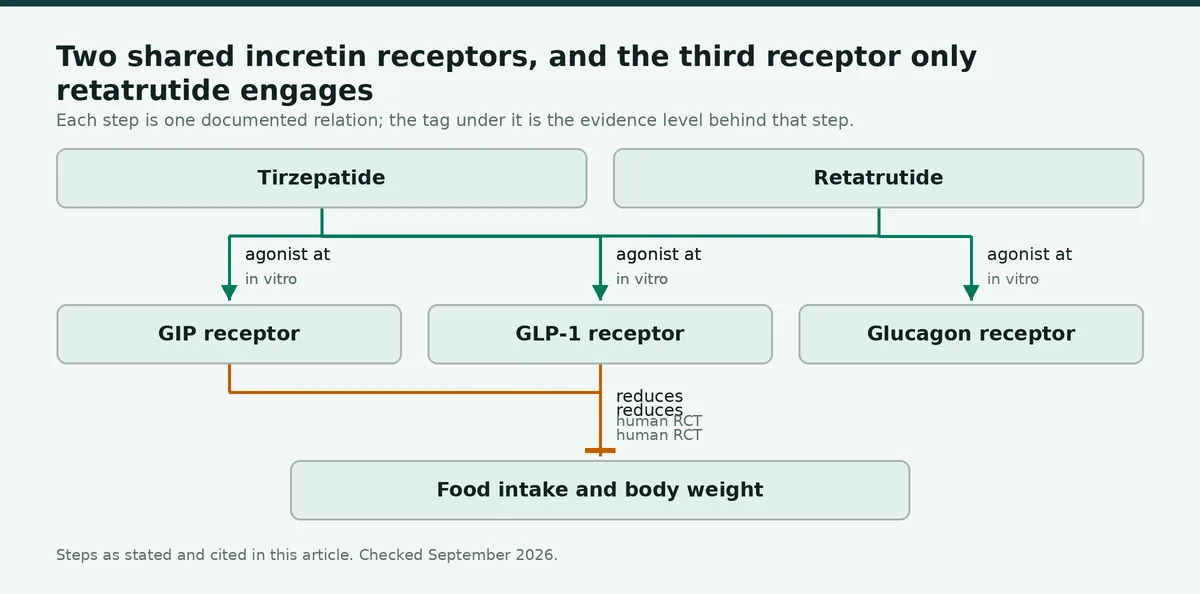
| Step | Relation | Target | Evidence |
|---|---|---|---|
| Tirzepatide | agonist at | GIP receptor | in vitro [4] |
| Tirzepatide | agonist at | GLP-1 receptor | in vitro [4] |
| Retatrutide | agonist at | GIP receptor | in vitro [5][7] |
| Retatrutide | agonist at | GLP-1 receptor | in vitro [5][7] |
| Retatrutide | agonist at | Glucagon receptor | in vitro [5][7] |
| GIP receptor | reduces | Food intake and body weight | human RCT [1][3] |
| GLP-1 receptor | reduces | Food intake and body weight | human RCT [1][3] |
Note what the diagram does not show: the glucagon receptor box has no arrow leaving it, and that is the state of the evidence rather than an omission. The investigators who ran the phase 2 obesity trial wrote that adding glucagon receptor agonism “may further reduce energy intake, increase energy expenditure, or both” — a hypothesis, not a measured human result [5]. Mechanistic plausibility is not clinical proof, and the third arm of retatrutide’s pharmacology is exactly where that gap is widest.
The two shared arrows are better supported: the FDA label describes tirzepatide as a GIP and GLP-1 receptor agonist acting on brain regions that regulate appetite to reduce food intake, and the weight outcome that follows was measured in randomised human trials [1][3].
Receptor potency is where they part company
The published potency figures are reported against different references in different laboratories, so they are not directly interchangeable — but each set is informative on its own.
| Compound | GIP receptor | GLP-1 receptor | Glucagon receptor |
|---|---|---|---|
| Tirzepatide [4] | Ki 0.135 nM; comparable to native GIP | Ki 4.23 nM; ~5-fold weaker binding and ~13-fold weaker signalling than native GLP-1 | Not a target |
| Retatrutide [5][7] | 8.9-fold more potent than the native ligand | 0.4-fold the native ligand | 0.3-fold the native ligand |
Two things follow. First, both molecules are deliberately GIP-weighted rather than GLP-1-weighted, which is a genuine departure from the single-pathway design of semaglutide (all in vitro) [4][5]. Second, retatrutide’s glucagon arm is its weakest relative potency, not its strongest — the triple agonist is not simply “three times the drug”. Cryo-electron microscopy structures at 2.68–3.26 Å resolution show how a single peptide accommodates three receptors by keeping contacts with conserved residues while tolerating receptor-specific ones (structural / in vitro) [7].
Head-to-head and trial evidence
There is no published head-to-head randomised trial of tirzepatide against retatrutide. Everything below comes from separate trials in different populations over different durations — a limit on any comparison made today, including this one.
Tirzepatide, SURMOUNT-1 (human RCT). A phase 3, double-blind, randomised, placebo-controlled trial in 2,539 adults with a BMI of 30 or more, or 27 or more with a weight-related complication, and without diabetes. Over 72 weeks, least-squares mean body-weight change was −15.0% on the 5 mg arm, −19.5% on 10 mg and −20.9% on 15 mg, against −3.1% on placebo. At least 5% of body weight was lost by 85–91% of participants across the three arms versus 35% on placebo, and 20% or more was lost by 50% (10 mg) and 57% (15 mg) versus 3% on placebo [3].
Tirzepatide, regulatory record. Beyond obesity, tirzepatide is approved as Zepbound for chronic weight management and for moderate-to-severe obstructive sleep apnoea in adults with obesity, and as Mounjaro for glycaemic control in adults and children aged 10 and over with type 2 diabetes and for reducing the risk of major adverse cardiovascular events (label revisions 01/2026 and 08/2026; initial US approval 2022) [1][2].
Retatrutide, phase 2 obesity trial (human RCT). A phase 2, double-blind, randomised, placebo-controlled trial in 338 US adults, run from May 2021 to November 2022, over 48 weeks of treatment with a 4-week safety follow-up. The dose arms studied were 1 mg, 4 mg, 8 mg and 12 mg weekly (with two different escalation schedules for 4 mg and 8 mg). At the primary 24-week endpoint, mean body-weight change was −7.2% (1 mg), −12.9% (4 mg pooled), −17.3% (8 mg pooled) and −17.5% (12 mg), against −1.6% on placebo. At 48 weeks the figures were −8.7%, −17.1%, −22.8% and −24.2%, against −2.1% on placebo. On the 12 mg arm, 83% of participants lost at least 15% of body weight and 26% lost at least 30% [5].
Retatrutide, earlier human work (human RCT). A phase 1b multiple-ascending-dose trial in 72 adults with type 2 diabetes over 12 weeks reported placebo-adjusted HbA1c reductions of 1.2–1.6 percentage points and placebo-adjusted weight reductions of 4.71–8.96 kg, alongside the pharmacokinetics that support weekly dosing: dose-proportional exposure, a median time to peak concentration of 12–48 hours and a half-life of roughly 6 days [6].
Retatrutide, phase 3. The TRIUMPH programme is described in a peer-reviewed design paper as four phase 3, multicentre, randomised, double-blind studies of weekly subcutaneous retatrutide against placebo in more than 5,800 participants, using a basket design that nests obstructive sleep apnoea and knee osteoarthritis protocols inside weight-management trials, plus a standalone osteoarthritis trial and a weight-management trial in people with cardiovascular disease. Primary endpoints are body-weight change, the apnoea–hypopnoea index and a knee-pain subscale [8]. We found no peer-reviewed publication of results from any TRIUMPH trial (checked September 2026); this page reports only peer-reviewed and regulatory sources, so sponsor topline announcements are not quoted here.
The asymmetry is the point. One compound’s best evidence is a 72-week phase 3 trial that led to an approved label; the other’s is a 48-week phase 2 trial, with phase 3 results still to appear in the literature.
Side effects and risks compared
Tirzepatide. The label carries a boxed warning: tirzepatide causes thyroid C-cell tumours in rats, and it is unknown whether it causes thyroid C-cell tumours, including medullary thyroid carcinoma, in humans (animal, with the human question open) [1][2]. It is contraindicated in people with a personal or family history of medullary thyroid carcinoma or multiple endocrine neoplasia syndrome type 2 [1]. The most common adverse reactions on the Zepbound label are gastrointestinal: nausea 25–29%, diarrhoea 19–23%, constipation 11–17%, vomiting 8–13%, abdominal pain 9–10% and dyspepsia 9–10%, plus injection-site reactions 6–8%, fatigue 5–7%, hypersensitivity reactions 5% and hair loss 4–5% (human RCT, pooled trial data) [1]. In SURMOUNT-1, discontinuation for adverse events ran at 4.3%, 7.1% and 6.2% on the 5, 10 and 15 mg arms against 2.6% on placebo [3].
Retatrutide. In the phase 2 trial, adverse events were reported by 73–94% of retatrutide recipients against 70% on placebo, and discontinuation for adverse events by 6–16% against 0% on placebo — a higher discontinuation rate than SURMOUNT-1 recorded for tirzepatide, though in a different trial and population. Gastrointestinal events predominated and were mostly mild to moderate and concentrated during dose escalation. Heart rate rose in a dose-dependent way, peaking at 24 weeks before declining at 36 and 48 weeks. Cardiac arrhythmias were recorded in 6% of retatrutide recipients, mild to moderate except for one severe case of prolonged QT. Transient ALT elevations above three times the upper limit of normal occurred in 1%; there was one serious case of acute pancreatitis; and cutaneous hyperesthesia was reported by 7% on retatrutide against 1% on placebo (human RCT) [5]. In the phase 1b diabetes trial, pulse rate rose by up to 13 beats per minute at 24 hours post-dose in the higher-dose groups [6].
The important difference is not that one list is longer. It is that tirzepatide’s list comes from a regulatory label backed by post-marketing surveillance, while retatrutide’s comes from trials of at most 48 weeks in a few hundred people. Rare events, long-term effects and anything that only emerges in wider use are simply unknown for retatrutide, and unknown is not the same as absent.
The FDA has also warned about compounded and unapproved GLP-1 products, citing dosing errors that led to hospitalisations, improper storage in transit and fraudulent products, and reporting 990 adverse event reports for compounded semaglutide and over 730 for compounded tirzepatide as of 31 May 2026 (page updated 1 September 2026) [9].
Regulatory and sports status (checked September 2026)
Tirzepatide is FDA-approved, initially in 2022, and now carries indications across two brand names, with labels revised in 2026 [1][2].
Retatrutide is not approved for any indication. The FDA states that retatrutide and cagrilintide “cannot be used in compounding under federal law” and that “these are not components of FDA-approved drugs and have not been found safe and effective for any condition” [9]. Any retatrutide material offered for sale is therefore an unapproved investigational compound, whatever the seller’s framing; our guide to the US regulatory status of peptides sets out the wider picture.
On sport: WADA’s 2026 Prohibited List and 2026 Monitoring Program came into force on 1 January 2026, and the Monitoring Program exists for substances WADA watches for patterns of misuse without prohibiting them [10]. A WADA-funded research project on detecting GLP-1 receptor agonists in blood records that semaglutide was added to the WADA Monitoring Program in 2024 [11]. We did not find tirzepatide or retatrutide named on the 2026 Prohibited List, and athletes should check the current List and their federation’s guidance directly rather than rely on a summary.
Comparison Framework scores
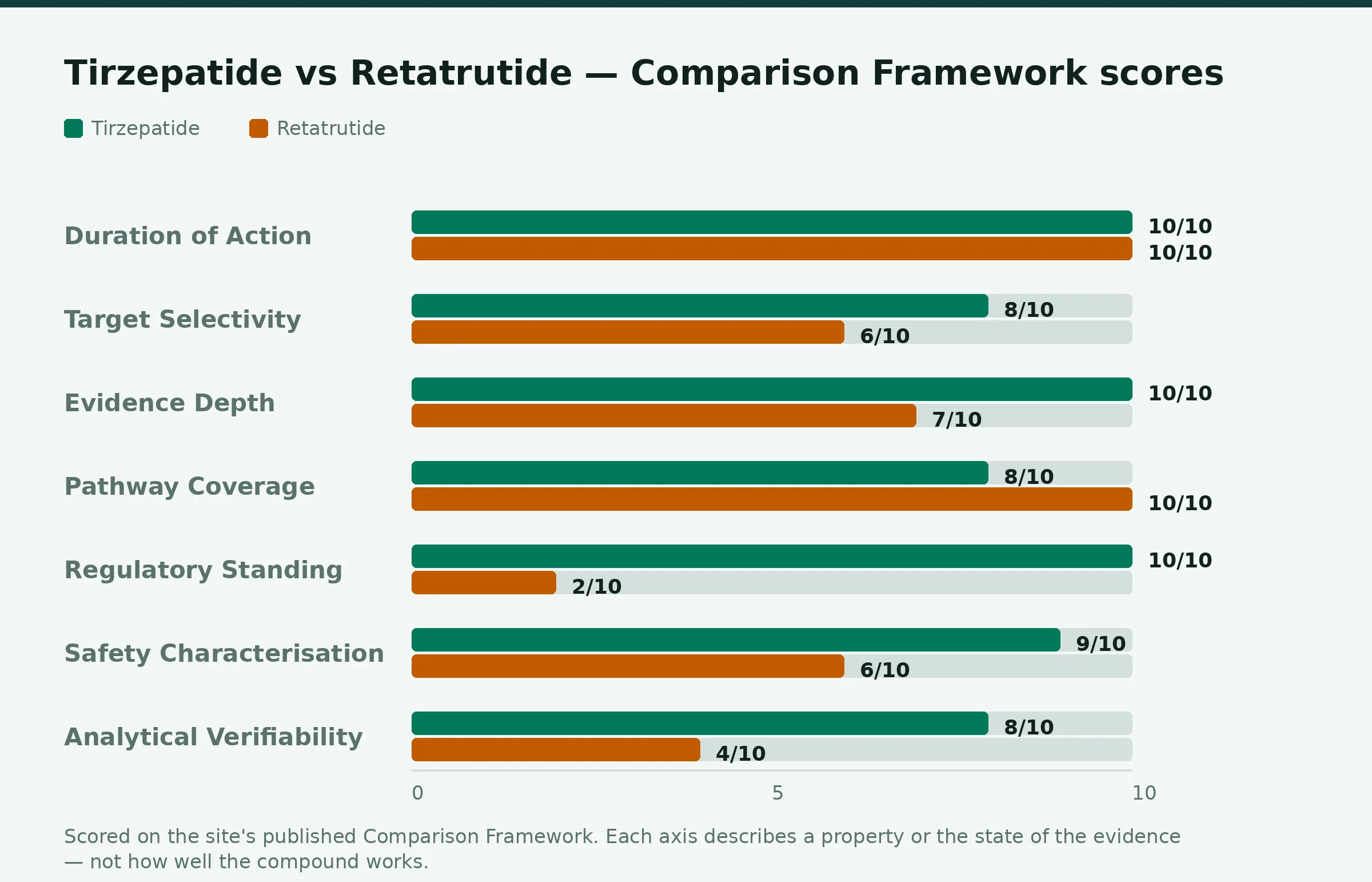
Each axis below describes a property of the molecule or the state of the published evidence, against the anchors on our Comparison Framework. No axis measures how well either compound works, how safe it is, or whether anyone should use it, and we publish no overall number.
Tirzepatide
| Axis | Score | Justification |
|---|---|---|
| Duration of Action | 10/10 | Elimination half-life approximately 5 days, steady state after four weekly doses [1][4] |
| Target Selectivity | 8/10 | Two intended receptors with published binding at both (GIPR Ki 0.135 nM, GLP-1R Ki 4.23 nM); no cross-activation of unrelated hormonal axes reported [4] |
| Evidence Depth | 10/10 | Approval plus a phase 3 programme including SURMOUNT-1 (n=2,539, 72 weeks) [1][3] |
| Pathway Coverage | 8/10 | Two receptor pathways engaged by design, the framework’s anchor for a dual agonist [1][4] |
| Regulatory Standing | 10/10 | FDA-approved for multiple indications across two brand names since 2022, labels revised 2026 (checked September 2026) [1][2] |
| Safety Characterisation | 9/10 | Regulatory-grade labelling with a boxed warning, quantified adverse reaction rates and active post-marketing reporting; this describes how completely risks are documented, not how small they are [1][2][9] |
| Analytical Verifiability | 8/10 | Sequence, acylation and synthesis published, and the approved product carries regulatory specifications; we found no public compendial monograph (checked September 2026) [4] |
Retatrutide
| Axis | Score | Justification |
|---|---|---|
| Duration of Action | 10/10 | Half-life approximately 6 days with dose-proportional exposure in phase 1b [6] |
| Target Selectivity | 6/10 | Three intended receptors with unbalanced potency (8.9-fold above the native ligand at GIPR, 0.4-fold and 0.3-fold at GLP-1R and GCGR), and measurable systemic effects such as a dose-dependent heart-rate rise [5][7] |
| Evidence Depth | 7/10 | Multiple randomised trials to phase 2 (n=72 phase 1b; n=338 over 48 weeks), no approval and no published phase 3 results [5][6][8] |
| Pathway Coverage | 10/10 | Three receptor pathways engaged by design [5][7] |
| Regulatory Standing | 2/10 | Not approved for any indication; FDA states it is not a component of an approved drug and cannot be used in compounding (checked September 2026) [9] |
| Safety Characterisation | 6/10 | Adverse events quantified across controlled trials of 12 and 48 weeks, but no regulatory labelling and no post-marketing surveillance [5][6] |
| Analytical Verifiability | 4/10 | Identity confirmable from the published sequence and cryo-EM structures; no public purity method or monograph found (checked September 2026) [7] |
Regulatory Standing and Evidence Depth separate them most, and they move together for a reason: approval generates the label, the post-marketing data and the specifications the other axes read from.
Which is studied for what?
Tirzepatide is studied — and approved — for chronic weight management, obstructive sleep apnoea in adults with obesity, glycaemic control in type 2 diabetes and cardiovascular risk reduction [1][2]. Its full profile is covered on our tirzepatide wiki page.
Retatrutide’s published clinical research covers obesity and type 2 diabetes, and the phase 3 TRIUMPH programme extends into obstructive sleep apnoea and knee osteoarthritis [5][6][8]. None of this is an approved use; it is a description of what the trials are measuring. Our retatrutide wiki page tracks the programme as results are published.
FAQ
Is retatrutide stronger than tirzepatide?
No trial has compared them directly, so the honest answer is that nobody knows. The largest published retatrutide trial reported a mean body-weight change of −24.2% at 48 weeks on the 12 mg arm (human RCT, phase 2, n=338) [5], and SURMOUNT-1 reported −20.9% at 72 weeks on the 15 mg tirzepatide arm (human RCT, phase 3, n=2,539) [3]. Different trials, different lengths, different populations and different trial phases — the numbers are not interchangeable, and a phase 2 result has historically been a poor predictor of a phase 3 one.
Is retatrutide FDA-approved?
No. As of September 2026 retatrutide is investigational. The FDA states that retatrutide is not a component of FDA-approved drugs, has not been found safe and effective for any condition, and cannot be used in compounding under federal law [9]. Tirzepatide, by contrast, has been FDA-approved since 2022 and is marketed as Mounjaro and Zepbound [1][2].
What is the difference between a dual agonist and a triple agonist?
A dual agonist activates two receptors; a triple agonist activates three. Tirzepatide engages the GIP and GLP-1 receptors [1][4]; retatrutide engages those two plus the glucagon receptor [5][7]. On our framework, breadth is a description rather than a virtue: more pathways may do more, and are also harder to predict, which is why Pathway Coverage and Target Selectivity are scored separately.
Does retatrutide raise heart rate?
In the published phase 2 obesity trial, heart rate rose in a dose-dependent manner, peaked at 24 weeks and then declined at weeks 36 and 48, and cardiac arrhythmias were recorded in 6% of retatrutide recipients — mild to moderate apart from one severe case of prolonged QT (human RCT) [5]. A phase 1b trial in type 2 diabetes reported pulse increases of up to 13 beats per minute at 24 hours after dosing in the higher-dose groups (human RCT) [6]. Longer-term cardiovascular effects have not been characterised.
Why does tirzepatide carry a boxed warning?
Tirzepatide causes thyroid C-cell tumours in rats, and the label states it is unknown whether it causes thyroid C-cell tumours, including medullary thyroid carcinoma, in humans (animal finding with the human question unresolved) [1][2]. It is contraindicated in people with a personal or family history of medullary thyroid carcinoma or multiple endocrine neoplasia syndrome type 2 [1]. Retatrutide has no label and therefore no boxed warning, which reflects the absence of a regulatory review rather than the absence of a risk.
Are these compounds banned in sport?
WADA’s 2026 Prohibited List and Monitoring Program took effect on 1 January 2026, and the Monitoring Program covers substances WADA tracks without prohibiting them [10]. A WADA research record notes that semaglutide was added to the Monitoring Program in 2024, and that detection methods for GLP-1 receptor agonists in blood are being developed [11]. We did not find tirzepatide or retatrutide listed as prohibited for 2026; anyone competing under the Code should verify against the current List rather than a third-party summary (checked September 2026).
References
- ZEPBOUND (tirzepatide) injection, Highlights of Prescribing Information. US Food and Drug Administration, label revised 01/2026. https://www.accessdata.fda.gov/drugsatfda_docs/label/2026/217806s037lbl.pdf
- MOUNJARO (tirzepatide) injection, Highlights of Prescribing Information. US Food and Drug Administration, label revised 08/2026. https://www.accessdata.fda.gov/drugsatfda_docs/label/2026/215866s044s045lbl.pdf
- Jastreboff AM, Aronne LJ, Ahmad NN, et al. “Tirzepatide Once Weekly for the Treatment of Obesity” (SURMOUNT-1, NCT04184622). New England Journal of Medicine, 2022;387(3):205–216; doi:10.1056/NEJMoa2206038. https://www.nejm.org/doi/full/10.1056/NEJMoa2206038
- Coskun T, Sloop KW, Loghin C, et al. “LY3298176, a novel dual GIP and GLP-1 receptor agonist for the treatment of type 2 diabetes mellitus: From discovery to clinical proof of concept.” Molecular Metabolism, 2018; doi:10.1016/j.molmet.2018.09.009; PMCID PMC6308032. https://pmc.ncbi.nlm.nih.gov/articles/PMC6308032/
- Jastreboff AM, Kaplan LM, Frías JP, et al. “Triple–Hormone-Receptor Agonist Retatrutide for Obesity — A Phase 2 Trial” (NCT04881760). New England Journal of Medicine, 2023; doi:10.1056/NEJMoa2301972. https://www.nejm.org/doi/full/10.1056/NEJMoa2301972
- Urva S, Coskun T, Loh MT, et al. “LY3437943, a novel triple GIP, GLP-1, and glucagon receptor agonist in people with type 2 diabetes: a phase 1b, multicentre, double-blind, placebo-controlled, randomised, multiple-ascending dose trial” (NCT04143802). The Lancet, 2022;400:1869–1881; doi:10.1016/S0140-6736(22)02033-5. https://www.thelancet.com/journals/lancet/article/PIIS0140-6736(22)02033-5/fulltext
- Li W, Zhou Q, Cong Z, et al. “Structural insights into the triple agonism at GLP-1R, GIPR and GCGR manifested by retatrutide.” Cell Discovery, 2024; doi:10.1038/s41421-024-00700-0. https://www.nature.com/articles/s41421-024-00700-0
- Giblin K, Kaplan LM, Somers VK, et al. “Retatrutide for the treatment of obesity, obstructive sleep apnea and knee osteoarthritis: Rationale and design of the TRIUMPH registrational clinical trials.” Diabetes, Obesity and Metabolism, 2026;28(1):83–93; doi:10.1111/dom.70209. https://doi.org/10.1111/dom.70209
- “FDA’s Concerns with Unapproved GLP-1 Drugs Used for Weight Loss.” US Food and Drug Administration, page last updated 1 September 2026. https://www.fda.gov/drugs/drug-alerts-and-statements/fdas-concerns-unapproved-glp-1-drugs-used-weight-loss
- “WADA’s 2026 Prohibited List is now in force.” World Anti-Doping Agency, 2026. https://www.wada-ama.org/en/news/wadas-2026-prohibited-list-now-force
- Thevis M. “Analysis of GLP-1 receptor agonists (Semaglutide, Liraglutide etc.) from blood and dried blood spots by means of LC-MS.” World Anti-Doping Agency scientific research project, approved 2024. https://www.wada-ama.org/en/resources/scientific-research/analysis-glp-1-receptor-agonists-semaglutide-liraglutide-etc-blood