Quick answer: Tirzepatide is a synthetic 39-amino-acid peptide that activates both the GIP and the GLP-1 receptor, made once-weekly by attaching a C20 fatty diacid to the lysine at position 20 [3]. It is the best-evidenced compound on this site: FDA-approved as Mounjaro for glycemic control in type 2 diabetes and as Zepbound for weight reduction and for moderate-to-severe obstructive sleep apnea in adults with obesity [1][2]. The evidence level is human RCT — phase 3 programs of several thousand participants each, plus a 13,165-patient cardiovascular outcomes trial [6]. Its risks are unusually well documented, including a boxed warning based on rodent thyroid C-cell tumors [1].
| Spec | Detail |
|---|---|
| Also known as | LY3298176; brands Mounjaro, Zepbound [1][2][3] |
| Class | Dual GIP and GLP-1 receptor agonist (incretin co-agonist) [2] |
| Sequence / length | 39-amino-acid linear peptide on the GIP sequence, aminoisobutyric acid at positions 2 and 13, C-terminal amide [2][3] |
| Molecular weight | 4813.53 Da (C225H348N48O68) [1][2] |
| Half-life | ~5 days; steady state after 4 weeks of once-weekly use [2] |
| Regulatory status (US) | FDA-approved prescription drug (Mounjaro and Zepbound, 2022; sleep apnea indication December 2024) (checked September 2026) [1][7] |
| WADA status | Not on the 2026 Prohibited List; the GLP-1 analogue semaglutide sits in WADA’s monitoring program (checked September 2026) [11][12] |
What is tirzepatide?
Tirzepatide is a laboratory-designed peptide, not a copy of a natural hormone. Its backbone is built on the sequence of glucose-dependent insulinotropic polypeptide (GIP), one of the two gut incretin hormones, but altered enough to activate the GLP-1 receptor as well [3]. The FDA label describes it as “based on the GIP sequence”, with aminoisobutyric acid — a non-standard amino acid — at positions 2 and 13, a C-terminal amide, and a lysine at position 20 attached to 1,20-eicosanedioic acid through a linker [2].
That last modification is why the drug is given once a week: the C20 fatty diacid binds circulating albumin, slowing clearance and stretching the half-life to roughly five days [2][3]. At 4813.53 Da it is an order of magnitude larger than the short research peptides that dominate the grey market [1].
It belongs to the wider incretin peptide family, where the nearest reference point is semaglutide, a single-receptor GLP-1 agonist. Tirzepatide is the first dual incretin receptor agonist approved anywhere, and so the usual benchmark for newer multi-receptor candidates such as retatrutide.
How tirzepatide works (mechanism)
The established part is receptor engagement. Tirzepatide binds and activates both the GIP and the GLP-1 receptor; the EMA describes the downstream consequence plainly as insulin secretion rising in response to food, blood glucose falling, and appetite being suppressed [10].
The contested part is the division of labor between the two receptors. A 2023 in vitro study using perifused human donor islets found that blocking the GIP receptor consistently reduced the insulin response to tirzepatide across every human preparation tested, while blocking the GLP-1 receptor produced variable effects; in mouse islets the dependence ran the other way, toward GLP-1R [4]. That species difference means animal mechanistic work here does not transfer cleanly to people.
What remains hypothesis is why adding GIP agonism improves on GLP-1 agonism alone in humans. Candidate explanations include effects on adipose tissue, central appetite circuits, and better gastrointestinal tolerability allowing higher exposure. None has been isolated in a human trial designed to test it, so treat the mechanism above the receptor level as unresolved.
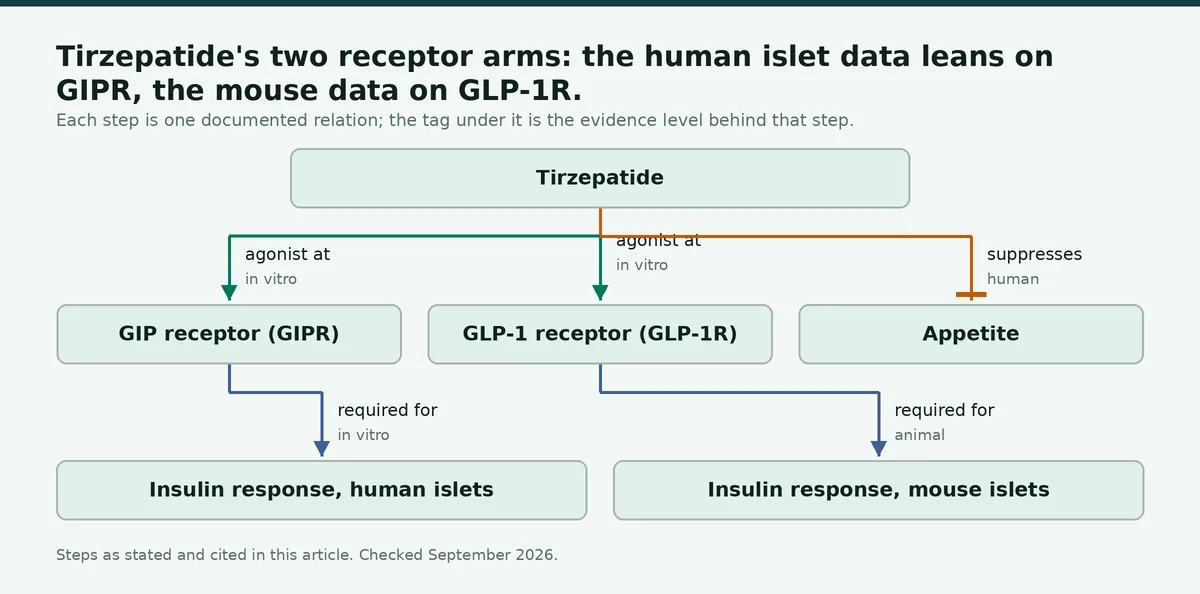
| Step | Relation | Target | Evidence |
|---|---|---|---|
| Tirzepatide | agonist at | GIP receptor (GIPR) | in vitro [4][10] |
| Tirzepatide | agonist at | GLP-1 receptor (GLP-1R) | in vitro [4][10] |
| Tirzepatide | suppresses | Appetite | human [10] |
| GIP receptor (GIPR) | required for | Insulin response, human islets | in vitro [4] |
| GLP-1 receptor (GLP-1R) | required for | Insulin response, mouse islets | animal [4] |
Key numbers
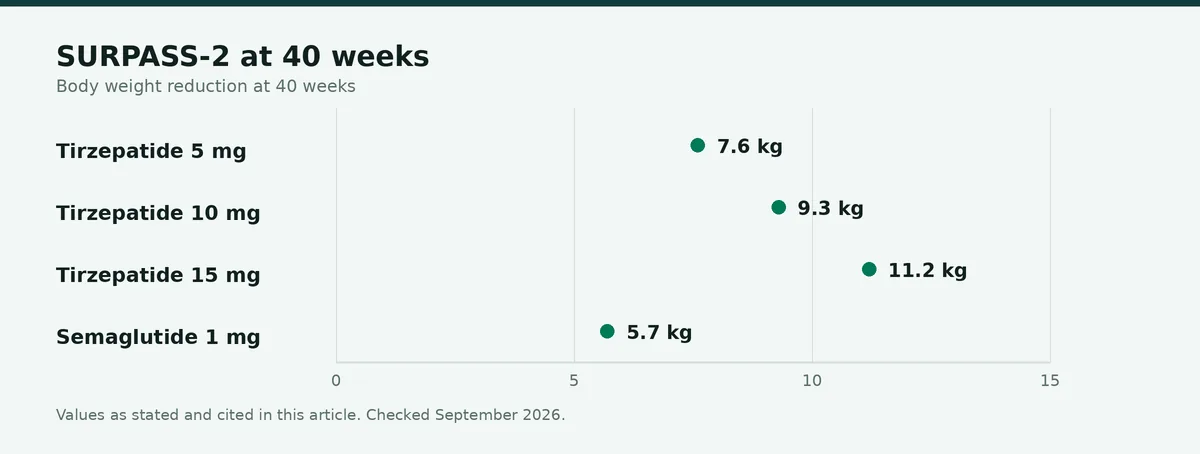
| SURPASS-2 arm | Body weight reduction at 40 weeks | Evidence level |
|---|---|---|
| Tirzepatide 5 mg | 7.6 kg | human RCT, FDA label [2] |
| Tirzepatide 10 mg | 9.3 kg | human RCT, FDA label [2] |
| Tirzepatide 15 mg | 11.2 kg | human RCT, FDA label [2] |
| Semaglutide 1 mg | 5.7 kg | human RCT, FDA label [2] |
Pharmacokinetics and label interval, reported in the FDA prescribing information [2]. These are four different kinds of quantity, so they are listed rather than plotted:
| Property | Value | Evidence level |
|---|---|---|
| Elimination half-life | 5 days | human PK, FDA label [2] |
| Time to peak concentration | 8–72 h | human PK, FDA label [2] |
| Time to steady state | 28 days | human PK, FDA label [2] |
| Label administration interval | 7 days | FDA label [2] |
Absolute bioavailability is approximately 80%, and the route is subcutaneous injection in every trial and both approved products [1][2].
What the research shows
Human studies
The type 2 diabetes program is called SURPASS, and its results are summarized in the FDA label [2]. All findings below are human RCT.
- SURPASS-1 (n=478, 40 weeks, monotherapy vs placebo): HbA1c fell 1.7–1.8% across the 5, 10 and 15 mg doses versus 0.1% on placebo; body weight fell 6.3–7.8 kg versus 1.0 kg [2].
- SURPASS-2 (n=1,879, 40 weeks, added to metformin, versus semaglutide 1 mg): HbA1c fell 2.0%, 2.2% and 2.3% on tirzepatide 5, 10 and 15 mg versus 1.9% on semaglutide; body weight fell 7.6, 9.3 and 11.2 kg versus 5.7 kg [2].
- SURPASS-3, -4 and -5 (n=1,444, 2,002 and 475; 40–52 weeks), versus insulin degludec, insulin glargine and placebo on background basal insulin: HbA1c fell 1.9–2.4% versus 0.9–1.4%, and body weight fell 5.4–11.3 kg while both insulin comparators gained 1.7–1.9 kg [2].
The obesity program is SURMOUNT. In the pivotal trial in adults with obesity or overweight without type 2 diabetes (n=2,539, 72 weeks), mean body weight change was −15.0%, −19.5% and −20.9% on 5, 10 and 15 mg versus −3.1% on placebo; 85–91% on tirzepatide reached at least 5% weight reduction versus 34.5% on placebo [1]. In the companion trial in adults who also had type 2 diabetes (n=938, 72 weeks), the figures were −12.8% and −14.7% on 10 and 15 mg versus −3.2% [1].
SURMOUNT-OSA (human RCT) ran two 52-week trials in 469 adults with moderate-to-severe obstructive sleep apnea and obesity, one off and one on positive airway pressure. The apnea-hypopnea index fell 25.3 events per hour on tirzepatide versus 5.3 on placebo in the first, and 29.3 versus 5.5 in the second; body weight fell 17.7% and 19.6% versus 1.6% and 2.3% [5]. This supported the December 2024 sleep apnea approval [7].
SURPASS-CVOT (human RCT) is the largest dataset available: 13,165 people with type 2 diabetes and cardiovascular disease randomized to tirzepatide escalated to a maximum of 15 mg weekly or to dulaglutide 1.5 mg weekly, median follow-up 4.0 years. The primary three-component major adverse cardiovascular event outcome met non-inferiority, hazard ratio 0.92 (95% CI 0.83–1.01) — which does not establish superiority over the active comparator. A post hoc six-component cardiorenal composite did favor tirzepatide: 23.7% versus 27.4% of patients had an event (HR 0.84, 95% CI 0.79–0.90) [6]. Post hoc analyses generate hypotheses; they do not carry the weight of a primary endpoint.
Animal studies
In diet-induced-obese mice, chronic tirzepatide produced dose-dependent weight reduction exceeding that of semaglutide in the same model, through both lower food intake and higher energy expenditure (animal) [3]. Rodent carcinogenicity work is the basis of the boxed warning below: in rats, tirzepatide caused dose- and duration-dependent thyroid C-cell tumors at clinically relevant exposures (animal) [1]. Mouse islets showed receptor dependence running toward GLP-1R rather than GIPR — the opposite of the human result (animal) [4].
In-vitro and preclinical
Isolated human donor islets perifused with tirzepatide showed insulin, glucagon and somatostatin responses that depended on GIP receptor activity (in vitro) [4]. The founding pharmacology paper established glucose-dependent insulin secretion in isolated islets across mouse genotypes (in vitro) and reported the first phase 1b human data: HbA1c down 0.58–0.84% and body weight about 2–2.6 kg versus placebo, numbers the phase 3 program later greatly exceeded [3].
Side effects and risks
Tirzepatide’s risks are documented in more detail than almost any other peptide covered here, and the documentation is not reassurance — it is simply better information.
Boxed warning. The label carries a boxed warning for thyroid C-cell tumors. The wording matters: the tumors were seen in rats, and the label states that “it is unknown whether ZEPBOUND causes thyroid C-cell tumors, including medullary thyroid carcinoma (MTC), in humans as human relevance of tirzepatide-induced rodent thyroid C-cell tumors has not been determined” [1]. It is contraindicated in people with a personal or family history of MTC or with Multiple Endocrine Neoplasia syndrome type 2 [1].
Gastrointestinal effects dominate and scale with dose. In the obesity trials, nausea occurred in 25–29% on tirzepatide versus 8% on placebo, diarrhea in 19–23% versus 8%, vomiting in 8–13% versus 2%, constipation in 11–17% versus 5% [1]. In the diabetes program, discontinuation for gastrointestinal adverse reactions rose with dose: 3.0% at 5 mg, 5.4% at 10 mg and 6.6% at 15 mg, against 0.4% on placebo [2].
Labeled warnings and precautions include severe gastrointestinal adverse reactions, acute kidney injury from volume depletion, acute gallbladder disease, acute pancreatitis, hypersensitivity reactions, hypoglycemia, diabetic retinopathy complications in people with type 2 diabetes, suicidal behavior and ideation, and pulmonary aspiration during general anesthesia or deep sedation [1]. Hypoglycemia risk is the reason the label singles out concomitant insulin and insulin secretagogues such as sulfonylureas [1]. Other reported reactions at 5% or more include injection site reactions, fatigue and hypersensitivity reactions [1]; the FDA’s own approval announcement also lists burping, hair loss and gastroesophageal reflux [7].
None of this is compatible with self-directed use of unapproved material. Everything above was observed under medical supervision with a characterized product, in people screened for the contraindications.
Regulatory and legal status (2026)
In the United States, tirzepatide is a prescription drug, not a research chemical (checked September 2026). Mounjaro is indicated “as an adjunct to diet and exercise to improve glycemic control in adults with type 2 diabetes mellitus” [2]. Zepbound, revised January 2026, is indicated “to reduce excess body weight and maintain weight reduction long term” in adults with obesity or overweight plus a weight-related comorbid condition, and “to treat moderate to severe obstructive sleep apnea (OSA) in adults with obesity” [1]. The sleep apnea indication was approved on 20 December 2024, the first drug approval for that condition [7]. In the EU, Mounjaro has held a marketing authorization since 15 September 2022 [10].
The compounding route has closed. FDA declared the tirzepatide injection shortage resolved on 19 December 2024, giving 503A pharmacies until 18 February 2025 and 503B outsourcing facilities until 19 March 2025 to stop compounding [8]. On 30 April 2026 it proposed excluding semaglutide, tirzepatide and liraglutide from the 503B bulk drug substances list, on the basis that there is no clinical need to compound them from bulk when approved products exist; comments ran to 29 June 2026 [9]. As of September 2026, “research-use” tirzepatide sold outside the approved supply chain has no lawful footing and unverified identity and purity. Our US peptide legal status guide covers the framework.
For sport, tirzepatide does not appear on WADA’s 2026 Prohibited List, effective 1 January 2026, whose published changes do not mention incretin agonists [11]. WADA funds detection-method development for GLP-1 receptor agonists in blood and dried blood spots, and notes that semaglutide entered its monitoring program in 2024 [12]. Monitoring is not prohibition, but it often precedes a listing decision (checked September 2026).
Comparison Framework scores
| Axis | n/10 | Justification |
|---|---|---|
| Duration of Action | 9/10 | Half-life of approximately 5 days, steady state at 4 weeks, once-weekly administration [2] |
| Target Selectivity | 6/10 | Deliberately dual rather than single-target, and imbalanced between the two receptors [3][4] |
| Evidence Depth | 10/10 | Five phase 3 diabetes trials, two 72-week obesity trials, a sleep apnea program and a 13,165-patient cardiovascular outcomes trial, plus FDA approval [1][2][5][6] |
| Pathway Coverage | 7/10 | Two incretin pathways engaged, GIP and GLP-1 — the framework’s two-pathway band [3][10] |
| Regulatory Standing | 9/10 | Approved prescription medicine in the US and the EU, with multiple indications [1][10] |
| Safety Characterisation | 9/10 | A boxed warning, ten labeled warnings and dose-stratified adverse event and discontinuation rates. High means well described, not small [1][2] |
| Analytical Verifiability | 7/10 | Exact formula and mass published in the label give a defined identity target; no public compendial monograph verified in this run [1][2] |
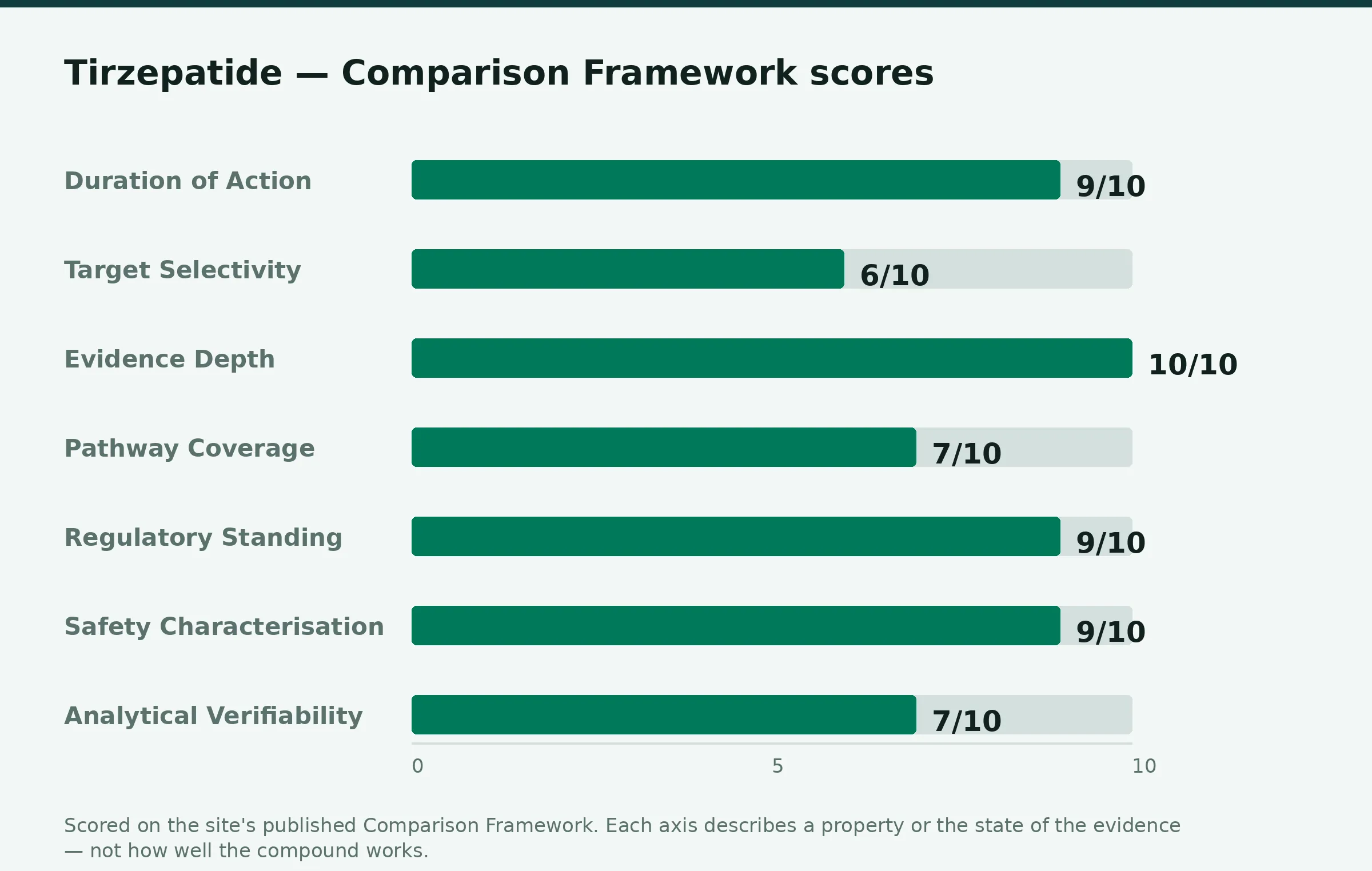
Scores follow the anchors published in our Comparison Framework. No axis measures how well the compound works or whether anyone should use it.
How tirzepatide compares
Against semaglutide, the only head-to-head data in the FDA label is SURPASS-2, where tirzepatide 15 mg lowered HbA1c by 2.3% versus 1.9% and body weight by 11.2 kg versus 5.7 kg for semaglutide 1 mg over 40 weeks [2]. That comparator dose is lower than the 2.4 mg used for weight management, so the trial answers a diabetes question, not an obesity one.
Against dulaglutide, a single-receptor GLP-1 agonist, SURPASS-CVOT showed non-inferiority on major cardiovascular events over four years rather than an advantage [6]. Against the experimental triple agonists, tirzepatide is the benchmark; see tirzepatide vs retatrutide.
Sourcing and quality: what to look for
In the United States tirzepatide is an approved medicine dispensed on prescription, and that is the only supply route with a verified identity, purity and sterility chain behind it. Material offered as “research grade” sits outside that chain, and since March 2025 outside the compounding exemptions as well [8][9].
The usual checks apply: a lot-specific certificate of analysis, an identity result by mass spectrometry matching the expected mass, a purity result by HPLC with the chromatogram attached, and a named third-party laboratory. Our guide on how to read a peptide certificate of analysis covers what a real one contains. A published exact mass of 4813.53 Da [1] makes identity checkable in principle — which is why a supplier that cannot produce a mass spectrum is telling you something.
FAQ
Is tirzepatide the same as semaglutide?
No. Semaglutide activates the GLP-1 receptor only; tirzepatide activates both the GLP-1 and the GIP receptor and is built on the GIP sequence [2][3]. SURPASS-2 compared them directly over 40 weeks, with larger HbA1c and body weight changes on tirzepatide 15 mg than on semaglutide 1 mg [2].
Is tirzepatide FDA-approved?
Yes — as Mounjaro for glycemic control in adults with type 2 diabetes, and as Zepbound for weight reduction and long-term maintenance in adults with obesity or overweight with a weight-related condition, and for moderate-to-severe obstructive sleep apnea in adults with obesity [1][2][7].
How long does tirzepatide stay in the body?
The elimination half-life is approximately 5 days, peak concentrations come 8 to 72 hours after a subcutaneous dose, and steady state is reached after about four weeks of once-weekly administration [2].
What is the thyroid warning about?
In rats, tirzepatide produced dose- and duration-dependent thyroid C-cell tumors at clinically relevant exposures — an animal finding. The label states that the human relevance has not been determined, and contraindicates the drug in people with a personal or family history of medullary thyroid carcinoma or MEN 2 [1].
Can compounding pharmacies still supply tirzepatide?
Generally no. FDA declared the shortage resolved on 19 December 2024, with wind-down deadlines of 18 February 2025 for 503A pharmacies and 19 March 2025 for 503B facilities, then in April 2026 proposed removing it from the 503B bulk substances list [8][9] (checked September 2026).
Is tirzepatide banned in sport?
It does not appear on WADA’s 2026 Prohibited List, effective 1 January 2026 [11]. WADA has placed the related GLP-1 analogue semaglutide in its monitoring program and funds detection research for the class, so the position could change [12].
References
- ZEPBOUND (tirzepatide) injection, for subcutaneous use — Highlights of Prescribing Information. US Food and Drug Administration. Revised 01/2026. https://www.accessdata.fda.gov/drugsatfda_docs/label/2026/217806s037lbl.pdf
- MOUNJARO (tirzepatide) injection, for subcutaneous use — Highlights of Prescribing Information. US Food and Drug Administration. Revised 05/2025. https://www.accessdata.fda.gov/drugsatfda_docs/label/2025/215866s031lbl.pdf
- Coskun T, Sloop KW, Loghin C, et al. LY3298176, a novel dual GIP and GLP-1 receptor agonist for the treatment of type 2 diabetes mellitus: From discovery to clinical proof of concept. Molecular Metabolism. 2018. https://pmc.ncbi.nlm.nih.gov/articles/PMC6308032/
- El K, Douros JD, Willard FS, et al. The incretin co-agonist tirzepatide requires GIPR for hormone secretion from human islets. Nature Metabolism. 2023. https://www.nature.com/articles/s42255-023-00811-0
- Malhotra A, et al. Tirzepatide for the Treatment of Obstructive Sleep Apnea and Obesity. New England Journal of Medicine. 2024. https://pmc.ncbi.nlm.nih.gov/articles/PMC11598664/
- Cardiorenal Outcomes With Tirzepatide Compared With Dulaglutide in Patients With Diabetes and Cardiovascular Disease: A Post Hoc Analysis of the SURPASS-CVOT Randomized Clinical Trial. JAMA Cardiology. 2026. https://pmc.ncbi.nlm.nih.gov/articles/PMC13033170/
- FDA Approves First Medication for Obstructive Sleep Apnea. US Food and Drug Administration press announcement. 2024. https://www.fda.gov/news-events/press-announcements/fda-approves-first-medication-obstructive-sleep-apnea
- Resolution of Tirzepatide Injection Product Shortage and Compounding Considerations (declaratory order memorandum, 19 December 2024). US Food and Drug Administration. 2024. https://www.fda.gov/media/185577/download
- FDA Proposes to Exclude Semaglutide, Tirzepatide, and Liraglutide on 503B Bulks List. US Food and Drug Administration press announcement. 2026. https://www.fda.gov/news-events/press-announcements/fda-proposes-exclude-semaglutide-tirzepatide-and-liraglutide-503b-bulks-list
- Mounjaro (tirzepatide) — European Public Assessment Report overview. European Medicines Agency. 2022, updated. https://www.ema.europa.eu/en/medicines/human/EPAR/mounjaro
- WADA’s 2026 Prohibited List is now in force. World Anti-Doping Agency. 2026. https://www.wada-ama.org/en/news/wadas-2026-prohibited-list-now-force
- Analysis of GLP-1 receptor agonists (Semaglutide, Liraglutide, etc.) in blood. World Anti-Doping Agency scientific research project. 2024. https://www.wada-ama.org/en/resources/scientific-research/analysis-glp-1-receptor-agonists-semaglutide-liraglutide-etc-blood