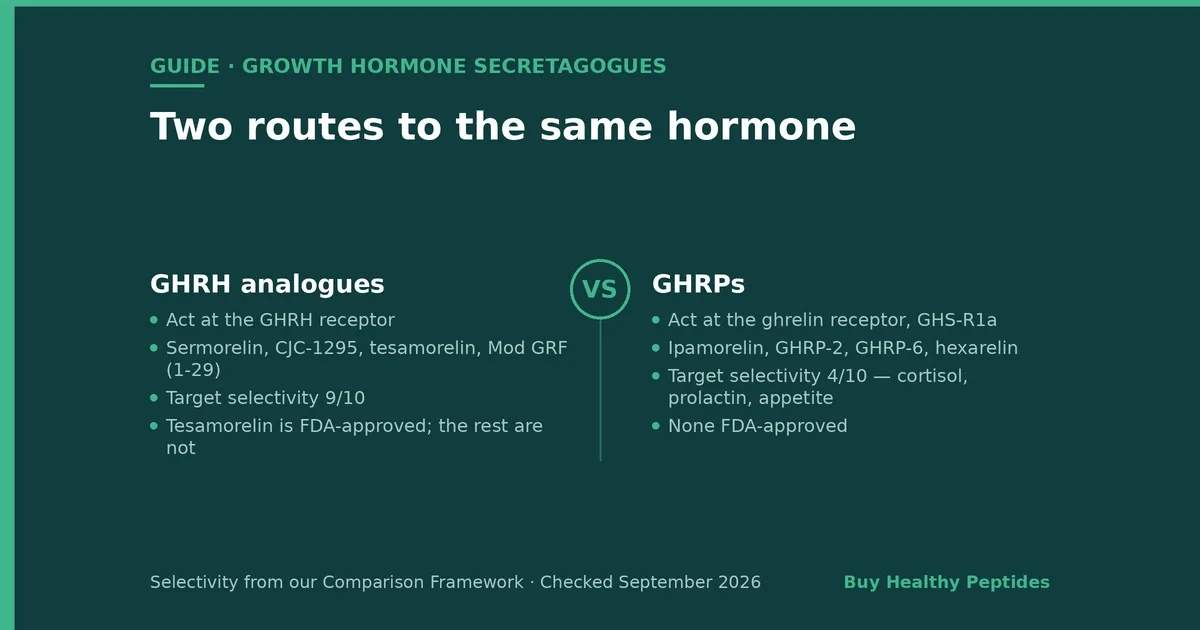
Quick answer: Growth hormone secretagogue peptides are compounds that push the pituitary to release more of your own growth hormone, instead of supplying GH from outside. They fall into two families with two different receptors: GHRH analogues (sermorelin, CJC-1295, tesamorelin, Mod GRF 1-29) at the GHRH receptor, and ghrelin-receptor agonists or GHRPs (ipamorelin, GHRP-2, GHRP-6, hexarelin) at GHS-R1a [1][3]. Only tesamorelin holds a current FDA approval, for reduction of excess abdominal fat in adults with HIV-associated lipodystrophy [10]; the rest are research-use-only or, like sermorelin, no longer marketed in the US [11]. All of them are prohibited in sport at all times under WADA section S2 [13].
What are growth hormone secretagogue peptides?
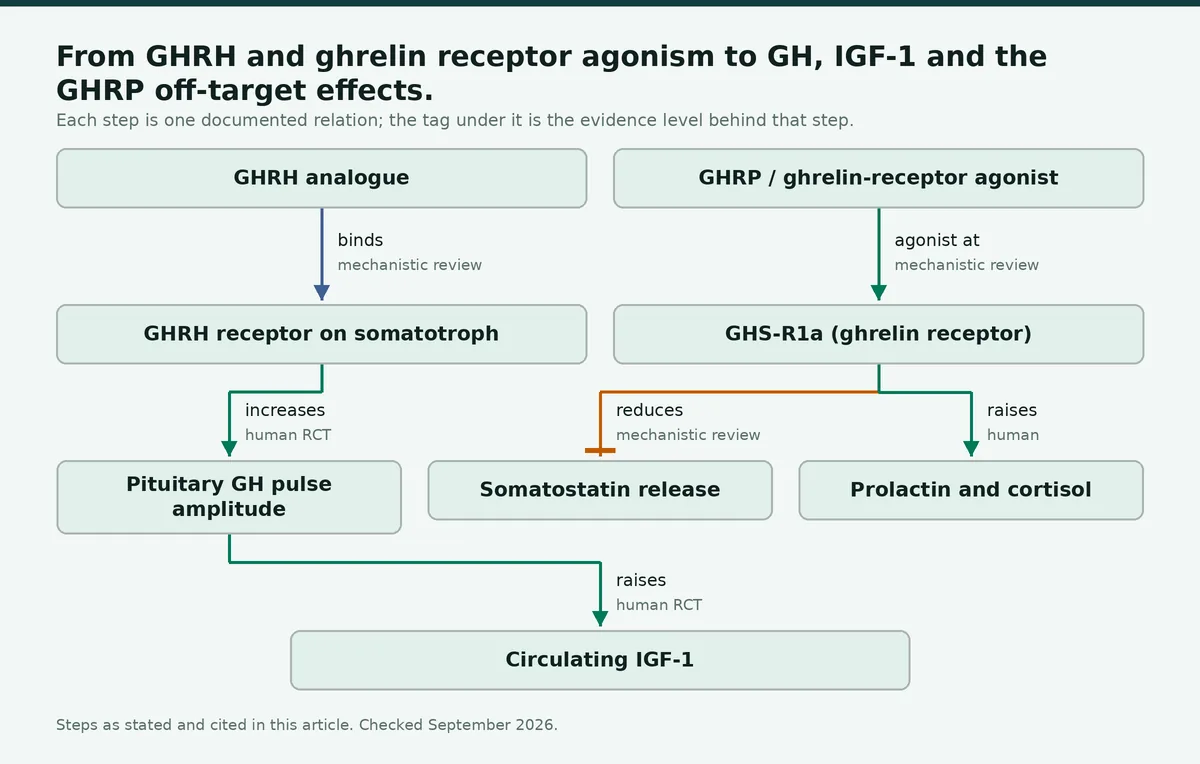
| Step | Relation | Target | Evidence |
|---|---|---|---|
| GHRH analogue | binds | GHRH receptor on somatotroph | mechanistic review [1][3] |
| GHRH receptor on somatotroph | increases | Pituitary GH pulse amplitude | human RCT [4] |
| Pituitary GH pulse amplitude | raises | Circulating IGF-1 | human RCT [4][8] |
| GHRP / ghrelin-receptor agonist | agonist at | GHS-R1a (ghrelin receptor) | mechanistic review [1][3] |
| GHS-R1a (ghrelin receptor) | reduces | Somatostatin release | mechanistic review [1] |
| GHS-R1a (ghrelin receptor) | raises | Prolactin and cortisol | human [3][7] |
A secretagogue is anything that makes a gland secrete. Growth hormone secretagogue peptides are short synthetic peptides that act upstream of growth hormone (GH) itself: rather than injecting recombinant GH, they stimulate the somatotroph cells of the anterior pituitary to release the GH already stored there [1].
That upstream position is the whole pitch for this class. Because release still passes through the pituitary, it remains partly governed by the body’s own control loops — somatostatin tone, and negative feedback from IGF-1 — so GH comes out in pulses rather than as a flat, continuous level [1][3]. Whether that matters for real-world outcomes is a separate question, and the human evidence is thinner than the marketing suggests.
Two receptor systems drive the class. The GHRH receptor is the target of hypothalamic GH-releasing hormone and its analogues. The second was found by reverse pharmacology: synthetic peptides released GH before anyone knew what they bound to. Expression cloning identified the GH secretagogue receptor (GHS-R), a G protein-coupled receptor expressed mainly in brain, pituitary and pancreas, and ghrelin was later identified as its natural agonist [1]. That is why “GHRP”, “ghrelin mimetic” and “GHS-R1a agonist” all name the same family. If peptide vocabulary is new, start with what peptides are.
GHRH analogues: sermorelin, CJC-1295, tesamorelin, Mod GRF 1-29
GHRH analogues are fragments or modified versions of human GH-releasing hormone. Native GHRH is 44 amino acids long; the first 29 residues carry most of the activity, which is where “GRF 1-29” comes from. They bind the GHRH receptor on somatotrophs and amplify GH pulse amplitude [1][3]. The family differs mainly in how long it survives in circulation:
- Sermorelin (GRF 1-29) is very short-acting, with a reported half-life of roughly 4.3 minutes [3]. It was approved in the US as Geref and is discussed below.
- Mod GRF 1-29, often sold as “CJC-1295 no DAC”, is a modified 1-29 fragment designed to resist enzymatic breakdown without the albumin-binding group. A 2026 review of this class concluded it is essentially uncharacterised in the peer-reviewed human literature, with no controlled human trials [3]. See CJC-1295 with DAC vs without DAC.
- CJC-1295 with DAC carries a drug-affinity complex that binds albumin, stretching its estimated half-life to 5.8–8.1 days in a human phase 1/2 program [4].
- Tesamorelin is a stabilised GHRH analogue with a reported half-life of 26–38 minutes and the only current FDA approval in the class [3][10].
The CJC-1295 data are the best human numbers in this family outside tesamorelin. In two randomized, placebo-controlled, double-blind ascending-dose trials in healthy adults aged 21–61, single injections raised plasma GH 2- to 10-fold in a dose-dependent way, with elevations persisting six days or more, and mean IGF-1 rose 1.5- to 3-fold for 9–11 days [4] (human RCT). No serious adverse reactions were reported, and tolerability was best at 30–60 µg/kg [4]. What those trials did not show is any clinical outcome: no muscle, fat, strength or performance endpoint.
Ghrelin-receptor agonists (GHRPs): ipamorelin, GHRP-2, GHRP-6, hexarelin
GHRPs act at GHS-R1a. Mechanistically they do more than one thing at once: work on this class describes increased GHRH release, enhanced GHRH signalling at the somatotroph, reduced somatostatin release, and antagonism of somatostatin receptor signalling [1]. That multi-pathway action is why GHRPs and GHRH analogues are synergistic — in a human dose-response study, a low hexarelin dose combined with GHRH produced a much larger GH rise than either alone [7].
What they do to pulsatility is subtler than “more GH”. A review of ghrelin’s role concluded that GHS-R1a signalling amplifies GH pulse height and area under the curve without changing the pulse rhythm; blocking the receptor reduced pulse amplitude while leaving the pattern intact [2] (human and animal work combined).
Selectivity is the axis that separates these compounds, because GHS-R1a agonism can spill into the pituitary–adrenal axis, prolactin and appetite:
- Hexarelin is the clearest example of spillover. In healthy men given 0–1.0 µg/kg intravenously, GH, prolactin and cortisol all rose dose-dependently: prolactin peaked around 180% above baseline and cortisol stepped up roughly 40% from 0.5 µg/kg [7] (human).
- GHRP-2 raises GH strongly and also stimulates eating. In 7 lean healthy men, a subcutaneous infusion of 1 µg/kg/h for 270 minutes increased food intake by about 36% versus saline [6] (human). A 2026 review describes transient cortisol and prolactin rises across the GHRP class, and GHRP-2 (pralmorelin) has an approved diagnostic use in Japan [3].
- GHRP-6 is the archetype: robust GH release, short-acting, and markedly orexigenic [3].
- Ipamorelin is the selective outlier. In the study that introduced it, ipamorelin matched GHRP-6 for GH potency and efficacy in rat pituitary cells and in conscious swine, but did not release ACTH or cortisol above what GHRH stimulation produced, even at 200-fold the GH ED50 [5]. That is animal and in-vitro data, not a human outcome, and its selectivity in humans is far less documented than forum posts imply. For a compound-by-compound read, see ipamorelin vs GHRP-2 vs GHRP-6.
GHRH vs GHRP: family comparison
| Feature | GHRH analogues | GHRPs / ghrelin-receptor agonists |
|---|---|---|
| Receptor | GHRH receptor (GHRH-R) [1][3] | GHS-R1a, the ghrelin receptor [1][3] |
| Effect on GH | Amplifies pulse amplitude; stays under somatostatin and IGF-1 feedback [1][3] | Amplifies pulse height and AUC; rhythm unchanged [2] |
| Mechanism breadth | Single receptor pathway [3] | Multi-pathway: GHRH release, somatotroph sensitisation, somatostatin suppression [1] |
| Cortisol / prolactin | Minimal reported [3] | Class-wide transient rises; marked for hexarelin and GHRP-2 [3][7] |
| Appetite | Minimal [3] | Marked; GHRP-2 raised food intake ~36% in healthy men [6] |
| Approved product | Tesamorelin (FDA, HIV lipodystrophy) [10]; sermorelin withdrawn [11] | None in the US; pralmorelin (GHRP-2) diagnostic in Japan [3] |
Reported half-life across the class
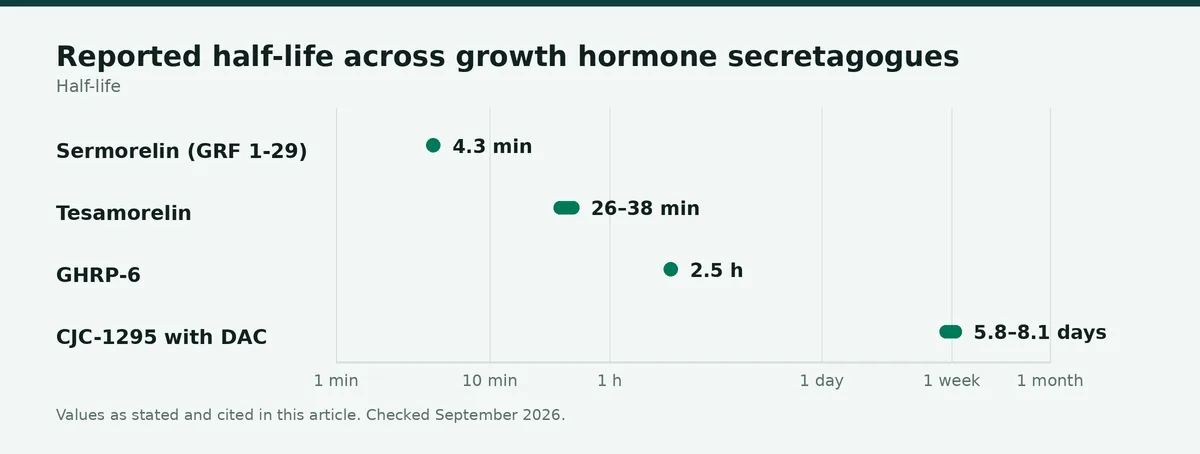
| Compound | Half-life | Evidence level |
|---|---|---|
| Sermorelin (GRF 1-29) | 4.3 min | human pharmacokinetics [3] |
| Tesamorelin | 26–38 min | human, on the FDA label [3][10] |
| GHRP-6 | 2.5 h | human [3][7] |
| CJC-1295 with DAC | 5.8–8.1 days | human phase 1/2 programme [4] |
Only the four compounds with a published half-life in the sources cited here appear above. Ipamorelin, GHRP-2, hexarelin and Mod GRF (1-29) are discussed in the literature without a figure we could verify, so they are left out rather than estimated.
What the human evidence actually supports
Tesamorelin has the deepest file. In a 26-week randomized, double-blind, placebo-controlled trial of 412 people with HIV and abdominal fat accumulation, 2 mg daily subcutaneously reduced visceral adipose tissue by 15.2% while placebo rose 5.0%; triglycerides fell and IGF-1 rose 81.0% [8] (human RCT). A pooled analysis of two phase 3 trials (n=806) reproduced the visceral fat effect at week 26 and maintained it to week 52, with IGF-1 up a mean 108 ng/mL and no clinically meaningful between-group differences in glucose parameters at either timepoint [9] (human RCT). Our tesamorelin product review covers what is sold under that name outside the pharmacy channel.
The oral non-peptide contrast: MK-677 (ibutamoren). MK-677 is a small molecule, not a peptide, but it is a GHS-R1a agonist and carries the longest controlled dataset in the secretagogue field. In a 2-year double-blind randomized trial in 65 healthy adults aged 60–81, 25 mg orally once daily restored 24-hour mean GH and IGF-1 to young-adult ranges and increased fat-free mass by 1.1 kg versus a 0.5 kg loss on placebo [12] (human RCT). It did not reduce abdominal visceral fat or total fat mass; body weight rose 2.7 kg versus 0.8 kg; fasting glucose rose 0.3 mmol/L and insulin sensitivity decreased [12]. Reported effects included increased appetite that subsided over months and transient mild lower-extremity oedema and muscle pain [12].
Everything else is thinner than it looks. The 2026 review that graded this field placed tesamorelin in its top evidence tier and compounds with no peer-reviewed human studies at the bottom, concluding that body-composition and performance claims in healthy people rest largely on biological plausibility rather than controlled trials [3]. Read sermorelin vs tesamorelin for how far apart two compounds in one family can sit on evidence.
Side effects and risks
The risks in this class are the risks of raising GH and IGF-1, and they are documented on an approved label — which is more than can be said for most research peptides.
Fluid retention. The tesamorelin label states fluid retention may occur during therapy, presenting as oedema, arthralgia or carpal tunnel syndrome [10]. The MK-677 trial reported transient mild lower-limb oedema [12].
Glucose and insulin sensitivity. The tesamorelin label warns that treatment can result in glucose intolerance, citing a hazard ratio of 3.3 versus placebo for that outcome [10]. In the MK-677 trial, fasting glucose rose and insulin sensitivity fell [12]. This is a class-level signal, not a quirk of one compound [3].
IGF-1 elevation. Sustained IGF-1 elevation is the intended effect and the main open safety question. The tesamorelin label instructs prescribers to monitor IGF-1 and to consider stopping if it stays elevated [10], and it carries a warning about increased risk of neoplasms in this population [10]. Reviews of the class describe the mitogenic concern as theoretical but real [3].
Off-target hormones. For GHRP-6, GHRP-2 and hexarelin, expect cortisol and prolactin movement and appetite stimulation, documented in human dose-response work [3][6][7].
Unknowns for unapproved compounds. No systematic human safety dataset exists for CJC-1295 no DAC, ipamorelin or hexarelin in healthy people. The FDA’s list of bulk substances that may present significant safety risks includes GHRP-2, GHRP-6, ipamorelin acetate and ibutamoren mesylate, citing immunogenicity from aggregation and peptide-related impurities and, for ibutamoren, congestive heart failure in certain patients [14] (checked September 2026).
Regulatory and legal status (2026)
Tesamorelin is FDA-approved (initial US approval 2010) for reduction of excess abdominal fat in HIV-infected adult patients with lipodystrophy, given as 1.28 mg subcutaneously once daily in the current formulation [10] (checked September 2026). It is a prescription drug; that approval does not extend to anti-ageing, bodybuilding or general metabolic use.
Sermorelin was approved in the US as Geref: NDA 19-863 (0.05 mg, for assessing pituitary GH secretion) in December 1990, and NDA 20-443 (0.5 and 1.0 mg, for idiopathic GH deficiency in children with growth failure) in September 1997 [11]. Both were discontinued in 2008 and the approvals were withdrawn effective 18 June 2009; the FDA determined the withdrawals were not for reasons of safety or effectiveness [11] (checked September 2026). So sermorelin has an approval history but no marketed US product.
CJC-1295, Mod GRF 1-29, ipamorelin, GHRP-2, GHRP-6 and hexarelin have no FDA approval for any indication and are sold for research use only. Several appear on the FDA’s list of bulk drug substances that may present significant safety risks [14] (checked September 2026). Rules differ by country and change; see are peptides legal?.
WADA. Growth hormone secretagogues — GHRH analogues and GHRPs alike — sit in section S2, peptide hormones, growth factors, related substances and mimetics, and are prohibited at all times, in and out of competition [13]. The same review notes GHRPs were detected 23 times in WADA-accredited laboratories in 2016–2017, more often than GH itself [13]. WADA republishes the List each January, so athletes should check the current edition.
Comparison Framework scores
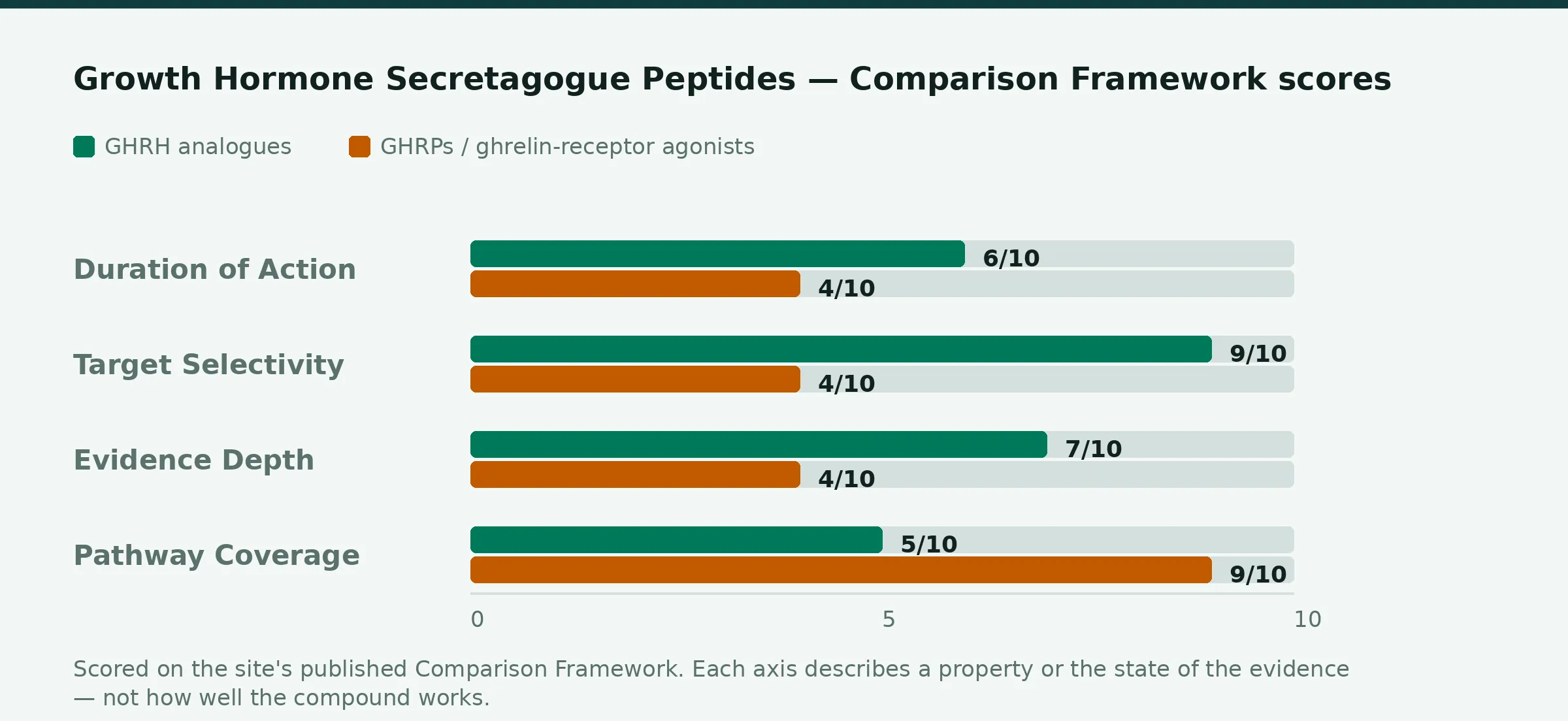
Scored on the site’s Comparison Framework axes, by family rather than by compound.
GHRH analogues
| Axis | Score | Why |
|---|---|---|
| Duration of Action | 6/10 | Spans minutes to days: sermorelin ~4.3 min, tesamorelin 26–38 min, CJC-1295 with DAC 5.8–8.1 days [3][4] |
| Target Selectivity | 9/10 | Single receptor (GHRH-R) with minimal reported cortisol or prolactin effect [3] |
| Evidence Depth | 7/10 | Tesamorelin has phase 3 RCTs and an FDA label [8][9][10]; CJC-1295 no DAC has none [3] |
| Pathway Coverage | 5/10 | One receptor pathway [1][3] |
GHRPs / ghrelin-receptor agonists
| Axis | Score | Why |
|---|---|---|
| Duration of Action | 4/10 | Short-acting; GHRP-6 half-life reported around 2.5 h, hexarelin studied as repeated daily doses [3][7] |
| Target Selectivity | 4/10 | Class-wide cortisol, prolactin and appetite effects; ipamorelin is the exception, on animal data [3][5][6][7] |
| Evidence Depth | 4/10 | No FDA approval; human data are mostly acute endocrine studies, not outcome trials [3][6][7] |
| Pathway Coverage | 9/10 | Acts through GHRH release, somatotroph sensitisation and somatostatin suppression [1] |
Sourcing and quality: what to look for
Everything in this class except tesamorelin reaches buyers through the research-chemical channel, where identity and purity are claims rather than regulated facts. The FDA’s stated concern for several of these peptides is immunogenicity arising from aggregation and peptide-related impurities [14] — a purity problem, not a mechanism problem.
Three things are worth checking first: a batch-specific certificate of analysis rather than a generic one, HPLC purity plus mass-spectrometry identity confirmation, and a named third-party laboratory. Our guides on reading a peptide COA and HPLC and mass spec purity testing cover what those documents should contain. Blends such as CJC-1295 with ipamorelin add a wrinkle: one vial holding two peptides needs both identities and both purities documented, not a single combined figure.
FAQ
Are growth hormone secretagogues the same as HGH?
No. Recombinant GH supplies the hormone directly; secretagogues prompt the pituitary to release its own, so output stays pulsatile and partly subject to somatostatin and IGF-1 feedback [1][3].
Which is better, GHRH analogues or GHRPs?
They are not interchangeable. GHRH analogues are more selective; GHRPs act through several pathways and are more likely to move cortisol, prolactin and appetite [1][3][7]. The only family member with phase 3 human outcome data is tesamorelin [8][9].
Is any growth hormone secretagogue FDA-approved?
Tesamorelin is, for reduction of excess abdominal fat in adults with HIV-associated lipodystrophy [10]. Sermorelin was approved but withdrawn from the US market in 2009 for non-safety reasons [11]. Everything else in the class is research-use-only (checked September 2026).
Does ipamorelin really avoid raising cortisol?
In the study that introduced it, ipamorelin did not raise ACTH or cortisol beyond GHRH-level stimulation even at 200-fold the GH ED50 — in rats and swine [5]. That is animal evidence, and it has not been replicated by comparable controlled human trials.
Do these peptides build muscle or burn fat in healthy adults?
Human data are limited and mixed. Tesamorelin reduced visceral fat in people with HIV-associated lipodystrophy [8][9]; MK-677 added 1.1 kg of fat-free mass over 12 months in healthy older adults but did not reduce fat mass and lowered insulin sensitivity [12]. Reviews conclude claims in healthy athletes rest on plausibility rather than trials [3][13].
Are they allowed in competitive sport?
No. GHRH analogues and GHRPs fall under WADA section S2 and are prohibited at all times [13].
References
- Smith RG. Development of Growth Hormone Secretagogues. Endocrine Reviews. 2005;26(3):346–360. https://academic.oup.com/edrv/article/26/3/346/2355231
- Dickson SL. Ghrelin’s effects on growth hormone release: to pulse or not to pulse? Nature Reviews Endocrinology. 2022. https://www.nature.com/articles/s41574-022-00698-z
- Dominikowski et al. The emerging landscape of performance-enhancing peptides modulating the GH-IGF1 axis: bridging the gap between clinical evidence and patient self-administration. Frontiers in Endocrinology. 2026. doi:10.3389/fendo.2026.1822475. https://www.frontiersin.org/journals/endocrinology/articles/10.3389/fendo.2026.1822475/full
- Teichman SL, Neale A, Lawrence B, et al. Prolonged stimulation of growth hormone (GH) and insulin-like growth factor I secretion by CJC-1295, a long-acting analog of GH-releasing hormone, in healthy adults. The Journal of Clinical Endocrinology & Metabolism. 2006;91(3):799–805. https://academic.oup.com/jcem/article-abstract/91/3/799/2843281
- Raun K, Hansen BS, Johansen NL, et al. Ipamorelin, the first selective growth hormone secretagogue. European Journal of Endocrinology. 1998;139(5):552–561. https://pubmed.ncbi.nlm.nih.gov/9849822/
- Laferrère B, Abraham C, Russell CD, Bowers CY. Growth hormone releasing peptide-2 (GHRP-2), like ghrelin, increases food intake in healthy men. The Journal of Clinical Endocrinology & Metabolism. 2005;90(2):611–614. https://academic.oup.com/jcem/article-abstract/90/2/611/2836522
- Massoud AF, Hindmarsh PC, Brook CG. Hexarelin-induced growth hormone, cortisol, and prolactin release: a dose-response study. The Journal of Clinical Endocrinology & Metabolism. 1996;81(12):4338–4341. https://academic.oup.com/jcem/article-abstract/81/12/4338/2650623
- Falutz J, Allas S, Blot K, et al. Metabolic effects of a growth hormone-releasing factor in patients with HIV. New England Journal of Medicine. 2007;357:2359–2370. https://pubmed.ncbi.nlm.nih.gov/18057338/
- Falutz J, Mamputu JC, Potvin D, et al. Effects of tesamorelin (TH9507), a growth hormone-releasing factor analog, in HIV-infected patients with excess abdominal fat: a pooled analysis of two multicenter, double-blind placebo-controlled phase 3 trials with safety extension data. The Journal of Clinical Endocrinology & Metabolism. 2010;95(9):4291–4304. https://pubmed.ncbi.nlm.nih.gov/20554713/
- Theratechnologies. EGRIFTA WR (tesamorelin) for injection — Full Prescribing Information. DailyMed, U.S. National Library of Medicine. 2025. https://dailymed.nlm.nih.gov/dailymed/drugInfo.cfm?setid=839334d3-8c1d-4c26-9036-2ab524a6ea75
- U.S. Food and Drug Administration. Determination That GEREF (Sermorelin Acetate) Injection … Were Not Withdrawn From Sale for Reasons of Safety or Effectiveness. Federal Register. 2013. https://www.federalregister.gov/documents/2013/03/04/2013-04827/determination-that-geref-sermorelin-acetate-injection-05-milligrams-basevial-and-10-milligrams
- Nass R, Pezzoli SS, Oliveri MC, et al. Effects of an oral ghrelin mimetic on body composition and clinical outcomes in healthy older adults: a randomized trial. Annals of Internal Medicine. 2008;149(9):601–611. https://pubmed.ncbi.nlm.nih.gov/18981485/
- Holt RIG, Ho KKY. The Use and Abuse of Growth Hormone in Sports. Endocrine Reviews. 2019;40(4):1163–1185. https://academic.oup.com/edrv/article/40/4/1163/5512652
- U.S. Food and Drug Administration. Certain Bulk Drug Substances for Use in Compounding that May Present Significant Safety Risks. FDA, updated April 2026. https://www.fda.gov/drugs/human-drug-compounding/certain-bulk-drug-substances-use-compounding-may-present-significant-safety-risks