Quick answer: Melanotan II is a synthetic, non-selective melanocortin receptor agonist — it activates MC1R through MC5R rather than one target — and holds no marketing authorisation as a medicine in the US, EU or UK. The human evidence is three small studies from 1996–2000: a three-subject phase-I pigmentation trial and two ten-man placebo-controlled crossover trials of erectile response. Against that sits a case-report literature of eruptive naevi, melanoma, rhabdomyolysis and renal infarction. Evidence Depth scores 4/10.
| Spec | Detail |
|---|---|
| Also known as | Melanotan 2, MT-II, MT-2; sold illicitly as a tanning injection or nasal spray [8][10] |
| Class | Synthetic cyclic α-MSH analogue; non-selective melanocortin agonist [1][2][8] |
| Receptor targets | MC1R (skin), MC2R (adrenal), MC3R (brain, gut), MC4R (CNS), MC5R (exocrine glands) [1] |
| Reported human half-life | None published in any source opened here; the approved agonists run ~15 h and ~2.7 h [11][12] |
| Regulatory status (US) | No FDA marketing authorisation; the FDA-approved melanocortin agonists are afamelanotide and bremelanotide (checked September 2026) [11] |
| Regulatory status (UK/EU) | Unauthorised medicine; sale, supply and advertising not permitted in the UK, no EU authorisation (checked September 2026) [10][13] |
| WADA status | Not verified — the Prohibited List could not be retrieved this run, so no status is asserted (checked September 2026) |
What is Melanotan II?
Melanotan II is a laboratory-made cyclic peptide modelled on α-melanocyte-stimulating hormone (α-MSH), the hormone that drives skin pigmentation. It was built to be more potent and longer-acting, and the trade-off is that it is non-selective: a peer-reviewed review calls it “a non-selective melanocortin-receptor agonist” acting across the MC1 to MC5 subtypes, which sit in skin, adrenal cortex, brain, gut and exocrine glands [1]. If the vocabulary is new, start with what a peptide actually is.
A molecule engaging five receptor families has a spread of effects, only one of which — pigmentation — is what buyers want; and having never completed a development programme, that spread was never characterised.
Three near-neighbours get confused with it. Afamelanotide (Scenesse) is the MC1R-directed α-MSH analogue that is approved, for phototoxicity in erythropoietic protoporphyria only [11][13]. Bremelanotide (Vyleesi) is also non-selective, label potency ranked MC1R > MC4R > MC3R > MC5R > MC2R [12] — the closest approved relative, covered as PT-141 (bremelanotide). Melatonin is an unrelated pineal hormone, confused often enough that a 2010 case report of tanning-induced naevi appeared under that word while describing melanotan injections [6][7].
How Melanotan II works (mechanism)
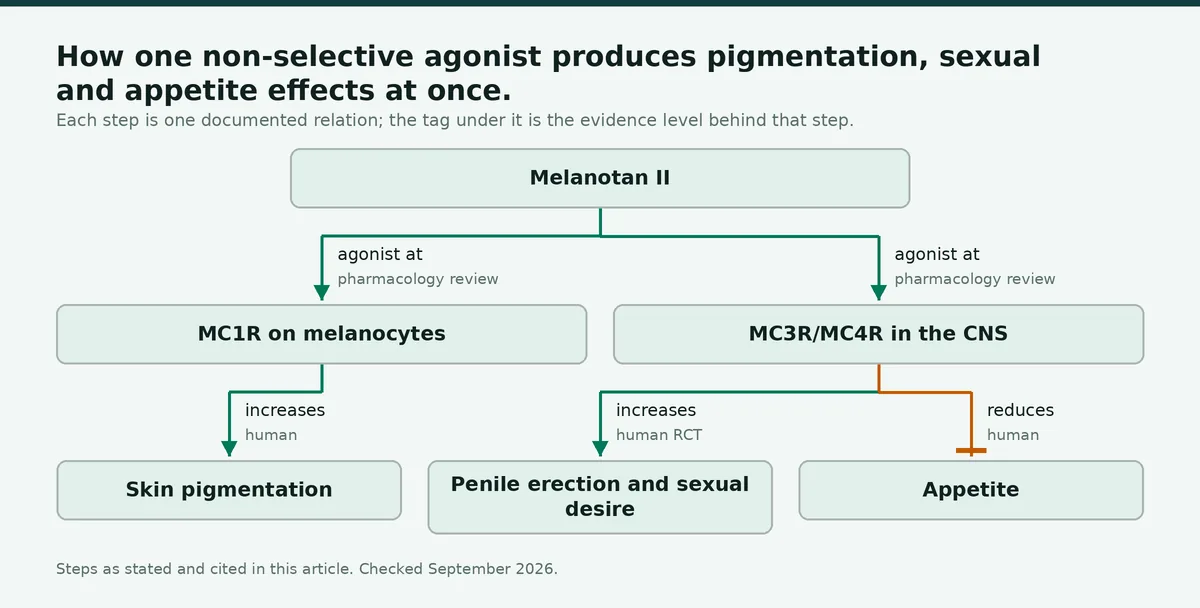
| Step | Relation | Target | Evidence |
|---|---|---|---|
| Melanotan II | agonist at | MC1R on melanocytes | pharmacology review [1] |
| Melanotan II | agonist at | MC3R/MC4R in the CNS | pharmacology review [1] |
| MC1R on melanocytes | increases | Skin pigmentation | human [2] |
| MC3R/MC4R in the CNS | increases | Penile erection and sexual desire | human RCT [3][4] |
| MC3R/MC4R in the CNS | reduces | Appetite | human [2][4] |
The receptor assignments in the first two rows come from the pharmacology literature as summarised in a review, not from human outcome measurement [1]. The human studies show those arms are engaged in people: pigmentation rose in two of three phase-I volunteers [2], erectile response and subjective desire exceeded placebo in two crossover trials [3][4], and decreased appetite appeared in both [2][4]. MC5R and MC2R are also engaged [1] but have no characterised human outcome here.
Key numbers: half-life across the melanocortin class
No human half-life for melanotan II appears in any source opened for this page — a consequence of never having gone through a regulated development programme, which is where such values get measured. The two melanocortin agonists that did go through one carry label pharmacokinetics, and the spread between them is the useful comparison.
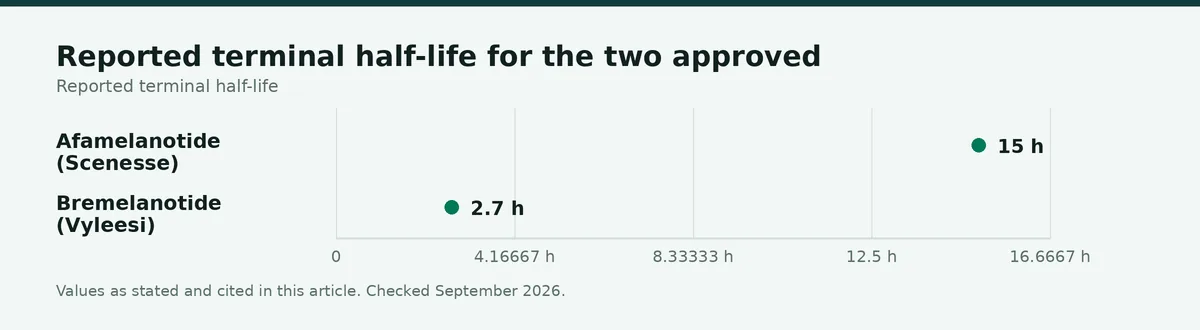
| Compound | Reported terminal half-life | Evidence |
|---|---|---|
| Afamelanotide (Scenesse) | 15 h | human PK, FDA label [11] |
| Bremelanotide (Vyleesi) | 2.7 h | human PK, FDA label [12] |
Afamelanotide’s figure follows a 16 mg implant given every two months, bremelanotide’s a single 1.75 mg dose [11][12]. A fivefold spread inside one class shows “melanocortin agonist” says nothing about duration by itself — and that a half-life quoted for melanotan II has no published human source behind it.
What the research shows
Human studies
Pigmentation, phase I (n=3). A single-blind, placebo-controlled pilot trial gave three healthy male volunteers subcutaneous melanotan II or saline on weekdays for two weeks, from 0.01 mg/kg escalating to 0.025–0.03 mg/kg. Two of three showed increased pigmentation in the face, upper body and buttock on quantitative reflectance a week later [2]. Human, n=3 — the whole of the controlled human pigmentation evidence for a compound sold worldwide as a tanning agent.
Erectile response (n=10, randomised crossover). In ten men with psychogenic erectile dysfunction, 0.025 mg/kg subcutaneously produced clinically apparent erections in eight; mean duration of tip rigidity above 80% was 38.0 minutes versus 3.0 with placebo (p = 0.0045) [3]. Human RCT.
Erectile response and desire (n=10, randomised crossover). A second crossover trial in ten men with organic erectile dysfunction at the same dose reported erections after 12 of 19 active administrations versus 1 of 21 placebo doses, tip rigidity above 80% lasting 45.3 versus 1.9 minutes, and a significant rise in subjective desire [4]. Human RCT.
User-reported experience. A qualitative analysis of 623 discussion entries from 205 participants on UK and Ireland forums (2016–2017) found users motivated mainly by wanting a tan, and flagged infectious disease transmission, contaminated product and sunbed exposure as what clinicians should ask about [9]. Human observational, self-reported.
Animal and in-vitro work
No animal or in-vitro study was opened for this page, so none is cited as a finding; the receptor pharmacology in the mechanism section comes from a review’s summary, not a primary binding assay [1].
Side effects and risks
This is the best-documented part of the melanotan II literature, and it rests mostly on case reports. The kinds of harm are known; the rates are not.
Acute effects in the trials. Mild nausea occurred at most dose levels in the phase-I study, with a stretching-and-yawning complex, decreased appetite, somnolence and fatigue at the highest dose, and spontaneous penile erections lasting one to five hours after dosing [2]. Nausea, yawning and stretching were more frequent than placebo in the 1998 trial [3], and severe nausea accompanied 4 of 19 active injections in 2000 [4]. The approved non-selective relative’s label quantifies the same direction of effect: nausea 40%, flushing 20.3%, rises of 6 mmHg systolic and 3 mmHg diastolic blood pressure, heart rate down up to 5 bpm [12].
Pigmented lesions. A 2010 report described a 25-year-old man who developed multiple lentigines and naevi on the trunk and neck after roughly 150 melanotan injections; excised lesions were a dermal naevus and a lentigo with no malignant transformation, and the authors warned that over-the-counter availability could increase freckles, lentigines, naevi “and possibly melanoma” [6]. A 2011 letter described the same augmentation in a young man who self-injected melanotan, with a suspicious naevus excised and benign histology [7]. Case reports. A 2010 review put the consequence plainly: these compounds “complicate the clinical presentation of patients with pigmented lesions” [8].
Melanoma. A 2014 case report described a 20-year-old woman with Fitzpatrick skin type II who presented with a suspicious black gluteal lesion and intensified pigmentation three months after a three- to four-week course of self-administered subcutaneous melanotan II used to enhance tanning bed results; it was a histologically confirmed cutaneous melanoma. The authors noted the plausibility of melanocyte stimulation plus sunbed exposure, stopped short of asserting causation, and called the drug “unlicensed and incompletely tested” [5]. Case report — one case with concurrent sunbed use cannot establish causation.
Systemic and vascular events. A 2020 case report with literature review described a 45-year-old man with right-sided renal infarction affecting roughly 50% of the kidney after a reported cumulative 27 mg self-administered subcutaneously over six months; CT showed normal renal arteries and no embolic source, and his blood pressure was 165/95 mmHg. The same review catalogues harms reported to that point: rhabdomyolysis and renal failure, abdominal pain, anxiety, flushing, dizziness, headache, appetite suppression, raised blood pressure and skin cancer induction [1]. Case report plus narrative review.
Product quality. Because melanotan II reaches users outside any regulated supply chain, what is in the vial is unverified. Regulators have raised the risk of blood-borne virus transmission from needle sharing and of product impurity [7][8], and the forum study found users discussing contaminated product as normal practice [9]. These are documented clinical concerns, not assay results — no analytical study of purchased product could be opened this run. See reading a certificate of analysis and HPLC and mass-spec purity testing.
Reporting is sparse. The UK regulator received 16 spontaneous adverse reaction reports for melanotan II products in the eleven years to 31 December 2022, and cautions that a report does not establish causation [10]. That describes the reporting system, not the safety profile: absence of rate data is not evidence of rarity.
Regulatory and legal status (2026)
Melanotan II holds no marketing authorisation as a medicine in the United States, the European Union or the United Kingdom, checked September 2026. The approved melanocortin agonists are other molecules: afamelanotide, FDA-approved in 2019 to increase pain-free light exposure in adults with a history of phototoxic reactions from erythropoietic protoporphyria [11] and authorised in the EU since 22 December 2014 under exceptional circumstances [13]; and bremelanotide, FDA-approved in 2019 for hypoactive sexual desire disorder [12].
The MHRA treats injectable melanotan II products and pens as medicines, and nasal sprays as medicines if marketed with disease claims; “the sale, supply and advertising of unauthorised medicines is not permitted under the Human Medicines Regulations”, and it “has repeatedly taken action to remove Melanotan products from the market for over 10 years” [10].
The WADA Prohibited List could not be retrieved this run, so this page asserts nothing about whether melanotan II appears on it — treat any claim either way as unverified. On US categories generally, see are peptides legal? and research vs compounded vs approved peptides.
Comparison Framework scores
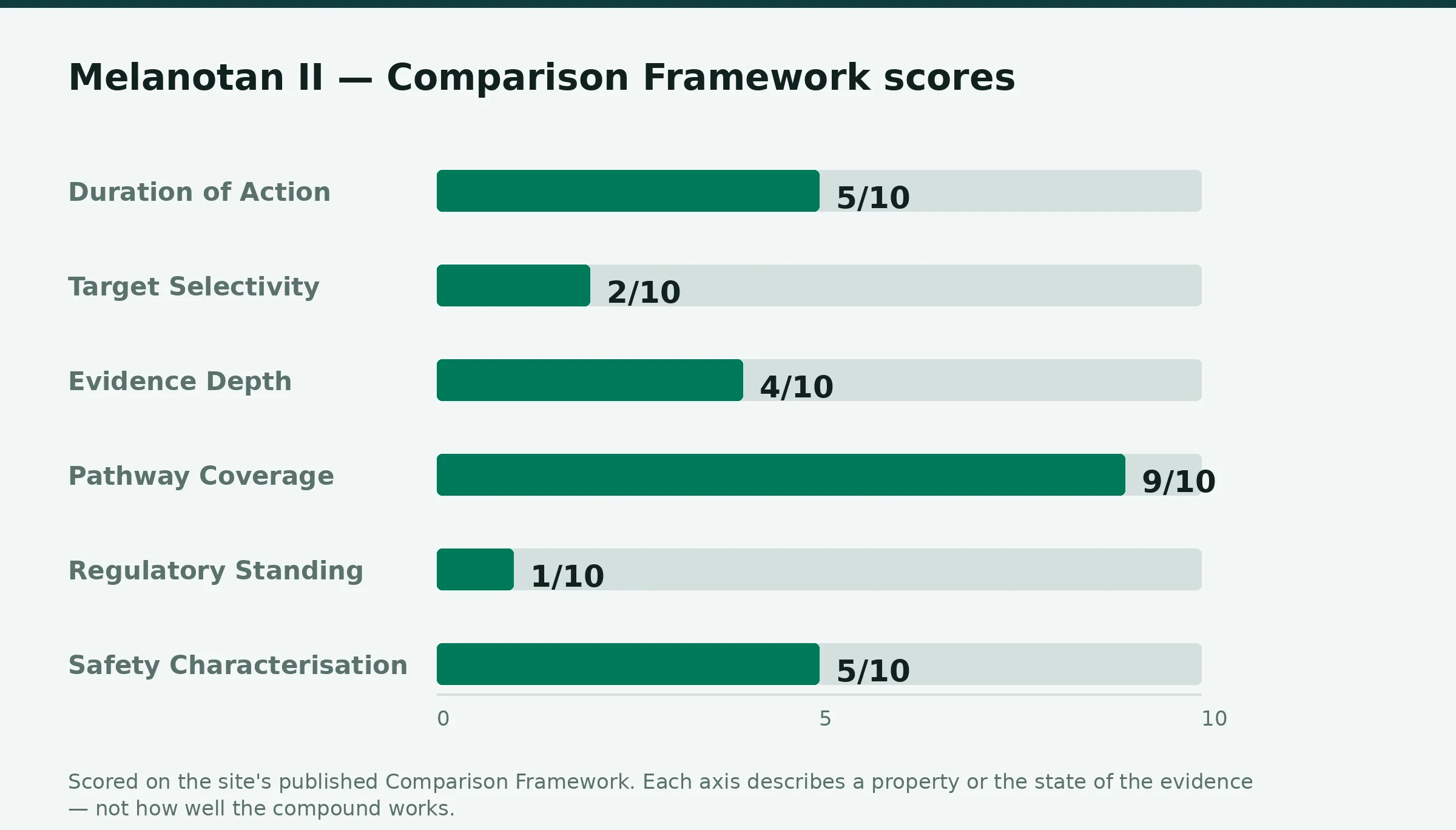
| Axis | Score | Why |
|---|---|---|
| Duration of Action | 5/10 | No published human half-life, so scored from acute effects: erections one to five hours after one dose [2], tip rigidity above 80% for 38–45 minutes [3]. The anchors fix only the ends, so this interpolates [4] |
| Target Selectivity | 2/10 | Explicitly non-selective across MC1R–MC5R [1]. No bands published; 2 reflects five receptor families with no preferential action at the intended one — a description, not a verdict [1] |
| Evidence Depth | 4/10 | Interpolated just below the published small-human band (5–6): the only randomised data are two ten-man crossover trials [3][4] and a three-subject phase-I study, none on the tanning use [2] |
| Pathway Coverage | 9/10 | Five melanocortin subtypes across pigmentary, central nervous, adrenal and exocrine pathways [1], with human effects in at least three — pigmentation, sexual response, appetite [2][3] |
| Regulatory Standing | 1/10 | No authorisation in the US, EU or UK; the UK regulator treats injectable product as unauthorised and has acted to remove it for over a decade (checked September 2026) [10]. At or below the research-use band (2–3), so it interpolates to the floor [11] |
| Safety Characterisation | 5/10 | Kinds of harm are well described — nausea, flushing, blood-pressure change in trials [2][3]; naevus eruption, melanoma, rhabdomyolysis, renal infarction in case reports [1][5][6] — but no controlled dataset gives rates [10] |
A mid-range Safety Characterisation score describes how completely risks have been documented, not that they are small: documented harm here includes a confirmed melanoma in a user [5] and a 50% renal infarction in another [1]. Our Comparison Framework sets out each axis.
How Melanotan II compares
Against afamelanotide, melanotan II is the unapproved, non-selective version of the same idea: afamelanotide went through trials and carries FDA and EMA labels with a quantified adverse-reaction table — implant site reaction 21%, nausea 19%, melanocytic naevus 4% versus 2% on vehicle [11]. Against bremelanotide the comparison is closer still, and the difference is documentation rather than chemistry [12]; see PT-141. Against skin-directed peptides such as GHK-Cu, it drives pigment through a receptor family that also sits in brain, gut and adrenal cortex — which is why its adverse-event list reads like a systemic drug’s.
Sourcing and quality: what to look for
Melanotan II is not sold through any legitimate pharmaceutical channel, so there is no supply chain to audit. Where research-use material is sold the questions are the ordinary ones: a batch-specific certificate of analysis naming method, date and batch; identity by mass spectrometry and purity by HPLC; independent testing rather than the seller’s own vendor red flags. Even so, a COA covers one batch and says nothing about sterility, endotoxin or what else is in the vial — the dermatology concerns about impurity and infection are about that gap [7][8]. And no analysis changes the regulatory position as of September 2026.
FAQ
Is Melanotan II the same as afamelanotide or Scenesse?
No. Afamelanotide (Scenesse) is an MC1R-directed α-MSH analogue approved by the FDA in 2019 and in the EU since December 2014, only for phototoxic reactions in erythropoietic protoporphyria [11][13]. Melanotan II is a different, non-selective molecule active across MC1R to MC5R [1], unauthorised anywhere as of September 2026 [10].
Is Melanotan II legal to buy?
It holds no medicines authorisation in the US, EU or UK. The MHRA treats injectable melanotan II products as unauthorised medicines, states that “the sale, supply and advertising of unauthorised medicines is not permitted”, and has acted repeatedly to remove them for over ten years [10]. Checked September 2026; rules differ by country.
What does the human research on Melanotan II actually show?
Three small studies. A three-subject phase-I trial found increased pigmentation in two of three volunteers at 0.01–0.03 mg/kg [2], and two ten-man double-blind placebo-controlled crossover trials found erectile response, and in the later one subjective desire, above placebo at 0.025 mg/kg [3][4]. No controlled trial has tested the cosmetic tanning use.
Does Melanotan II cause melanoma?
Not established. A 2014 case report described a histologically confirmed cutaneous melanoma in a 20-year-old woman three months after a short course of melanotan II taken alongside tanning bed use; the authors called the link concerning but did not claim causation [5]. Other case reports document new and darkening naevi and lentigines, with benign histology on excision [6][7].
Why do sellers quote a half-life for Melanotan II?
No human half-life for melanotan II appears in any primary source opened for this page, because it never completed a regulated programme where such values get measured. The figures that exist belong to other molecules: about 15 hours for afamelanotide, about 2.7 hours for bremelanotide, both from FDA labels [11][12].
References
- Peters B, Hadimeri H, Wahlberg R, Afghahi H. Melanotan II: a possible cause of renal infarction: review of the literature and case report. CEN Case Reports. 2020. https://pmc.ncbi.nlm.nih.gov/articles/PMC7148395/
- Dorr RT, Lines R, Levine N, Brooks C, Xiang L, Hruby VJ, Hadley ME. Evaluation of melanotan-II, a superpotent cyclic melanotropic peptide in a pilot phase-I clinical study. Life Sciences. 1996;58(20). https://www.sciencedirect.com/science/article/abs/pii/0024320596001609
- Wessells H, Fuciarelli K, Hansen J, Hadley ME, Hruby VJ, Dorr R, Levine N. Synthetic melanotropic peptide initiates erections in men with psychogenic erectile dysfunction: double-blind, placebo controlled crossover study. The Journal of Urology. 1998;160(2):389–393. https://www.sciencedirect.com/science/article/pii/S0022534701629033
- Wessells H, Gralnek D, Dorr R, Hruby VJ, Hadley ME, Levine N. Effect of an alpha-melanocyte stimulating hormone analog on penile erection and sexual desire in men with organic erectile dysfunction. Urology. 2000;56(4):641–646. https://www.sciencedirect.com/science/article/pii/S0090429500006804
- Hjuler KF, Lorentzen HF. Melanoma Associated with the Use of Melanotan-II. Dermatology. 2014;228(1):34–36. https://karger.com/drm/article/228/1/34/114247/Melanoma-Associated-with-the-Use-of-Melanotan-II
- Thestrup-Pedersen K, Søndergaard K. Melatonin Used for Tanning Induces and Augments Lentigines and Naevi. Acta Dermato-Venereologica. 2010;90:1–2. https://medicaljournalssweden.se/actadv/article/view/7822
- Langan EA, Rhodes LE. Melanotropic Peptides: What Exactly is Meant by “Melanotan”? Acta Dermato-Venereologica. 2011;91:377–378. https://medicaljournalssweden.se/actadv/article/view/9078
- Langan EA, Nie Z, Rhodes LE. Melanotropic peptides: more than just ‘Barbie drugs’ and ‘sun-tan jabs’? British Journal of Dermatology. 2010;163(3):451–455. https://academic.oup.com/bjd/article-abstract/163/3/451/6642605
- Gilhooley E, Daly S, McKenna D. Melanotan II User Experience: A Qualitative Study of Online Discussion Forums. Dermatology. 2021;237(6):995–999. https://karger.com/drm/article-abstract/237/6/995/828180/Melanotan-II-User-Experience-A-Qualitative-Study
- Medicines and Healthcare products Regulatory Agency. Freedom of Information response FOI 24/274 — side effect reports of melanotan II products. 17 April 2024. https://assets.publishing.service.gov.uk/media/669fbd3aa3c2a28abb50d55a/Final_Redaction_FOI_24_274.pdf
- US Food and Drug Administration. SCENESSE (afamelanotide) implant, for subcutaneous use — prescribing information. 2024. https://www.accessdata.fda.gov/drugsatfda_docs/label/2024/210797s007lbl.pdf
- US Food and Drug Administration. VYLEESI (bremelanotide injection), for subcutaneous use — prescribing information. 2019. https://www.accessdata.fda.gov/drugsatfda_docs/label/2019/210557s000lbl.pdf
- European Medicines Agency. Scenesse (afamelanotide) — European public assessment report. Authorised 22 December 2014. https://www.ema.europa.eu/en/medicines/human/EPAR/scenesse