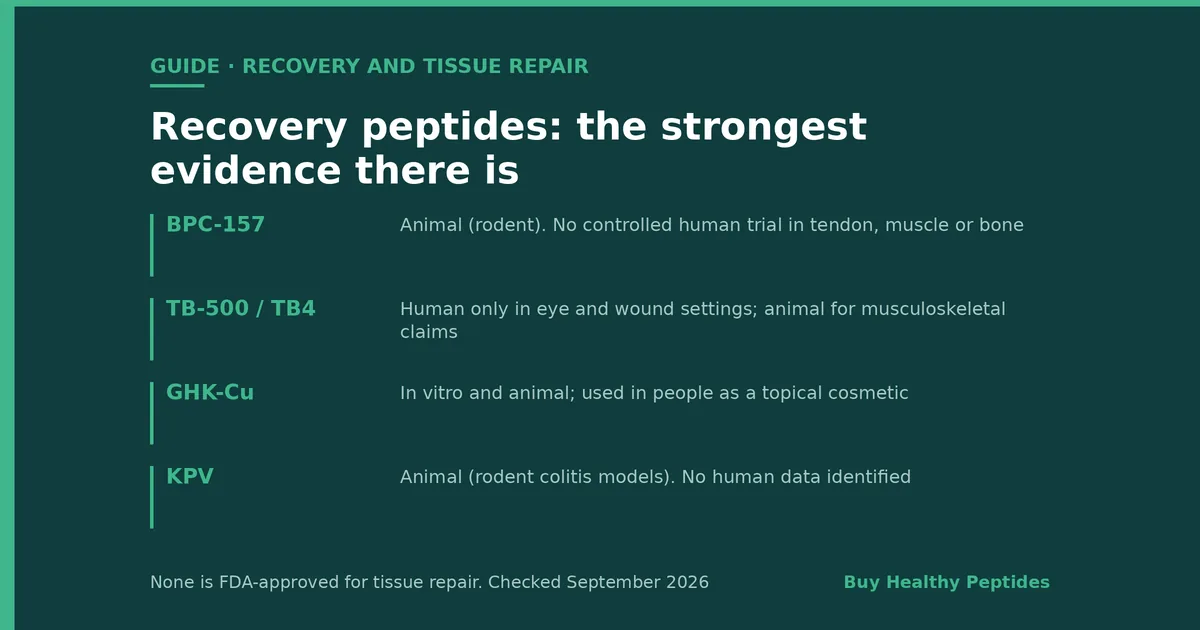
Quick answer: “Healing peptides” is a marketing umbrella for compounds sold for tissue repair, most often BPC-157, TB-500, GHK-Cu and KPV. The laboratory case for them rests on real mechanisms — angiogenesis, cell migration, NF-κB signalling — but the published literature is overwhelmingly animal and in vitro, and no controlled human trial has shown that any of them repairs a tendon, muscle or joint [1][3][4]. All four appear on the FDA’s list of bulk drug substances that may present significant safety risks, and BPC-157 and thymosin beta-4 derivatives are prohibited in sport (checked September 2026) [4][9][11].
| Compound | Class | Strongest evidence level | Human data? | US status (Sept 2026) |
|---|---|---|---|---|
| BPC-157 | Synthetic 15-amino-acid pentadecapeptide, GEPPPGKPADDAGLV [2] | Animal (rodent) [1][3] | One retrospective series of 12 patients; fewer than 30 subjects across three uncontrolled pilots [1][2] | Not approved; on FDA’s safety-risk bulks page; WADA-prohibited [1][9] |
| TB-500 / thymosin beta-4 | TB4 is a natural 43-amino-acid peptide; “TB-500” is a commercial label for synthetic material related to it [4] | Human for TB4 in eye and skin/wound settings; animal and in vitro for musculoskeletal claims [4] | Yes for TB4 in those settings; a single included study for TB-500 itself [4] | Not approved; TB4 fragment on FDA’s safety-risk page; WADA-prohibited [4][9] |
| GHK-Cu | Copper complex of the human tripeptide glycyl-L-histidyl-L-lysine [7] | In vitro and animal for repair mechanisms [5][6] | Used in people as a topical cosmetic, not a systemic repair drug [7][9] | Sold as a cosmetic ingredient; injectable form on FDA’s safety-risk page [9] |
| KPV | C-terminal tripeptide of alpha-MSH (Lys-Pro-Val) [8] | Animal (rodent colitis models) and in vitro [8] | None identified [8][9] | Not approved; FDA found no human exposure data [9] |
What people mean by “healing peptides”
The phrase has no regulatory or scientific definition. In practice it covers short peptide sequences marketed for faster recovery from soft-tissue injury, surgery, gut inflammation or skin damage. None of them is an approved medicine for any of those uses, and most are sold as research chemicals — see research versus compounded versus approved peptides for what that distinction means legally.
Four compounds dominate the category, and they belong in the same article for a single reason: the same mechanistic story is told about all of them, and the same evidence gap sits under all of them.
One useful contrast: ingestible collagen peptides are a food supplement studied in their own right, a different product class from injectable research peptides despite the shared word. Our collagen peptides hub covers that literature separately.
How healing peptides are supposed to work
The mechanistic case is genuine, well-published, and almost entirely preclinical. Four pathways recur.
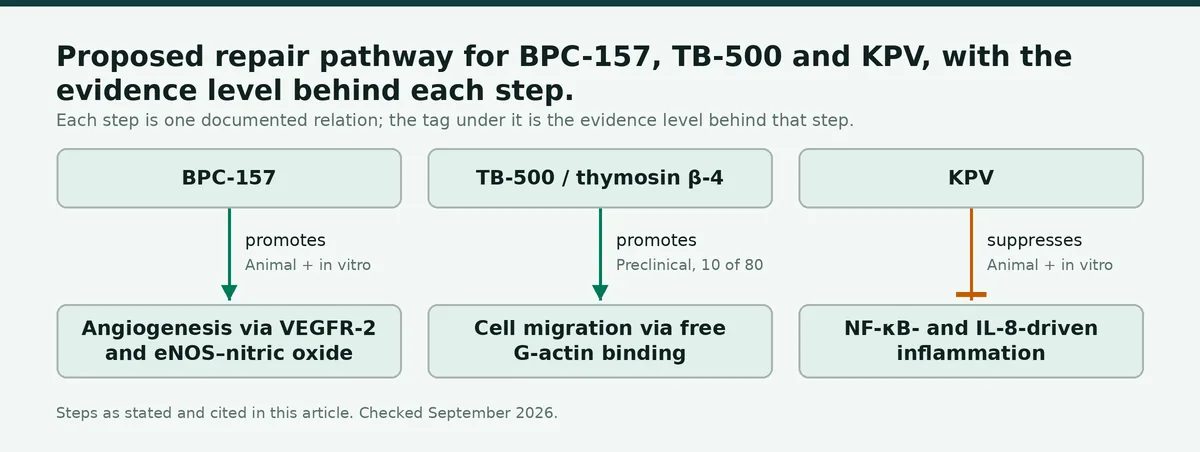
| Step | Relation | Target | Evidence |
|---|---|---|---|
| BPC-157 | promotes | Angiogenesis via VEGFR-2 and eNOS–nitric oxide | Animal + in vitro [3] |
| TB-500 / thymosin β-4 | promotes | Cell migration via free G-actin binding | Preclinical, 10 of 80 [4] |
| KPV | suppresses | NF-κB- and IL-8-driven inflammation | Animal + in vitro [8] |
Angiogenesis and blood supply
Repair needs blood vessels. BPC-157 increased expression of the VEGFR-2 receptor in rats with hind-limb ischaemia and in endothelial cell cultures, and nitric oxide via eNOS is described as its main molecular target [3]. In a scoping review of thymosin beta-4 and TB-500, angiogenesis was the single most studied mechanism — 19 of 80 included studies, covering endothelial migration and tube formation, VEGF and hypoxia-inducible factor signalling, and PI3K/Akt/eNOS pathways [4].
Cell migration, actin and fibroblasts
Thymosin beta-4 is the most abundant beta-thymosin in the human body and is best known as an actin-sequestering protein; 10 of the 80 studies in that review examined cell migration, including endothelial and progenitor-cell migration, myoblast chemotaxis and dermal wound repair, and four looked at collagen and extracellular-matrix remodelling [4].
Inflammation and NF-κB
KPV is the clearest example. In preclinical work it suppressed TNF-α-dependent NF-κB-driven reporter activity and IL-8, reduced matrix metalloproteinase-9 activity, cut myeloperoxidase activity by roughly half in experimental colitis, and promoted intestinal healing and weight recovery in mice [8]. Uptake appears to be mediated by the PepT1 transporter rather than a classical melanocortin receptor [8]. Five of the TB4 studies addressed inflammatory signalling, including NF-κB and IL-8 [4].
Copper delivery and gene expression
GHK-Cu’s proposed mechanism is different again: it chelates copper and delivers it to cells, with antioxidant effects demonstrated in vitro and in animal studies [5]. A gene-expression analysis reported that GHK changes expression of 31.2% of human genes by 50% or more [6]. The authors of that work added the caveat that matters most: at current knowledge, there is not enough information to establish a clear relationship between those expression changes and actual biological activity [5].
Why mechanism is not proof
Every pathway above is real. None of them is evidence that a person heals faster.
The numbers make the gap concrete. A 2025 systematic review of BPC-157 in orthopaedic sports medicine screened 544 articles and included 36: 35 were preclinical animal studies and one was a human clinical study — a retrospective series in which 7 of 12 patients given intra-articular BPC-157 for chronic knee pain reported subjective improvement lasting more than six months [1]. A 2026 review of the peptide’s development status found that all available clinical data come from fewer than 30 subjects across three uncontrolled pilot studies, none using a standardised pharmaceutical preparation, with early industry trials unpublished and a registered Phase I trial terminated without published results [2]. A separate review notes that a 2015 Phase I study in 42 healthy volunteers had its results submission cancelled in 2016 [3].
For thymosin beta-4 the pattern is subtler and more often misrepresented. Of 80 included studies, 19 (23.8%) were human, but that human evidence clustered in ocular-surface and skin/soft-tissue wound settings — where the full 43-amino-acid TB4 protein was studied — while direct evidence for “TB-500” amounted to a single included study [4]. The review states plainly that no human interventional studies of administered TB4 or TB-500 were identified in tendon, ligament, muscle, bone, cartilage, fat graft or spine [4]. Conflating the two is the most common error in this category: human trial data for a full protein in the eye is not evidence for a research-chemical fragment in a shoulder. Our BPC-157 versus TB-500 comparison goes through the differences in detail.
The reviewers’ own summaries are blunter than most marketing. The TB4 scoping review concludes that the literature “remains unevenly distributed and largely preclinical”, and that the central finding “is not that TB4 or TB-500 lack biologic activity” but that the published work “does not match the way these peptides are often discussed in clinical, performance, or public-facing settings” [4]. The BPC-157 development review reaches the same place from the pharmaceutical side: the barrier is not absent biological activity but absent pharmaceutical science — no characterised formulation, no validated pharmacokinetics [2]. Marketing has run well ahead of the data.
Compound-by-compound detail lives on the individual pages: BPC-157, TB-500 and thymosin beta-4, GHK-Cu and KPV.
Evidence by type
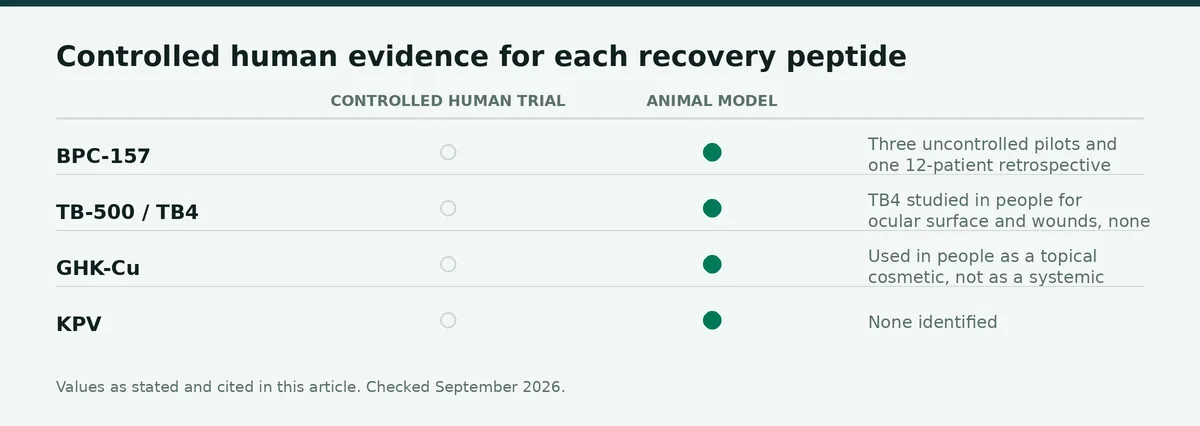
| Compound | Controlled human trial | Animal model | What the human evidence actually is |
|---|---|---|---|
| BPC-157 | no | yes | Three uncontrolled pilots and one 12-patient retrospective series [1][2] |
| TB-500 / TB4 | no | yes | TB4 studied in people for ocular surface and wounds, none in tendon, muscle or bone [4] |
| GHK-Cu | no | yes | Used in people as a topical cosmetic, not as a systemic repair drug [7][9] |
| KPV | no | yes | None identified [8][9] |
Every row reads “no” in the first column. That is the finding, not a gap in our reading.
Side effects and risks
This section deserves at least as much weight as the mechanisms above, because for three of the four compounds there is no systematic human safety dataset at all.
Unknown long-term safety. Animal toxicity work on BPC-157 has not flagged acute organ toxicity, but clinical safety in humans remains unknown [1]. One 2025 review of the peptide concludes there is “no convincing certainty that BPC 157 is harmless”, and raises specific theoretical hazards: excess nitric oxide signalling, and free proline released during degradation depleting intracellular proline and producing superoxide [3]. For KPV, the FDA states it has not identified any human exposure data [9].
The angiogenesis paradox. The pro-angiogenic effect that makes these peptides interesting for repair is the same effect that supports tumour growth. As one review puts it, blood-vessel formation during carcinogenesis supplies oxygen to a tumour and enhances its proliferation, diffusion and metastasis [3]. This is a theoretical concern drawn from mechanism, not an observed human outcome — but it is unresolved, and nobody has run the long-term human studies that would resolve it.
Immunogenicity and impurities. The FDA’s stated concerns for these substances are concrete: compounded drugs containing BPC-157 may pose a risk of immunogenicity for certain routes of administration, with problems in peptide-related impurities and active-ingredient characterisation; the same immunogenicity and aggregation concerns are recorded for thymosin beta-4 and for injectable GHK-Cu, where the agency notes there are limited data in humans [9].
Product quality and contamination. Research-chemical supply chains are not pharmaceutical supply chains. An analysis of 601 seized illicit products found the declared active ingredient actually present in only 65.1% of samples, with 6.4% containing an additional undeclared ingredient and 14.3% containing a different undeclared ingredient instead — roughly two in five products mislabelled [13]. Those samples were mostly steroid-era products rather than peptides, but they describe the same unregulated market, and a vial with no batch-specific third-party testing carries the same unknowns.
Sport sanctions. For any tested athlete, these compounds are a competition risk, not just a health one — see the regulatory section below.
Regulatory and legal status (2026)
All statements here were checked September 2026.
None of the four compounds is an approved drug product in the United States for tissue repair. Instead, each appears on the FDA’s page listing bulk drug substances that may present significant safety risks — the agency’s “category 2” grouping, applied to substances it identified as presenting potential significant safety risks when reviewing nominations for the section 503A or 503B compounding bulks lists [9][10]. BPC-157, thymosin beta-4 (including the TB4 fragment LKKTETQ), injectable GHK-Cu and KPV are all recorded there, each with a risk note attached, on a page current as of 22 April 2026 [9][4].
The sequence matters for BPC-157. The FDA designated it a category 2 bulk drug substance in 2023 [1]; the nomination was later withdrawn, and the compound now sits in the withdrawn-nominations part of that same safety-risk page with the agency’s note that it lacks sufficient information to know whether the drug would cause harm when administered to humans [9]. The FDA has also stated that it does not intend to categorise substances nominated after 7 January 2025 into the three interim-policy categories [10]. The upshot is unchanged: no approved product, and no route to lawful compounding from bulk substance.
GHK-Cu is the exception worth stating separately. As a topical cosmetic ingredient it is sold widely and described in the literature as a mainstream anti-ageing ingredient [7] — a different regulatory lane from an injectable drug, and the FDA’s bulks-page concerns apply to the injectable form [9].
WADA. The 2026 Prohibited List was approved by WADA’s Executive Committee on 11 September 2025 and entered into force on 1 January 2026 [11]. Both S0 (non-approved substances) and S2 (peptide hormones, growth factors, related substances and mimetics) are prohibited at all times, in and out of competition [12]. WADA issued a specific ban on BPC-157 in 2022 [1], and thymosin beta-4 and its derivatives, including TB-500, are classified as prohibited under the 2026 List [4]. We were unable to open WADA’s own List PDF during this run, so the substance-level entries above are cited to the peer-reviewed reviews that report them.
For the wider legal picture, see the legal status of peptides.
Comparison Framework scores
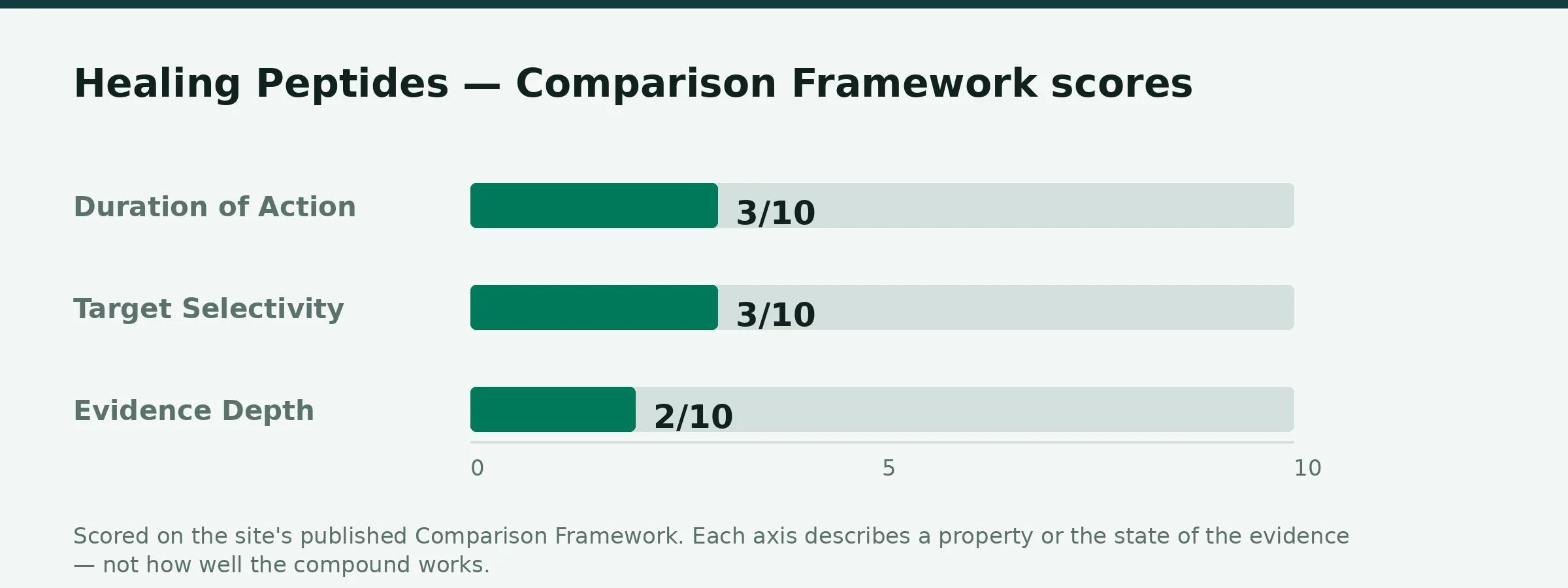
Scored as a cluster on the axes in our peptide comparison framework. Individual compound pages carry their own scores.
| Axis | Score | Why |
|---|---|---|
| Duration of Action | 3/10 | BPC-157’s plasma half-life is under 30 minutes with intramuscular bioavailability of 14–51% depending on species, and no compound in the group has a validated human pharmacokinetic profile [2] |
| Target Selectivity | 3/10 | These are broad multi-pathway signalling molecules, not receptor-selective drugs: no high-affinity binding site has been identified for BPC-157, and GHK is reported to shift expression of about a third of human genes [2][6] |
| Evidence Depth | 2/10 | 35 of 36 included BPC-157 studies were preclinical, and no human interventional studies of TB4 or TB-500 exist in tendon, ligament, muscle, bone or cartilage [1][4] |
GHK-Cu would score higher than 2/10 for topical cosmetic use and lower for systemic repair; the cluster score reflects the tissue-repair claims that bring people to these compounds.
Sourcing and quality: what to look for
Nothing in this section makes an unapproved compound safe or legal for human use. It is about not being lied to by a label.
- Batch-specific certificates of analysis, not a generic PDF. A COA should name the batch you are actually looking at. Our guide on how to read a peptide COA walks through the fields that matter.
- Identity as well as purity. Mass spectrometry confirms the sequence; HPLC quantifies how much of the sample is that molecule. The FDA’s stated concern with these substances is peptide-related impurities and poor active-ingredient characterisation [9] — exactly what those two tests address.
- An independent laboratory. In-house numbers are a claim, not verification.
- Scepticism about names. “TB-500” and “thymosin beta-4” are used loosely across commercial, regulatory and research contexts [4].
- A clean assay still proves nothing about efficacy. Verified purity and absent human evidence coexist comfortably, and usually do here.
FAQ
Do healing peptides actually work for injuries?
No controlled human trial has shown that BPC-157, TB-500, GHK-Cu or KPV repairs a tendon, ligament, muscle, bone or cartilage injury. The mechanistic and animal literature is substantial; the human musculoskeletal literature is effectively empty [1][4].
Is BPC-157 legal?
It is not an approved drug in the US, and it sits on the FDA’s list of bulk drug substances that may present significant safety risks, where the agency states it lacks sufficient information to know whether the drug would cause harm in humans (checked September 2026) [9].
Are TB-500 and thymosin beta-4 the same thing?
Not reliably. Thymosin beta-4 is a natural 43-amino-acid peptide that has been studied in human trials in eye and wound settings; “TB-500” is a commercial designation for synthetic material related to it, and the FDA’s entry concerns the TB4 fragment LKKTETQ [4][9].
Will these peptides fail a drug test?
BPC-157 has been specifically banned by WADA since 2022, and thymosin beta-4 and its derivatives including TB-500 are prohibited under the 2026 List, which took effect on 1 January 2026 [1][4][11].
Is GHK-Cu different from the others?
Somewhat. Its real-world human use is topical cosmetic rather than systemic repair, and its skin penetration is itself limited — one permeation study measured copper retention of 0.6–2.8% across skin layers [7]. Injectable GHK-Cu carries the same FDA concerns as the rest [9].
What about KPV?
KPV is a tripeptide fragment of alpha-MSH with consistent anti-inflammatory effects in rodent colitis models and cell work, and no identified human clinical data [8][9].
References
- Vasireddi N, Hahamyan H, Salata MJ, Karns M, Calcei JG, Voos JE, Apostolakos JM. Emerging Use of BPC-157 in Orthopaedic Sports Medicine: A Systematic Review. HSS Journal. 2025. https://pmc.ncbi.nlm.nih.gov/articles/PMC12313605/
- Mateescu DM, Gavrilescu DM, Constantinescu FE, et al. BPC-157 as an Investigational Peptide Therapeutic: Biopharmaceutical Challenges, Formulation Strategies, and Translational Development Barriers. Pharmaceutics. 2026;18(5):625. https://www.mdpi.com/1999-4923/18/5/625
- Józwiak M, Bauer M, Kamysz W, Kleczkowska P. Multifunctionality and Possible Medical Application of the BPC 157 Peptide — Literature and Patent Review. Pharmaceuticals. 2025;18(2):185. https://www.mdpi.com/1424-8247/18/2/185
- McGuire F, Hughes E, Maak T, Cushman DM. Thymosin Beta-4 and TB-500 in Tissue Healing, Regeneration, and Musculoskeletal Repair: A Scoping Review. Applied Sciences. 2026;16(12):6202. https://www.mdpi.com/2076-3417/16/12/6202
- Pickart L, Vasquez-Soltero JM, Margolina A. GHK-Cu may Prevent Oxidative Stress in Skin by Regulating Copper and Modifying Expression of Numerous Antioxidant Genes. Cosmetics. 2015;2(3):236–247. https://www.mdpi.com/2079-9284/2/3/236
- Pickart L, Margolina A. Skin Regenerative and Anti-Cancer Actions of Copper Peptides. Cosmetics. 2018;5(2):29. https://www.mdpi.com/2079-9284/5/2/29
- Ogórek K, Nowak K, Wadych E, Ruzik L, Timerbaev AR, Matczuk M. Are We Ready to Measure Skin Permeation of Modern Antiaging GHK–Cu Tripeptide Encapsulated in Liposomes? Molecules. 2025;30(1):136. https://www.mdpi.com/1420-3049/30/1/136
- Dinparastisaleh R, Mirsaeidi M. Antifibrotic and Anti-Inflammatory Actions of α-Melanocytic Hormone: New Roles for an Old Player. Pharmaceuticals (Basel). 2021;14(1):45. https://pmc.ncbi.nlm.nih.gov/articles/PMC7827684/
- U.S. Food and Drug Administration. Certain Bulk Drug Substances for Use in Compounding that May Present Significant Safety Risks. FDA, page current as of 22 April 2026. https://www.fda.gov/drugs/human-drug-compounding/certain-bulk-drug-substances-use-compounding-may-present-significant-safety-risks
- U.S. Food and Drug Administration. Bulk Drug Substances Used in Compounding Under Section 503A of the FD&C Act. FDA, 2026. https://www.fda.gov/drugs/human-drug-compounding/bulk-drug-substances-used-compounding-under-section-503a-fdc-act
- World Anti-Doping Agency. 2026 Prohibited List. WADA, 2025 (approved 11 September 2025; in force 1 January 2026). https://www.wada-ama.org/en/resources/2026-prohibited-list
- World Anti-Doping Agency. Athlete and Athlete Support Personnel Guide to the 2026 Prohibited List. WADA, 2025. https://www.wada-ama.org/sites/default/files/2025-12/Athlete%20and%20Athlete%20Support%20Personnel%20Guide%20to%20the%202026%20Prohibited%20List.pdf
- Illegal and falsified medicines self-administrated in not approved post-cycle therapy after the cessation of anabolic-androgenic steroids — qualitative analysis. Frontiers in Chemistry. 2025. https://www.frontiersin.org/journals/chemistry/articles/10.3389/fchem.2025.1536858/full