Quick answer: CJC-1295 is a synthetic analogue of growth hormone-releasing hormone. The molecule of that name in the literature carries a “drug affinity complex” (DAC) bonding it covalently to albumin: estimated half-life 5.8–8.1 days, IGF-I raised for 9–11 days after one subcutaneous dose in healthy adults — human RCT [1]. What the market sells as “CJC-1295 without DAC” is a different molecule, the unconjugated modified GRF (1-29) backbone, with no human trial programme published under that name. Neither is FDA-approved (checked September 2026) [8][9].
| Spec | CJC-1295 with DAC | “Without DAC” (modified GRF 1-29) |
|---|---|---|
| Backbone | hGRF(1-29), tetrasubstituted: D-Ala2, Gln8, Ala15, Leu27 [3] | Same GRF(1-29) amide backbone [5] |
| Key feature | Maleimidopropionamide lysine at the C terminus, bonding Cys34 of albumin [3] | No linker; nothing binds albumin [3] |
| Half-life | 5.8–8.1 days, human [1] | No published human value (checked September 2026) |
| Human trials | Two published studies, one terminated Phase 2 [1][2][6] | None under this name |
| Status (US) | Not approved; nomination withdrawn (checked September 2026) [8][9] | Not approved; not on FDA’s lists [8][9] |
What is CJC-1295?
CJC-1295 was a clinical candidate from the Canadian company ConjuChem, built on hGRF(1-29) — the shortest fragment of human growth hormone-releasing factor that still activates the pituitary GHRH receptor — with four substitutions, D-Ala2, Gln8, Ala15 and Leu27, that make the peptide resistant to the enzymes which normally destroy it [3].
Native GHRH does not last. Injected intravenously into normal human subjects, human GRH(1-44)-NH2 had an HPLC-measured half-life of 6.8 minutes, cleaved at the N-terminus to an inactive product — human PK [4]. Every analogue in this class exists to fight that number. See our primer on what peptides are and the overview of growth hormone secretagogues.
What makes it unusual is a fifth modification: an Nε-3-maleimidopropionamide derivative of lysine at the C terminus, which reacts with the free thiol on Cys34 of serum albumin and tethers the peptide to the most abundant protein in plasma [3]. ConjuChem called that the drug affinity complex, or DAC.
The two molecules the market calls “CJC-1295”
This is the most important thing on the page. “With DAC” and “without DAC” are not two formulations of one drug. They are two chemical entities with very different evidence bases, and only one has ever been in a published human trial.
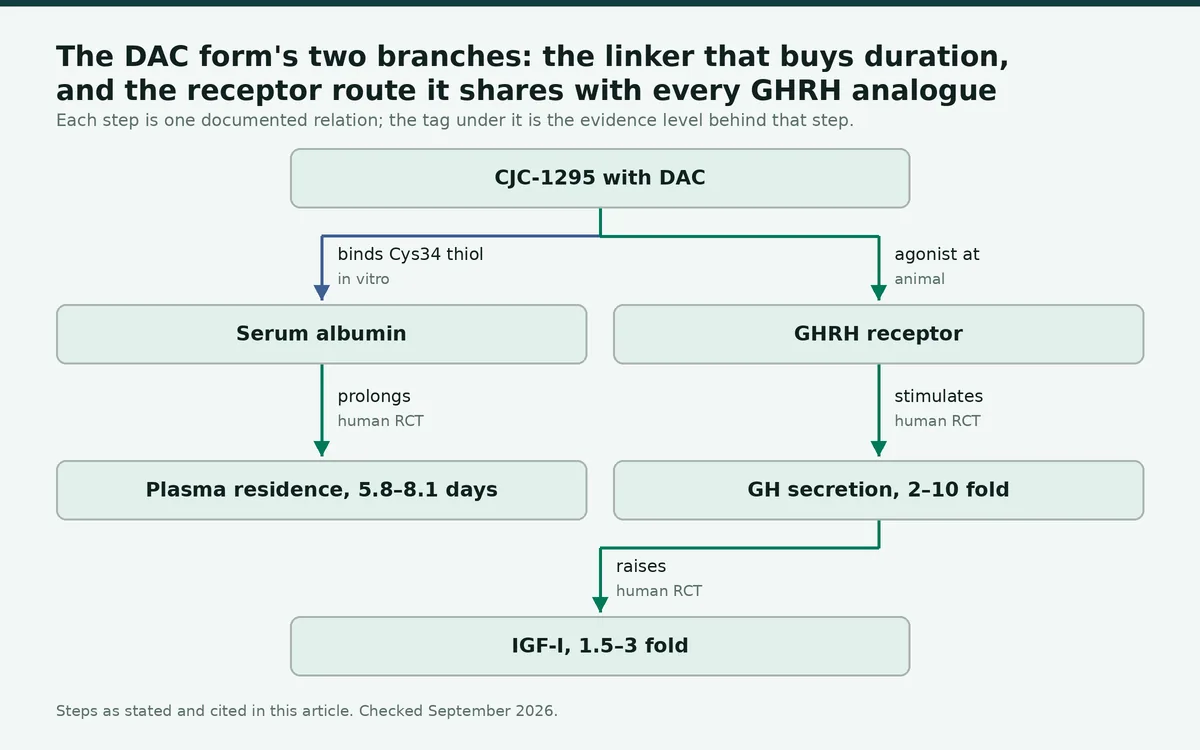
| Step | Relation | Target | Evidence |
|---|---|---|---|
| CJC-1295 with DAC | binds Cys34 thiol | Serum albumin | in vitro [3] |
| Serum albumin | prolongs | Plasma residence, 5.8–8.1 days | human RCT [1] |
| CJC-1295 with DAC | agonist at | GHRH receptor | animal [3] |
| GHRH receptor | stimulates | GH secretion, 2–10 fold | human RCT [1] |
| GH secretion, 2–10 fold | raises | IGF-I, 1.5–3 fold | human RCT [1] |
Remove the linker and the left-hand branch disappears; the right-hand branch is what any GHRH analogue does, for as long as it survives in plasma.
Remove the maleimidopropionyl-lysine and you remove the mechanism of long action. What is left is the unconjugated tetrasubstituted GRF(1-29) amide, sold as modified GRF (1-29) or Mod GRF 1-29. The confusion reaches the analytical literature: a doping-control paper describes CJC-1295 as “(D-Ala2, Gln8, Ala15, Leu27)-GRF amide” and lists a separate ConjuChem compound, CJC-1293, as “(D-Ala2)-GRF amide” [5].
“CJC-1295 no-DAC” is a market label, not a separately trialled drug — and the half-life figure that sells the name belongs to the molecule with the linker. The dedicated comparison goes deeper.
Key numbers
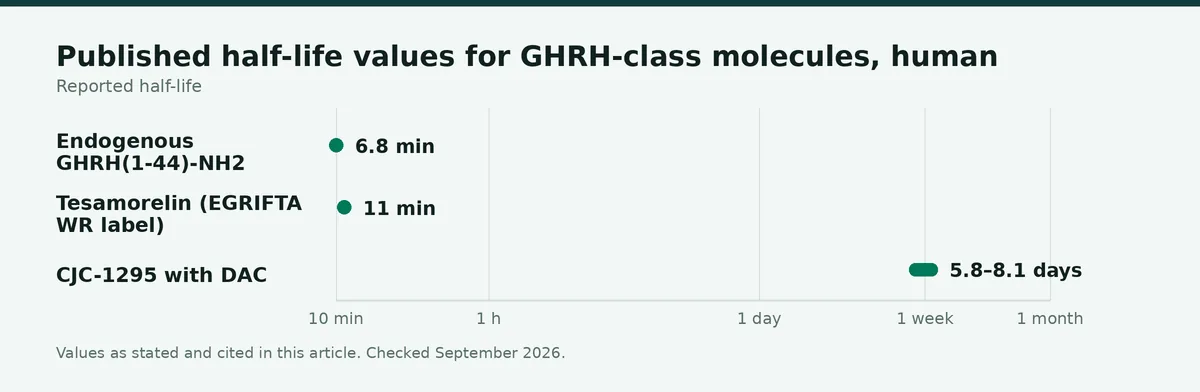
| Molecule | Reported half-life |
|---|---|
| Endogenous GHRH(1-44)-NH2 [4] | 6.8 min |
| Tesamorelin (EGRIFTA WR label) [7] | 11 min |
| CJC-1295 with DAC [1] | 5.8–8.1 days |
Modified GRF (1-29) is absent from that chart deliberately: no published human half-life for it was located in September 2026, and the rule here is to leave a row out rather than estimate one. Both measured unconjugated analogues sit under 30 minutes, which is as far as the evidence goes.
With DAC or without: what has actually been studied
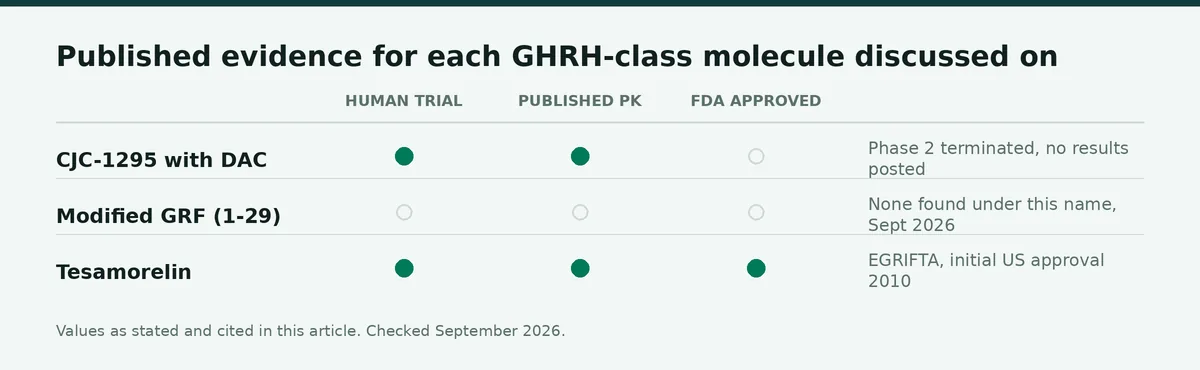
| Molecule | Human trial | Published PK | FDA approved | Note |
|---|---|---|---|---|
| CJC-1295 with DAC | yes | yes | no | Phase 2 terminated, no results posted [6] |
| Modified GRF (1-29) | no | no | no | None found under this name, Sept 2026 |
| Tesamorelin | yes | yes | yes | EGRIFTA, initial US approval 2010 [7] |
How CJC-1295 works (mechanism)
CJC-1295 is an agonist at the GHRH receptor on the anterior pituitary; in cultured rat pituitary cells the maleimido hGRF(1-29) derivatives were bioactive in a GH secretion assay — in vitro [3]. The DAC does not change which receptor is engaged, only how long the peptide stays available to engage it.
The consequence was measured directly. In healthy men aged 20–40 given 60 or 90 μg/kg, 12-hour overnight sampling one week after injection showed the frequency and amplitude of GH secretory pulses unchanged, while trough GH rose 7.5-fold (p < 0.0001), mean GH secretion 46% (p < 0.01) and IGF-I 45% (p < 0.001) — human [2]. IGF-I increases did not correlate with any parameter of pulsatile secretion, pointing to trough elevation as the driver [2]. A raised floor rather than bigger peaks: that is why selectivity scoring here counts sustained occupancy as its own issue, separate from receptor promiscuity.
What the research shows
Human studies
The primary human dataset is Teichman and colleagues, 2006: two randomised, placebo-controlled, double-blind trials of 28 and 49 days in healthy adults aged 21–61, CJC-1295 given subcutaneously as ascending single doses in the first study and weekly or biweekly in the second — human RCT [1]. A single injection produced dose-dependent increases in mean plasma GH of 2- to 10-fold for six days or more; IGF-I rose 1.5- to 3-fold for 9–11 days, stayed elevated up to 28 days after multiple doses, and the estimated half-life was 5.8–8.1 days [1]. No serious adverse reactions were reported, and 30–60 μg/kg were the most effective and best tolerated doses [1] — reported strictly as the doses used in that study. The second human study is the pulsatility work above [2].
The registry record is thin. A ClinicalTrials.gov search in September 2026 found one interventional CJC-1295 record: NCT00267527, a ConjuChem-sponsored randomised, placebo-controlled, double-blind Phase 2 of CJC 1295 for 12 weeks in HIV-associated visceral obesity, enrolment 120, December 2005 to September 2006, listed as Terminated with no explanation and no results posted [6]. Development never reached approval.
Animal and in-vitro studies
The identification work is rat and cell culture. Three maleimido derivatives of hGRF(1-29) were conjugated to human serum albumin ex vivo, all showed enhanced stability against dipeptidylpeptidase-IV in vitro, and all released GH in cultured rat pituitary cells [3]. Given subcutaneously to male Sprague-Dawley rats, CJC-1295 produced a four-fold increase in GH area under the curve over two hours versus unmodified hGRF(1-29), stayed in plasma beyond 72 hours, and appeared on Western blot at the serum albumin band from 15 minutes onward — animal [3]. Strong mechanistic work, and rat work: a four-fold GH AUC in a rat is not a human outcome.
The “CJC-1295 + ipamorelin” combination
The combination is widely marketed; the published evidence for it is not there. No human trial of CJC-1295 combined with ipamorelin was found in the registry and literature searches run for this page in September 2026. This page gives no protocol, ratio or timing information — only the observation that the pairing is sold far ahead of its evidence, a pattern documented in the UCLA evidence review.
Side effects and risks
The published CJC-1295 safety record is two small, short human studies reporting no serious adverse reactions [1][2]. Small and short are the operative words: the longest published exposure is 49 days [1], and the 12-week Phase 2 that would have extended it was terminated without posted results [6].
FDA has recorded concerns of its own. Compounded drugs containing CJC-1295 “may pose risk for immunogenicity for certain routes of administration and may have complexities with regard to for peptide-related impurities and API characterization,” and FDA “has identified serious adverse events associated with CJC-1295 including increased heart rate and systemic vasodilatory reaction,” with available clinical data limited [8].
The class risks are documented on the one approved GHRH analogue. The EGRIFTA WR (tesamorelin) label warns of increased risk of neoplasms, elevated IGF-1, fluid retention, glucose intolerance or diabetes mellitus, hypersensitivity reactions, injection site reactions and increased mortality in acute critical illness; adverse reactions above 5% include arthralgia, injection site erythema and pruritus, peripheral edema and myalgia [7]. None of that is a CJC-1295 finding, but it is what regulators concluded about sustained GHRH-receptor stimulation in humans.
The IGF-1 question has been adjudicated once. Reviewing tesamorelin, the EMA committee identified “an increase in the level of a protein called insulin-like growth factor 1 (IGF-1) in a considerable number of patients,” warned that this may increase cancer risk and worsen diabetic eye disease, and called it a major safety concern; the application was withdrawn in June 2012 [11]. CJC-1295 with DAC raises IGF-I for 9–11 days on one dose and up to 28 days after repeated doses [1], with no long-term safety dataset behind it. For the no-DAC form it is worse: it has not been characterised in humans at all.
Regulatory and legal status (2026)
United States, checked September 2026. Neither form is FDA-approved for any indication. CJC-1295 appears on FDA’s page of bulk drug substances that may present significant safety risks, but in the table headed “Bulk drug substances nominated but withdrawn” rather than the active category 2 table — the nominators pulled it [8]. It is not on FDA’s 503A bulks list, and modified GRF (1-29) is not named on either page [8][9].
It was also not among the substances reviewed at the Pharmacy Compounding Advisory Committee meeting of 23–24 July 2026, whose agenda covered BPC-157, KPV, TB-500 and MOTs-C on day one and emideltide/DSIP, Semax and epitalon on day two [10]. Related secretagogues do sit in the active category 2 table: ipamorelin acetate, GHRP-2, GHRP-6 and ibutamoren mesylate [8].
The practical position is research-use-only. Our guide to US peptide legal status explains what that classification does and does not permit.
Sport. Growth hormone-releasing hormones — the published analytical work names sermorelin, CJC-1293, CJC-1295 and tesamorelin together — are prohibited in sport under World Anti-Doping Agency regulations, with validated plasma detection methods published at limits below 50 pg/mL [5]. No Prohibited List section number is quoted, because the current List document could not be opened during this run.
Comparison Framework scores
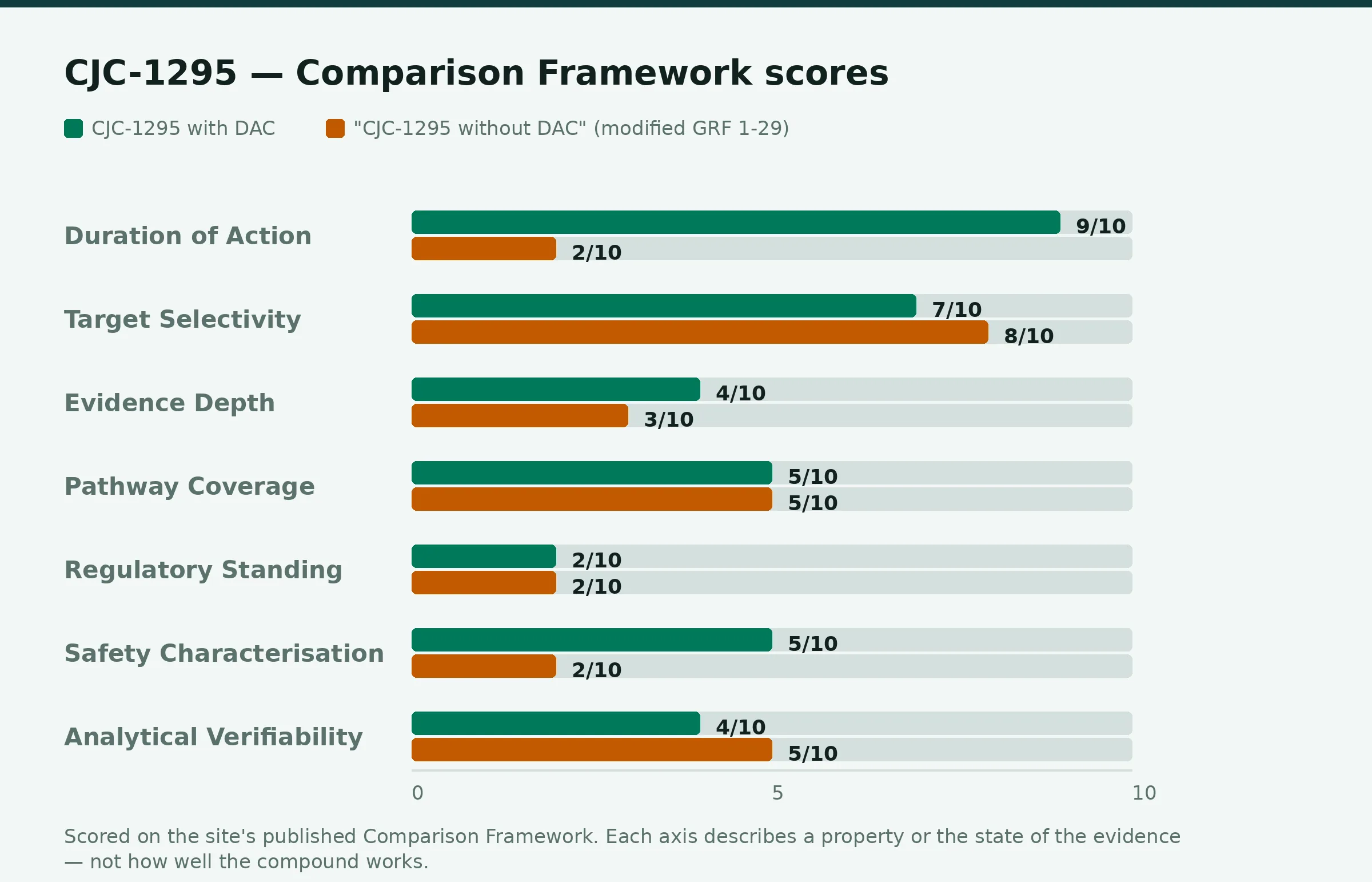
Scored against the anchors in our peptide comparison framework. The two forms get separate tables because they are separate molecules. No axis measures how well anything works.
CJC-1295 with DAC
| Axis | n/10 | Justification |
|---|---|---|
| Duration of Action | 9/10 | Half-life 5.8–8.1 days; GH raised six days or more from one dose [1] |
| Target Selectivity | 7/10 | GHRH-receptor agonist, no cross-axis activity documented [3]; marked down for sustained albumin-tethered occupancy [2] |
| Evidence Depth | 4/10 | Two small studies, one sponsor, no replication; only Phase 2 terminated [1][2][6] |
| Pathway Coverage | 5/10 | One pathway, the GHRH receptor [3] |
| Regulatory Standing | 2/10 | Not approved; nomination withdrawn, absent from the 503A list and July 2026 PCAC agenda [8][9][10] |
| Safety Characterisation | 5/10 | Adverse events from two short human studies [1][2]; FDA records serious events separately [8] |
| Analytical Verifiability | 4/10 | Class LC-HRMS/MS methods published [5]; FDA flags API characterisation complexity [8] |
“CJC-1295 without DAC” (modified GRF 1-29)
| Axis | n/10 | Justification |
|---|---|---|
| Duration of Action | 2/10 | No measured half-life published; anchored to the unconjugated analogues measured in humans, 6.8 and 11 minutes [4][7], and to the absence of albumin binding [3] |
| Target Selectivity | 8/10 | Same GHRH-receptor backbone [3][5], without the sustained-occupancy confound [2] |
| Evidence Depth | 3/10 | No human trial under this name; only rat and in-vitro work on the backbone [3] and a method paper [5] |
| Pathway Coverage | 5/10 | One pathway, the GHRH receptor [3][5] |
| Regulatory Standing | 2/10 | Not approved, not named on FDA’s 503A or category 2 pages [8][9] |
| Safety Characterisation | 2/10 | No published human safety dataset; FDA’s concerns attach to the CJC-1295 nomination [8] |
| Analytical Verifiability | 5/10 | A named target in published LC-HRMS/MS doping-control methods, though the shared trade name means identity must be checked against a stated structure [5] |
With modified GRF (1-29) at 3 on Evidence Depth, the point has to be said out loud: mechanistic plausibility is not clinical proof. A peptide can hit the right receptor in a rat pituitary cell and still have no demonstrated human outcome. A 5 on Safety Characterisation is not reassurance either: it records only how much has been documented, which here is two short studies.
How CJC-1295 compares
Tesamorelin is the reference point because it is the approved one: a growth hormone-releasing factor analogue on the full 44-amino-acid human GRF sequence with a hexenoyl moiety on the N-terminal tyrosine, molecular weight 5135.9 Da, approved in the US in 2010 for reduction of excess abdominal fat in HIV-infected adults with lipodystrophy, label half-life 11 minutes [7]. The approved molecule is the short-acting one, and its approval rests on a trial programme CJC-1295 never completed. Ipamorelin, by contrast, works the other arm of the axis — a ghrelin-receptor agonist, not a GHRH analogue — and sits in FDA’s active category 2 table [8], a worse position than CJC-1295’s withdrawn nomination. Our GH secretagogue guide scores the rest.
Sourcing and quality: what to look for
Because two molecules share one trade name, a certificate of analysis for “CJC-1295” means little unless it states which structure was tested: the two forms do not share an observed mass, so a document that does not say which it measured cannot be checked against anything. Published LC-HRMS/MS methods for GHRH analogues reach detection limits below 50 pg/mL [5], so the chemistry is not the bottleneck — the labelling is, and FDA’s note about “complexities with regard to for peptide-related impurities and API characterization” [8] is about exactly this. Our guide to reading a peptide COA covers what a usable certificate contains.
FAQ
What is the difference between CJC-1295 with and without DAC?
They are different molecules. CJC-1295 with DAC carries an Nε-3-maleimidopropionamide lysine at the C terminus that bonds covalently to the free thiol on Cys34 of serum albumin, giving an estimated 5.8–8.1 day half-life in healthy adults [1][3]. The version sold as “without DAC” has no linker: it is the unconjugated tetrasubstituted GRF(1-29) amide, modified GRF (1-29), and nothing tethers it to albumin [3][5].
Has CJC-1295 been tested in humans?
The DAC form has, in a limited way: two randomised, placebo-controlled, double-blind studies of 28 and 49 days in healthy adults, published in 2006, reporting 2- to 10-fold GH increases for six days or more and IGF-I up 1.5- to 3-fold for 9–11 days after one subcutaneous dose [1], plus a study of GH pulsatility [2]. A Phase 2 in HIV-associated visceral obesity, NCT00267527, enrolled 120 participants, was terminated in 2006 with no posted results, and the registry records no reason [6].
Is CJC-1295 FDA-approved or legal to use in 2026?
It is not FDA-approved for any indication (checked September 2026). CJC-1295 appears on FDA’s bulk drug substances safety page only under the heading “Bulk drug substances nominated but withdrawn,” and is not on the 503A bulks list [8][9]. It was not reviewed at the Pharmacy Compounding Advisory Committee meeting of 23–24 July 2026, which covered BPC-157, KPV, TB-500, MOTs-C, emideltide/DSIP, Semax and epitalon [10].
What are the known risks of CJC-1295?
FDA states that compounded drugs containing CJC-1295 may pose immunogenicity risk for certain routes of administration and that it has identified serious adverse events including increased heart rate and systemic vasodilatory reaction, with clinical data limited [8]. The published trials reported no serious adverse reactions but covered at most 49 days [1]. Tesamorelin, the approved analogue in the class, carries labelled warnings for neoplasms, elevated IGF-1, fluid retention and glucose intolerance [7].
Is CJC-1295 banned in sport?
Yes, as part of the GHRH class. Peer-reviewed doping-control work states that growth hormone-releasing hormones are prohibited under World Anti-Doping Agency regulations, and names sermorelin, CJC-1293, CJC-1295 and tesamorelin as the analogues its plasma method targets at limits below 50 pg/mL [5]. No Prohibited List section number is quoted, because the List document itself could not be opened during this run.
References
- Teichman SL, Neale A, Lawrence B, Gagnon C, Castaigne J-P, Frohman LA. Prolonged Stimulation of Growth Hormone (GH) and Insulin-Like Growth Factor I Secretion by CJC-1295, a Long-Acting Analog of GH-Releasing Hormone, in Healthy Adults. The Journal of Clinical Endocrinology & Metabolism. 2006;91(3):799–805. https://academic.oup.com/jcem/article-abstract/91/3/799/2843281
- Ionescu M, Frohman LA. Pulsatile Secretion of Growth Hormone (GH) Persists during Continuous Stimulation by CJC-1295, a Long-Acting GH-Releasing Hormone Analog. The Journal of Clinical Endocrinology & Metabolism. 2006;91(12):4792–4797. https://academic.oup.com/jcem/article-abstract/91/12/4792/2656274
- Jetté L, Léger R, Thibaudeau K, Benquet C, Robitaille M, Pellerin I, Paradis V, van Wyk P, Pham K, Bridon DP. Human Growth Hormone-Releasing Factor (hGRF)1–29-Albumin Bioconjugates Activate the GRF Receptor on the Anterior Pituitary in Rats: Identification of CJC-1295 as a Long-Lasting GRF Analog. Endocrinology. 2005;146(7):3052–3058. https://academic.oup.com/endo/article-abstract/146/7/3052/2500187
- Frohman LA, Downs TR, Williams TC, Heimer EP, Pan YC, Felix AM. Rapid enzymatic degradation of growth hormone-releasing hormone by plasma in vitro and in vivo to a biologically inactive product cleaved at the NH2 terminus. The Journal of Clinical Investigation. 1986;78(4):906–913. https://www.jci.org/articles/view/112679
- Knoop A, Thomas A, Fichant E, Delahaut P, Schänzer W, Thevis M. Qualitative identification of growth hormone-releasing hormones in human plasma by means of immunoaffinity purification and LC-HRMS/MS. Analytical and Bioanalytical Chemistry. 2016;408:3145–3153. https://link.springer.com/article/10.1007/s00216-016-9377-3
- ConjuChem. A Multicenter, Randomized, Placebo-Controlled, Double-Blind, Phase 2 Study to Evaluate the Efficacy and Safety of CJC 1295 Administered for 12 Weeks in HIV Infected Patients With HIV Associated Visceral Obesity. ClinicalTrials.gov, NCT00267527. 2005–2006. https://classic.clinicaltrials.gov/ct2/show/NCT00267527
- Theratechnologies Inc. EGRIFTA WR (tesamorelin) for injection — full prescribing information. DailyMed, US National Library of Medicine. Accessed September 2026. https://dailymed.nlm.nih.gov/dailymed/fda/fdaDrugXsl.cfm?setid=839334d3-8c1d-4c26-9036-2ab524a6ea75&type=display
- US Food and Drug Administration. Certain Bulk Drug Substances for Use in Compounding that May Present Significant Safety Risks. Content current as of 22 April 2026, checked September 2026. https://www.fda.gov/drugs/human-drug-compounding/certain-bulk-drug-substances-use-compounding-may-present-significant-safety-risks
- US Food and Drug Administration. Bulk Drug Substances Used in Compounding Under Section 503A of the FD&C Act. Content current as of 14 May 2026, checked September 2026. https://www.fda.gov/drugs/human-drug-compounding/bulk-drug-substances-used-compounding-under-section-503a-fdc-act
- US Food and Drug Administration. July 23-24, 2026: Meeting of the Pharmacy Compounding Advisory Committee. Advisory Committee Calendar. Checked September 2026. https://www.fda.gov/advisory-committees/advisory-committee-calendar/july-23-24-2026-meeting-pharmacy-compounding-advisory-committee-07232026
- European Medicines Agency. Egrifta (tesamorelin): withdrawn application. EMA. Withdrawal 21 June 2012. https://www.ema.europa.eu/en/medicines/human/withdrawn-applications/egrifta