Quick answer: semaglutide vs tirzepatide is a comparison between a single-receptor GLP-1 agonist and a dual GIP/GLP-1 agonist, and both are FDA-approved prescription drugs rather than research chemicals [1][2][3][4]. One direct randomised comparison exists — SURPASS-2, in which tirzepatide 15 mg lowered HbA1c by 2.3% and body weight by 11.2 kg over 40 weeks against 1.9% and 5.7 kg on semaglutide 1 mg (human RCT) [2]. That trial used a diabetes dose of semaglutide, not the higher weight-management dose, so it does not settle the obesity question. Semaglutide holds the deeper cardiovascular-outcome evidence, including a placebo-controlled trial in people without diabetes [4]; tirzepatide’s outcome trial was run against an active comparator [8]. Both carry a boxed warning based on rodent thyroid C-cell tumours (animal) [1][4].
At a glance
| Semaglutide | Tirzepatide | |
|---|---|---|
| Class | GLP-1 receptor agonist [3][4] | GIP and GLP-1 receptor agonist [1][2] |
| Structure | GLP-1 analogue, 94% sequence homology to human GLP-1, C18 fatty diacid at Lys26; 4113.58 g/mol [3] | Based on the GIP sequence, Aib at positions 2 and 13, C20 fatty diacid at Lys20; 4813.53 Da [1][2] |
| Half-life | ~1 week; >99% albumin-bound; 89% bioavailability by subcutaneous route [3] | ~5 days; 99% albumin-bound; 80% bioavailability, peak at 8–72 h [1][2] |
| Direct comparison | SURPASS-2 comparator arm, 1 mg [2] | SURPASS-2 active arms, 5/10/15 mg [2] |
| Cardiovascular trial | SELECT, placebo-controlled, 17,604 people, HR 0.80 [4] | SURPASS-CVOT, active-comparator, 13,165 people [8] |
| US status (checked September 2026) | Approved prescription drug, initial US approval 2017 [3][4] | Approved prescription drug, Mounjaro and Zepbound [1][2] |
Both are prescription medicines dispensed through the regulated supply chain. Powder sold online “for research use only” is a different matter, and the FDA treats it as such [11]. For the chemistry basics behind either molecule, see what peptides actually are.
Mechanism: how they differ
Native GLP-1 is an incretin hormone with a circulating life of one to two minutes before dipeptidyl peptidase-4 degrades it, which is why neither of these drugs is simply the hormone (in vitro and mechanistic review) [7]. Both molecules solve the duration problem the same way — a fatty diacid that binds plasma albumin — and diverge in what they bind at the receptor end [1][3].
Semaglutide selectively binds and activates the GLP-1 receptor and nothing else at therapeutic exposure; the FDA and EMA labels describe it as a GLP-1 analogue with 94% homology to the human hormone (in vitro) [3][4][5]. Downstream, GLP-1 receptor activation enhances glucose-dependent insulin secretion, suppresses glucagon, slows gastric emptying and reduces food intake through appetite circuits (in vitro and mechanistic review) [7].
Tirzepatide engages two receptors: the GIP receptor and the GLP-1 receptor [1][2]. Which one does the work is not symmetric across species. In perifused human donor islets, blocking the GIP receptor consistently reduced the insulin response to tirzepatide across donor preparations, while GLP-1 receptor blockade cut the response in only about half the experiments; in mouse islets the dependence ran the other way, toward the GLP-1 receptor (in vitro, with an animal comparison) [6]. Tirzepatide is also 3- to 60-fold weaker at the mouse GIP receptor than native mouse GIP, which is a direct warning against reading rodent mechanistic work as human mechanism [6].
What remains unresolved is why adding GIP agonism produces larger average effects in human trials: no human study has isolated the contribution of the GIP arm, so the receptor-level chain below is documented while the tissue-level explanation is not.
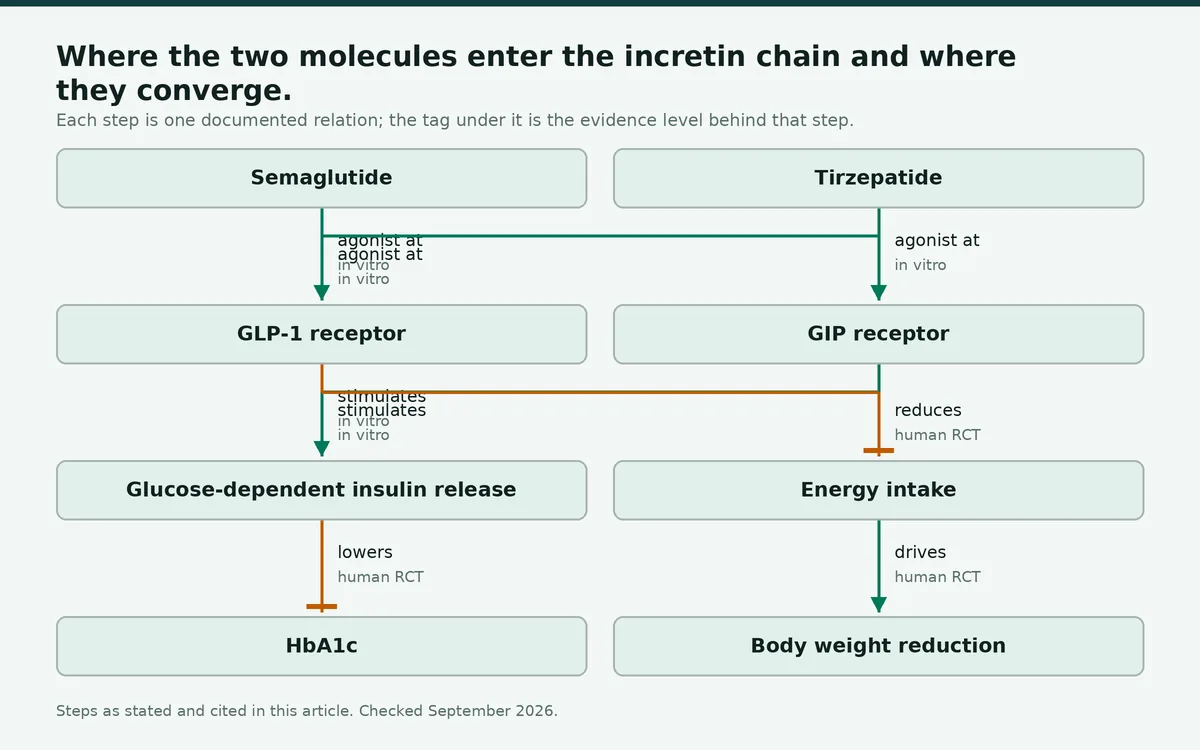
| Step | Relation | Target | Evidence |
|---|---|---|---|
| Semaglutide | agonist at | GLP-1 receptor | in vitro [3][4] |
| Tirzepatide | agonist at | GLP-1 receptor | in vitro [1][2] |
| Tirzepatide | agonist at | GIP receptor | in vitro [6] |
| GLP-1 receptor | stimulates | Glucose-dependent insulin release | in vitro [7] |
| GIP receptor | stimulates | Glucose-dependent insulin release | in vitro [6] |
| GLP-1 receptor | reduces | Energy intake | human RCT [5] |
| Glucose-dependent insulin release | lowers | HbA1c | human RCT [2] |
| Energy intake | drives | Body weight reduction | human RCT [1][5] |
The two compounds sit inside a wider family; the incretin peptide hub covers the rest of it, including the triple agonists now in development.
Head-to-head and trial evidence
The one direct comparison
SURPASS-2 is the only randomised head-to-head between these two molecules reported in either FDA label. Adults with type 2 diabetes on stable metformin — roughly 470 per arm — received tirzepatide 5, 10 or 15 mg or semaglutide 1 mg once weekly for 40 weeks (human RCT) [2]. HbA1c fell 2.0%, 2.2% and 2.3% on tirzepatide against 1.9% on semaglutide. Body weight fell 7.6 kg, 9.3 kg and 11.2 kg against 5.7 kg [2].
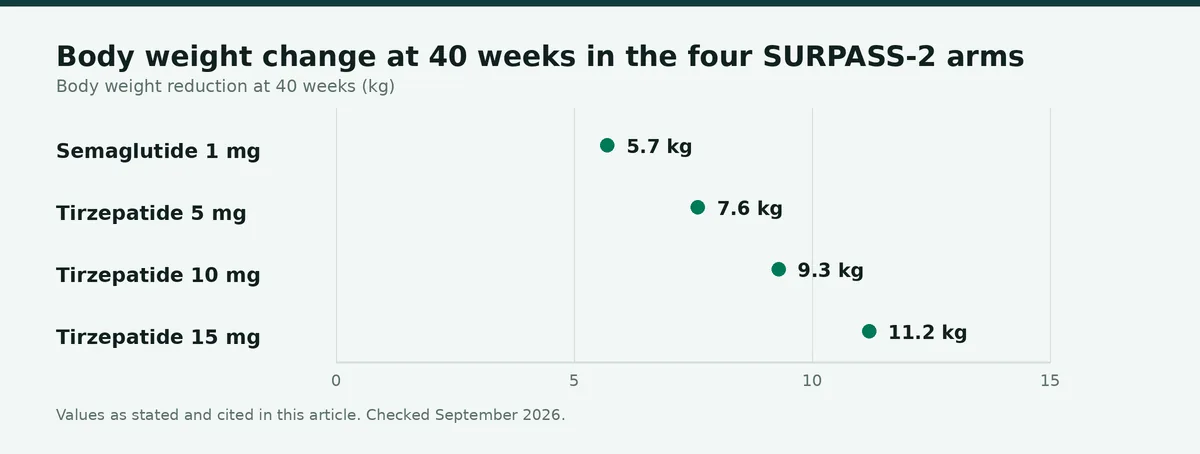
| SURPASS-2 arm | Body weight reduction at 40 weeks (kg) |
|---|---|
| Semaglutide 1 mg | 5.7 kg [2] |
| Tirzepatide 5 mg | 7.6 kg [2] |
| Tirzepatide 10 mg | 9.3 kg [2] |
| Tirzepatide 15 mg | 11.2 kg [2] |
Two caveats travel with those numbers. The semaglutide comparator was 1 mg, the glycaemic dose, not the 2.4 mg used for weight management [4], so the trial answers a diabetes question. And the endpoint was 40 weeks, well short of the 68- and 72-week obesity programmes below.
Obesity trials, compared indirectly
Neither company has run a head-to-head at weight-management doses, so the obesity comparison is indirect — different trials, different populations, different durations, and effect sizes that cannot be subtracted from one another.
In the pivotal tirzepatide obesity trial, 2,539 adults with obesity or overweight without type 2 diabetes were treated for 72 weeks: mean body-weight change was −15.0%, −19.5% and −20.9% on 5, 10 and 15 mg against −3.1% on placebo, and 85.1% to 90.9% reached at least 5% weight reduction against 34.5% on placebo (human RCT) [1].
In the pivotal semaglutide obesity trial, 1,961 adults were treated for 68 weeks: mean body-weight change was −14.9% on semaglutide 2.4 mg against −2.4% on placebo, with 83.5% against 31.1% reaching at least 5% loss and 66.1% against 12.0% reaching at least 10% (human RCT) [5].
Both are effect sizes in selected populations under protocol-driven monitoring, and both studied continued treatment rather than a finite course.
Cardiovascular and kidney outcomes
This is where the two evidence bases differ most, and it runs the other way from the weight data.
Semaglutide has a placebo-controlled outcome trial in people without diabetes. SELECT randomised 17,604 adults with established cardiovascular disease and obesity or overweight; over a median 41.8 months the primary major adverse cardiovascular event composite occurred in 6.5% on semaglutide against 8% on placebo, hazard ratio 0.80 (95% CI 0.72, 0.90) (human RCT) [4]. In type 2 diabetes, SUSTAIN 6 randomised 3,297 patients with a MACE hazard ratio of 0.74 (95% CI 0.58, 0.95) over a median 2.1 years (human RCT) [3]. Ozempic also carries a labelled indication for reducing sustained eGFR decline, end-stage kidney disease and cardiovascular death in type 2 diabetes with chronic kidney disease [3].
Tirzepatide’s outcome trial, SURPASS-CVOT, randomised 13,165 people with type 2 diabetes and cardiovascular disease to tirzepatide escalated to 15 mg or to dulaglutide 1.5 mg — an active GLP-1 comparator, not placebo — over a median 46.9 months, and met non-inferiority on the three-component MACE outcome (human RCT) [8]. A post hoc six-component cardiorenal composite favoured tirzepatide, 23.7% against 27.4% of patients with an event, HR 0.84 (95% CI 0.79, 0.90) [8]. A post hoc analysis generates hypotheses; it does not carry the weight of a primary endpoint, and non-inferiority against an active drug is not superiority.
So the honest summary is asymmetric: larger average weight and HbA1c effects for tirzepatide in the direct comparison [2], and a longer, placebo-controlled outcome record for semaglutide [3][4].
Side effects and risks compared
Both labels carry a boxed warning for thyroid C-cell tumours seen in rodents. The tumours were dose- and duration-dependent in rats given tirzepatide and appeared in rodents given semaglutide; both labels state that the human relevance has not been determined (animal) [1][4]. Both are contraindicated in people with a personal or family history of medullary thyroid carcinoma or with Multiple Endocrine Neoplasia syndrome type 2 [1][4].
Gastrointestinal effects dominate for both and scale with dose (human RCT):
- Tirzepatide, obesity trials: nausea 25–29% against 8% on placebo, diarrhoea 19–23% against 8%, vomiting 8–13% against 2%, constipation 11–17% against 5% [1]. In the diabetes programme, discontinuation for gastrointestinal reactions rose from 3.0% at 5 mg to 5.4% at 10 mg and 6.6% at 15 mg, against 0.4% on placebo [2].
- Semaglutide at the weight-management dose: nausea 44% against 16%, diarrhoea 30% against 16%, vomiting 24% against 6%, constipation 24% against 11% [4]. At the lower glycaemic doses the rates are much smaller — nausea 15.8% at 0.5 mg and 20.3% at 1 mg against 6.1% on placebo [3].
The labelled warning lists overlap heavily — severe gastrointestinal reactions, acute kidney injury from volume depletion, acute gallbladder disease, acute pancreatitis, hypersensitivity, hypoglycaemia when combined with insulin or insulin secretagogues, diabetic retinopathy complications in type 2 diabetes, and pulmonary aspiration during general anaesthesia or deep sedation appear on both [1][4]. Two do not overlap: the tirzepatide label lists suicidal behaviour and ideation [1], and the semaglutide weight-management label lists heart-rate increase [4].
Everything above was observed under medical supervision, with a characterised product, in people screened for the contraindications. We publish no administration guidance; the prescribing label is the authoritative document.
Regulatory status in 2026 (checked September 2026)
Both are approved prescription drugs in the United States, which puts them in a different legal category from most compounds covered on this site — see the US peptide legal status guide for the wider framework.
Semaglutide was first approved in the US in 2017 [3]. Ozempic is indicated for glycaemic control in type 2 diabetes, for reducing major adverse cardiovascular events in type 2 diabetes with established cardiovascular disease, and for kidney outcomes in type 2 diabetes with chronic kidney disease [3]. Wegovy is indicated for reducing major adverse cardiovascular events in adults with established cardiovascular disease and obesity or overweight, for weight reduction in adults and patients aged 12 and older, and for non-cirrhotic MASH with moderate-to-advanced fibrosis [4]. Tirzepatide is approved as Mounjaro for glycaemic control in type 2 diabetes, including patients aged 10 and older [2], and as Zepbound for weight reduction and for moderate-to-severe obstructive sleep apnoea in adults with obesity [1].
The compounding route has closed for both. The FDA declared the tirzepatide injection shortage resolved on 19 December 2024, giving 503A pharmacies until 18 February 2025 and 503B outsourcing facilities until 19 March 2025; the semaglutide shortage was declared resolved on 21 February 2025, with deadlines of 22 April 2025 and 22 May 2025 [10]. On 30 April 2026 the agency proposed excluding semaglutide, tirzepatide and liraglutide from the 503B bulk drug substances list, on the basis that there is no clinical need to compound from bulk when approved products exist, with comments due 29 June 2026 [9]. No final determination appeared in the FDA sources checked in September 2026.
Material sold outside that chain is not the same product. The FDA states that salt forms including semaglutide sodium and semaglutide acetate “are different active ingredients than are used in the approved drugs”, has warned about products “falsely labeled ‘for research purposes’ or ‘not for human consumption’” that were nonetheless marketed with dosing instructions, and as of 31 May 2026 had recorded 990 adverse-event reports associated with compounded semaglutide and more than 730 associated with compounded tirzepatide [11].
In sport, WADA’s summary of the 2026 Prohibited List, in force 1 January 2026, does not mention incretin agonists among its changes [12]. WADA’s own research record states that semaglutide entered the monitoring programme in 2024 and funds detection-method development covering semaglutide, liraglutide and tirzepatide in blood and dried blood spots [13]. Monitoring is not prohibition, but it is often what precedes a listing decision (checked September 2026).
Comparison Framework scores
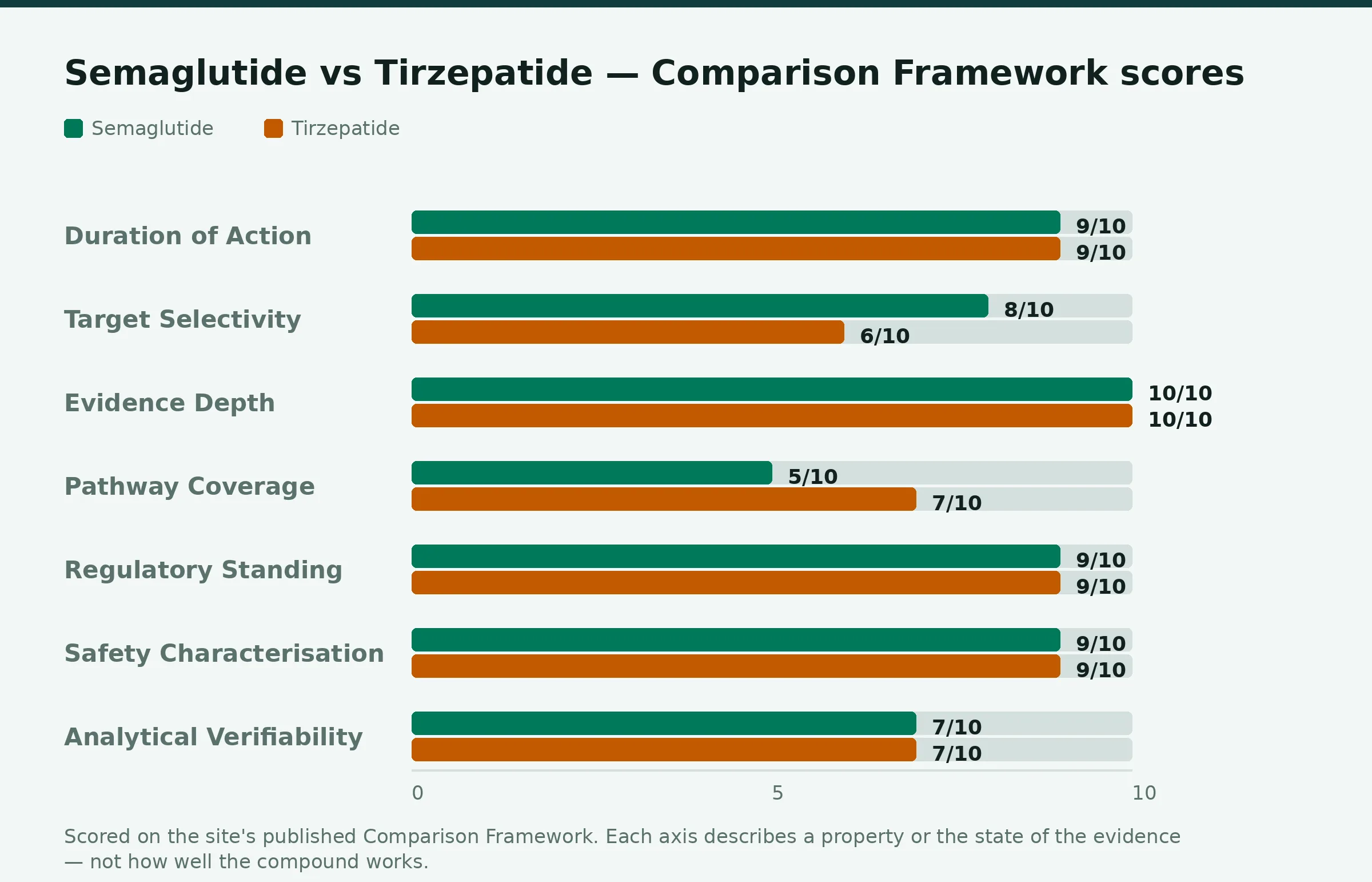
One column per compound, scored against the axes published in our Comparison Framework. The axes describe properties of the molecule and the state of its evidence — none of them measures how well either drug works, how safe it is, or whether anyone should take it. No overall score is given.
| Axis | Semaglutide | Tirzepatide | Notes |
|---|---|---|---|
| Duration of Action | 9/10 | 9/10 | Half-life ~1 week for semaglutide and ~5 days for tirzepatide; both once-weekly [1][3] |
| Target Selectivity | 8/10 | 6/10 | Semaglutide is selective for one receptor; tirzepatide is deliberately dual and imbalanced between the two [3][6] |
| Evidence Depth | 10/10 | 10/10 | Both approved, both with multi-thousand-patient phase 3 programmes and a cardiovascular outcomes trial [1][2][3][4][8] |
| Pathway Coverage | 5/10 | 7/10 | One incretin pathway against two, which is the framework’s one- and two-pathway bands [1][6][7] |
| Regulatory Standing | 9/10 | 9/10 | Both approved US prescription drugs with multiple labelled indications (checked September 2026) [1][2][3][4] |
| Safety Characterisation | 9/10 | 9/10 | Boxed warning, ten labelled warnings each, dose-stratified adverse-event rates. High means well documented, not small [1][2][3][4] |
| Analytical Verifiability | 7/10 | 7/10 | Exact formula and mass published in both labels give a defined identity target; no public compendial monograph was verified in this run [1][3] |
Evidence Depth at 10 for both is unusual on this site and reflects the same thing in each case: approval plus published registration trials. It says nothing about which compound suits which question.
Which is studied for what?
Research contexts only — this is not a recommendation, and neither compound is something to self-select.
- Glycaemic control in type 2 diabetes. Both have large phase 3 programmes; the direct comparison at 40 weeks favoured tirzepatide on HbA1c by 0.1 to 0.4 percentage points across doses (human RCT) [2].
- Weight reduction. Tirzepatide reached −20.9% at 72 weeks in its pivotal trial [1] and semaglutide −14.9% at 68 weeks in its own [5], in separate populations that were never randomised against each other at these doses.
- Cardiovascular risk. Semaglutide has placebo-controlled MACE reduction in people with and without diabetes [3][4]; tirzepatide has non-inferiority against an active GLP-1 comparator [8].
- Obstructive sleep apnoea. Only tirzepatide carries a labelled indication [1].
- Liver disease. Only semaglutide carries a labelled MASH indication [4].
Compound-level detail sits on the individual pages: the semaglutide wiki page and the tirzepatide wiki page.
FAQ
Is tirzepatide stronger than semaglutide?
In the only direct randomised comparison, SURPASS-2, tirzepatide produced larger average reductions than semaglutide 1 mg over 40 weeks: HbA1c down 2.0–2.3% against 1.9%, and body weight down 7.6–11.2 kg against 5.7 kg (human RCT) [2]. The comparator was the glycaemic dose of semaglutide rather than the 2.4 mg weight-management dose, so the result does not generalise to obesity treatment, and “stronger” is not a property either label assigns.
What is the actual mechanistic difference between semaglutide and tirzepatide?
Semaglutide activates the GLP-1 receptor only; tirzepatide activates both the GIP and the GLP-1 receptor [1][3]. In perifused human donor islets the insulin response to tirzepatide consistently depended on the GIP receptor, while GLP-1 receptor blockade had variable effects — and the dependence ran the opposite way in mouse islets, so rodent mechanism does not transfer (in vitro with an animal comparison) [6].
Do both carry the same warnings?
Their labels overlap almost completely: both carry a boxed warning about rodent thyroid C-cell tumours, the same contraindications for medullary thyroid carcinoma and MEN 2, and the same core warnings on gastrointestinal reactions, pancreatitis, gallbladder disease, kidney injury, hypoglycaemia in combination with insulin, retinopathy complications and aspiration under anaesthesia [1][4]. Two differ: suicidal behaviour and ideation is listed on the tirzepatide label [1], and heart-rate increase on the semaglutide weight-management label [4].
Which one has better cardiovascular evidence?
Semaglutide, on current published trials. SELECT randomised 17,604 people with cardiovascular disease and obesity but not diabetes and found a MACE hazard ratio of 0.80 (95% CI 0.72, 0.90) against placebo over a median 41.8 months (human RCT) [4]. Tirzepatide’s SURPASS-CVOT randomised 13,165 people against dulaglutide 1.5 mg and met non-inferiority on the primary MACE outcome, with a favourable post hoc cardiorenal composite (HR 0.84, 95% CI 0.79–0.90) that is hypothesis-generating rather than confirmatory [8].
Can either be bought as a research peptide in the US?
Neither is a research chemical: both are approved prescription drugs, and compounding from bulk was closed off after the FDA declared both shortages resolved in 2024 and 2025 [10]. The FDA has stated that semaglutide salt forms sold online are different active ingredients from the approved drugs, has flagged products falsely labelled “for research purposes”, and had logged 990 adverse-event reports for compounded semaglutide and over 730 for compounded tirzepatide as of 31 May 2026 [11] (checked September 2026).
Are they banned in sport?
WADA’s published summary of changes to the 2026 Prohibited List, in force on 1 January 2026, does not mention incretin agonists [12]. WADA’s research record notes that semaglutide was added to the monitoring programme in 2024, and the agency funds development of detection methods for semaglutide, liraglutide and tirzepatide in blood and dried blood spots [13]. Monitoring is surveillance, not prohibition (checked September 2026).
References
- Eli Lilly. ZEPBOUND (tirzepatide) injection, for subcutaneous use — Highlights of Prescribing Information. U.S. Food and Drug Administration, revised 01/2026. https://www.accessdata.fda.gov/drugsatfda_docs/label/2026/217806s037lbl.pdf
- Eli Lilly. MOUNJARO (tirzepatide) injection, for subcutaneous use — Highlights of Prescribing Information. U.S. Food and Drug Administration, revised 12/2025. https://www.accessdata.fda.gov/drugsatfda_docs/label/2025/215866s039lbl.pdf
- Novo Nordisk. OZEMPIC (semaglutide) injection, for subcutaneous use — Highlights of Prescribing Information. U.S. Food and Drug Administration, revised 10/2025. https://www.accessdata.fda.gov/drugsatfda_docs/label/2025/209637s035,209637s037lbl.pdf
- Novo Nordisk. WEGOVY (semaglutide) injection and tablets — Highlights of Prescribing Information. U.S. Food and Drug Administration, revised 02/2026. https://www.accessdata.fda.gov/drugsatfda_docs/label/2026/215256s033lbl.pdf
- European Medicines Agency. Wegovy (semaglutide) — Summary of Product Characteristics, EPAR product information. 2026. https://www.ema.europa.eu/en/documents/product-information/wegovy-epar-product-information_en.pdf
- El K, Douros JD, Willard FS, et al. The incretin co-agonist tirzepatide requires GIPR for hormone secretion from human islets. Nature Metabolism. 2023;5:945–954. https://www.nature.com/articles/s42255-023-00811-0
- Zheng Z, Zong Y, Ma Y, et al. Glucagon-like peptide-1 receptor: mechanisms and advances in therapy. Signal Transduction and Targeted Therapy. 2024;9:234. https://www.nature.com/articles/s41392-024-01931-z
- Nissen SE, et al. Cardiorenal Outcomes With Tirzepatide Compared With Dulaglutide in Patients With Diabetes and Cardiovascular Disease: A Post Hoc Analysis of the SURPASS-CVOT Randomized Clinical Trial. JAMA Cardiology. 2026. https://jamanetwork.com/journals/jamacardiology/fullarticle/2847048
- U.S. Food and Drug Administration. FDA Proposes to Exclude Semaglutide, Tirzepatide, and Liraglutide on 503B Bulks List. FDA press announcement, 30 April 2026. https://www.fda.gov/news-events/press-announcements/fda-proposes-exclude-semaglutide-tirzepatide-and-liraglutide-503b-bulks-list
- U.S. Food and Drug Administration. FDA clarifies policies for compounders as national GLP-1 supply begins to stabilize. FDA.gov, 2025. https://www.fda.gov/drugs/drug-alerts-and-statements/fda-clarifies-policies-compounders-national-glp-1-supply-begins-stabilize
- U.S. Food and Drug Administration. FDA’s Concerns with Unapproved GLP-1 Drugs Used for Weight Loss. FDA.gov, content current as of 1 September 2026. https://www.fda.gov/drugs/drug-alerts-and-statements/fdas-concerns-unapproved-glp-1-drugs-used-weight-loss
- World Anti-Doping Agency. WADA’s 2026 Prohibited List is now in force. WADA.org, 2026. https://www.wada-ama.org/en/news/wadas-2026-prohibited-list-now-force
- World Anti-Doping Agency. Analysis of GLP-1 receptor agonists (Semaglutide, Liraglutide etc.) in blood and dried blood spots. WADA Scientific Research project, 2024. https://www.wada-ama.org/en/resources/scientific-research/analysis-glp-1-receptor-agonists-semaglutide-liraglutide-etc-blood