Quick answer: Peptide purity testing is not one test. Reversed-phase HPLC with UV detection produces the “99%” figure printed on most certificates, but that number is an area-percent of what eluted and absorbed light — it is not a measure of how much peptide is in the vial, and it cannot tell you which molecule you have. Mass spectrometry supplies identity; amino acid analysis, water determination and counter-ion assay supply content. Regulators treat these as separate specifications, and published laboratory analysis of peptide products bought online has found purity and content that diverge sharply from the label.
| Question you are asking | Method that answers it | What the result looks like |
|---|---|---|
| How much of the sample is something other than the target peptide? | RP-HPLC, UV detection | Area-percent, e.g. “99.1% by HPLC” [4] |
| Is this molecule the one on the label? | LC–MS, UHPLC–HRMS, peptide mapping | Observed monoisotopic mass, sequence coverage [4] |
| How much actual peptide is in the vial? | Amino acid analysis, LC assay, Kjeldahl, qNMR | Net peptide content, counter-ion-free and anhydrous [4] |
| What is the non-peptide mass? | Karl Fischer water, counter-ion assay | Percent water; percent TFA or acetate [4][5] |
| Is the material pyrogen-free? | Bacterial endotoxins test | Endotoxin units per milligram [7] |
| Who ran the test, on which lot, when? | The certificate itself | Lab name, lot number, date, method |
What “purity” means on a peptide label
The word is doing two jobs at once, and the confusion is the root of nearly every bad reading of a certificate.
Purity is a ratio: the target peptide as a proportion of the peptide-related material detected by a separation method. Content — often called net peptide content — is a mass: how much peptide is actually present once water, counter-ions and residual solvents are subtracted. A sample can be 99% pure and, by mass, less than three-quarters peptide, because the impurity that dominates the vial is not a peptide at all and never enters the purity calculation.
Regulators write the distinction into the specification. The European Medicines Agency’s guideline on the development and manufacture of synthetic peptides requires assay and content to be determined by liquid chromatography, elemental analysis, amino acid analysis, Kjeldahl nitrogen or qNMR, with limits “expressed in terms of the counter-ion free, anhydrous substance” [4] (regulatory guidance; adopted 4 December 2025, in effect from 1 June 2026, checked September 2026). The same guideline requires the type of counter-ion to be defined and its amount controlled against a justified upper limit [4]. The US Pharmacopeia publishes dedicated general chapters for exactly these determinations: ⟨503⟩ Acetic Acid in Peptides, ⟨503.1⟩ Trifluoroacetic Acid (TFA) in Peptides and ⟨1052⟩ Biotechnology-derived Articles—Amino Acid Analysis, alongside ⟨1503⟩ Quality Attributes of Synthetic Peptide Drug Substances and ⟨1504⟩ on starting materials [5][6] (compendial standards, checked September 2026).
If you are new to the vocabulary, our plain-English introduction to peptides covers the underlying chemistry first.
Method one: RP-HPLC with UV detection
Reversed-phase high-performance liquid chromatography separates a mixture by hydrophobicity. The sample travels through a column in a gradient of increasing organic solvent; species that bind the stationary phase more tightly leave later. A UV detector, usually reading the peptide bond around 214 nm, records each species as a peak, and software integrates the peaks into percentages.
Three limits follow directly from how that works, and all three are why no serious specification stops here.
It only sees what elutes. Material that stays on the column, or that passes through unretained, is not in the denominator. It only sees what absorbs. Response at 214 nm varies with composition, so area-percent and mass-percent are different numbers that happen to be close for well-behaved samples. And it cannot resolve what co-elutes: an impurity that shares the retention time of the main peak is counted as main peak.
That last failure is the one regulators name explicitly. The FDA’s guidance on abbreviated applications for highly purified synthetic peptides tells applicants to “apply sensitive and high resolution analytical procedures (e.g., UHPLC-HRMS)” to detect peptide-related impurities, precisely because conventional chromatography is not sufficient on its own [2][3] (regulatory guidance, checked September 2026). The EMA guideline makes the same point structurally, recommending “at least two orthogonal methods” for identification and an orthogonal approach — size-based, charge-based and hydrophobicity-based separation — for comparability work [4].
Orthogonal, here, means a second method that separates on a different physical principle. Two HPLC runs at different pH are more informative than two runs at the same pH; an ion-exchange run is more informative still. A certificate showing one chromatogram is showing one axis of one method.
Method two: LC–MS and high-resolution mass spectrometry
Mass spectrometry measures mass-to-charge ratio, which is the only routine way to answer the identity question: is this the molecule on the label, or a close analogue?
For a synthetic peptide the observed mass should match the theoretical monoisotopic or average mass of the declared sequence within the instrument’s error. A high-resolution instrument narrows that tolerance far enough to distinguish species that a nominal-mass instrument cannot — a deamidation, for instance, shifts mass by about one dalton, and an oxidation by sixteen. Tandem experiments fragment the peptide and read sequence directly, which is what “peptide mapping” means on a certificate. The EMA guideline lists LC–MS and mass-spectrometric peptide mapping among acceptable identification methods and describes MS as a powerful tool for structure elucidation [4].
Mass spectrometry also rescues the co-elution problem. Because the detector is mass-selective, an impurity hidden under the main chromatographic peak still appears at its own mass, so it can be counted even when the UV trace shows one clean peak.
What mass spectrometry does not do, by default, is quantify. Ionisation efficiency varies between species, so peak intensity is not proportional to amount unless the method has been calibrated for that purpose against a reference standard. USP characterises its peptide analytical reference materials using orthogonal techniques — LC-MS, NMR and HPLC together — for that reason [5].
Method three: amino acid analysis, water and counter-ions
This is the group most often missing from a research-grade certificate, and it is the group that determines how much peptide a vial actually holds.
Amino acid analysis hydrolyses the peptide into its constituent residues and quantifies them against calibrated standards, which yields both a composition check and an absolute quantity. USP ⟨1052⟩ is the compendial chapter for it [5]. Karl Fischer titration measures water, which matters because lyophilised peptides are hygroscopic; the EMA guideline requires water content in stability protocols for hygroscopic peptides [4]. Counter-ion assay measures the salt — typically trifluoroacetate from purification, or acetate — which can be a substantial fraction of the powder mass and is the subject of USP ⟨503⟩ and ⟨503.1⟩ [5].
Subtract water, counter-ion and residual solvent from the gross mass and what remains is net peptide content. A vial labelled 10 mg that is 99% pure by HPLC may still contain materially less than 10 mg of peptide, and nothing on a purity-only certificate would reveal it.
Which method answers which question
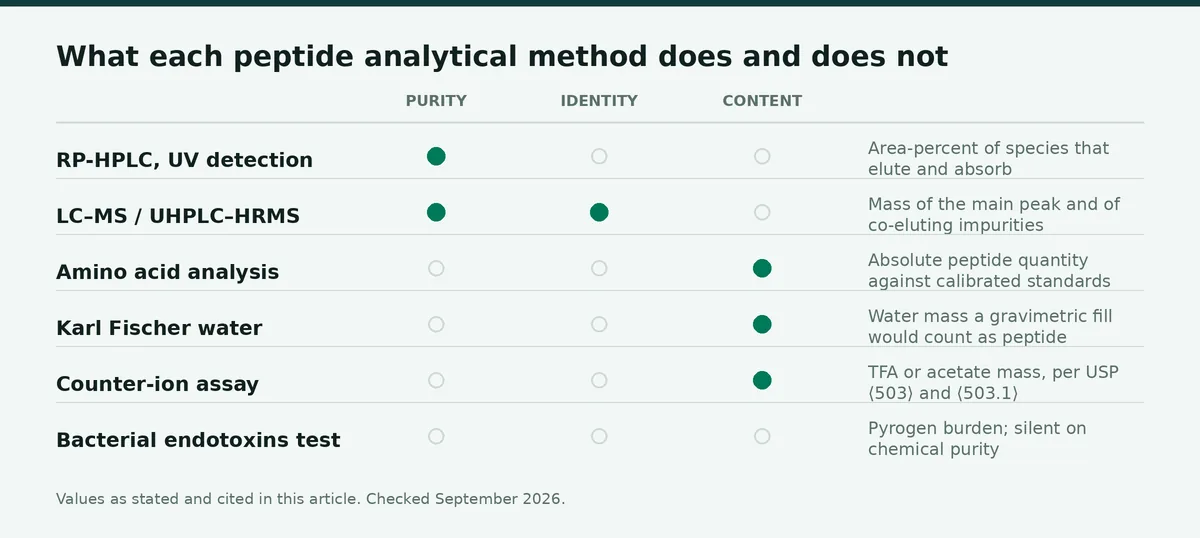
| Method | Purity | Identity | Content | What it actually reports |
|---|---|---|---|---|
| RP-HPLC, UV detection | yes | no | no | Area-percent of species that elute and absorb [4] |
| LC–MS / UHPLC–HRMS | yes | yes | no | Mass of the main peak and of co-eluting impurities [2][4] |
| Amino acid analysis | no | no | yes | Absolute peptide quantity against calibrated standards [4][5] |
| Karl Fischer water | no | no | yes | Water mass a gravimetric fill would count as peptide [4] |
| Counter-ion assay | no | no | yes | TFA or acetate mass, per USP ⟨503⟩ and ⟨503.1⟩ [5] |
| Bacterial endotoxins test | no | no | no | Pyrogen burden; silent on chemical purity [7] |
The Identity column has one entry. That is the single most useful thing on this chart: a certificate carrying only a chromatogram has not confirmed which molecule is in the vial.
The impurity thresholds regulators actually apply
Peptides sit in a regulatory gap that surprises people. ICH Q3A(R2), the impurity guideline everyone quotes, explicitly excludes them — its scope statement lists “biological/biotechnological, peptide, oligonucleotide, radiopharmaceutical, fermentation products” as outside the guidance [8] (regulatory guidance, 2008, checked September 2026). The small-molecule ladder of 0.05% reporting, 0.10% identification and 0.15% qualification does not govern a synthetic peptide.
The peptide-specific numbers are these:
| Framework | Threshold | What it triggers |
|---|---|---|
| Ph. Eur. general monograph, per EMA guideline | above 0.1% | Impurity must be reported [4] |
| Ph. Eur. general monograph, per EMA guideline | above 0.5% | Impurity must be identified [4] |
| Ph. Eur. general monograph, per EMA guideline | above 1.0% | Impurity must be qualified [4] |
| FDA synthetic peptide ANDA guidance | 0.10% or greater | Each peptide-related impurity must be identified [3] |
| FDA synthetic peptide ANDA guidance | above 0.5% | A new impurity is not acceptable [9] |
Put in plain terms: for a regulated generic peptide, an impurity present at one part in a thousand has to be named, and a new impurity above one part in two hundred is generally not allowed at all [3][9] (regulatory guidance, checked September 2026). A certificate reporting “≥99% purity” with no impurity table is reporting a number that, in a regulated setting, would be the beginning of the analysis rather than the end of it.
FDA’s own risk assessment for peptide impurities runs through in silico screening, in vitro cell-based assays and in vivo animal models to judge immunogenicity risk [9]. There are no human outcome studies linking a specific impurity level in an unapproved research peptide to a specific clinical result, and the guide does not imply one.
Endotoxin, bioburden and what chemistry cannot see
Chemical purity and microbiological quality are independent. A chemically immaculate peptide can carry bacterial endotoxin from contaminated water or glassware, and no chromatogram will show it.
The relevant test is the bacterial endotoxins test, USP general chapter ⟨85⟩, which became official with the Second Supplement to USP 35–NF 30 and is harmonised through the Pharmacopeial Discussion Group with the Japanese Pharmacopoeia as coordinating pharmacopoeia [7] (compendial standard, checked September 2026). Sterility is a further, separate determination again.
This matters for reading third-party reports because the three results answer three different questions, and a vendor publishing one of them has not addressed the other two.
What independent laboratory testing has found
The best-documented dataset on products sold outside the regulated supply chain comes from a 2024 JAMA Network Open research letter by Ashraf, Mackey and colleagues [1] (laboratory product analysis; not a human study).
The team ran structured internet searches, identified 1,080 hyperlinks advertising semaglutide, narrowed to 317 pharmacy websites of which 134 were operating illegally, and made test purchases from six vendors. Three vendors took payment and delivered nothing. The three delivered products were assessed against genuine reference product using the International Pharmaceutical Federation’s 22-point visual checklist, tested for sterility and microbiological contamination under European and US pharmacopoeial methods, and quantified by LC–MS [1].
The findings were stark. Measured purity was 7% to 14%, against an advertised 99%. Semaglutide content exceeded the labelled amount in every sample, by 29% to 39%. One sample showed elevated endotoxin at 8.95 EU/mg, although no viable microorganisms were recovered. Genuine reference product scored 22 of 22 on the visual checklist; the test purchases scored 8 or 9 [1].
Two things are worth separating there. Purity was an order of magnitude below the claim and content was above the label — which is exactly the pattern the purity-versus-content distinction predicts, and exactly the pattern a single HPLC number cannot express. The FDA has separately warned that products from unregulated online sources may be counterfeit and may contain “too little, too much or no active ingredient at all” [10] (regulatory statement, page last updated 1 September 2026, checked September 2026).
For the regulatory backdrop to all of this in the United States, see our guide to the legal status of peptides, and for the compound at the centre of that dataset, our semaglutide reference page.
Reading a third-party report without over-reading it
A certificate is a record of what one laboratory measured on one lot on one date. Its value is entirely in those specifics.
Ask whether the lot number on the certificate matches the vial, whether the testing party is named and independent of the seller, whether the method is stated in enough detail to be repeated, whether identity was confirmed by mass and not inferred from retention time, and whether content — not only purity — was determined. Our companion guide, how to read a peptide certificate of analysis, walks through a document field by field.
Why this page carries no Comparison Framework score
Our Comparison Framework scores properties of a molecule and the state of its evidence — duration of action, target selectivity, evidence depth, and so on. A methods guide has no single molecule to score, so inventing a score table here would be decoration rather than measurement, and the framework’s own rule is that a number without a definition and a citation is marketing.
The framework does have an axis that this guide feeds: Analytical Verifiability, which scores how readily a claim about identity and purity can be checked for a given compound — from no public reference standard at the bottom of the scale to a compendial monograph at the top. That axis is scored on each compound page, using the methods and standards described here.
FAQ
Does 99% purity mean the vial contains 99% peptide?
No. A 99% figure from RP-HPLC is an area-percent of the species that eluted from the column and absorbed UV light, not a proportion of the vial’s mass [4]. Water, counter-ions such as trifluoroacetate or acetate, and residual solvents are non-peptide mass that the purity calculation never sees, which is why the EMA guideline requires content to be expressed on a counter-ion-free, anhydrous basis and determined separately by methods such as amino acid analysis or qNMR [4].
Can HPLC alone confirm which peptide is in a vial?
No. Chromatography reports retention time, which is a property of how a molecule interacts with a column, not a fingerprint of its structure — two different molecules can elute at the same time. Identity requires a mass-based method, and the EMA guideline recommends at least two orthogonal methods for identification, listing LC–MS and mass-spectrometric peptide mapping among them [4]. The FDA guidance for synthetic peptide applications likewise directs applicants toward high-resolution techniques such as UHPLC–HRMS [2][3].
What impurity level is considered acceptable for a synthetic peptide?
For regulated products the ladder is explicit: under the European framework described in the EMA guideline, peptide-related impurities are reported above 0.1%, identified above 0.5% and qualified above 1.0% [4]. FDA’s guidance for synthetic peptide abbreviated applications asks applicants to identify each peptide-related impurity at 0.10% or greater, and treats a new impurity above 0.5% as not acceptable [3][9] (checked September 2026). Research-grade material sold outside those pathways is not held to any of these thresholds.
Why doesn’t ICH Q3A apply to peptides?
Because its scope excludes them. ICH Q3A(R2) covers new drug substances produced by chemical synthesis and states that “biological/biotechnological, peptide, oligonucleotide, radiopharmaceutical, fermentation products and semisynthetic products derived therefrom” are not covered [8]. Its familiar 0.05%/0.10%/0.15% ladder therefore does not govern peptides, which is why the peptide-specific USP chapters ⟨1503⟩ and ⟨1504⟩ and the 2025 EMA synthetic peptide guideline exist [4][5][6].
Has anyone independently tested peptides sold online?
Yes. A 2024 JAMA Network Open research letter purchased semaglutide from six no-prescription online vendors; three took payment without delivering, and the three delivered products were tested by LC–MS alongside sterility and endotoxin assays [1]. Measured purity was 7% to 14% against an advertised 99%, active ingredient content exceeded the label by 29% to 39%, and one sample carried endotoxin at 8.95 EU/mg [1] (laboratory product analysis). This is analysis of products, not a human clinical study, and it describes the vendors sampled rather than any market as a whole.
Does an endotoxin result tell you anything about purity?
No — they are independent measurements. The bacterial endotoxins test, USP ⟨85⟩, quantifies pyrogenic material in endotoxin units and says nothing about the chemical identity or chromatographic purity of the peptide [7]. A sample can pass endotoxin testing and be the wrong molecule, or be chemically clean and carry endotoxin, as the 8.95 EU/mg result in the 2024 product analysis illustrates alongside its separate purity finding [1].
References
- Ashraf AR, Mackey TK, Schmidt J, et al. Safety and Risk Assessment of No-Prescription Online Semaglutide Purchases. JAMA Network Open. 2024. https://jamanetwork.com/journals/jamanetworkopen/fullarticle/2821882
- US Food and Drug Administration. ANDAs for Certain Highly Purified Synthetic Peptide Drug Products That Refer to Listed Drugs of rDNA Origin (guidance landing page, final guidance). FDA. 2021. https://www.fda.gov/regulatory-information/search-fda-guidance-documents/andas-certain-highly-purified-synthetic-peptide-drug-products-refer-listed-drugs-rdna-origin
- US Food and Drug Administration. ANDAs for Certain Highly Purified Synthetic Peptide Drug Products That Refer to Listed Drugs of rDNA Origin (guidance text, docket FDA-2017-D-5767). FDA. 2017. https://downloads.regulations.gov/FDA-2017-D-5767-0002/attachment_1.pdf
- European Medicines Agency. Guideline on the development and manufacture of synthetic peptides (EMA/CHMP/CVMP/QWP/367182/2025). EMA. 2025. https://www.ema.europa.eu/system/files/documents/scientific-guideline/guideline-synthetic-peptides-en.pdf
- United States Pharmacopeia. USP Peptide Standards and Solutions. USP. 2026. https://www.usp.org/sites/default/files/usp/document/our-work/biologics/documents/USP_PeptideStandardsFlyer_Digital_V11.pdf
- United States Pharmacopeia. ⟨1503⟩ Quality Attributes of Synthetic Peptide Drug Substances. USP–NF. 2021. https://doi.usp.org/USPNF/USPNF_M12935_02_01.html
- United States Pharmacopeia. Bacterial Endotoxins — PDG harmonised general chapter ⟨85⟩. USP. https://www.usp.org/harmonization-standards/pdg/general-methods/bacterial-endotoxins
- International Council for Harmonisation / US Food and Drug Administration. Q3A(R2) Impurities in New Drug Substances. 2008. https://www.hhs.gov/guidance/sites/default/files/hhs-guidance-documents/FDA/Q3A%28R%29-Impurities-in-New-Drug-Substances.pdf
- Pang E. Assessing Immunogenicity Risk of Peptides: the Synthetic Peptide Guidance and PSGs. Office of Research and Standards, CDER, US Food and Drug Administration. 2020. https://www.fda.gov/media/166571/download
- US Food and Drug Administration. FDA’s Concerns with Unapproved GLP-1 Drugs Used for Weight Loss. FDA. 2026. https://www.fda.gov/drugs/drug-alerts-and-statements/fdas-concerns-unapproved-glp-1-drugs-used-weight-loss