Quick answer: Selank is a synthetic seven-amino-acid peptide, Thr-Lys-Pro-Arg-Pro-Gly-Pro, built by extending the endogenous immunopeptide tuftsin with a C-terminal Pro-Gly-Pro tripeptide to slow its breakdown [1]. Almost all published work on it is Russian, and most of it is animal or in vitro; the human evidence retrievable for this page is one 20-patient open-label study with no placebo arm [8]. There is no FDA-approved Selank product and no US label (checked September 2026) [11].
| Spec | Detail |
|---|---|
| Also known as | TP-7, tuftsin heptapeptide analogue |
| Class | Synthetic regulatory peptide; tuftsin analogue studied as an anxiolytic |
| Sequence / length | Thr-Lys-Pro-Arg-Pro-Gly-Pro; 7 residues [1,4] |
| Structural basis | Tuftsin, Thr-Lys-Pro-Arg, plus C-terminal Pro-Gly-Pro for metabolic stability [1] |
| Route studied | Intranasal in rats and in the human study located here; intraperitoneal in most rodent work [1,8,10] |
| Half-life | No published human or animal half-life located; degradation fragments identified instead [9] |
| Regulatory status (US) | No FDA-approved product; no DailyMed label (checked September 2026) [11] |
| WADA status | Not established — the Prohibited List could not be retrieved this run |
What is Selank?
Selank is a heptapeptide made by taking tuftsin — the Thr-Lys-Pro-Arg fragment of the heavy chain of human immunoglobulin G — and adding three natural L-amino acids, Pro-Gly-Pro, at the C-terminus. The primary literature states why: the extension was made “to improve its metabolic stability and yield a relatively longer duration” [1]. Tuftsin itself is an endogenous immunomodulatory tetrapeptide, which is why Selank appears in two literatures at once, neuropharmacology and immunology [14,15]. New to the class? Start with what a peptide actually is.
The peptide comes out of the Institute of Molecular Genetics of the Russian Academy of Sciences — the affiliation on most primary Selank papers [1,3,14], and the institute that produced the ACTH(4–10) analogue Semax [12]. That single-centre origin matters: much of the record was produced by one collaborating network, published largely in Russian-language journals, and not replicated independently. Much of what circulates about Selank online rests on exactly those studies — small, unblinded, or unreproduced.
How Selank works (mechanism)
There is no single accepted mechanism, only separate observations at different evidence levels.
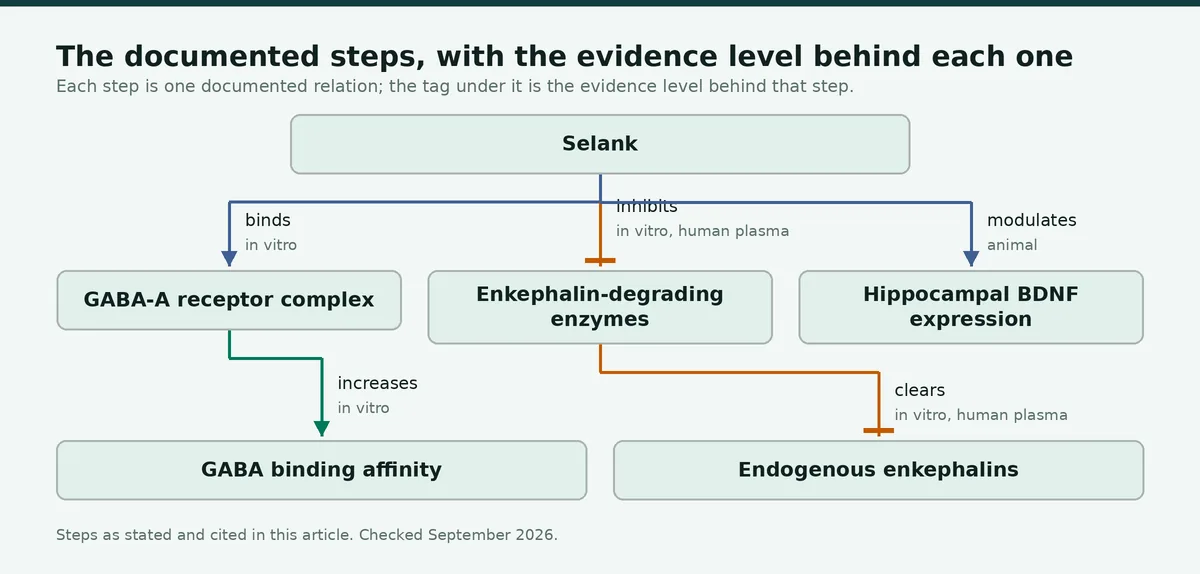
| Step | Relation | Target | Evidence |
|---|---|---|---|
| Selank | binds | GABA-A receptor complex | in vitro [3] |
| GABA-A receptor complex | increases | GABA binding affinity | in vitro [3] |
| Selank | inhibits | Enkephalin-degrading enzymes | in vitro, human plasma [4] |
| Enkephalin-degrading enzymes | clears | Endogenous enkephalins | in vitro, human plasma [4] |
| Selank | modulates | Hippocampal BDNF expression | animal [13] |
The GABAergic step is in-vitro radioligand work. Vyunova and colleagues reported that Selank affects tritiated GABA binding as a positive allosteric modulator, and that its interaction with benzodiazepines is non-additive: it could blunt the modulatory activity of diazepam and of olanzapine, which they read as partially overlapping rather than identical binding sites [3].
The enkephalin step is ex-vivo human plasma. Zozulya and colleagues measured enkephalin hydrolysis in plasma from patients with anxiety disorders and found Selank inhibited it dose-dependently, half-maximally at 15 μM and more potently than bacitracin or puromycin in the same assay [4]. That is biochemistry in a tube, not a measurement in a treated person.
The gene-expression and monoamine steps are animal. A single 300 μg/kg intranasal dose in male Wistar rats changed expression of 45 genes in frontal cortex at one hour and 22 at three hours, including the GABA-A subunit genes Gabre and Gabrq, dopamine receptor genes and GABA transporter genes; the authors concluded allosteric modulation of the GABAergic system is one possible mechanism [1]. In rats exposed to antenatal hypoxia, 300 μg/kg intraperitoneally reportedly restored the balance between serotonergic and noradrenergic activity [5], and in an alcohol-withdrawal model a single 0.3 mg/kg dose prevented the serotonin rise measured by HPLC in three brain regions [6].
The BDNF step is animal, and its direction depends on the model. Intranasal Selank reportedly regulates BDNF expression in rat hippocampus in vivo [13]; in ethanol-exposed rats, 0.3 mg/kg daily for seven days prevented an ethanol-induced increase in hippocampal and cortical BDNF [7]. “Modulates” is the strongest word the sources support.
One step often asserted and not supported here. In cultured human IMR-32 neuroblastoma cells, Selank alone changed none of 84 neurotransmission-related genes’ mRNA levels, which the authors attributed to that line’s limited GABA-A subunit composition [2]. A mechanism visible in rat cortex and absent in a human cell line is worth stating, not hiding.
Tuftsin-like immunomodulation is repeatedly claimed; a review from the originating group summarises immunostimulatory and cytokine-gene effects in animals [14]. Specific interleukin-6 or Th1/Th2 findings appear in the Russian-language literature, but no source stating them could be opened here, so none is asserted.
Key numbers, and the ones that do not exist
No published pharmacokinetic half-life for Selank in humans or animals could be retrieved — unusual for a compound this widely sold. What exists instead is a degradation map: tritium-labelled tracing identified the fragments formed in vivo and in vitro as TKPRP, TKP, RP and GP [9], and those fragments have their own reported behavioural effects in rodents [14,15]. Because no single quantity has two comparable published values, this page carries no magnitude chart.
What the research shows
Human studies
The human record is thin and unblinded. In an open-label study of 20 patients aged 24 to 52 with DSM-IV generalised anxiety disorder, investigators gave 2700 μg per day intranasally for at least 14 days and reported that Hamilton Anxiety Rating Scale scores fell significantly (p < 0.01), with 40% classed as rapid responders changing within one to three days [8]. Human open-label, no placebo, no randomisation, published as a conference abstract. That is the entire human efficacy signal this page stands behind; a review from the originating group refers to further clinical observations without retrievable primary data [14] — human observational.
Animal studies
The animal literature is broader and more consistent. Selank and related tuftsin-family peptides were reported to have anti-stress effects in rats and mice stratified by emotional reactivity, varying by structure and degradation product [15]. In BALB/c mice, 300 μg/kg/day reduced anxiety-like behaviour by both intraperitoneal and intranasal routes; in C57BL/6 mice the same doses did almost nothing [10]. That strain dependence limits extrapolation. Other animal findings include cognitive-stimulating effects in aged rats and prevention of ethanol-associated memory disturbances during withdrawal [7], and restored serotonergic–noradrenergic balance after antenatal hypoxia [5].
In-vitro and ex-vivo work
The GABA-binding modulation [3] and enkephalinase inhibition [4] described above are the two substantial in vitro results, and the IMR-32 cell study [2] is the useful negative.
Side effects and risks
The risk picture is dominated by what has not been measured. No randomised safety data, no dose-ranging study and no long-term human exposure data could be retrieved; the 20-patient open-label report gives efficacy and EEG outcomes but no adverse-event table [8]. That absence is not a clean bill of health.
- Unknown tolerability. With no published safety dataset there is no characterised adverse-event profile at any dose or duration, and nothing to weigh against an approved anxiolytic.
- Unknown interactions. In-vitro work shows Selank interacting non-additively with diazepam and olanzapine at the GABA-A complex [3]. That makes interactions plausible; it does not say what they do in a person.
- Product risk as well as compound risk. Material sold as Selank is not made under drug-manufacturing rules, so identity and purity vary by supplier — and because its own fragments are biologically active in animals [14,15], partial degradation is not neutral.
The comparison the Russian literature draws — tranquilliser-like effects without the amnesia, withdrawal and dependence associated with benzodiazepines [1] — is a claim from that literature, not a safety advantage shown in trials.
Regulatory and legal status (2026)
United States. There is no FDA-approved Selank product; a DailyMed search for “selank” returns zero drug labels (checked September 2026) [11]. It is sold as a research chemical, for laboratory use rather than as a medicine. Our guide to the US regulatory position on research peptides explains what that framing permits, and the difference between research, compounded and approved peptides is the distinction most vendor copy blurs.
European Union. No EMA authorisation could be confirmed; the EMA site search returned an error this run, so nothing is asserted from it either way.
Russia. Russian-language reviews describe Selank as having gone through clinical evaluation and into clinical use in Russia [14], and the study above ran in a Russian research setting [8]. This page asserts no specific Russian marketing authorisation, because no state-register entry could be retrieved from an allowed primary source this run.
Sport. The WADA Prohibited List could not be retrieved this run — the site’s robots policy blocked the request — so this page makes no claim about whether Selank is prohibited in sport.
Comparison Framework scores
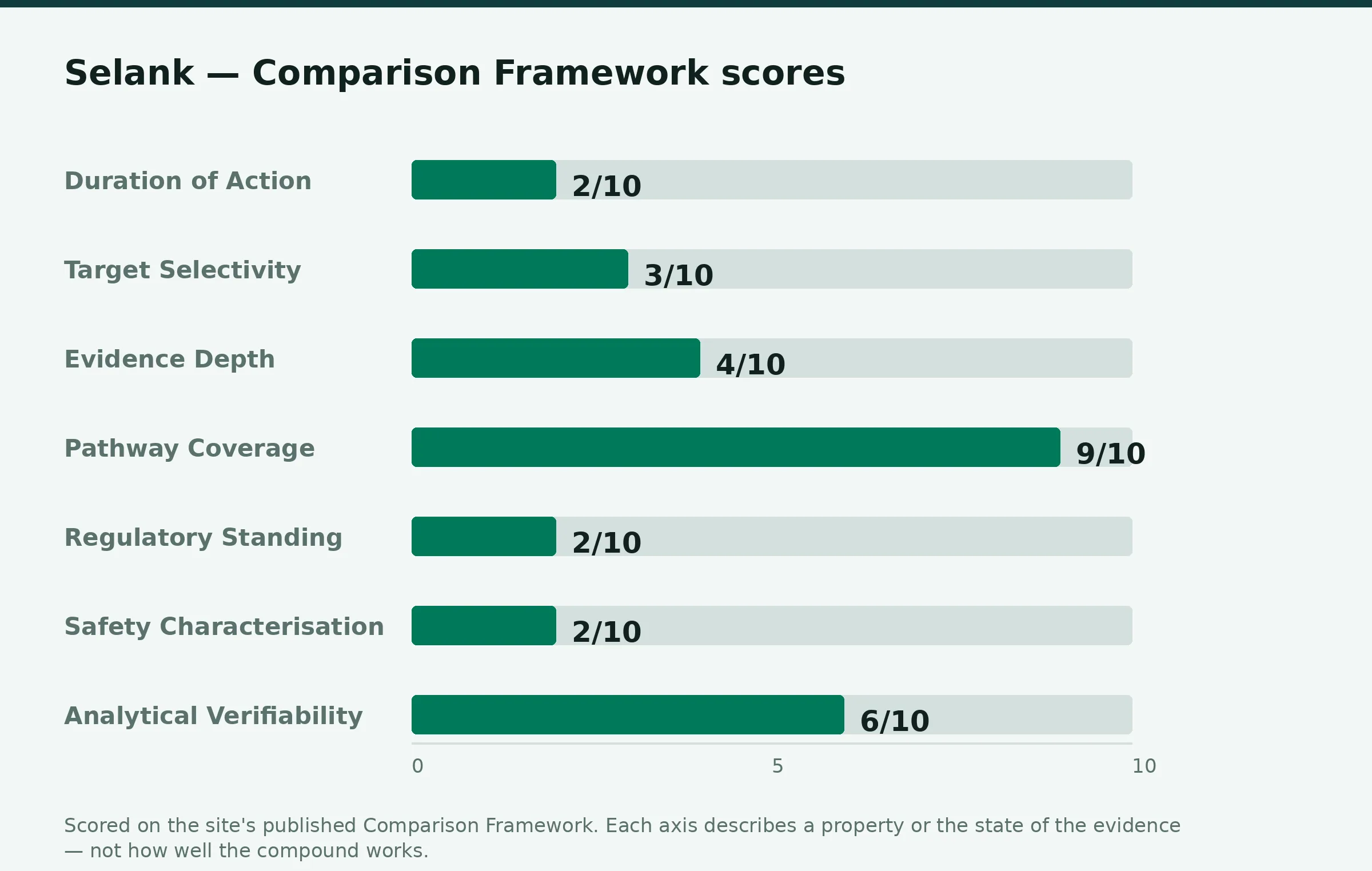
| Axis | Score | Why |
|---|---|---|
| Duration of Action | 2/10 | No published half-life in any species; tracing shows breakdown to TKPRP, TKP, RP and GP [9], and Pro-Gly-Pro was appended to slow it [1]. Sub-30-minute action bands at 1–2; interpolated to its top, since no source measures longer. |
| Target Selectivity | 3/10 | No band published, so interpolated. No identified primary receptor: allosteric modulation of GABA binding [3], enkephalinase inhibition [4], shifts in dozens of unrelated rat-cortex genes [1]. Diffuse, not clean. |
| Evidence Depth | 4/10 | The ladder runs animal 3–4, small human 5–6. The only human efficacy data is one 20-patient open-label abstract [8]; the substantive body is animal [5,6,7,10,15] and in vitro [2,3,4]. Interpolated at the animal band’s top. |
| Pathway Coverage | 9/10 | Three or more pathways bands at 9–10: GABAergic [1,3], enkephalinergic [4], monoaminergic [5,6], neurotrophic [7,13], glutamatergic [10] — nearly all animal or in vitro, so this counts pathways implicated, not how firmly established. |
| Regulatory Standing | 2/10 | Research-use-only bands at 2–3. No FDA-approved product, no DailyMed label, checked September 2026 [11]; no EMA authorisation confirmable; no documented US review. Bottom of the band. |
| Safety Characterisation | 2/10 | No band published, so interpolated. No randomised safety data, no dose-ranging study, no long-term exposure data; the one human report has no adverse-event table [8]. A low score means risks are poorly documented, not small or absent. |
| Analytical Verifiability | 6/10 | Interpolated between anchors of 1–2 for no public method and 9–10 for a compendial monograph. The sequence is published [1,4], HPLC and radioligand methods exist [3], the fragment profile is characterised [9] — but no monograph exists. |
Selank sits in the lower half on evidence depth, so the obvious is worth saying: mechanistic plausibility is not clinical proof. A binding result and a set of rodent findings can be real and still say nothing about a person. No axis above measures how well Selank works or how safe it is — the rules are in our Comparison Framework.
How Selank compares
The closest comparator is Semax, the other peptide from the same Russian institute: also a heptapeptide, Met-Glu-His-Phe-Pro-Gly-Pro, but an analogue of the ACTH(4–10) fragment rather than of tuftsin, and tied in the Russian literature to ischaemic stroke rather than anxiety [12]. Both carry the C-terminal Pro-Gly-Pro motif and an intranasal research route, and were compared head to head in mice, where route decided which effect predominated — anxiolytic-type after intraperitoneal dosing, nootropic-type after intranasal, in BALB/c but not C57BL/6 animals [10]. We break the two apart in Selank vs Semax. Neither has an FDA or EMA authorisation, and neither has a randomised controlled trial in the retrievable literature.
Sourcing and quality: what to look for
With no pharmacopoeial monograph for Selank, batch quality rests on what a supplier publishes and which lab did the work. A useful certificate names the method, the batch, the date and the identity confirmation — not just a purity percentage; our guide to reading a peptide certificate of analysis separates informative fields from decorative ones. Selank’s characterised fragment profile [9] makes mass spectrometry the meaningful identity check and HPLC the purity check, as covered in HPLC and mass-spec purity testing. Vendor copy also cites Russian studies as though they were controlled human trials — itself a signal, alongside the patterns in our list of vendor red flags.
FAQ
Is Selank the same thing as tuftsin?
No. Tuftsin is an endogenous tetrapeptide, Thr-Lys-Pro-Arg, from the heavy chain of human immunoglobulin G. Selank takes that sequence and adds Pro-Gly-Pro at the C-terminus, which the developers describe as improving metabolic stability and lengthening duration [1]. Related by design, not identical.
Is Selank approved by the FDA?
No. A DailyMed search for “selank” returns zero drug labels, checked September 2026 [11], and no FDA-approved Selank product exists. In the US it circulates as a research chemical, offered for laboratory use rather than as a medicine.
How strong is the human evidence for Selank?
Weak, and thinner than most summaries imply. The human efficacy data locatable here is one open-label study in 20 patients with generalised anxiety disorder given 2700 μg per day intranasally for at least 14 days, in which investigators reported significant falls in Hamilton Anxiety Rating Scale scores [8]. No placebo arm, no randomisation, no independent replication.
Why is most Selank research in Russian journals?
Selank was developed at the Institute of Molecular Genetics of the Russian Academy of Sciences, the institute behind Semax [12], and most of the primary literature carries authors from that group [1,3,14]. The record is concentrated in one network and one language, and largely unreproduced by independent laboratories.
Does Selank act on the same receptor site as benzodiazepines?
Not in the way that phrasing implies. In-vitro radioligand work reports Selank acting as a positive allosteric modulator of GABA binding, and that its effect with diazepam is not additive — it could blunt diazepam’s modulatory activity — which the authors read as sites that may partially overlap rather than coincide [3]. That is a binding-assay result, not a shared mechanism in a person.
Is Selank banned in sport?
This page cannot answer that. The WADA Prohibited List could not be retrieved this run — the site’s robots policy blocked the request — and no other source opened here states Selank’s status. Anyone competing under anti-doping rules should consult the current list directly.
References
- Volkova A, Shadrina M, Kolomin T, Andreeva L, Limborska S, Myasoedov N, Slominsky P. Selank Administration Affects the Expression of Some Genes Involved in GABAergic Neurotransmission. Frontiers in Pharmacology. 2016;7:31. https://www.frontiersin.org/journals/pharmacology/articles/10.3389/fphar.2016.00031/full
- Filatova E, Kasian A, Kolomin T, Rybalkina E, Alieva A, Andreeva L, Limborska S, Myasoedov N, Pavlova G, Slominsky P, Shadrina M. GABA, Selank, and Olanzapine Affect the Expression of Genes Involved in GABAergic Neurotransmission in IMR-32 Cells. Frontiers in Pharmacology. 2017;8:89. https://www.frontiersin.org/journals/pharmacology/articles/10.3389/fphar.2017.00089/full
- Vyunova TV, Andreeva L, Shevchenko K, Myasoedov N. Peptide-based Anxiolytics: The Molecular Aspects of Heptapeptide Selank Biological Activity. Protein and Peptide Letters. 2018;25(10):914–923. https://www.benthamdirect.com/content/journals/ppl/10.2174/0929866525666180925144642
- Zozulya AA, Kost NV, Sokolov OYu, Gabaeva MV, Grivennikov IA, Andreeva LN, Zolotarev YuA, Ivanov SV, Andryushchenko AV, Myasoedov NF, Smulevich AB. The Inhibitory Effect of Selank on Enkephalin-Degrading Enzymes as a Possible Mechanism of Its Anxiolytic Activity. Bulletin of Experimental Biology and Medicine. 2001;131(4):315–317. https://link.springer.com/article/10.1023/A:1017979514274
- Semenova TP, Kozlovskaya MM, Zuikov AV, Kozlovskii II, Zakharova NM, Andreeva LA. Use of Selank to Correct Measures of Integrative Brain Activity and Biogenic Amine Levels in Adult Rats Resulting from Antenatal Hypoxia. Neuroscience and Behavioral Physiology. 2008;38(2):203–207. https://link.springer.com/article/10.1007/s11055-008-0030-2
- Nadorova AV, Kolik LG, Klodt PM, Narkevich VB, Naplyokova PL, Kozlovskaya MM, Kudrin VS. The Relationship Between the Anxiolytic Action of Selank and the Level of Serotonin in Brain Structures During the Modeling of Alcohol Abstinence in Rats. Neurochemical Journal. 2014;8(2):115–120. https://link.springer.com/article/10.1134/S1819712414020081
- Kolik LG, Nadorova AV, Antipova TA, et al. Selank, Peptide Analogue of Tuftsin, Protects Against Ethanol-Induced Memory Impairment by Regulating of BDNF Content in the Hippocampus and Prefrontal Cortex in Rats. Bulletin of Experimental Biology and Medicine. 2019;167(5):641–644. https://link.springer.com/article/10.1007/s10517-019-04588-9
- Syunyakov T, Teleshova ES, Neznamov GG, Bochkarev VK. P-1114 — Rapid and Slow Response During Treatment of Generalized Anxiety Disorder with Peptide Anxiolytic Selank. European Psychiatry. 2012;27(Supplement 1):1. https://www.sciencedirect.com/science/article/abs/pii/S0924933812752811
- Zolotarev YA, Dadayan AK, Dolotov OV, et al. Evenly Tritium Labeled Peptides in Study of Peptide In Vivo and In Vitro Biodegradation. Russian Journal of Bioorganic Chemistry. 2006;32(2):166–173. https://link.springer.com/article/10.1134/S1068162006020099
- Vasileva EV, Kondrakhin EA, Abdullina AA, Salimov RM, Kovalev GI. Predominance of Nootropic or Anxiolytic Effects of Selank, Semax, and Noopept Peptides Depending on the Route of Administration to BALB/c and C57BL/6 Mice. Neurochemical Journal. 2020;14(3):268–278. https://link.springer.com/article/10.1134/S1819712420030113
- DailyMed. Search results for “selank” — 0 results. US National Library of Medicine. Checked September 2026. https://dailymed.nlm.nih.gov/dailymed/search.cfm?labeltype=all&query=selank
- Deigin VI, Poluektova EA, Beniashvili AG, Kozin SA, Poluektov YM. Development of Peptide Biopharmaceuticals in Russia. Pharmaceutics. 2022;14(4):716. https://www.mdpi.com/1999-4923/14/4/716
- Inozemtseva LS, Karpenko EA, Dolotov OV, et al. Intranasal Administration of the Peptide Selank Regulates BDNF Expression in the Rat Hippocampus In Vivo. Doklady Biological Sciences. 2008;421(1):241–243. https://link.springer.com/content/pdf/10.1134/S0012496608040066.pdf
- Koroleva SV, Mjasoedov NF. Physiological Effects of Selank and Its Fragments. Biology Bulletin. 2019;46(4):407–414. https://link.springer.com/article/10.1134/S1062359019040071
- Kozlovskaya MM, Kozlovskii II, Val’dman EA, Seredenin SB. Selank and Short Peptides of the Tuftsin Family in the Regulation of Adaptive Behavior in Stress. Neuroscience and Behavioral Physiology. 2003;33(9):853–860. https://link.springer.com/article/10.1023/A:1025988519919