Quick answer: Ipamorelin is a synthetic pentapeptide that activates the ghrelin receptor and triggers a short burst of growth hormone release. Its claim to fame is selectivity: in conscious swine it raised GH without moving ACTH or cortisol, unlike GHRP-2 and GHRP-6 [1] (animal). Human data is thin — one pharmacokinetic study and one randomised phase 2 trial that missed its endpoint [2][4] — and US regulators have repeatedly declined to let pharmacies compound it.
| Spec | Detail |
|---|---|
| Also known as | Ipamorelin (free base), ipamorelin acetate [5] |
| Class | Pentapeptide growth hormone secretagogue; ghrelin receptor (GHS-R1a) agonist [1][5] |
| Sequence / length | Aib-His-D-2-Nal-D-Phe-Lys-NH2, five residues [1][5] |
| Molecular formula / weight | C38H49N9O5; 711.85 g/mol (free base) [5] |
| Half-life | ~2 h terminal, after 15-minute intravenous infusion in healthy men [2] |
| Regulatory status (US) | No approved product; ipamorelin acetate in FDA category 2 for 503B compounding since 29 September 2023, and an FDA advisory committee voted 0–12–1 against 503A listing (checked September 2026) [6][7] |
| WADA status | Prohibited at all times under class S2.4, growth hormone releasing factors [9] |
What is ipamorelin?
Ipamorelin is a five-residue synthetic peptide first described in 1998 by Raun and colleagues, under the title “Ipamorelin, the first selective growth hormone secretagogue” [1]. It came out of a medicinal-chemistry programme built around growth hormone-releasing peptide-1 (GHRP-1), and its defining structural move was the removal of that scaffold’s central Ala-Trp dipeptide [1]. The result is short, unnatural and amidated: Aib-His-D-2-Nal-D-Phe-Lys-NH2, with two D-amino acids and the non-proteinogenic residue Aib [1][5].
It belongs to the growth hormone secretagogue family rather than the GHRH family — it works through the ghrelin receptor, not the GHRH receptor. That distinction organises the whole category, and our guide to growth hormone secretagogues sets out how the two arms differ. Ipamorelin was later taken into clinical development as an intravenous agent for postoperative ileus, a programme FDA describes as discontinued after disappointing results [5]. It has never been approved for any indication.
How ipamorelin works (mechanism)
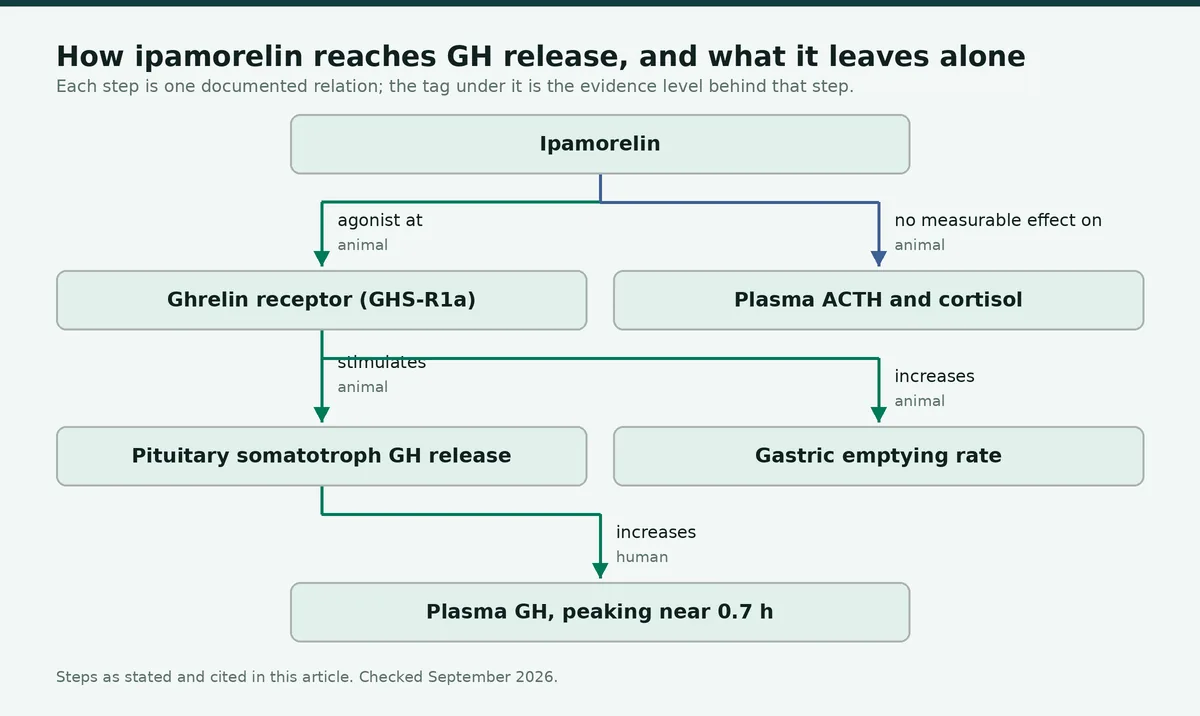
| Step | Relation | Target | Evidence |
|---|---|---|---|
| Ipamorelin | agonist at | Ghrelin receptor (GHS-R1a) | animal [1][5] |
| Ghrelin receptor (GHS-R1a) | stimulates | Pituitary somatotroph GH release | animal [1] |
| Pituitary somatotroph GH release | increases | Plasma GH, peaking near 0.7 h | human [2] |
| Ghrelin receptor (GHS-R1a) | increases | Gastric emptying rate | animal [3] |
| Ipamorelin | no measurable effect on | Plasma ACTH and cortisol | animal [1] |
The receptor identification is unusually clean for a research peptide. Raun and colleagues profiled ipamorelin against GHRP and GHRH antagonists in rat pituitary cells and showed that, like GHRP-6, it releases GH through a GHRP-type receptor rather than the GHRH receptor [1] (in vitro). FDA describes its primary mechanism of action as ghrelin receptor agonism [5].
The same receptor drives gut motility, which is where the clinical programme went. In rats given a laparotomy with intestinal manipulation, intravenous ipamorelin accelerated gastric emptying: 78% ± 5% of the test meal remained in the stomach at 15 minutes in vehicle controls against 52% ± 11% at the lowest dose tested, 0.014 µmol/kg (P < 0.05), with non-surgical controls at 44% ± 6% [3] (animal).
Key numbers
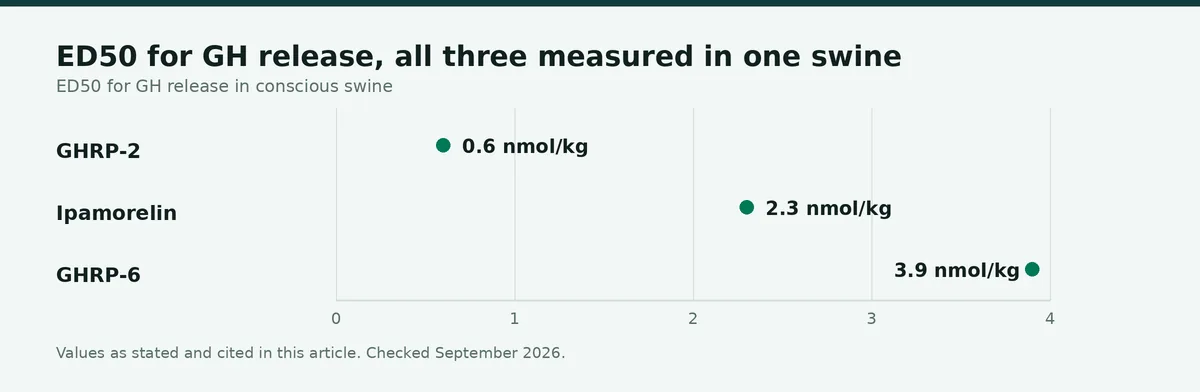
| Secretagogue | ED50 for GH release in conscious swine | Evidence level |
|---|---|---|
| GHRP-2 | 0.6 nmol/kg | animal [1] |
| Ipamorelin | 2.3 nmol/kg | animal [1] |
| GHRP-6 | 3.9 nmol/kg | animal [1] |
Those three numbers come from one experiment in one species, which is the only reason they can be lined up at all. GHRP-2 is roughly four times more potent than ipamorelin on a molar basis and GHRP-6 slightly less potent, while maximal GH responses were broadly similar (ipamorelin 65 ± 0.2, GHRP-6 74 ± 7, GHRP-2 56 ± 6 ng/mL) [1]. Potency is not the interesting axis here; what separates them is what else they move.
What the research shows
Human studies
There are two published human datasets, and both are small.
The first is a pharmacokinetic and pharmacodynamic study in healthy male volunteers, eight per dose level across five 15-minute intravenous infusion rates from 4.21 to 140.45 nmol/kg [2] (human PK). Disposition was dose-proportional, with a terminal half-life of 2 hours, clearance of 0.078 L/h/kg and a steady-state volume of distribution of 0.22 L/kg [2]. GH release was episodic rather than sustained: a single pulse peaking at 0.67 hours and declining exponentially to negligible concentrations at every dose, with a half-maximal stimulating concentration of 214 nmol/L [2]. That is the entire published human pharmacokinetic record, and it covers the intravenous route only.
The second is the phase 2 ileus trial. Beck and colleagues ran a multicentre, double-blind, placebo-controlled proof-of-concept study in adults undergoing open or laparoscopic bowel resection: 117 enrolled, 114 analysed, with intravenous ipamorelin 0.03 mg/kg twice daily from postoperative day 1 through day 7 or discharge [4] (human RCT). The primary endpoint was time from first dose to tolerance of a standardised solid meal: median 25.3 hours on ipamorelin against 32.6 hours on placebo, a difference that did not reach statistical significance (P = 0.15), so the trial missed its primary endpoint [4]. FDA’s later review summarised the outcome plainly: “Due to these disappointing results, its development was discontinued” [5].
Animal studies
The 1998 characterisation is the reference work. In conscious swine, ipamorelin released GH with an ED50 of 2.3 ± 0.03 nmol/kg and an Emax of 65 ± 0.2 ng/mL, closely comparable to GHRP-6 [1] (animal). None of the secretagogues tested altered FSH, LH, prolactin or TSH [1]. The separation appeared in the stress axis: GHRP-6 and GHRP-2 both raised plasma ACTH and cortisol, while ipamorelin did not produce levels significantly different from GHRH stimulation, and that held at doses more than 200-fold above its own ED50 for GH release [1]. This single experiment is the origin of essentially every “selective” claim made about the compound. The rodent ileus work described above is the other substantive animal dataset [3] (animal).
In-vitro / preclinical
In primary rat pituitary cells, ipamorelin released GH with an EC50 of 1.3 ± 0.4 nmol/L and an Emax of 85 ± 5% of the GHRP-6 maximum (GHRP-6: EC50 2.2 ± 0.3 nmol/L), and antagonist profiling in the same system established the receptor route [1] (in vitro).
What the evidence does not cover
This is the more useful list. FDA’s 2024 evaluation found no acute toxicity, repeat-dose toxicity, genotoxicity or carcinogenicity studies for either form, and no pharmacokinetic data at all for the subcutaneous route compounders proposed — every human number above comes from intravenous infusion [2][5]. There are no published trials in growth hormone deficiency; the nomination to FDA cited one pharmacokinetic study containing no efficacy data [5]. There is no long-term exposure data, no published body composition, bone or performance endpoint measured in people, and no head-to-head human comparison against another secretagogue.
Side effects and risks
The risk profile is under-documented rather than reassuring. The one controlled trial reported treatment-emergent adverse events in 87.5% of ipamorelin recipients versus 94.8% on placebo, in a post-surgical population where a high background rate is expected, and identified no signal that stopped the study [4] (human RCT). FDA’s adverse event system held two reports involving ipamorelin at the time of its review, both non-serious [5].
Against that, FDA raised three concerns in its briefing document [5]. Ghrelin receptor agonism carries potential behavioural reinforcing properties. Ghrelin receptor work in mice raises the possibility of effects on reproduction. And neither form is well characterised: for the free base, FDA could not locate critical data on impurities, aggregates or bacterial endotoxins, and no USP or NF monograph exists for either [5]. The category 2 listing for ipamorelin acetate rests on exactly this point — immunogenicity risk for certain routes of administration, given the potential for aggregation or peptide-related impurities [7]. FDA also notes that the peptide’s unnatural amino acids complicate analytical characterisation, and that the free base is only slightly water-soluble at 0.0032 mg/mL against 5 mg/mL for the acetate [5].
Regulatory and legal status (2026)
All of the following was checked September 2026. There is no FDA-approved ipamorelin product for any indication, and clinical development ended after the phase 2 ileus result [5].
On compounding, the position hardened in two steps. Ipamorelin acetate was placed in category 2 of FDA’s interim policies — bulk substances that may present significant safety risks — for section 503B outsourcing-facility compounding on 29 September 2023, on immunogenicity grounds [7]. It also appears in FDA’s separate list of substances previously in category 2 whose nominations were withdrawn by the nominators [7].
Then, on 29 October 2024, FDA’s Pharmacy Compounding Advisory Committee considered both ipamorelin (free base) and ipamorelin acetate for the section 503A Bulks List. FDA’s briefing document concluded that the evaluation criteria “weigh against” placing either form on that list [5], and the committee agreed unanimously: 0 in favour, 12 against, 1 abstention for each form, citing the lack of information supporting safety and efficacy for growth hormone deficiency and postoperative ileus [6]. Ipamorelin does not appear on FDA’s current list of substances nominated for 503A compounding, updated 14 May 2026 [8].
For sport, ipamorelin is named as an example substance under class S2.4 of the WADA Prohibited List, growth hormone releasing factors, prohibited at all times rather than in competition only [9]. Material sold for laboratory work is not approved for human use, and our overview of peptide legal status covers what research-use-only labelling does and does not mean.
Comparison Framework scores
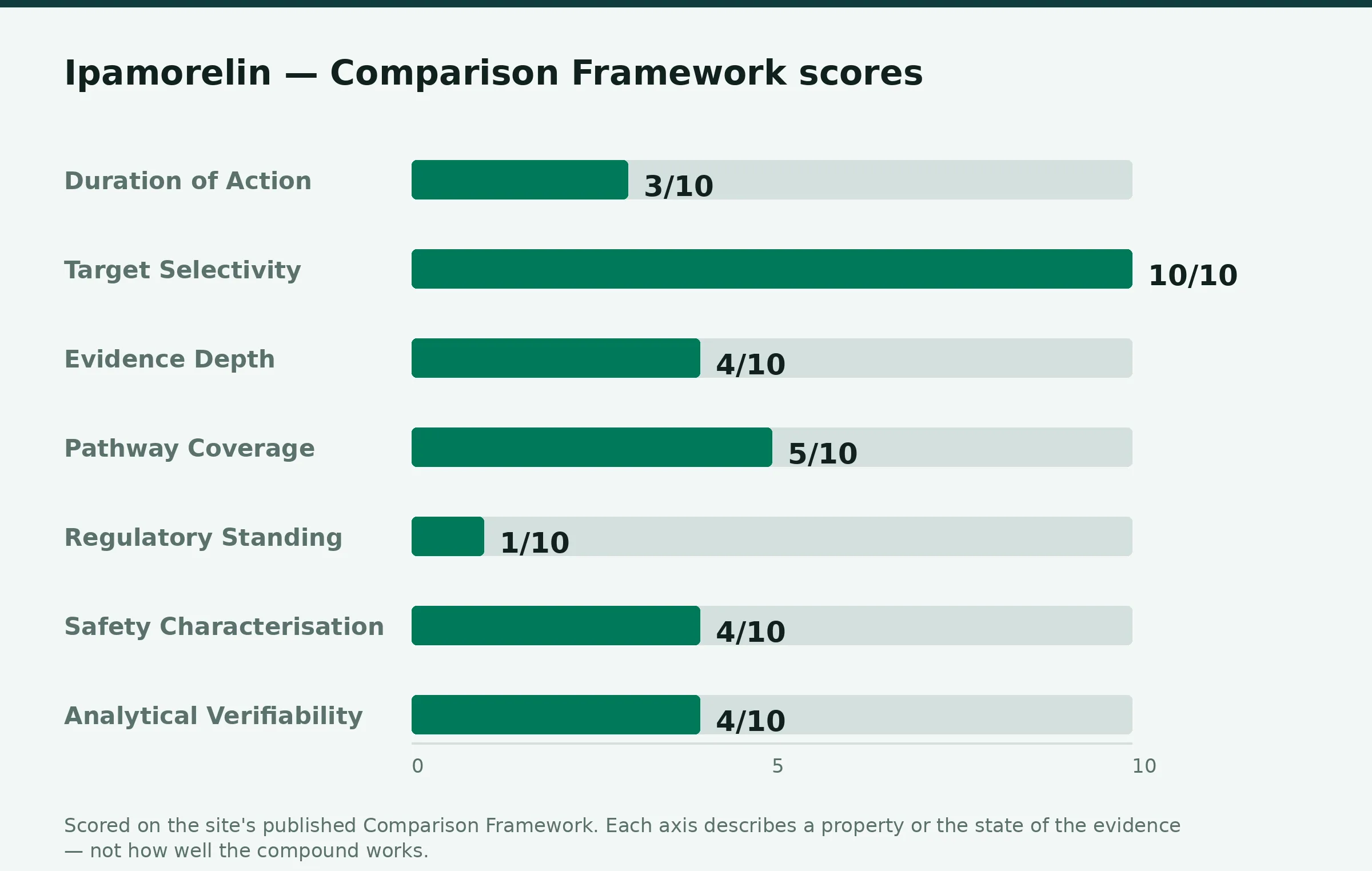
| Axis | Score | Why |
|---|---|---|
| Duration of Action | 3/10 | Terminal half-life of ~2 h and a single GH pulse peaking at 0.67 h after IV infusion in healthy men [2] |
| Target Selectivity | 10/10 | No change in ACTH, cortisol, FSH, LH, prolactin or TSH in swine at doses >200× the GH ED50, unlike GHRP-2 and GHRP-6 [1] |
| Evidence Depth | 4/10 | One published PK study and one randomised phase 2 trial that missed its endpoint; no approval anywhere [2][4] |
| Pathway Coverage | 5/10 | A single receptor, GHS-R1a; no second pathway engaged by design [1][5] |
| Regulatory Standing | 1/10 | Ipamorelin acetate in category 2 for 503B compounding since September 2023, plus a 0–12–1 advisory-committee vote against 503A listing [6][7] |
| Safety Characterisation | 4/10 | Adverse events quantified in one controlled trial, but FDA located no repeat-dose toxicity, genotoxicity or carcinogenicity studies and no subcutaneous PK [4][5] |
| Analytical Verifiability | 4/10 | Identity confirmable by formula and mass, but no USP or NF monograph and missing impurity, aggregate and endotoxin data [5] |
An evidence score of 4 means what it says: the mechanism is well demonstrated in animals, and the one thing anyone tried to prove in humans did not reach significance. Mechanistic plausibility is not clinical proof. The full anchors for each axis are published in our Comparison Framework.
How ipamorelin compares
Against GHRP-2 and GHRP-6, ipamorelin trades potency for cleanliness: GHRP-2 is about four times more potent per mole in swine, but both older peptides raised ACTH and cortisol in the same experiment where ipamorelin did not [1]. That is the entire case for ipamorelin as a research tool, and it rests on animal data — a point our three-way comparison takes apart, alongside the pages for GHRP-2 and GHRP-6.
Against CJC-1295, the comparison crosses arms of the axis. CJC-1295 with DAC acts on the GHRH receptor and lasts days; ipamorelin acts on GHS-R1a and is gone in hours [2]. They are often sold together for that reason, but combination human data is thinner than the single-agent data on either. There are cases in which CJC-1295 is combined with Ipamorelin.
Against the GHRH analogues tesamorelin and sermorelin, ipamorelin is the one whose clinical file ends with a phase 2 trial that missed its endpoint and two advisory-committee votes against compounding it [4][6].
Sourcing and quality: what to look for
With no compendial monograph for either form, nothing about a supplier’s identity or purity claim is anchored to an official specification [5]. That puts the burden on the certificate of analysis and on who issued it.
Three things are checkable by a reader: which form the certificate covers, since free base and acetate differ enough in water solubility to matter; whether purity was measured by a stated HPLC method with the column and gradient reported; and whether identity was confirmed by mass spectrometry against the expected 711.85 g/mol for the free base [5]. Aggregation and endotoxin testing are the gaps FDA flagged, so a certificate silent on both is silent on the exact risk regulators named [5][7]. Our guide to reading a peptide certificate of analysis walks through each line.
FAQ
Is ipamorelin approved by the FDA?
No. There is no FDA-approved ipamorelin product for any indication. Its development for postoperative ileus was discontinued after a phase 2 trial missed its primary endpoint, and FDA’s 2024 review concluded that the evidence weighed against allowing pharmacies to compound with it [4][5].
Can a compounding pharmacy legally make ipamorelin?
Not under the current federal position, checked September 2026. Ipamorelin acetate sits in category 2 of FDA’s interim compounding policies for section 503B outsourcing facilities, added 29 September 2023 over immunogenicity concerns, and FDA’s advisory committee voted 0 for, 12 against, 1 abstaining on adding either form to the 503A Bulks List [6][7].
What is ipamorelin’s half-life?
Roughly 2 hours. In the only published human pharmacokinetic study, 40 healthy men received 15-minute intravenous infusions across five dose levels; terminal half-life was 2 hours, clearance 0.078 L/h/kg and steady-state volume of distribution 0.22 L/kg [2]. No human pharmacokinetic data exists for the subcutaneous route [5].
Why is ipamorelin called selective?
Because of one swine experiment. In conscious pigs, GHRP-6 and GHRP-2 both raised plasma ACTH and cortisol, while ipamorelin produced levels no different from GHRH stimulation, even at doses more than 200 times its own ED50 for growth hormone release [1]. That finding is animal evidence and has not been replicated in a published human study.
Is ipamorelin banned in sport?
Yes. Growth hormone secretagogues including ipamorelin fall under class S2.4 of the WADA Prohibited List, growth hormone releasing factors, prohibited at all times rather than only in competition [9]. Athletes in tested sport face that risk regardless of the form or source.
What evidence is missing on ipamorelin?
Nearly all of the long-term picture. FDA’s review located no acute toxicity, repeat-dose toxicity, genotoxicity or carcinogenicity studies for either form, and no subcutaneous pharmacokinetic data [5]. There are also no published human trials in growth hormone deficiency and no controlled human comparison against another secretagogue.
References
- Raun K, Hansen BS, Johansen NL, Thøgersen H, Madsen K, Ankersen M, Andersen PH. Ipamorelin, the first selective growth hormone secretagogue. European Journal of Endocrinology. 1998;139(5):552–561. https://academic.oup.com/ejendo/article-abstract/139/5/552/6748390
- Gobburu JVS, Agersø H, Jusko WJ, Ynddal L. Pharmacokinetic-pharmacodynamic modeling of ipamorelin, a growth hormone releasing peptide, in human volunteers. Pharmaceutical Research. 1999;16(9):1412–1416. https://link.springer.com/article/10.1023/A:1018955126402
- Greenwood-Van Meerveld B, Tyler K, Mohammadi E, Pietra C. Efficacy of ipamorelin, a ghrelin mimetic, on gastric dysmotility in a rodent model of postoperative ileus. Journal of Experimental Pharmacology. 2012;4:149–155. https://doi.org/10.2147/JEP.S35396
- Beck DE, Sweeney WB, McCarter MD; Ipamorelin 201 Study Group. Prospective, randomized, controlled, proof-of-concept study of the ghrelin mimetic ipamorelin for the management of postoperative ileus in bowel resection patients. International Journal of Colorectal Disease. 2014;29(12):1527–1534. https://link.springer.com/article/10.1007/s00384-014-2030-8
- US Food and Drug Administration. FDA Briefing Document: Pharmacy Compounding Advisory Committee Meeting, 29 October 2024 — Ipamorelin (free base) and Ipamorelin Acetate. 2024. https://www.fda.gov/media/182088/download
- US Food and Drug Administration. Summary Minutes, Pharmacy Compounding Advisory Committee Meeting, 29 October 2024. 2024. https://www.fda.gov/media/185412/download
- US Food and Drug Administration. Certain Bulk Drug Substances for Use in Compounding that May Present Significant Safety Risks. Updated 2026. https://www.fda.gov/drugs/human-drug-compounding/certain-bulk-drug-substances-use-compounding-may-present-significant-safety-risks
- US Food and Drug Administration. Bulk Drug Substances Nominated for Use in Compounding Under Section 503A of the Federal Food, Drug, and Cosmetic Act. Updated 14 May 2026. https://www.fda.gov/media/94155/download
- Thevis M, Kuuranne T, Geyer H. Annual Banned-Substance Review 17th Edition — Analytical Approaches in Human Sports Drug Testing 2023/2024. Drug Testing and Analysis. 2025;17(8):1417–1442. https://pmc.ncbi.nlm.nih.gov/articles/PMC12319490/