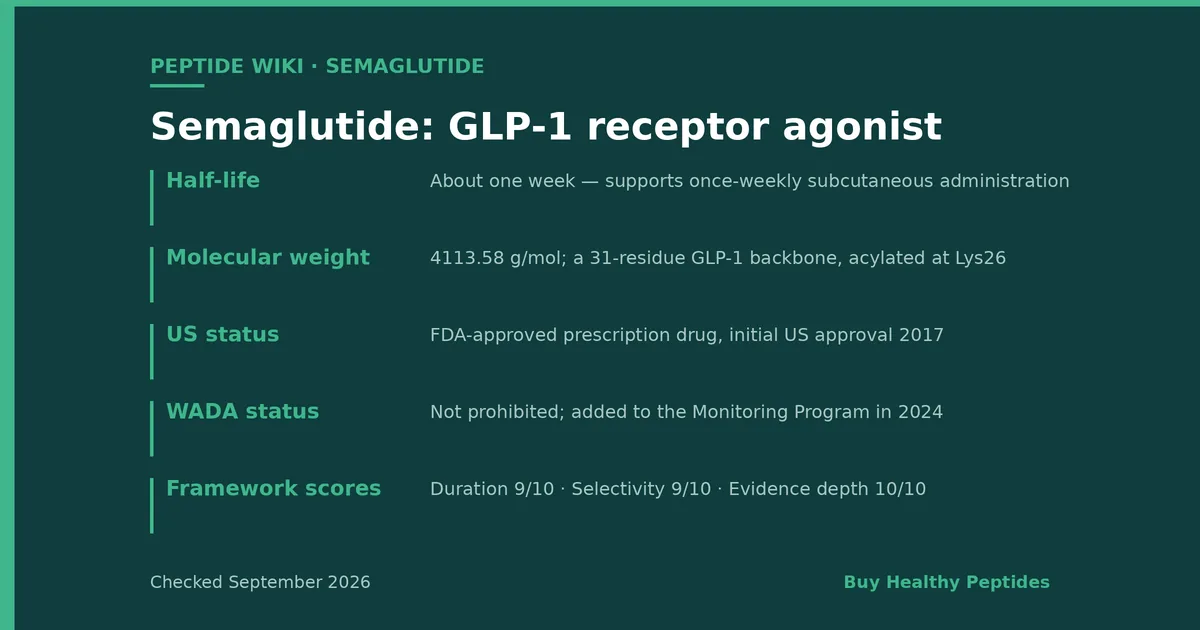
Quick answer: Semaglutide is a modified 31-amino-acid analogue of human glucagon-like peptide-1 (GLP-1) and an FDA-approved prescription drug, sold as Ozempic, Rybelsus and Wegovy [1][2][3]. Its evidence base is unusually deep for a peptide: several large randomised human outcome trials underpin the approved indications for glycaemic control, cardiovascular risk reduction, chronic kidney disease and weight management [1][2][3]. The label carries a boxed warning about thyroid C-cell tumours seen in rodents — an animal finding of undetermined human relevance [1]. Powder sold online “for research use only” is not the approved drug, and the FDA has documented hundreds of adverse-event reports tied to compounded semaglutide [7].
| Spec | Detail |
|---|---|
| Also known as | Ozempic, Rybelsus, Wegovy (brands); Aib8,Arg34-GLP-1(7-37) analogue [10] |
| Class | GLP-1 receptor agonist (incretin mimetic); acylated peptide analogue [8][10] |
| Sequence / length | 31-residue GLP-1 backbone, ~94% sequence homology to human GLP-1; Aib at position 8, Arg at position 34, acylation at Lys26 [1][10] |
| Molecular weight | 4113.58 g/mol (C187H291N45O59) [1] |
| Half-life | Approximately 1 week; >99% bound to plasma albumin; 89% absolute bioavailability by subcutaneous route [1] |
| Regulatory status (US) | FDA-approved prescription drug (initial US approval 2017); brand- and formulation-specific indications (checked September 2026) [1][2][3] |
| WADA status | Not listed as a prohibited substance; semaglutide was added to the WADA Monitoring Program in 2024 (checked September 2026) [11] |
What is semaglutide?
Semaglutide is a synthetic analogue of GLP-1, a hormone released by intestinal L-cells after eating [8]. Native GLP-1 is useless as a drug because it survives only one to two minutes in circulation before DPP-4 degrades it [8]. Semaglutide is what happens when chemists rebuild that molecule to last a week.
Three changes do the work. Alanine at position 8 is replaced with 2-aminoisobutyric acid (Aib), which blocks DPP-4 cleavage; lysine at position 34 becomes arginine, leaving a single acylation site; and a C18 fatty di-acid is attached to Lys26 through a hydrophilic spacer [10]. That fatty-diacid tail is the main protraction mechanism, driving binding to plasma albumin and slowing degradation [1][10]. The backbone itself is produced by yeast fermentation [1]. The result is an elimination half-life of roughly one week, with steady state after four to five weeks of once-weekly administration [1].
It matters which brand is which. Ozempic is an injection; Rybelsus and Ozempic tablets are oral formulations co-formulated with the absorption enhancer SNAC; Wegovy exists as an injection and as tablets [1][2][3]. Oral bioavailability is very low — roughly 0.4% to 1% for Rybelsus and 1% to 2% for Ozempic tablets [3]. For the wider family, see our GLP-1 and incretin peptides hub, and for the chemistry basics, what are peptides.
How semaglutide works (mechanism)
GLP-1 is an incretin hormone: a gut signal that amplifies the pancreatic response to a meal [8]. Semaglutide is an agonist at the GLP-1 receptor (GLP-1R), which is expressed in the pancreas and, as animal knockout and distribution studies show, in many other tissues including the cardiovascular, nervous and digestive systems [8].
Four mechanistic strands are usually described [8]:
- Glucose-dependent insulin secretion. GLP-1R activation on pancreatic beta cells enhances insulin release, and the effect is glucose-dependent — it falls away as blood glucose normalises, which is why GLP-1 agonists alone carry a lower intrinsic hypoglycaemia risk than insulin or sulfonylureas [8].
- Glucagon suppression. Receptor activation inhibits glucagon release, reducing hepatic glucose output [8].
- Delayed gastric emptying. Slower gastric emptying prolongs satiety [8], and is the likely substrate for much of the gastrointestinal side-effect profile and for the label’s aspiration warning [1].
- Central appetite regulation. GLP-1R signalling in the central nervous system reduces food intake [8].
The central limb is the most animal-dependent. In diet-induced obese mice and rats, semaglutide did not cross the blood-brain barrier; instead it interacted with the brain through circumventricular organs and sites adjacent to the ventricles, including the hypothalamic arcuate nucleus, area postrema and nucleus tractus solitarius, with secondary activation in the parabrachial nucleus, central amygdala and bed nucleus of the stria terminalis [9]. Weight loss in those models came from reduced food intake rather than increased energy expenditure [9]. That is a rodent map, not a human one, and the authors present it as such.
In vitro, in cells expressing the human GLP-1 receptor, semaglutide showed a potency of approximately 0.15 nM — comparable to liraglutide and roughly eight-fold less potent than native GLP-1 itself [10]. The point of the molecule was never raw potency; it was duration.
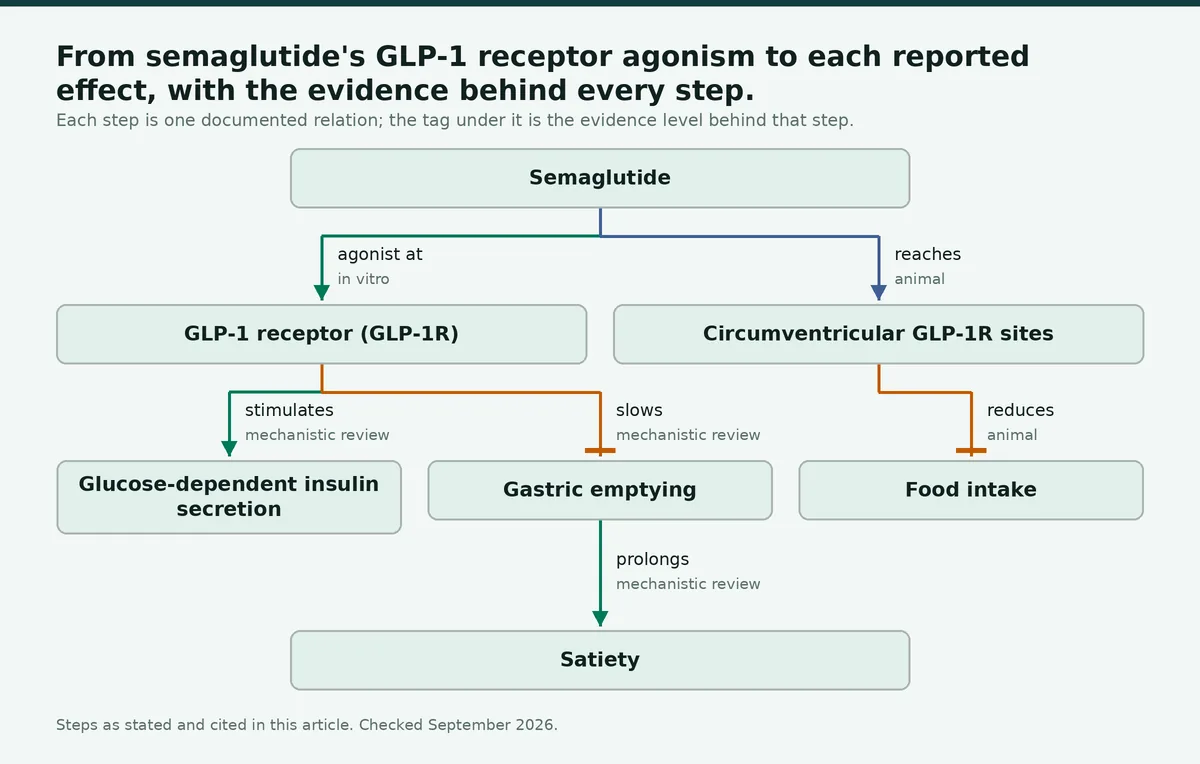
| Step | Relation | Target | Evidence |
|---|---|---|---|
| Semaglutide | agonist at | GLP-1 receptor (GLP-1R) | in vitro [10] |
| Semaglutide | reaches | Circumventricular GLP-1R sites | animal [9] |
| GLP-1 receptor (GLP-1R) | stimulates | Glucose-dependent insulin secretion | mechanistic review [8] |
| GLP-1 receptor (GLP-1R) | slows | Gastric emptying | mechanistic review [8] |
| Circumventricular GLP-1R sites | reduces | Food intake | animal [9] |
| Gastric emptying | prolongs | Satiety | mechanistic review [8] |
What the research shows
Human studies
Semaglutide’s human RCT base is one of the largest for any peptide drug. The figures below come from the FDA labels’ clinical-studies sections, which summarise the registration trials.
Glycaemic control (SUSTAIN, injectable; PIONEER, oral). In SUSTAIN, semaglutide injection 0.5 mg and 1 mg reduced HbA1c by 1.4% and 1.6% versus 0.1% for placebo over 30 weeks of monotherapy, and beat sitagliptin (−1.3%/−1.5% vs −0.7% at 56 weeks) [1]. In the oral PIONEER programme, tablets at 7 mg and 14 mg reduced HbA1c by 1.2% and 1.4% versus 0.3% for placebo at 26 weeks [3]. Human RCT.
Cardiovascular outcomes in type 2 diabetes (SUSTAIN 6, SOUL). SUSTAIN 6 randomised 3,297 patients with type 2 diabetes and atherosclerotic cardiovascular disease, with a hazard ratio for major adverse cardiovascular events (MACE) of 0.74 (95% CI 0.58, 0.95) [1]. SOUL randomised 9,650 patients with type 2 diabetes and established cardiovascular disease and/or chronic kidney disease to oral semaglutide 14 mg or placebo: MACE hazard ratio 0.86 (95% CI 0.77, 0.96) over a median 49.6 months [3]. Human RCT.
Cardiovascular outcomes without diabetes (SELECT). SELECT randomised 17,604 patients with established cardiovascular disease and overweight or obesity, but without diabetes, to semaglutide 2.4 mg weekly or placebo [2][12]. Over a median 41.8 months, the primary MACE composite occurred in 6.5% versus 8% on placebo, hazard ratio 0.80 (95% CI 0.72, 0.90) [2]. Human RCT.
Kidney outcomes (FLOW). FLOW randomised 3,533 patients: hazard ratio 0.76 (95% CI 0.66, 0.88) for a composite of sustained eGFR decline of 50% or more, sustained eGFR below 15 mL/min/1.73 m², chronic renal replacement therapy, or renal or cardiovascular death [1]. Human RCT.
Weight management (STEP). In the 68-week trial of adults with obesity or overweight without diabetes, mean body-weight change was −18.0% with semaglutide 2.4 mg injection versus −2.7% with placebo; 86.2% versus 31.5% lost at least 5% of body weight, and 69.1% versus 11.7% lost at least 10% [2]. In adults who also had type 2 diabetes, weight changes were −9.5% versus −3.5%, with 57.9% versus 20.9% reaching 5% loss [2]. In 201 patients aged 12 and older with obesity, mean BMI change over 68 weeks was −15.3% versus −2.5% [2]. Human RCT.
Liver disease. The Wegovy label also describes a trial of 1,195 adults with non-cirrhotic MASH and moderate-to-advanced fibrosis (F2–F3), with 800 patients exposed for a median of 95.3 weeks [2]. Human RCT.
One caveat worth stating: these are effect sizes in selected trial populations under protocol-driven monitoring, not expectations for any individual, and the trials studied continuous treatment rather than a finite course.
Animal studies
The most consequential animal data are toxicological, not efficacy-related. In rodent carcinogenicity studies, thyroid C-cell adenomas and carcinomas were observed at all dose levels tested, a finding treated as a class effect of GLP-1 receptor agonists [10]. That is the direct basis for the boxed warning on every semaglutide label, which states that the human relevance of the rodent tumours “has not been determined” [1]. The neural-pathway mapping above is also animal work: it shows where the compound acts in rodent brain, not that the same circuitry drives human appetite [9].
In-vitro / preclinical
In vitro, semaglutide behaves as a selective GLP-1 receptor agonist with roughly 0.15 nM potency at the human receptor [10]. Biochemical work underpins the design rationale: Aib8 confers DPP-4 resistance, and the C18 fatty di-acid drives the albumin binding measured at over 99% in plasma [1][10]. These are mechanistic findings, not clinical outcomes.
Side effects and risks
This section carries at least as much weight as the efficacy data above, because semaglutide is a drug with a boxed warning and a long labelled risk list.
Boxed warning. “In rodents, semaglutide causes thyroid C-cell tumors.” The label states it is unknown whether semaglutide causes thyroid C-cell tumours, including medullary thyroid carcinoma (MTC), in humans, because the human relevance of the rodent finding has not been determined [1].
Contraindications. Semaglutide products are contraindicated in people with a personal or family history of MTC, in people with Multiple Endocrine Neoplasia syndrome type 2 (MEN 2), and in anyone with a prior serious hypersensitivity reaction to semaglutide or label excipients [1][2][3].
Labelled warnings and precautions on the Ozempic label include acute pancreatitis, diabetic retinopathy complications, hypoglycaemia when combined with insulin or insulin secretagogues, acute kidney injury from volume depletion, severe gastrointestinal adverse reactions, hypersensitivity reactions, acute gallbladder disease, and pulmonary aspiration during general anaesthesia or deep sedation [1]. The Wegovy label additionally lists heart-rate increase [2].
Quantified signals. Acute pancreatitis was reported at 0.3 cases per 100 patient-years on semaglutide versus 0.2 with comparators [1]. Cholelithiasis occurred in 1.5% and 0.4% of patients on 0.5 mg and 1 mg respectively, and was not reported in placebo-treated patients [1]. In SUSTAIN 6, diabetic retinopathy complications were more frequent on semaglutide (3.0%) than placebo (1.8%) [1].
Common adverse reactions. Gastrointestinal effects dominate, and they scale with dose. On the Ozempic label, nausea affected 15.8% (0.5 mg) and 20.3% (1 mg) versus 6.1% on placebo, with vomiting, diarrhoea, abdominal pain and constipation also reported in at least 5% of patients [1]. At the higher weight-management doses on the Wegovy label the rates are much greater: nausea 44%, diarrhoea 30%, vomiting 24%, constipation 24%, abdominal pain 20%, headache 14% and fatigue 11% [2].
We publish no administration guidance. Anyone for whom semaglutide is clinically appropriate receives dosing from a prescriber, and the label is the authoritative document.
Regulatory and legal status (2026)
Semaglutide is an FDA-approved prescription drug, first approved in the US in 2017, but the approved indications are brand- and formulation-specific (all checked September 2026):
| Product | Indications per FDA label |
|---|---|
| Ozempic (injection) | Glycaemic control in adults with type 2 diabetes, as an adjunct to diet and exercise; reducing major adverse cardiovascular events in adults with type 2 diabetes and established cardiovascular disease; reducing the risk of sustained eGFR decline, end-stage kidney disease and cardiovascular death in adults with type 2 diabetes and chronic kidney disease [1] |
| Rybelsus / Ozempic tablets | Glycaemic control in adults with type 2 diabetes; reducing major adverse cardiovascular events in adults with type 2 diabetes at high risk for those events [3] |
| Wegovy (injection) | Reducing major adverse cardiovascular events in adults with established cardiovascular disease and obesity or overweight; reducing excess body weight in adults and patients aged 12 and older with obesity, or adults with overweight plus a weight-related comorbidity; non-cirrhotic MASH with F2–F3 fibrosis in adults [2] |
| Wegovy (tablets) | The two cardiovascular and weight-reduction indications above, in adults [2] |
Compounding is the live regulatory story. FDA declared the shortage of semaglutide injection products resolved on 21 February 2025, and its enforcement-discretion periods for compounders ended on 22 April 2025 for 503A pharmacies and 22 May 2025 for 503B outsourcing facilities [6]. On 1 May 2026 the agency published a Federal Register notice (document 2026-08552, docket FDA-2018-N-3240) proposing not to include semaglutide, tirzepatide or liraglutide on the 503B bulk drug substances list, concluding that no attribute of the approved products makes them medically unsuitable and that arguments based on patient preference, alternative routes or “hyper-responder” dosing did not establish clinical need [4]. The comment period, originally closing 30 June 2026, was extended to 30 July 2026 [5]. As of checked September 2026 the proposal was not finalised — a moving target.
Grey-market material is a different product. FDA states that salt forms sold online, including semaglutide sodium and semaglutide acetate, “are different active ingredients than are used in the approved drugs” [7]. The agency recorded 990 adverse-event reports associated with compounded semaglutide as of 31 May 2026, has described hospitalisations from dosing errors, has warned about counterfeit Ozempic in the US supply chain, and has flagged products “falsely labeled ‘for research purposes’ or ‘not for human consumption’” that were nonetheless sold with human-use instructions [7]. Research-use-only powder is not an approved medicine and is not quality-assured. Our framing throughout the site is research-use only; see research vs compounded vs approved peptides and are peptides legal?.
Sport. Semaglutide does not appear as a prohibited substance; WADA’s own research documentation states that the GLP-1 analogue semaglutide was included in the WADA Monitoring Program in 2024, and WADA has funded method development to detect GLP-1 receptor agonists in blood and dried blood spots [11]. Monitored substances are not banned, but athletes should check the current List directly (checked September 2026).
Approved indications at a glance
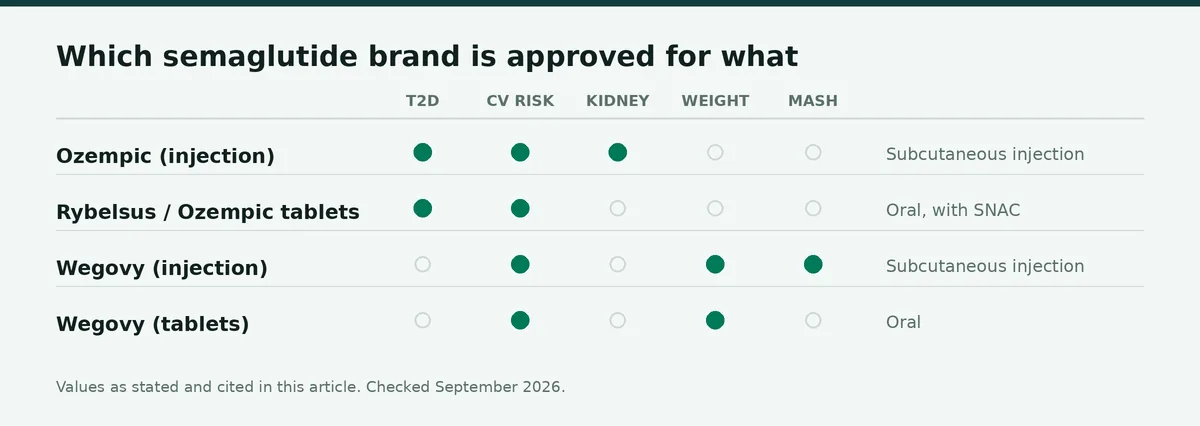
| Brand | T2D | CV risk | Kidney | Weight | MASH | Formulation |
|---|---|---|---|---|---|---|
| Ozempic (injection) | yes | yes | yes | no | no | Subcutaneous injection [1] |
| Rybelsus / Ozempic tablets | yes | yes | no | no | no | Oral, with SNAC [3] |
| Wegovy (injection) | no | yes | no | yes | yes | Subcutaneous injection [2] |
| Wegovy (tablets) | no | yes | no | yes | no | Oral [2] |
Comparison Framework scores
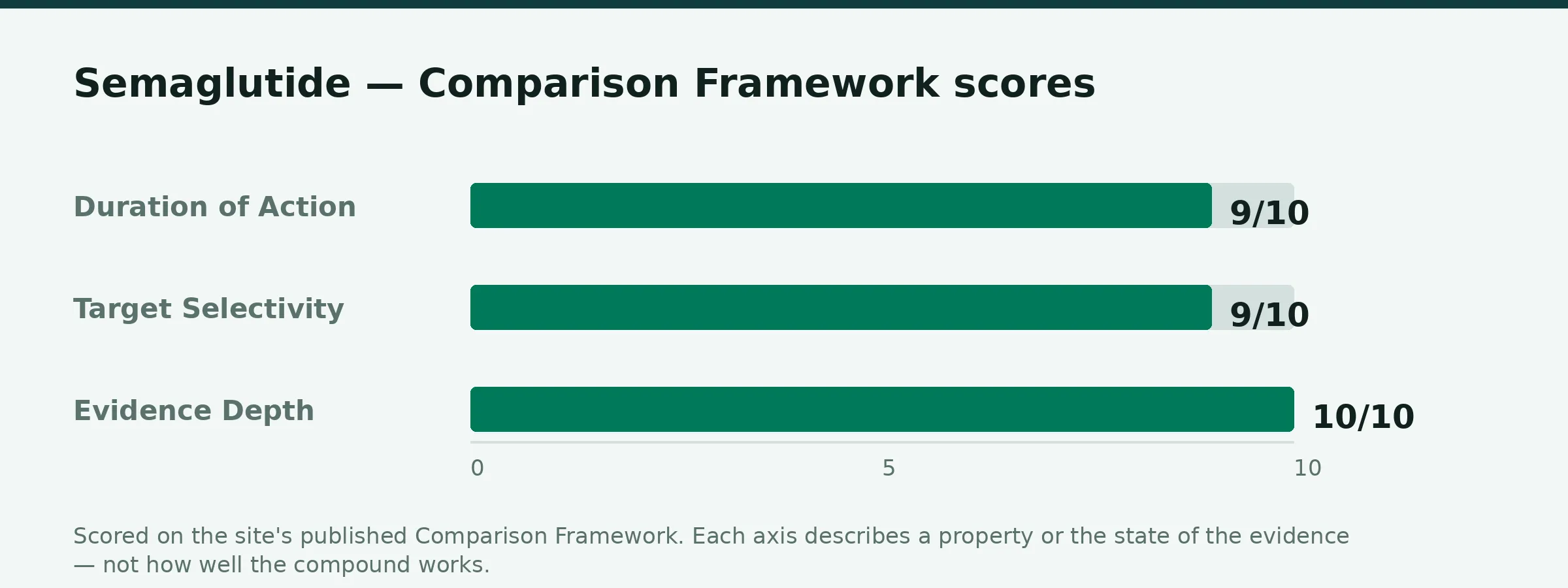
| Axis | Score | Why |
|---|---|---|
| Duration of Action | 9/10 | Half-life of about one week supports once-weekly administration; steady state at 4–5 weeks [1] |
| Target Selectivity | 9/10 | Single-receptor agonist, ~0.15 nM potency at the human GLP-1 receptor; one point deducted because GLP-1R is widely distributed beyond the pancreas [8][10] |
| Evidence Depth | 10/10 | Multiple large randomised human outcome trials (SUSTAIN 6, SOUL, SELECT, FLOW, STEP) plus FDA approval and a published risk profile [1][2][3] |
See the methodology behind these numbers on our Comparison Framework page.
How semaglutide compares
Against native GLP-1 the contrast is purely pharmacokinetic: one to two minutes in circulation versus about a week [1][8]. Almost every design decision in the molecule serves that difference.
Oral versus injectable is the same ingredient behaving differently by route. Oral absolute bioavailability is roughly 0.4% to 2% depending on product, requiring SNAC as an absorption enhancer and, per the label, a narrow administration window with water on an empty stomach [3]. Injectable bioavailability is 89% [1].
Among other incretin-based drugs, semaglutide is the most heavily studied but no longer alone. Tirzepatide and liraglutide were addressed alongside it in FDA’s 2026 503B bulks proposal, a sign of how closely regulators now group these agents [4]. Head-to-head analysis lives on dedicated pages: semaglutide vs tirzepatide, plus tirzepatide and retatrutide.
Sourcing and quality: what to look for
For an approved product, sourcing is straightforward: a prescription, a licensed pharmacy, and the label in the box. Everything else carries verification problems no vendor claim resolves.
For research-use material, the discriminating questions are documentary. Is there a batch-specific certificate of analysis, tied to the lot number in front of you, from a laboratory independent of the seller? Does it report purity by HPLC and identity by mass spectrometry, showing the actual chromatogram and spectrum rather than a summary figure? Does the stated active ingredient match the approved drug substance, or is it a salt form FDA has called a different active ingredient [7]? Our guide to reading a peptide certificate of analysis covers what those documents can and cannot tell you.
Two points bear stating plainly. A COA speaks to one batch, not to a seller’s practices over time. And no certificate turns an unapproved product into an approved one [7].
FAQ
Is semaglutide FDA-approved?
Yes, since 2017 — but indications differ by brand and formulation: Ozempic and Rybelsus for type 2 diabetes and cardiovascular risk reduction, Wegovy for cardiovascular risk reduction, weight management and non-cirrhotic MASH with F2–F3 fibrosis [1][2][3].
What is the difference between Ozempic and Wegovy?
Same active ingredient, separate approvals with different labelled indications and dose ranges. Ozempic centres on type 2 diabetes, cardiovascular events and diabetic kidney disease; Wegovy on weight management, cardiovascular risk in obesity or overweight, and MASH [1][2].
Why does semaglutide carry a boxed warning?
Rodent carcinogenicity studies found thyroid C-cell adenomas and carcinomas at all dose levels tested [10]. The label states it is unknown whether the same happens in humans, since the human relevance of that finding has not been determined [1].
What are the most common side effects?
Gastrointestinal: nausea, vomiting, diarrhoea, constipation and abdominal pain, rising with dose — nausea about 20% on Ozempic 1 mg and 44% on the Wegovy label [1][2].
Is compounded or “research-use-only” semaglutide the same thing?
No. Compounded products are not FDA-approved and get no premarket review for safety, effectiveness and quality; salt forms such as semaglutide sodium and acetate are different active ingredients; and FDA has warned about counterfeit product and about powders falsely labelled for research use but sold with human-use instructions [7].
Is semaglutide banned in sport?
It is not listed as prohibited. WADA documentation states semaglutide was added to the WADA Monitoring Program in 2024 — watched for patterns of misuse rather than banned. Athletes should confirm against the current List (checked September 2026) [11].
References
- Novo Nordisk. OZEMPIC (semaglutide) injection, for subcutaneous use — Highlights of Prescribing Information. U.S. Food and Drug Administration, revised 10/2025. https://www.accessdata.fda.gov/drugsatfda_docs/label/2025/209637s035,209637s037lbl.pdf
- Novo Nordisk. WEGOVY (semaglutide) injection and tablets — Highlights of Prescribing Information. U.S. Food and Drug Administration, revised 02/2026. https://www.accessdata.fda.gov/drugsatfda_docs/label/2026/215256s033lbl.pdf
- Novo Nordisk. RYBELSUS (semaglutide) tablets and OZEMPIC (semaglutide) tablets, for oral use — Highlights of Prescribing Information. U.S. Food and Drug Administration, revised 01/2026. https://www.accessdata.fda.gov/drugsatfda_docs/label/2026/213051s030lbl.pdf
- U.S. Food and Drug Administration. List of Bulk Drug Substances for Which There Is a Clinical Need Under Section 503B of the Federal Food, Drug, and Cosmetic Act. Federal Register, document 2026-08552, docket FDA-2018-N-3240, published 1 May 2026. https://www.federalregister.gov/documents/2026/05/01/2026-08552/list-of-bulk-drug-substances-for-which-there-is-a-clinical-need-under-section-503b-of-the-federal
- U.S. Food and Drug Administration. List of Bulk Drug Substances for Which There Is a Clinical Need Under Section 503B; Extension of Comment Period. Federal Register, document 2026-12937, published 26 June 2026. https://www.federalregister.gov/documents/2026/06/26/2026-12937/list-of-bulk-drug-substances-for-which-there-is-a-clinical-need-under-section-503b-of-the-federal
- U.S. Food and Drug Administration. FDA clarifies policies for compounders as national GLP-1 supply begins to stabilize. FDA.gov, 2026. https://www.fda.gov/drugs/drug-alerts-and-statements/fda-clarifies-policies-compounders-national-glp-1-supply-begins-stabilize
- U.S. Food and Drug Administration. FDA’s Concerns with Unapproved GLP-1 Drugs Used for Weight Loss. FDA.gov, content current as of 1 September 2026. https://www.fda.gov/drugs/drug-alerts-and-statements/fdas-concerns-unapproved-glp-1-drugs-used-weight-loss
- Zheng Z, Zong Y, Ma Y, Tian Y, Pang Y, Zhang C, Gao J. Glucagon-like peptide-1 receptor: mechanisms and advances in therapy. Signal Transduction and Targeted Therapy. 2024. doi:10.1038/s41392-024-01931-z. https://www.nature.com/articles/s41392-024-01931-z
- Gabery S, Salinas CG, Paulsen SJ, et al. Semaglutide lowers body weight in rodents via distributed neural pathways. JCI Insight. 2020;5(6). doi:10.1172/jci.insight.133429. https://insight.jci.org/articles/view/133429
- European Medicines Agency. Ozempic — EPAR Public Assessment Report. Committee for Medicinal Products for Human Use, 14 December 2017. https://www.ema.europa.eu/en/documents/assessment-report/ozempic-epar-public-assessment-report_en.pdf
- World Anti-Doping Agency. Analysis of GLP-1 receptor agonists (Semaglutide, Liraglutide etc.) in blood and dried blood spots. WADA Scientific Research project (M. Thevis, German Sport University Cologne), 2024. https://www.wada-ama.org/en/resources/scientific-research/analysis-glp-1-receptor-agonists-semaglutide-liraglutide-etc-blood
- Lincoff AM, et al. Semaglutide and Cardiovascular Outcomes in Obesity without Diabetes (SELECT). New England Journal of Medicine. 2023;389(24). PMID 37952131. doi:10.1056/NEJMoa2307563. https://pubmed.ncbi.nlm.nih.gov/37952131/