Quick answer: BPC-157 is a synthetic 15-amino-acid peptide whose healing reputation rests almost entirely on animal and in vitro work — a 2025 systematic review of the orthopaedic literature found 36 studies, of which 35 were preclinical [7]. Human data is minimal: one retrospective series of 12 knee patients and one 53-subject ulcerative colitis trial published only as a meeting abstract [7][1]. FDA placed BPC-157 in Category 2 of the bulk drug substances reviewed for compounding — the group that raises significant safety risks — and its July 2026 evaluation concluded there is not enough clinical safety information to characterise the substance at all [2][1]. No published human pharmacokinetic study exists [8].
| Spec | Detail |
|---|---|
| Also known as | Body protection compound 157; BPC 157; “stable gastric pentadecapeptide”; PL 14736 [1][9] |
| Class | Synthetic pentadecapeptide; unapproved investigational substance, no approved product anywhere in the US [1][9] |
| Sequence / length | 15 amino acids: H-Gly-Glu-Pro-Pro-Pro-Gly-Lys-Pro-Ala-Asp-Asp-Ala-Gly-Leu-Val-OH (GEPPPGKPADDAGLV) [1] |
| Molecular weight | 1419.5 g/mol, free base; formula C62H98N16O22 [1] |
| Half-life | 5.27–15.2 min intravenously and 7.87–29.7 min intramuscularly in animals (rats and dogs); no human value published [8] |
| Regulatory status (US) | Not approved; reviewed under FDA’s Category 2 “significant safety risks” heading, nominations later withdrawn, and FDA’s 2026 evaluation recommends against listing it for 503A compounding (checked September 2026) [1][2][3] |
| WADA status | Reported as class S0, non-approved substances, by the US Department of Defense’s Operation Supplement Safety and by a 2025 peer-reviewed review; WADA’s own list could not be opened in this run [9][7] |
What is BPC-157?
BPC-157 is a chain of fifteen amino acids made by solid-phase synthesis and sold as a white to off-white lyophilised powder [1]. FDA’s own evaluation gives the sequence in full — H-Gly-Glu-Pro-Pro-Pro-Gly-Lys-Pro-Ala-Asp-Asp-Ala-Gly-Leu-Val-OH — with the molecular formula C62H98N16O22 and a molecular weight of 1419.5 g/mol for the free base [1]. A separate acetate salt form is also in circulation, and FDA reviewed both [1][6].
The name is an abbreviation of “body protection compound”, and the standard description is that BPC-157 is “a pentadecapeptide fragment of BPC … that has been found in gastric juice” [1]. That description deserves more scepticism than it usually gets. None of the sources opened for this page characterises the full-length parent protein: FDA’s evaluation goes no further than the sentence above, and it separately flagged that inconsistent naming across nominations was itself a safety concern and that the substance is inadequately characterised [1]. A 2025 systematic review repeats the “naturally occurring gastric peptide” framing without establishing independent verification of it [7]. So the honest position is that BPC-157 is a defined synthetic peptide whose claimed natural parent is asserted rather than demonstrated in the literature we could read.
The other common tag, “stable gastric pentadecapeptide”, refers to a claim that the molecule survives gastric acid without a carrier. That claim is worth separating from the healing claims, because the two are often cited together as though one proved the other.
How BPC-157 works (mechanism)
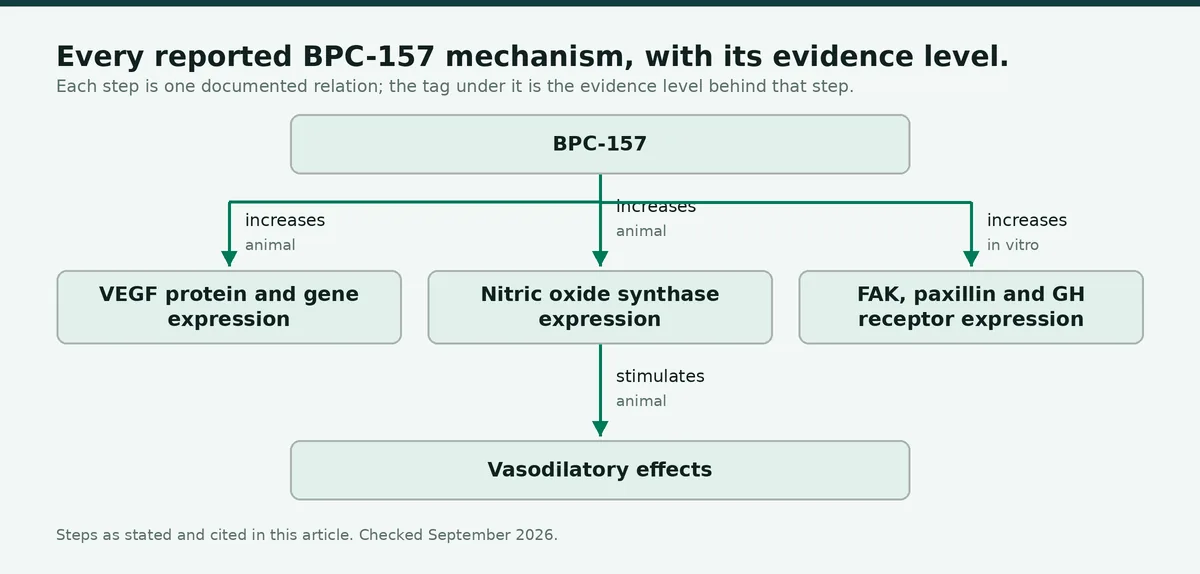
Every mechanism attributed to BPC-157 comes from animal or in vitro experiments. The 2025 systematic review found no human mechanistic studies at all [7].
| Step | Relation | Target | Evidence |
|---|---|---|---|
| BPC-157 | increases | VEGF protein and gene expression | animal [7] |
| BPC-157 | increases | Nitric oxide synthase expression | animal [7] |
| BPC-157 | increases | FAK, paxillin and GH receptor expression | in vitro [7] |
| Nitric oxide synthase expression | stimulates | Vasodilatory effects | animal [7] |
The most-cited route is angiogenesis. In preclinical animal models, BPC-157 has been reported to stimulate vascular endothelial growth factor protein and gene expression, the ligand arm of VEGFR2 signalling [7] (animal). A second reported route is the nitric-oxide system: the same review describes upregulation of nitric oxide synthase gene and protein expression, with downstream vasodilatory effects [7] (animal).
A third route is cell adhesion and migration. In cultured tendon fibroblasts isolated from rats, BPC-157 was associated with increased focal adhesion kinase and paxillin gene expression — the machinery cells use to grip a matrix and move along it — and with increased growth hormone receptor gene and protein expression in the same cells [7] (in vitro).
Read together these are plausible stories about how a tissue might heal faster. They are not evidence that it does so in a person. A mechanism that works in a rat tendon fibroblast can fail in humans for reasons of dose, exposure, receptor distribution or immune response — none of which has been measured here.
What the evidence covers
| Claim or indication | Animal | Human | RCT | What exists |
|---|---|---|---|---|
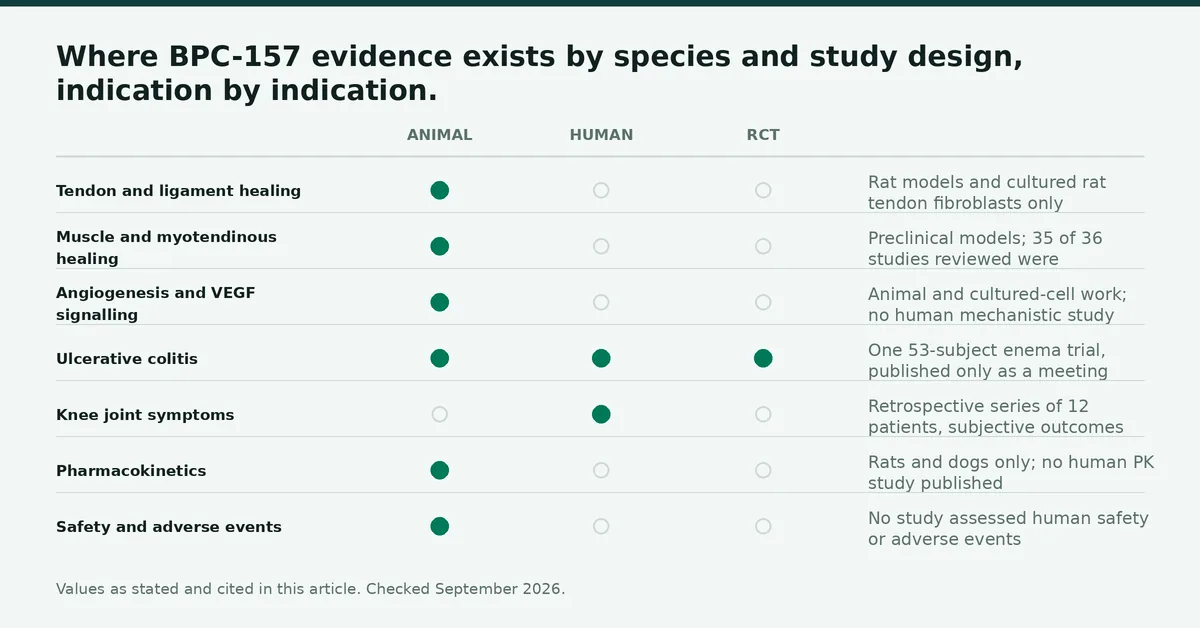
| Tendon and ligament healing | yes | no | no | Rat models and cultured rat tendon fibroblasts only [7] |
| Muscle and myotendinous healing | yes | no | no | Preclinical models; 35 of 36 studies reviewed were preclinical [7] |
| Angiogenesis and VEGF signalling | yes | no | no | Animal and cultured-cell work; no human mechanistic study found [7] |
| Ulcerative colitis | yes | yes | yes | One 53-subject enema trial, published only as a meeting abstract [1] |
| Knee joint symptoms | no | yes | no | Retrospective series of 12 patients, subjective outcomes [7] |
| Pharmacokinetics | yes | no | no | Rats and dogs only; no human PK study published [8] |
| Safety and adverse events | yes | no | no | No study assessed human safety or adverse events [7][1] |
The column that matters on that table is the one that is almost empty. This is the gap the rest of this page describes, and it is also the gap the wider field has: our summary of the UCLA review of 565 peptide studies found the same imbalance across the category, not just here.
Key numbers
| Species and route | Reported elimination half-life | Evidence level |
|---|---|---|
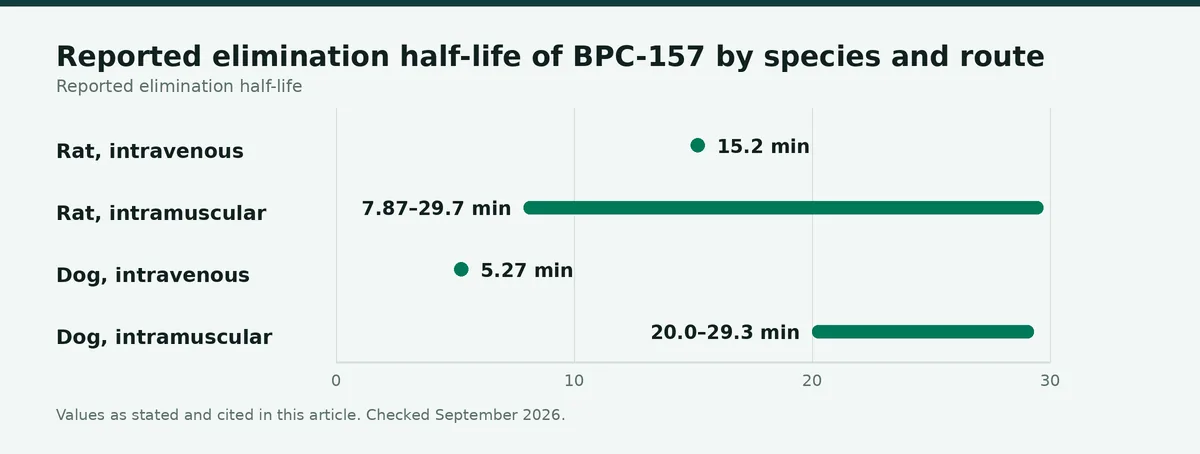
| Rat, intravenous | 15.2 min | animal [8] |
| Rat, intramuscular | 7.87–29.7 min | animal [8] |
| Dog, intravenous | 5.27 min | animal [8] |
| Dog, intramuscular | 20.0–29.3 min | animal [8] |
There is no human row because there is no human study. The 2022 rat-and-dog work is explicit that its scope was preclinical [8], and the 2025 orthopaedic review likewise reports only that the half-life “was reported to be less than 30 minutes” with linear kinetics [7]. Intramuscular bioavailability in that animal work was 14.49–19.35% in rats and 45.27–50.56% in dogs — a fourfold species difference in a basic parameter, which is a useful reminder of how poorly animal exposure predicts human exposure [8]. Peak tissue concentrations in rats came about an hour after dosing, highest in kidney, liver, stomach, spleen and thymus; the peptide was degraded to smaller fragments and free amino acids, with roughly 15.88% of radioactivity recovered in urine and 9.08% in bile over 72 hours [8].
What the research shows
Human studies
There are two human datasets in the sources we could open, and neither carries much weight.
The first is a retrospective case series. In the single clinical study identified by the 2025 systematic review, 7 of 12 patients reported subjective improvement in knee symptoms for more than six months after an intraarticular injection of BPC-157 alone, given as 2 cc of a 2000 mcg/mL solution [7] (human observational). Twelve patients, no control group, no blinding and a self-reported outcome is a hypothesis, not a result.
The second is an ulcerative colitis trial FDA identified while evaluating the substance for compounding: 53 subjects with mild to moderate disease randomised to enema treatment for two weeks [1] (human, randomised). FDA’s assessment of it is the important part — it was presented only as a meeting abstract, so the primary endpoint, inclusion and exclusion criteria, statistical methods and post-treatment follow-up are all missing from the record [1]. FDA also noted that it found no studies at all administering BPC-157 by the oral, subcutaneous, nasal or transdermal routes in patients with ulcerative colitis, which are precisely the routes compounders proposed [1]. Its conclusion was that “there is a lack of evidence to support the effectiveness” of either form of the substance for that condition [1]. The US Department of Defense’s Operation Supplement Safety separately notes that a clinical trial registered in 2015 produced no approved use [9].
Animal studies
The animal literature is large, and it is where every well-known BPC-157 claim originates. The 2025 systematic review of orthopaedic and sports-medicine applications screened the literature to June 2024 and included 36 studies, of which 35 were preclinical [7] (animal and in vitro). Reported effects span tendon, ligament, muscle and gastrointestinal healing models.
One methodological observation belongs here, and the review makes it: the foundational studies from the 1990s onward repeatedly come from Sikiric and colleagues, which means limited independent verification of the findings [7]. A body of work concentrated in one group is not thereby wrong. It does mean the usual safeguard — other laboratories reproducing the result with their own animals, their own material and their own incentives — has largely not happened.
Reported doses in animal work vary widely by model, and the 2022 pharmacokinetic study used 20, 100 and 500 μg/kg in rats and 6, 30 and 150 μg/kg in dogs [8]. Those are research quantities in research species, and they do not translate into anything a person should do.
In-vitro and preclinical
The cultured-cell work is described in the mechanism section above: increased FAK, paxillin and growth hormone receptor expression in rat tendon fibroblasts [7] (in vitro). On the toxicology side, the systematic review found three studies assessing organ-specific outcomes in animal and in vitro models, all reporting no acute toxicity across several organ systems [7]. That is a narrow finding from a narrow set of experiments, and the same review states plainly that clinical safety in humans remains unknown [7].
Side effects and risks
The honest headline is that BPC-157 has essentially no human safety characterisation. FDA’s July 2026 evaluation states that “there is insufficient clinical safety information to characterize the safety profile of BPC-157 (free base) and BPC-157 acetate” [1]. The 2025 systematic review reached the same place from the literature side: no study assessed the safety or adverse events of BPC-157 in humans [7]. No controlled human safety data has been published, which is a different and much weaker statement than a clean safety record.
Three specific unknowns are worth naming.
Immunogenicity. FDA’s position is that a 15-amino-acid peptide given by a parenteral or nasal route “may pose a significant risk for immunogenicity, potentially amplified by aggregation as well as potential peptide-related impurities” [1]. The same concern appears on FDA’s public list of bulk substances that may present significant safety risks [2]. Nobody has measured anti-drug antibody formation in people.
Impurities and identity. FDA flagged complexities with peptide-related impurities and active pharmaceutical ingredient characterisation, and found the available data too limited to understand how the substance has historically been used in compounded products at all [1][2]. Inconsistent naming between nominations was itself listed as a concern [1].
Long-term exposure. There is no long-term human data of any kind — no chronic dosing study, no registry, no post-marketing surveillance, because there is no marketed product. FDA’s summary of the position is blunt: the agency “lacks sufficient information to know whether the drug would cause harm when administered to humans” [2].
Material sold online as “research” BPC-157 adds a further layer, because the identity and purity of what is in the vial are unverified unless the buyer verifies them. Operation Supplement Safety has documented BPC-157 turning up as an ingredient in health and wellness products despite being an unapproved drug [9].
Regulatory and legal status (2026)
In the United States BPC-157 is not an approved drug, and it is not a legal dietary supplement ingredient. Operation Supplement Safety states that it “is an unapproved drug and cannot be legally prescribed or sold over the counter”, and that it appears on the Department of Defense Prohibited Dietary Supplement Ingredients List [9] (checked September 2026).
The compounding question is where the record is most detailed. FDA sorts nominated bulk drug substances into three categories: Category 1 for substances with sufficient supporting information and no identified problem, Category 2 for substances that raise significant safety risks and against which FDA may take enforcement action, and Category 3 for substances nominated with insufficient information [3]. BPC-157 was placed in Category 2 in 2023 [7]. On FDA’s current page for these substances, last updated 22 April 2026, BPC-157 now appears under a further heading — “bulk drug substances previously in category 2 of the interim policies … withdrawn by the nominators” — alongside TB-500, GHK-Cu, epitalon and a dozen other research peptides [2]. FDA’s stated safety concerns for BPC-157 remain published there in full [2].
The nomination was nonetheless carried through to a formal review. A Federal Register notice of 16 April 2026 (docket FDA-2025-N-6895) announced a Pharmacy Compounding Advisory Committee meeting on 23–24 July 2026 to consider BPC-157 free base and BPC-157 acetate, among others, for ulcerative colitis [5]. The committee was asked to vote on whether each form should go on the 503A list [6]. FDA’s own briefing document for that meeting recommended against: “we believe the evaluation criteria weigh against placing both BPC-157 (free base) and BPC-157 acetate on the list of bulk drug substances” [1]. BPC-157 does not appear on the 503B outsourcing-facility bulks list either, in the included or the not-included table [4] (checked September 2026).
For sport, BPC-157 is reported to sit in class S0, non-approved substances, on the WADA Prohibited List, with a specific ban dated to 2022 and further bans by the UFC, NFL, NCAA, MLB, NHL, NBA and PGA [9][7]. We could not open WADA’s own list or explanatory notes during this run because the site blocked automated retrieval, so that status is reported here on the authority of a US Department of Defense programme and a peer-reviewed 2025 review rather than the primary document (checked September 2026). Our US peptide legal status guide sets out the wider framework.
Comparison Framework scores
| Axis | n/10 | Justification |
|---|---|---|
| Duration of Action | 2/10 | Half-lives of 5.27–15.2 min intravenously and under 30 min intramuscularly, all in rats and dogs [8][7] |
| Target Selectivity | 2/10 | No identified receptor or defined molecular target; effects are attributed across several unrelated pathways [7] |
| Evidence Depth | 3/10 | 35 of 36 studies in the 2025 systematic review were preclinical; the human record is a 12-patient retrospective series and one trial available only as an abstract [7][1] |
| Pathway Coverage | 7/10 | Three signalling routes reported — VEGF/angiogenesis, nitric oxide and FAK–paxillin — but all in animal or cultured-cell models, which keeps it below the confirmed three-pathway band [7] |
| Regulatory Standing | 1/10 | Reviewed under FDA’s Category 2 significant-safety-risks heading, with FDA recommending against 503A listing and no presence on the 503B list [2][1][4] |
| Safety Characterisation | 1/10 | Poorly documented: FDA states there is insufficient clinical safety information to characterise the safety profile, and no study has assessed human adverse events [1][7] |
| Analytical Verifiability | 4/10 | An exact formula and mass are published, giving a checkable identity target, but FDA flagged peptide-related impurity and API characterisation complexity and no compendial monograph was found [1][2] |
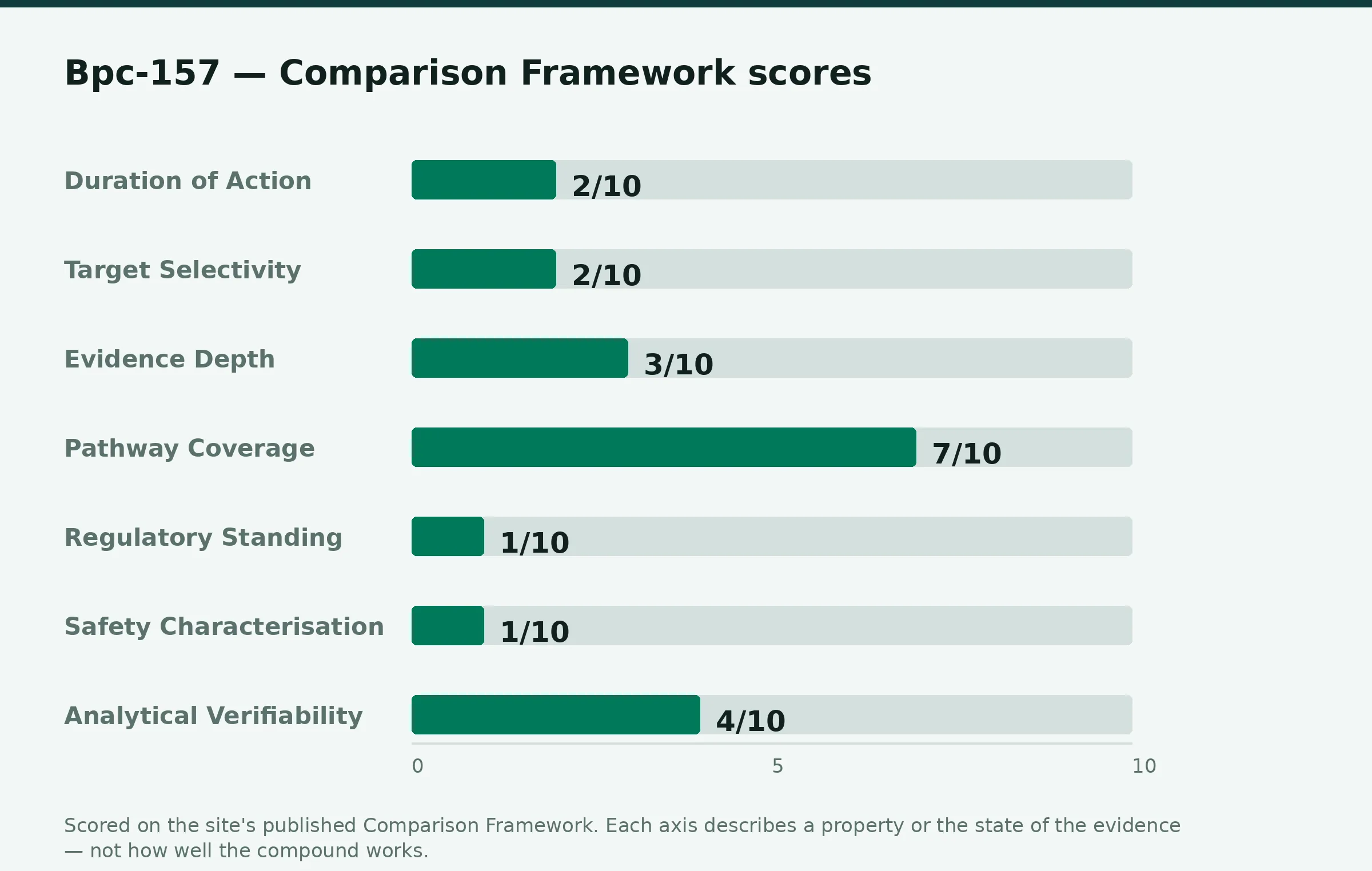
Because Evidence Depth here is low, one point needs stating outright: mechanistic plausibility is not clinical proof. A pathway that moves in the right direction in a rat model tells you what to test next, not what will happen in a person. Scores follow the anchors published in our Comparison Framework, and no axis measures how well the compound works or whether anyone should use it.
How BPC-157 compares
The closest reference point is TB-500, the thymosin beta-4 fragment, which sits in the same grey-market recovery niche and on the same FDA withdrawn-nomination list [2]. The two are routinely discussed together, and we set out the differences in BPC-157 vs TB-500. Both share the defining problem on this page: a large animal literature and almost no human record.
The contrast worth drawing is with an approved peptide, which can be scored on Evidence Depth in the high single digits because multi-thousand-patient randomised trials and an FDA label with quantified adverse event rates exist. BPC-157 cannot be scored that way, because those studies do not exist — a difference in kind, not degree, and the main thing to carry away from any comparison within the broader healing and recovery peptide group.
Sourcing and quality: what to look for
Nothing in this section should be read as a route to lawful human use. BPC-157 has no approved product and no legal supply chain for people, so any vial in circulation sits outside the system that would otherwise stand behind its identity, purity and sterility.
For laboratory work, the published formula C62H98N16O22 and mass of 1419.5 g/mol give a concrete identity target [1], which makes a mass spectrometry result checkable rather than decorative. A usable certificate is lot-specific, names the testing laboratory, reports purity by HPLC with the chromatogram attached, and reports identity by mass spectrometry against that expected mass. Our guide on how to read a peptide certificate of analysis covers what a real one contains.
FDA’s concern about peptide-related impurities and inconsistent product naming is the relevant warning here [1][2]: a supplier that cannot produce a mass spectrum for the specific lot is not offering a verified product, whatever the label says.
FAQ
Is BPC-157 legal?
In the United States it is not an approved drug and not a lawful dietary supplement ingredient; the Department of Defense’s Operation Supplement Safety states that it cannot legally be prescribed or sold over the counter [9]. It is not on the 503A bulk drug substances list — FDA’s 2026 evaluation recommends against placing it there [1] — and it is not on the 503B list [4] (checked September 2026).
Is there any human evidence?
Very little. A 2025 systematic review of the orthopaedic literature identified one clinical study among 36: a retrospective series in which 7 of 12 patients reported subjective knee improvement for more than six months [7]. FDA separately identified a single 53-subject randomised ulcerative colitis trial, available only as a meeting abstract with the endpoint and methods missing from the record [1]. That is the entire human base in the sources opened for this page.
What is BPC-157’s half-life?
No human figure has been published. In rats the elimination half-life was 15.2 minutes intravenously and 7.87–29.7 minutes intramuscularly; in dogs it was 5.27 minutes intravenously and 20.0–29.3 minutes intramuscularly [8]. The 2025 review summarises the class of findings as under 30 minutes [7].
Is BPC-157 banned in sport?
It is reported to be prohibited at all times under class S0, non-approved substances, with a ban dated to 2022, and separately prohibited by several major leagues [9][7]. We were unable to open WADA’s own Prohibited List during this run, so treat that as well-attested secondhand rather than verified at source (checked September 2026).
Why did FDA flag BPC-157 as a safety risk?
For three reasons it has published: the immunogenicity risk of a 15-residue peptide given parenterally or nasally, potentially amplified by aggregation and peptide-related impurities; the difficulty of characterising the active ingredient consistently; and the absence of safety information for the proposed routes of administration [1][2].
Is BPC-157 really a natural fragment of a human protein?
That is the standard description — FDA repeats it as “a pentadecapeptide fragment of BPC … that has been found in gastric juice” [1] — but none of the sources opened for this page characterises the full-length parent protein, and FDA’s same evaluation concluded the substance is inadequately characterised [1]. Treat the natural-origin framing as an assertion in the literature rather than a settled fact.
References
- FDA Briefing Document, Pharmacy Compounding Advisory Committee Meeting, July 23–24, 2026: BPC-157 (free base) and BPC-157 acetate. US Food and Drug Administration. 2026. https://www.fda.gov/media/193343/download
- Certain Bulk Drug Substances for Use in Compounding that May Present Significant Safety Risks. US Food and Drug Administration. Content current as of 22 April 2026. https://www.fda.gov/drugs/human-drug-compounding/certain-bulk-drug-substances-use-compounding-may-present-significant-safety-risks
- Bulk Drug Substances Used in Compounding Under Section 503A of the FD&C Act. US Food and Drug Administration. 2026. https://www.fda.gov/drugs/human-drug-compounding/bulk-drug-substances-used-compounding-under-section-503a-fdc-act
- 503B Bulk Drug Substances List. US Food and Drug Administration. Content current as of 16 May 2024. https://www.fda.gov/drugs/human-drug-compounding/503b-bulk-drug-substances-list
- Pharmacy Compounding Advisory Committee; Notice of Meeting; Establishment of a Public Docket; Request for Comments — Bulk Drug Substances Nominated for Inclusion on the Section 503A Bulk Drug Substances List (docket FDA-2025-N-6895). Federal Register. 16 April 2026. https://www.federalregister.gov/documents/2026/04/16/2026-07361/pharmacy-compounding-advisory-committee-notice-of-meeting-establishment-of-a-public-docket-request
- Draft Questions for the Pharmacy Compounding Advisory Committee, July 23–24, 2026. US Food and Drug Administration. 2026. https://www.fda.gov/media/193711/download
- Vasireddi N, Hahamyan H, Salata MJ, Karns M, Calcei JG, Voos JE, Apostolakos JM. Emerging Use of BPC-157 in Orthopaedic Sports Medicine: A Systematic Review. HSS Journal. 2025. https://pmc.ncbi.nlm.nih.gov/articles/PMC12313605/
- He L, Feng D, Guo H, et al. Pharmacokinetics, distribution, metabolism, and excretion of body-protective compound 157, a potential drug for treating various wounds, in rats and dogs. Frontiers in Pharmacology. 2022. https://pmc.ncbi.nlm.nih.gov/articles/PMC9794587/
- BPC-157: A Prohibited Peptide and an Unapproved Drug Found in Health and Wellness Products. Operation Supplement Safety, US Department of Defense. 29 April 2025. https://www.opss.org/article/bpc-157-prohibited-peptide-and-unapproved-drug-found-health-and-wellness-products