Quick answer: TB-500 is a seven-amino-acid synthetic fragment of thymosin beta-4 (Tβ4), residues 17–23 [11] — not the same molecule as Tβ4, a 43-amino-acid, 4.9 kDa protein [1][2]. Almost all published tissue-repair work concerns full-length Tβ4 and is animal or in vitro; reviewing TB-500 in July 2026, FDA found no information on the fragment being given to humans by any route [11].
| Spec | Detail |
|---|---|
| Also known as | Thymosin beta-4 fragment; LKKTETQ peptide [11] |
| Class | Synthetic fragment of an actin-sequestering protein [1][11] |
| Sequence / length | Seven amino acids, Tβ4 residues 17–23 [11] |
| Molecular weight | 889.01 g/mol, C38H68N10O14 (free base) [11] |
| Parent protein | Thymosin beta-4: 43 amino acids, 4.9 kDa [1][2] |
| Human PK | None identified [11] |
| Regulatory status (US) | Not approved; FDA proposed against adding it to the 503A Bulks List, July 2026; listed under nominated-but-withdrawn on FDA’s safety-risks page (checked September 2026) [11][12][13][14] |
| WADA status | Tβ4 and derivatives including TB-500 prohibited; 2026 List in force 1 January 2026 [16][17] |
What is TB-500?
The most important fact about TB-500 is that the name does not describe a well-defined regulated substance. FDA’s briefing document puts it plainly: “TB-500 is a common name and not a United States Adopted Name (USAN),” and the agency treats naming that departs from INN, IUPAC or USAN conventions as a safety risk in itself [11].
Chemically, FDA describes TB-500 (free base) as “a seven amino acid synthetic fragment of thymosin beta-4 (β4) from amino acids 17 to 23,” formula C38H68N10O14, weight 889.01 g/mol [11]. That fragment is the LKKTETQ sequence — the actin-binding active site of the parent protein.
Thymosin beta-4 is a different thing: a 43-amino-acid, 4.9 kDa polypeptide found widely across tissues [1][2]. The two are routinely conflated; a 2026 scoping review pooling 80 studies had to treat “TB-500” simply as a commercial designation for products marketed as related to Tβ4, because the literature does not use the label consistently [17].
That distinction runs through everything below: where a study used the full-length protein, this page says so. See also our guide to healing and recovery peptides.
How thymosin beta-4 works (mechanism)
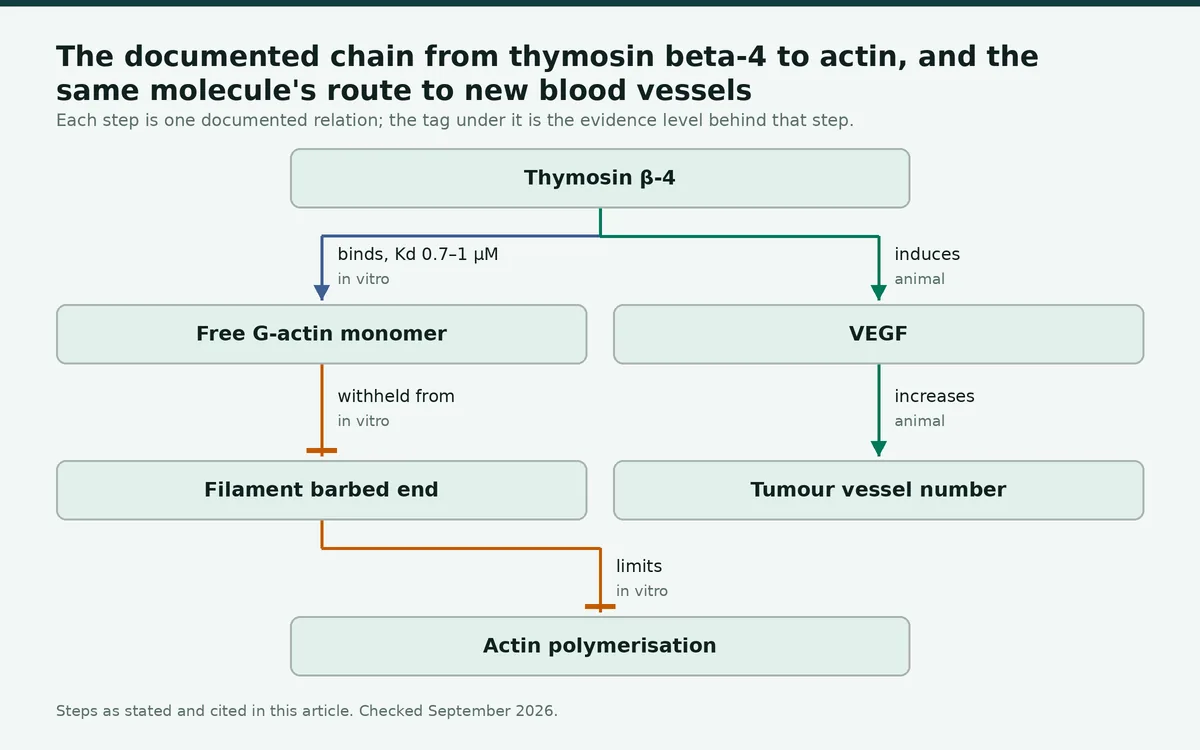
| Step | Relation | Target | Evidence |
|---|---|---|---|
| Thymosin β-4 | binds, Kd 0.7–1 µM | Free G-actin monomer | in vitro [1] |
| Free G-actin monomer | withheld from | Filament barbed end | in vitro [1] |
| Filament barbed end | limits | Actin polymerisation | in vitro [1] |
| Thymosin β-4 | induces | VEGF | animal [4] |
| VEGF | increases | Tumour vessel number | animal [4] |
Tβ4’s primary documented activity is actin sequestration. Work in the Journal of Biological Chemistry showed it binds actin monomers and inhibits polymerisation with a dissociation constant of 0.7–1 µM, and that actin complexed with the thymosin does not polymerise from filament barbed ends, unlike profilin (in vitro) [1]. Sequestering free actin changes how readily a cell remodels its cytoskeleton — the plausible route to cell migration.
Two further pathways are documented. In a mouse melanoma model, Tβ4 overexpression produced a mean 2.3-fold increase in cell migration and a 4.4-fold increase in tumour blood vessel number, via induction of vascular endothelial growth factor (animal) [4]. A 2018 study mapped a TGFβ/Tβ4/MRTF/SRF transcriptional axis, Tβ4 knockout markedly reducing tumour-associated gene expression (in vitro and animal) [5].
Note what that means: the mechanism credited with promoting repair — new vessel growth, cell migration — is the mechanism documented in the tumour literature. One pathway, not two, and the risk section returns to it.
Key numbers
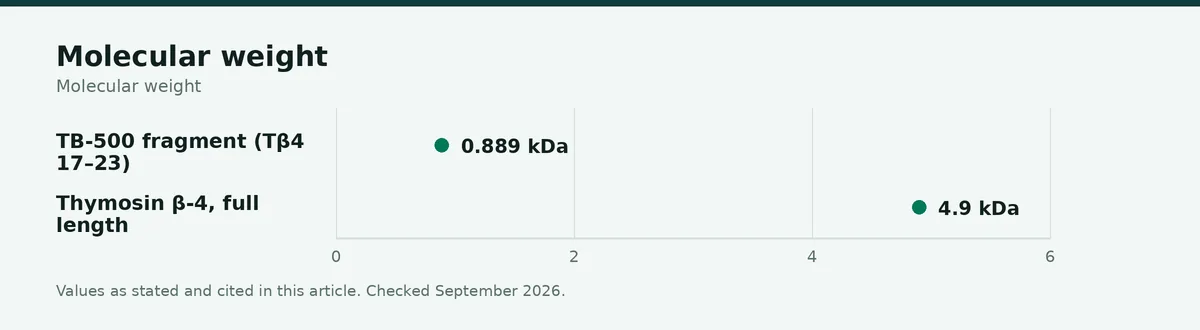
| Molecule | Molecular weight |
|---|---|
| TB-500 fragment (Tβ4 17–23) | 0.889 kDa |
| Thymosin β-4, full length | 4.9 kDa |
Those figures come from FDA’s chemistry summary for the fragment [11] and the literature on the parent protein [1][2]. There is no published human half-life for TB-500 to put beside them: FDA states the nomination “did not include, and FDA did not find information on products containing TB-500 (free base) or TB-500 acetate administered in humans” [11]. Rather than estimate one, that row is left out.
The closest pharmacokinetic data concern Tβ4 in mice, where serum levels peaked within two minutes at 2.34 ± 0.54 µg/ml and persisted roughly 40 minutes, kidneys clearing it rapidly (animal) [3]. Different molecule, different species.
What the research shows
Human studies
There is a real clinical record here, but it belongs to full-length Tβ4. RegeneRx ran a randomised, double-blind, placebo-controlled phase 2 study of topical Tβ4 gel in venous stasis ulcers, enrolling 72 participants across three concentrations (0.01%, 0.03% and 0.1% w/w) for up to 84 days. The primary outcome was safety and tolerability; on the secondary wound-closure measure, 12 of 55 treated and 4 of 17 placebo participants reached closure by day 84 (human RCT) [9] — small numbers, from a trial not powered for efficacy.
A phase 1a study gave single intravenous doses of recombinant human Tβ4 to 54 healthy volunteers across seven cohorts from 0.05 to 25 µg/kg, assessing tolerated dose, adverse events, pharmacokinetics and antidrug antibodies (human) [10]. Again, the full-length protein.
The 2026 scoping review found 19 of 80 studies were human, concluding that “human evidence directly relevant to musculoskeletal applications was limited” [17] — the honest state of play for the tendon, ligament and muscle uses TB-500 is marketed around.
Animal studies
The animal literature is where most repair evidence sits. In rats with 8 mm full-thickness wounds, topical Tβ4 (5 µg) increased reepithelialisation by 42% at day 4 and 61% at day 7 versus saline, improved contraction 11–24% by day 7, and roughly doubled vessel counts (animal) [2].
Cardiac work is more equivocal than its reputation suggests. A mouse lineage-tracing study found Tβ4 given after myocardial infarction did not reprogram epicardial cells into cardiomyocytes; the epicardium thickened and capillary density rose, but cells adopted fibroblast and smooth muscle fates (animal) [6]. A later mouse study using a self-assembling peptide carrier reported epicardial activation, higher microvessel density and smaller scar size at four weeks (animal) [7]. Neither establishes a human outcome.
In ocular research, an RGN-259 (Tβ4) formulation improved tear production, corneal irregularity and goblet cell counts in a mouse dry eye model (animal) [8].
In-vitro / preclinical
Beyond the actin-binding characterisation already described [1], LC-MS/MS metabolite mapping of Tβ4 identified 13 candidate metabolites, six confirmed against synthesised standards — groundwork for analytical detection, and a reminder that the parent protein breaks into multiple fragments (in vitro) [18]. The 2026 scoping review classed 23 of 80 studies as in vitro, angiogenesis being the most studied mechanism [17].
Side effects and risks
The risk profile of TB-500 is undocumented rather than reassuring. FDA found no human data on the fragment, stating that “potential safety risks associated with the use of these substances in humans are unknown” [11].
The specific concerns FDA identified: peptides given by injectable routes “may pose a significant risk for immunogenicity, potentially amplified by aggregation as well as potential peptide-related impurities”; insufficient data on bacterial endotoxin levels and aggregates; and poor chemical characterisation following from the naming problem already noted [11].
The angiogenesis question deserves its own line. The pro-angiogenic, pro-migratory activity that makes Tβ4 interesting for repair is the activity documented in tumour models: a 4.4-fold rise in tumour blood vessels and 2.3-fold rise in melanoma cell migration in mice (animal) [4], and an axis in which high Tβ4 expression associates with poorer prognosis in several cancers [5]. That is not evidence of a human cancer risk — no such study exists — but it is a documented signal pointing the opposite way from the marketing.
Regulatory and legal status (2026)
TB-500 is not an FDA-approved drug and has no approved human indication (checked September 2026).
Its status moved in 2026. Wells Pharmacy Network nominated TB-500 (free base) and acetate for the 503A Bulks List — the substances compounding pharmacies may use — proposing a 3 mg/mL injectable for wound healing [11]. FDA reviewed the nomination for the Pharmacy Compounding Advisory Committee meeting of 23–24 July 2026, where TB-500 appeared alongside BPC-157, KPV, MOTS-c, semax and epitalon [12]. Its briefing document concluded: “Accordingly, we propose not adding TB-500 (free base) or TB-500 acetate to the 503A Bulks List” [11]. Committee recommendations are non-binding [12].
As checked in September 2026, TB-500 is listed on FDA’s page of bulk drug substances that may present significant safety risks — though not in its active category 2 table, where the peptides named include GHRP-2, GHRP-6, ibutamoren mesylate, ipamorelin acetate and kisspeptin-10. The TB-500 entry sits in the table below that one, headed “Bulk drug substances nominated but withdrawn”, and reads “Thymosin beta-4, fragment (LKKTETQ), also known as TB-500”. FDA introduces that table as substances previously in category 2 of the interim policies whose nominations were withdrawn by the nominators, and it keeps the safety concern published beside the entry: compounded drugs containing the fragment “may pose risk for immunogenicity for certain routes of administration due to the potential for aggregation as well as peptide-related impurities”. That page was current as of 22 April 2026 [13].
The distinction is narrow but real. No active category 2 designation stands against TB-500 today, and that is not the same as the substance being absent from FDA’s safety-risk page or free of the concerns recorded there. Category 2 status, a withdrawn nomination and a rejected nomination are three different positions, and the rubric scores the position on record.
FDA has also been explicit that research-use framing does not change a product’s regulatory character, writing in an August 2026 warning letter that “despite statements on your product labeling marketing your products ‘for research use only’ and ‘not for human or animal consumption,’ evidence obtained from your website establishes that your products are intended to be drugs for human use” [15]. Our guide to peptide legal status covers that reasoning.
In sport, the 2026 WADA Prohibited List came into force on 1 January 2026 [16], and the 2026 scoping review records that WADA classifies Tβ4 and its derivatives, including TB-500, as prohibited substances [17].
Comparison Framework scores
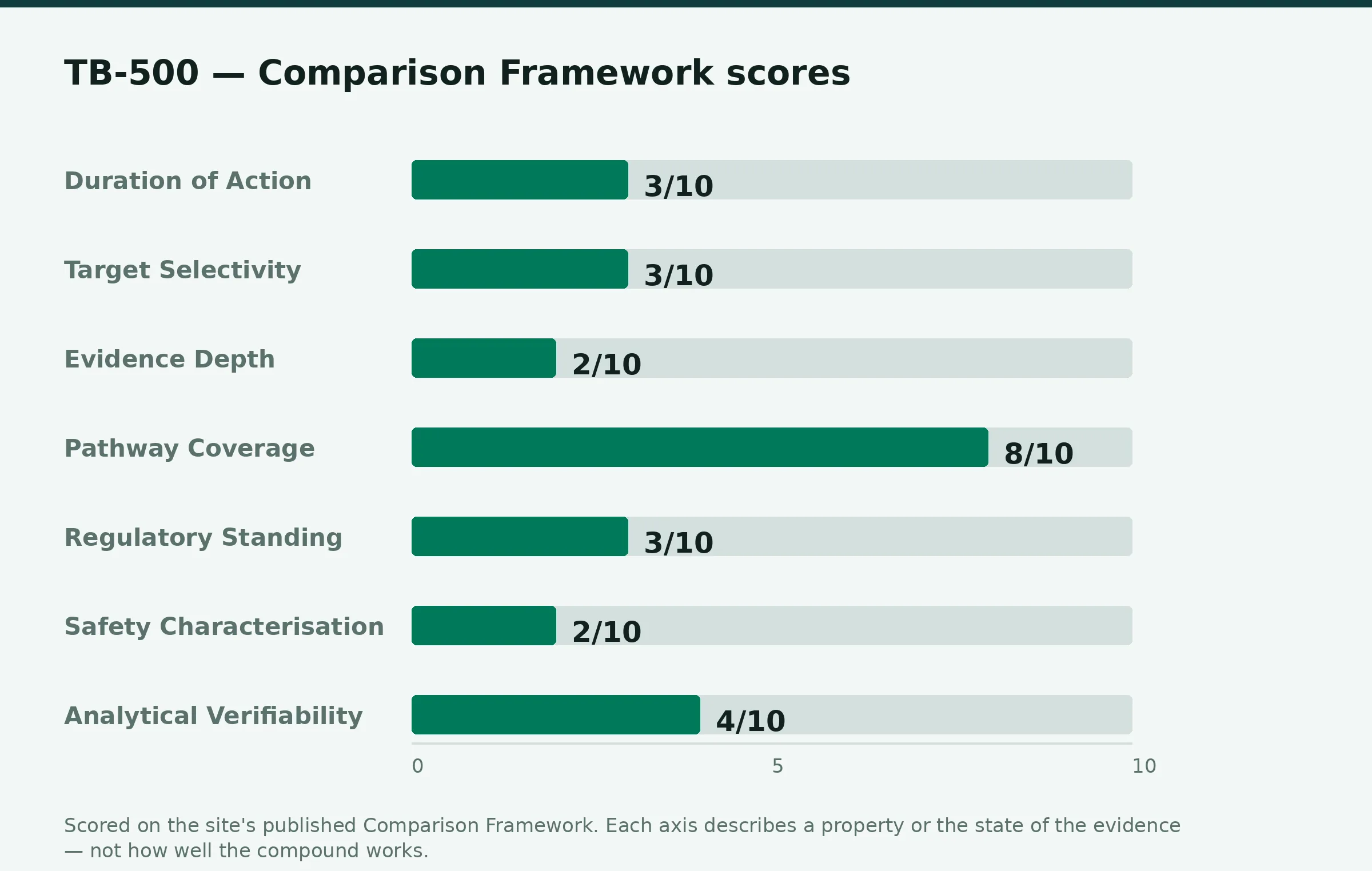
| Axis | n/10 | justification [n] |
|---|---|---|
| Duration of Action | 3/10 | No human PK for the fragment [11]; in mice Tβ4 peaked in serum within 2 min, persisting ~40 min (animal) [3] |
| Target Selectivity | 3/10 | Not a receptor ligand — actin sequestration (Kd 0.7–1 µM) [1] alongside VEGF induction [4] and TGFβ/MRTF/SRF signalling [5] |
| Evidence Depth | 2/10 | FDA found no human data on TB-500 by any route [11]; the trial record belongs to full-length Tβ4 [9][10] |
| Pathway Coverage | 8/10 | One dominant mechanism, actin sequestration, with documented secondary angiogenic and transcriptional activity [1][4][5] |
| Regulatory Standing | 3/10 | Research use only; FDA proposed against adding it to the 503A Bulks List, July 2026 [11][14], and it remains listed under nominated-but-withdrawn on FDA’s significant-safety-risks page [13] |
| Safety Characterisation | 2/10 | No published human safety data; FDA flagged immunogenicity, aggregation, impurity and endotoxin gaps [11] |
| Analytical Verifiability | 4/10 | Identity confirmable by mass from FDA’s stated formula, but no compendial monograph and no USAN name [11] |
Evidence Depth sits at 2/10, so this needs saying directly: mechanistic plausibility is not clinical proof. A molecule can have a well-characterised biochemical activity, a coherent story about why it should help repair, and still no evidence that it does anything useful or safe in a person. The anchors behind each axis are published in our Comparison Framework.
The low Safety Characterisation score is not a claim that the compound is dangerous — it means nobody has measured, a different and often worse position than knowing a risk precisely.
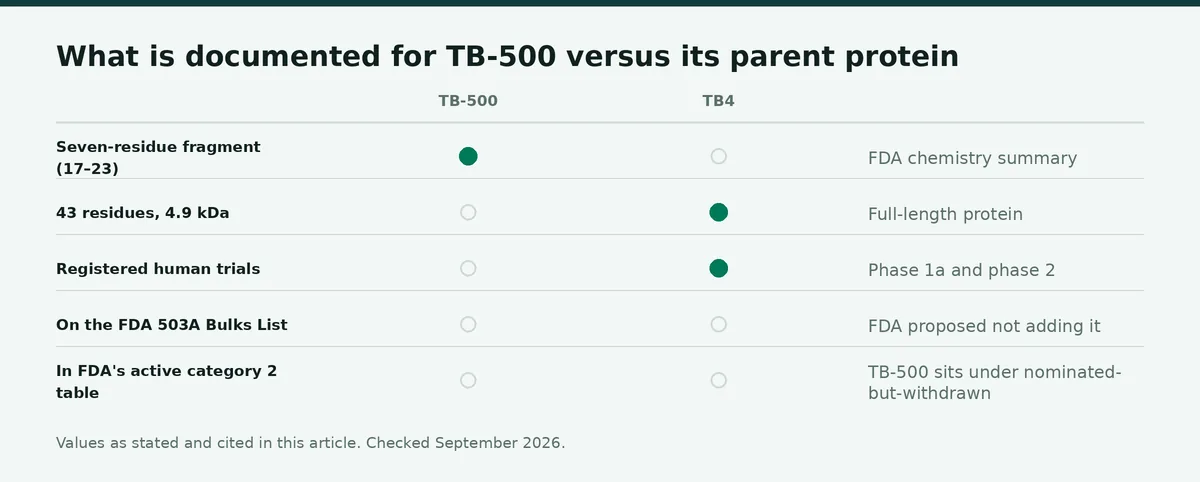
| Attribute | TB-500 | Tβ4 | Note |
|---|---|---|---|
| Seven-residue fragment (17–23) | yes | no | FDA chemistry summary [11] |
| 43 residues, 4.9 kDa | no | yes | Full-length protein [1][2] |
| Registered human trials | no | yes | Phase 1a and phase 2 [9][10] |
| On the FDA 503A Bulks List | no | no | FDA proposed not adding it [11][14] |
| In FDA’s active category 2 table | no | no | TB-500 sits under nominated-but-withdrawn [13] |
The TB-500 column is almost entirely empty, and that emptiness is the most informative thing here — with the caveat that the last row is empty only of an active category 2 designation.
How TB-500 compares
The closest comparison is BPC-157, which went before the same FDA advisory committee on the same day in July 2026 [12] and sits in a similar position: animal-heavy literature, no approved human indication. Both appear in our recovery and tissue-repair guide.
A useful contrast is the growth hormone secretagogue class in our GHRH versus GHRP guide, where one member carries regulatory-grade trial data. That gap is what Evidence Depth measures, and the pattern recurs across the field in the UCLA peptide evidence review.
Sourcing and quality: what to look for
Because “TB-500” is a trade name rather than a standardised chemical identity [11], a certificate of analysis matters more here than for a compound with a monograph. At minimum it should state the sequence tested rather than the marketing name, report identity by mass spectrometry against the stated formula, give purity by HPLC with the method named, and carry a lot number, date and testing laboratory.
FDA flagged missing endotoxin and aggregate data for this class [11], so an endotoxin result is worth looking for and is frequently absent. Our walkthrough of how to read a peptide certificate of analysis covers how certificates fall short, and what peptides are sets out the basics.
FAQ
Is TB-500 the same thing as thymosin beta-4?
No. FDA describes TB-500 as a seven-amino-acid synthetic fragment corresponding to residues 17 to 23 of thymosin beta-4, weighing 889.01 g/mol [11]. Thymosin beta-4 itself is a 43-amino-acid, 4.9 kDa protein [1][2]. Because most published repair research used the full-length protein, evidence about Tβ4 does not transfer automatically to the fragment.
Is TB-500 approved by the FDA?
No. TB-500 has no FDA-approved human indication (checked September 2026). It was nominated for the 503A Bulks List used by compounding pharmacies, and in a briefing document for the Pharmacy Compounding Advisory Committee meeting of 23–24 July 2026 FDA proposed not adding TB-500 free base or acetate to that list [11][12].
Is there any human research on TB-500?
FDA reported that the nomination did not include, and the agency did not find, information on TB-500 free base or acetate administered in humans by any route [11]. The human record that does exist — a 72-participant phase 2 trial of topical thymosin beta-4 gel in venous stasis ulcers, and a 54-volunteer phase 1a intravenous study — concerns the full-length protein [9][10].
Why does the tumour question keep coming up?
Because the pro-angiogenic activity behind the repair hypothesis is documented in tumour models too. In mice, thymosin beta-4 overexpression raised tumour blood vessel number 4.4-fold and melanoma cell migration 2.3-fold via VEGF induction (animal) [4], and high Tβ4 expression associates with poorer prognosis in several cancers [5]. No human study has tested this for TB-500: the signal exists, the data to interpret it does not.
Is TB-500 banned in sport?
The 2026 WADA Prohibited List came into force on 1 January 2026 [16], and a 2026 peer-reviewed scoping review records that WADA classifies thymosin beta-4 and its derivatives, including TB-500, as prohibited [17]. Athletes under anti-doping rules should check the current List directly, as it is revised annually.
Does a “research use only” label change its legal status?
No. FDA wrote in an August 2026 warning letter that evidence from a seller’s own website can establish that products labelled “for research use only” and “not for human or animal consumption” are nonetheless “intended to be drugs for human use” [15]. The label does not by itself determine how the agency classifies a product.
References
- Yu FX, Lin SC, Morrison-Bogorad M, Atkinson MA, Yin HL. Thymosin beta 10 and thymosin beta 4 are both actin monomer sequestering proteins. Journal of Biological Chemistry. 1993. https://www.sciencedirect.com/science/article/pii/S002192581854179X
- Malinda KM, Kleinman HK, Sidhu GS, Mani H, Banaudha K, Maheshwari RK, Goldstein AL. Thymosin β4 accelerates wound healing. Journal of Investigative Dermatology. 1999. https://www.sciencedirect.com/science/article/pii/S0022202X15405950
- Mora CA, Baumann CA, Paino JE, Goldstein AL, Badamchian M. Biodistribution of synthetic thymosin β4 in the serum, urine, and major organs of mice. International Journal of Immunopharmacology. 1997. https://www.sciencedirect.com/science/article/abs/pii/S0192056197000052
- Cha HJ, Jeong MJ, Kleinman HK. Role of thymosin β4 in tumor metastasis and angiogenesis. JNCI: Journal of the National Cancer Institute. 2003. https://academic.oup.com/jnci/article-abstract/95/22/1674/2606660
- Morita T, Hayashi K. Tumor progression is mediated by thymosin-β4 through a TGFβ/MRTF signaling axis. Molecular Cancer Research. 2018. https://aacrjournals.org/mcr/article/16/5/880/268687/Tumor-Progression-Is-Mediated-by-Thymosin-4
- Zhou B, Honor LB, Ma Q, Pu WT, et al. Thymosin beta 4 treatment after myocardial infarction does not reprogram epicardial cells into cardiomyocytes. Journal of Molecular and Cellular Cardiology. 2012. https://www.sciencedirect.com/science/article/pii/S0022282811003403
- Wang YL, Yu SN, Shen HR, Wang HJ, Wu XP, Wang QL, Zhou B, Tan YZ. Thymosin β4 released from functionalized self-assembling peptide activates epicardium and enhances repair of infarcted myocardium. Theranostics. 2021. https://www.thno.org/v11p4262.htm
- Kim CE, Kleinman HK, Sosne G, Ousler GW, et al. RGN-259 (thymosin β4) improves clinically important dry eye efficacies in comparison with prescription drugs in a dry eye model. Scientific Reports. 2018. https://www.nature.com/articles/s41598-018-28861-5
- RegeneRx Biopharmaceuticals. A randomized, double-blind, placebo-controlled, dose-response study of the safety and efficacy of thymosin beta 4 in the treatment of patients with venous stasis ulcers (NCT00832091). ClinicalTrials.gov. Results posted 2010. https://classic.clinicaltrials.gov/ct2/show/NCT00832091
- Beijing Northland Biotech Co. Ltd. A randomized, double-blind, placebo-controlled, single dose, dose-escalation, phase 1a study of the safety, tolerability, pharmacokinetics and the potential immunological reaction of recombinant human thymosin beta4 in Chinese healthy volunteers (NCT04555824). ClinicalTrials.gov. 2018. https://classic.clinicaltrials.gov/ct2/show/NCT04555824
- US Food and Drug Administration. FDA Briefing Document, Pharmacy Compounding Advisory Committee Meeting: TB-500 (free base) and TB-500 acetate. FDA. 2026. https://www.fda.gov/media/193349/download
- US Food and Drug Administration. July 23-24, 2026: Meeting of the Pharmacy Compounding Advisory Committee. FDA. 2026. https://www.fda.gov/advisory-committees/advisory-committee-calendar/july-23-24-2026-meeting-pharmacy-compounding-advisory-committee-07232026
- US Food and Drug Administration. Certain bulk drug substances for use in compounding that may present significant safety risks. FDA. Content current as of 22 April 2026. https://www.fda.gov/drugs/human-drug-compounding/certain-bulk-drug-substances-use-compounding-may-present-significant-safety-risks
- US Food and Drug Administration. Bulk drug substances used in compounding under section 503A of the FD&C Act. FDA. Content current as of 14 May 2026. https://www.fda.gov/drugs/human-drug-compounding/bulk-drug-substances-used-compounding-under-section-503a-fdc-act
- US Food and Drug Administration. Warning Letter: Royal Peptides LLC (734884). FDA. 24 August 2026. https://www.fda.gov/inspections-compliance-enforcement-and-criminal-investigations/warning-letters/royal-peptides-llc-734884-08242026
- World Anti-Doping Agency. 2026 Prohibited List (in force 1 January 2026). WADA. 2026. https://www.wada-ama.org/en/resources/2026-prohibited-list
- Thymosin Beta-4 and TB-500 in tissue healing, regeneration, and musculoskeletal repair: a scoping review. Applied Sciences. 2026. https://www.mdpi.com/2076-3417/16/12/6202
- Rahaman M, Muresan AR, Min H, Son J, Kang MJ, Kwon OS. An approach for identifying in silico peptides against authentic metabolites: in vitro characterization of thymosin β4 metabolites. Journal of Pharmaceutical Investigation. 2022. https://link.springer.com/article/10.1007/s40005-022-00581-z