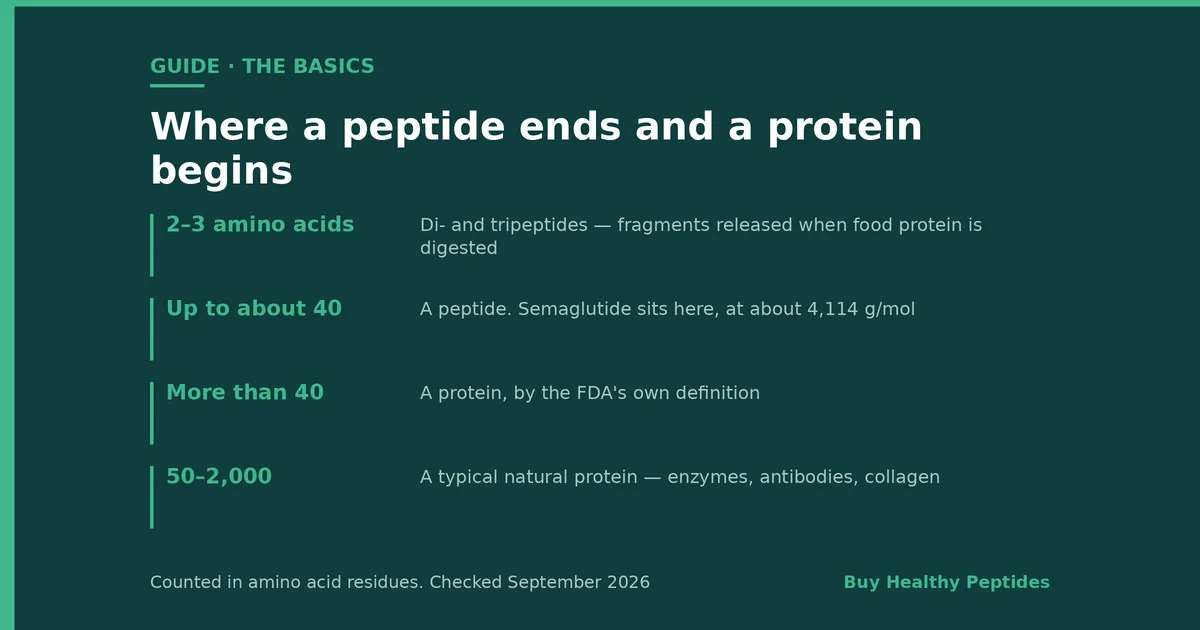
Quick answer: Peptides are short chains of amino acids joined by peptide bonds. They are the same basic material as proteins, just smaller: the FDA draws the line at 40 amino acids, above which a chain counts as a protein [1][2]. The body uses peptides as hormones and signalling molecules, and more than 80 peptide drugs have been approved worldwide, from insulin to modern GLP-1 medicines like semaglutide [3][4].
What are peptides, exactly?
Every peptide is built from amino acids, the same 20 or so building blocks that make up every protein in your body. Two amino acids link when the carboxyl group of one joins the amino group of the next. This forms a peptide bond and releases a molecule of water [1]. Repeat that step and you get a chain.
That chain has a direction. One end carries a free amino group (the N-terminus) and the other a free carboxyl group (the C-terminus). By convention, sequences are always written from N to C [1]. Order matters: the same amino acids in reverse order make a different molecule with different properties [1].
Peptide bonds are also surprisingly durable on their own. Without an enzyme to cut them, a peptide bond in water can last for centuries [1]. Inside the body it’s a different story, because enzymes called proteases break peptides down quickly. That single fact explains a lot about how peptide drugs are designed, as you’ll see below.
Peptides vs proteins: where is the line?
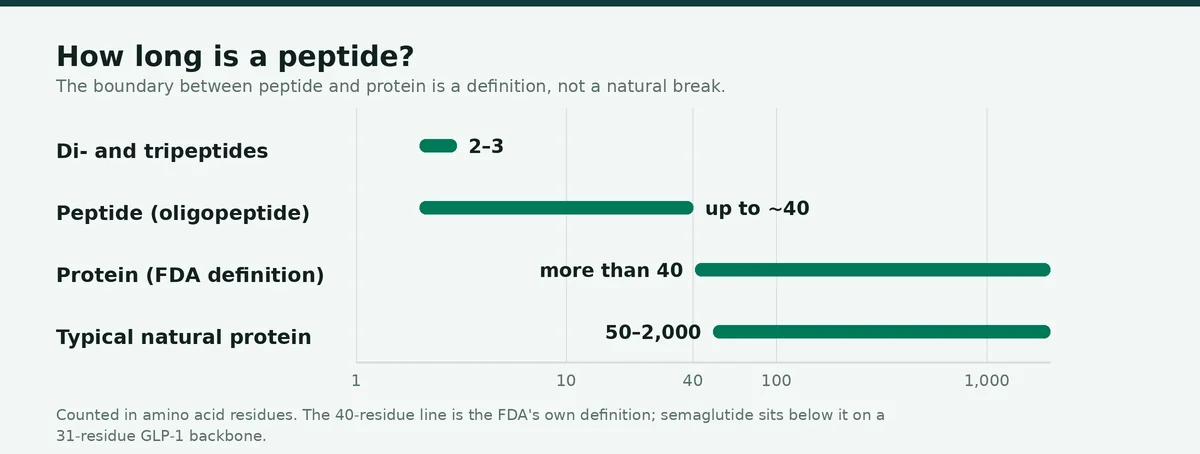
“Peptide” and “protein” describe the same kind of molecule at different sizes:
| Term | Typical size | Example |
|---|---|---|
| Dipeptide / tripeptide | 2–3 amino acids | Small fragments released when food proteins are digested |
| Peptide (oligopeptide) | Up to about 40 amino acids | Semaglutide, a modified GLP-1 peptide (about 4,114 g/mol) [5] |
| Protein | More than 40 amino acids (FDA definition) [2] | Insulin (two chains counted together) [2] |
| Typical natural protein | 50–2,000 amino acids [1] | Enzymes, antibodies, collagen |
In textbooks the boundary is fuzzy. For regulation it’s precise: since March 2020, the FDA defines a protein as “any alpha amino acid polymer with a specific, defined sequence that is greater than 40 amino acids in size” [2]. Chains that naturally associate, like the two chains of insulin, are counted together [2]. This matters because proteins are regulated as biologics in the US, while peptides of 40 amino acids or fewer generally stay on the drug pathway. For a deeper side-by-side, see peptides vs proteins vs amino acids.
Most therapeutic peptides weigh roughly 500–5,000 daltons [3], much smaller than an antibody but much larger than a typical pill-sized drug molecule.
What do peptides do in the body?
Your body makes peptides constantly and uses them mostly as messengers. Many hormones are peptides. They bind to receptors on the surface of cells and switch specific processes on or off with high affinity and specificity [3]. Insulin, which regulates blood sugar, is the best-known example. It was first isolated in 1921 and became the first commercial peptide drug in 1923 [3].
Other peptides act as neurotransmitters, as antimicrobial defenders in the immune system, or as growth and repair signals. Researchers study many of these natural peptides as starting points for new drugs. Some come from surprising places: animal venoms are an active source of new peptide drug leads [4].
Why medicine uses peptides
Peptides sit in a useful middle ground between small-molecule drugs and large biologics. Reviews of the field highlight a few recurring advantages [3][4]:
- Precision. Peptides bind their target receptors selectively, which can mean fewer off-target effects than many small molecules [3].
- Lower immunogenicity than large biologics. Compared with antibodies, peptides generally provoke less immune response and cost less to make [3].
- Reach. Their size lets them block protein–protein interactions that small molecules struggle to disrupt [3].
The field has grown fast. More than 80 peptide drugs have reached the market, treating conditions including diabetes, cancer, osteoporosis, multiple sclerosis, HIV infection and chronic pain [4]. Between 2000 and 2022, 33 non-insulin peptide drugs were approved worldwide, and more than 170 were in active clinical development [3].
The catch: why peptides are hard to use as drugs
Peptides have two built-in weaknesses [3]:
- They break down fast. Proteases cut the amide (peptide) bonds, so many natural peptides have a very short half-life and are eliminated quickly [3].
- They struggle to get into cells, or through the gut. Most peptides can’t cross cell membranes to reach targets inside the cell [3], and digestion degrades them. That’s why most peptide drugs are given by injection rather than as a pill.
Much of modern peptide chemistry exists to work around these limits. Semaglutide is a clear example. According to its FDA label, it shares 94% of its sequence with human GLP-1, with one change that protects it from the enzyme DPP-4 and a fatty-acid side chain that extends how long it stays in circulation [5]. Its peptide backbone is produced by yeast fermentation [5]. These changes are what make once-weekly dosing possible [5]. Explore that family in our guide to GLP-1 and incretin peptides.
How peptides are made
There are two main routes [3]:
- Chemical synthesis. Amino acids are added one at a time on a solid support (solid-phase peptide synthesis). This is the standard route for shorter peptides and lets chemists insert unnatural amino acids or other modifications.
- Biological production. Cells such as yeast or bacteria are engineered to produce the peptide chain, as with semaglutide’s backbone [5].
Either way, the product has to be purified and analytically confirmed. Purity testing (typically HPLC) and identity testing (typically mass spectrometry) matter, because synthesis can leave truncated sequences, deletions and other impurities. Our guide on how to read a peptide certificate of analysis walks through what those tests show.
Types of peptides you’ll see discussed
People use “peptides” to mean very different things, and the evidence behind each group varies enormously:
| Category | What it means | Evidence level |
|---|---|---|
| Approved peptide drugs | Prescription medicines reviewed by regulators (for example insulin, GLP-1 agonists, tesamorelin) | Human trials; full label with risks |
| Dietary collagen peptides | Hydrolysed collagen sold as a food supplement | Human studies of varying quality; see our collagen peptides hub |
| Cosmetic peptides | Short peptides in skincare (for example copper peptide GHK-Cu) | Limited; often lab studies and small trials |
| Research peptides | Compounds sold “for research use only,” not approved for human use (for example BPC-157) | Often animal and in vitro data only |
That last category is where most online hype lives. A compound can have dozens of promising animal studies and still have little or no controlled human data. Our wiki pages label the evidence level of every finding (human, animal or in vitro) and score each compound’s Evidence Depth on our Comparison Framework, so you can see how much is actually known.
Popular clusters we cover in depth:
- Metabolic and weight research: semaglutide, tirzepatide, retatrutide
- Growth hormone secretagogues: GHRH and GHRP peptides explained, including tesamorelin and CJC-1295
- Tissue-repair research: recovery peptides such as BPC-157 and TB-500
How to read peptide claims critically
A few questions filter out most of the noise:
- What kind of evidence is it? A result in rats or in a cell dish is a lead, not a human outcome. Look for randomized human trials.
- Who is making the claim? Sellers have an incentive to overstate benefits. Primary sources (PubMed, clinicaltrials.gov, FDA labels) are the reference point.
- What is the regulatory status? “Research use only” means the product is not approved for human use, and rules differ by compound and change over time. See are peptides legal? and research vs compounded vs approved peptides.
- Can the quality be verified? Without independent testing, you can’t know what is actually in a vial. Check for batch-specific, third-party certificates of analysis.
- What are the risks? Approved drugs carry known risks too. Semaglutide’s label, for example, has a boxed warning about thyroid C-cell tumors seen in rodents [5]. Unapproved compounds often have no systematic safety data at all.
FAQ
Are peptides the same as proteins?
They’re made of the same building blocks, but peptides are shorter. The FDA counts a chain of more than 40 amino acids as a protein [2].
Are peptides natural?
Many are. The body makes peptide hormones like insulin, and many drugs are modified versions of natural peptides [3][4]. Others are fully synthetic designs.
Why are most peptide drugs injected?
Digestive enzymes break peptides down and they cross the gut wall poorly, so injection is usually the only reliable route [3]. Chemical modifications and new delivery methods are gradually changing this.
How many peptide drugs are approved?
More than 80 worldwide, according to recent reviews [3][4].
Are “research peptides” safe to use?
Research-use-only products are not approved for human use, and many have little or no controlled human safety data. Anyone considering any compound should talk to a qualified healthcare professional.
What’s the difference between collagen peptides and other peptides?
Collagen peptides are digested fragments of collagen protein sold as food supplements. They’re a very different product from signalling peptides like GLP-1 agonists. See our collagen peptides hub.
References
- Berg JM, Tymoczko JL, Stryer L. Biochemistry, 5th ed., Section 3.2: Primary Structure: Amino Acids Are Linked by Peptide Bonds to Form Polypeptide Chains. W H Freeman; 2002. https://www.ncbi.nlm.nih.gov/books/NBK22364/
- U.S. Food and Drug Administration. Definition of the Term “Biological Product”. Final rule, Federal Register, 21 Feb 2020 (effective 23 Mar 2020). https://www.federalregister.gov/documents/2020/02/21/2020-03505/definition-of-the-term-biological-product
- Wang L, Wang N, Zhang W, et al. Therapeutic peptides: current applications and future directions. Signal Transduction and Targeted Therapy. 2022;7:48. https://www.nature.com/articles/s41392-022-00904-4
- Muttenthaler M, King GF, Adams DJ, Alewood PF. Trends in peptide drug discovery. Nature Reviews Drug Discovery. 2021;20:309–325. https://www.nature.com/articles/s41573-020-00135-8
- Novo Nordisk. OZEMPIC (semaglutide) injection — Prescribing Information. DailyMed, U.S. National Library of Medicine. https://dailymed.nlm.nih.gov/dailymed/drugInfo.cfm?setid=adec4fd2-6858-4c99-91d4-531f5f2a2d79