
Quick answer: Retatrutide (LY3437943) is an investigational 39-amino-acid peptide that activates three receptors at once — GIP, GLP-1 and glucagon [1][2]. It is not approved by any regulator, anywhere, for any use (checked September 2026) [15][18]. The best human evidence is human phase 2: a 48-week randomised trial in 338 adults with obesity reported mean body-weight reductions of 8.7% to 24.2% by dose versus 2.1% on placebo [1][5]. The phase 3 TRIUMPH programme, in more than 5,800 participants, has produced three sponsor-announced toplines — up to 28.3% mean weight reduction at 80 weeks — but none has been peer-reviewed or published in full, and no regulator has reviewed the data [10][21][22].
| Spec | Detail |
|---|---|
| Also known as | LY3437943, LY-3437943 [2][20] |
| Class | Triple GIP / GLP-1 / glucagon receptor agonist (investigational tri-agonist) [1][3] |
| Sequence / length | 39 amino acids on a GIP backbone, non-coded residues at positions 2, 13 and 20, exendin-4-derived C-terminal tail [1][2] |
| Molecular weight | Formula C221H342N46O68 in PubChem; no regulator-published reference mass, because nothing is approved [20] |
| Half-life | ~6 days; peak concentration 12–72 h after a subcutaneous dose [4] |
| Regulatory status (US) | Investigational new drug only. Not approved; FDA states it “cannot be used in compounding under federal law” and has not been found safe and effective for any condition (checked September 2026) [15] |
| WADA status | Not named in WADA’s announcement of the 2026 Prohibited List; the list text could not be retrieved here, so check it directly (checked September 2026) [19] |
What is retatrutide?
Retatrutide is a laboratory-designed peptide developed under the code LY3437943, built on the sequence of glucose-dependent insulinotropic polypeptide (GIP) and engineered so one molecule activates three separate receptors: GIP, GLP-1 and glucagon [1][3].
The chain is 39 amino acids long, with non-coded residues at three positions — aminoisobutyric acid at position 2 (blocking DPP-4 cleavage), α-methyl-leucine at 13, and a second aminoisobutyric acid at 20 [1][2]. A C20 fatty diacid is attached through an AEEA–γGlu linker to the lysine at position 17, and the C-terminus borrows a tail derived from exendin-4 [2][3]. That fatty-acid anchor is what makes weekly administration possible: it binds circulating albumin and stretches the half-life to roughly six days [4].
The design sits one step beyond the approved incretin peptide class. Semaglutide hits one receptor, tirzepatide two, retatrutide three. The critical difference is that those two are approved medicines with published labels, and retatrutide is not [6][10].
How retatrutide works (mechanism)
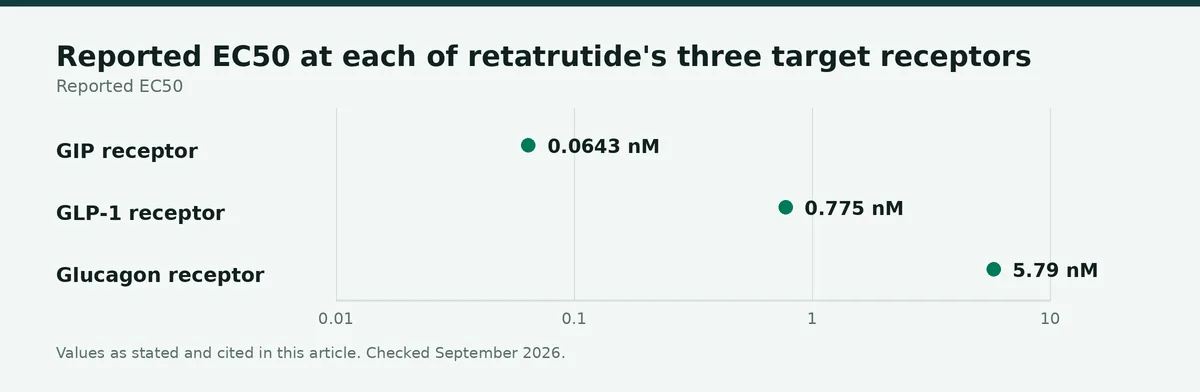
What is established is receptor engagement. Cryo-electron microscopy of retatrutide bound to all three receptors shows a single continuous helix threading the transmembrane bundle, confirming genuine triple agonism [3]. The potency is deliberately unbalanced: relative to each native hormone, retatrutide is about 8.9 times more potent at the GIP receptor and roughly 0.4 and 0.3 times as potent at the GLP-1 and glucagon receptors [3]. Reported half-maximal effective concentrations run 0.0643 nM at GIPR, 0.775 nM at GLP-1R and 5.79 nM at GCGR [4].
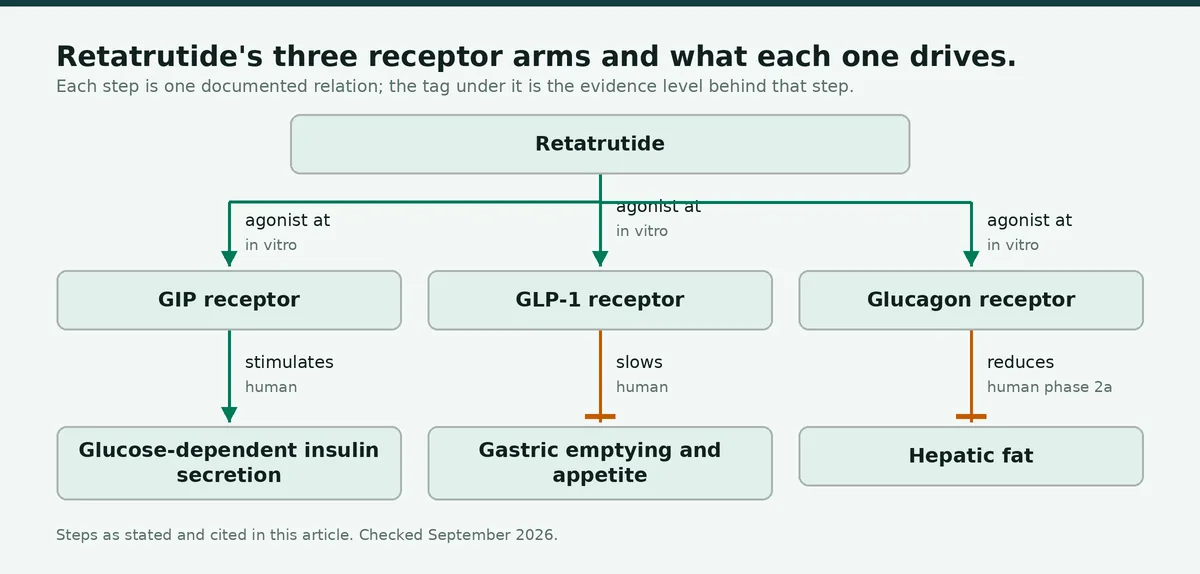
| Step | Relation | Target | Evidence |
|---|---|---|---|
| Retatrutide | agonist at | GIP receptor | in vitro [3][4] |
| Retatrutide | agonist at | GLP-1 receptor | in vitro [3][4] |
| Retatrutide | agonist at | Glucagon receptor | in vitro [3][4] |
| GIP receptor | stimulates | Glucose-dependent insulin secretion | human [4][6] |
| GLP-1 receptor | slows | Gastric emptying and appetite | human [4][6] |
| Glucagon receptor | reduces | Hepatic fat | human phase 2a [8] |
The GIP and GLP-1 arms are familiar territory: glucose-dependent insulin secretion, slowed gastric emptying and suppressed appetite, the machinery behind the approved incretin drugs [4][6].
The glucagon arm is the differentiator, and the least settled part. The working hypothesis is that chronic glucagon-receptor agonism raises energy expenditure — increasing calories burned rather than only reducing calories eaten — mainly through a rise in sympathetic tone driving brown adipose thermogenesis; glucagon signalling is also credited with reducing hepatic lipid accumulation [1][7].
The supporting evidence is indirect. The strongest human-relevant signal is the liver, where phase 2a hepatic fat fell further than weight alone would predict [8]. But no human trial has isolated the glucagon contribution by blocking that receptor while leaving the other two intact, so the energy-expenditure account is a hypothesis consistent with the data, not a demonstrated mechanism. Glucagon agonism also carries a predictable downside — it can raise blood glucose — which is why the three arms were balanced rather than maximised [1][3].
Key numbers
| Receptor | Reported EC50 | Evidence level |
|---|---|---|
| GIP receptor | 0.0643 nM | in vitro [4] |
| GLP-1 receptor | 0.775 nM | in vitro [4] |
| Glucagon receptor | 5.79 nM | in vitro [4] |
Pharmacokinetics and trial exposure, for reference. These are four different quantities rather than one measured across comparable subjects, so they are listed here rather than charted.
| Property | Value | Evidence level |
|---|---|---|
| Elimination half-life | 6 days | human PK [4] |
| Time to peak concentration | 12–72 h | human PK [4] |
| Dosing interval used in trials | 7 days | human phase 2 [4][8] |
| Longest completed phase 2 exposure | 48 weeks | human phase 2 [5][8] |
Phase 1 enrolled 47 healthy adults, 45 of whom received at least one dose. Metabolism is hepatic, with no reported cytochrome P450 interaction [4].
What the research shows
Human studies
Phase 2, obesity (human phase 2). A 48-week double-blind randomised placebo-controlled trial in 338 adults with obesity, or overweight plus a weight-related condition, reported mean body-weight reductions of 8.7%, 17.1%, 22.8% and 24.2% across dose groups, against 2.1% on placebo [1][5]. At 48 weeks, 83% of the 12 mg group reached at least 15% weight reduction, versus 2% on placebo [4].
Phase 2, type 2 diabetes (human phase 2). Over 36 weeks, HbA1c fell by up to 2.02% and body weight by up to 16.9%, versus 3.0% on placebo; 82% reached an HbA1c of 6.5% or below [4][7].
Phase 2a, MASLD (human phase 2). A 48-week substudy randomised 98 participants with obesity and metabolic dysfunction-associated steatotic liver disease to placebo or 1, 4, 8 or 12 mg weekly. Relative liver-fat reduction at 24 weeks ran 42.9% to 82.4% by dose, against a 0.3% increase on placebo; by 48 weeks 93% of the 12 mg group had liver fat below 5%, and body weight had fallen 25.9% versus 0.1% [8].
Phase 2b, chronic kidney disease (human phase 2). TRANSCEND-CKD randomised 146 adults with overweight or obesity and CKD to retatrutide up to 12 mg weekly or placebo for 24 weeks, with measured glomerular filtration rate as the primary endpoint — a mechanistic study, not a registrational one [11].
Pooled analysis (human phase 2). A 2025 systematic review pooled three randomised trials totalling 878 participants and found a mean difference of −14.33% in body weight versus placebo, concluding that larger and longer trials are required [9].
Phase 3 (sponsor-announced topline; not yet peer-reviewed). The TRIUMPH programme is four randomised trials in more than 5,800 participants, with percent change in body weight, apnea-hypopnea index and WOMAC pain score as primary endpoints [10]; a cardio-kidney outcomes trial is also running [11]. Three readouts have been announced by the sponsor, Eli Lilly, in company statements rather than in a journal, so they carry a lower evidentiary weight than the peer-reviewed phase 2 work above and the full datasets are not yet public.
In TRIUMPH-1, 2,339 adults with obesity were randomised across four arms for 80 weeks; the company reported 28.3% mean body-weight reduction on 12 mg against 2.2% on placebo, with discontinuation for adverse events of 4.1%, 6.9% and 11.3% across the 4 mg, 9 mg and 12 mg arms versus 4.9% on placebo [21]. In TRIUMPH-2, 1,152 adults with type 2 diabetes and obesity or overweight reported 20.8% weight reduction and a 1.5-percentage-point HbA1c fall on 12 mg, against 4.0% and 0.2 points on placebo; TRIUMPH-3, in 1,949 adults with severe obesity and established cardiovascular disease, reported 22.6% versus 3.2% [22]. The dose-dependent rise in discontinuations is the number to watch in these announcements: the weight figures and the tolerability figures move together.
Animal studies
In diet-induced obese mice given 30 nmol/kg every other day, retatrutide cut body weight by about 38% from baseline and tumour volume 14-fold in a pancreatic model and 17-fold in a lung model versus vehicle (animal) [14]. Those are mouse oncology models, not evidence about cancer in people.
In isolated mouse atrial preparations, retatrutide raised beating rate from 3 nM upward and at 100 nM was nearly as effective as 1 µM isoprenaline, through glucagon-receptor signalling via cAMP and protein kinase A (animal) [13].
In-vitro and preclinical
In isolated human right atrial tissue from 29 cardiac surgery patients, retatrutide increased force of contraction from 10 nM up to 100 nM through all three receptors and the cAMP pathway; the authors note they did not test the human sinus node directly (in vitro, human tissue) [12]. The structural work resolving the peptide bound to each receptor is likewise in vitro [3].
Side effects and risks
Retatrutide’s risk profile is thinner than the approved incretin drugs’ for one reason: there is no label, no post-marketing surveillance and no regulator-reviewed safety summary. What follows is what trials reported, not a complete account.
Gastrointestinal effects dominate and are dose-related. Nausea, vomiting, diarrhoea and constipation were the commonest adverse events across the phase 2 programme, concentrated at higher doses and faster titration [7][9]. In the pooled analysis the 12 mg group carried a significantly higher relative risk of adverse events (RR 1.34), while the 4 mg group did not differ significantly from placebo [9]. Serious adverse events occurred in 4% of retatrutide recipients and 4% on placebo [7].
Heart rate rises. Published review of the trial data puts the mean increase at 6.7 beats per minute, and describes the chronotropic effect as more pronounced than that of semaglutide or tirzepatide [2]. The mouse atrial work gives a plausible route, through glucagon-receptor activation of cAMP/PKA signalling [13]. This is the safety signal most specific to the third receptor.
Other reported signals include transient alanine aminotransferase elevation and skin hyperesthesia [4]. The MASLD substudy found no hepatotoxicity signal through 48 weeks, though with 98 participants that is weak reassurance [8].
What is unknown is the larger problem. No trial has yet run long enough, or in enough people, to characterise rare events, cardiovascular outcomes or multi-year exposure; that is what phase 3 exists to find out [10][11]. Material bought outside a trial carries a separate set of risks — unverified identity, unknown purity, non-sterile injectables — that FDA has addressed directly in warning letters [16][17].
Regulatory and legal status (2026)
Retatrutide is not approved for human use anywhere (checked September 2026). It is an investigational new drug, studied under IND in registered clinical trials [6][10]. The European Medicines Agency’s database of centrally authorised medicines returns no retatrutide entry [18].
FDA’s position is explicit. In guidance updated 1 September 2026, the agency states that retatrutide and cagrilintide “cannot be used in compounding under federal law,” that they “are not components of FDA-approved drugs,” and that they “have not been found safe and effective for any condition” [15]. That closes the 503A and 503B compounding routes as well as the prescription route.
The “research use only” label grey-market sellers rely on does not change the analysis. In a warning letter dated 31 March 2026 naming retatrutide, FDA wrote that “despite statements on your product labeling marketing your products for ‘Research Use Only,’… evidence obtained from your website establishes that your products are intended to be drugs for human use” [16]. A letter of 24 August 2026, also naming retatrutide, repeats the finding and adds that injectable products “bypass some of the body’s key defenses against toxins and microorganisms” [17]. Our US peptide legal status guide sets out the wider framework.
For sport, WADA’s 2026 Prohibited List took effect on 1 January 2026, and the agency’s announcement records that further examples were added to section S2, peptide hormones and growth factors [19]. Retatrutide is not named in that announcement, and the list document could not be retrieved during this run, so no status is confirmed here either way — check the current list directly (checked September 2026).
Comparison Framework scores
| Axis | n/10 | Justification |
|---|---|---|
| Duration of Action | 9/10 | Half-life of ~6 days supports the weekly interval used in every trial [4] |
| Target Selectivity | 3/10 | Deliberately non-selective and unbalanced: 8.9× native potency at GIPR against 0.4× and 0.3× at GLP-1R and GCGR [3] |
| Evidence Depth | 6/10 | Peer-reviewed randomised phase 2 trials in obesity, diabetes, MASLD and CKD; phase 3 toplines announced by the sponsor but not yet peer-reviewed, published in full or reviewed by a regulator [5][9][10][21][22] |
| Pathway Coverage | 9/10 | Three distinct receptor pathways in one molecule: GIP, GLP-1 and glucagon [1][3] |
| Regulatory Standing | 2/10 | Investigational only; FDA states it is not approved, not compoundable, not found safe and effective for any condition [15][16] |
| Safety Characterisation | 5/10 | GI events, a 6.7 bpm mean heart-rate rise and transient ALT elevation documented, but no label, no regulatory safety review, no long-term outcome data [2][4][9] |
| Analytical Verifiability | 4/10 | A registered molecular formula gives an identity target, but there is no compendial monograph and no approved reference product [20] |
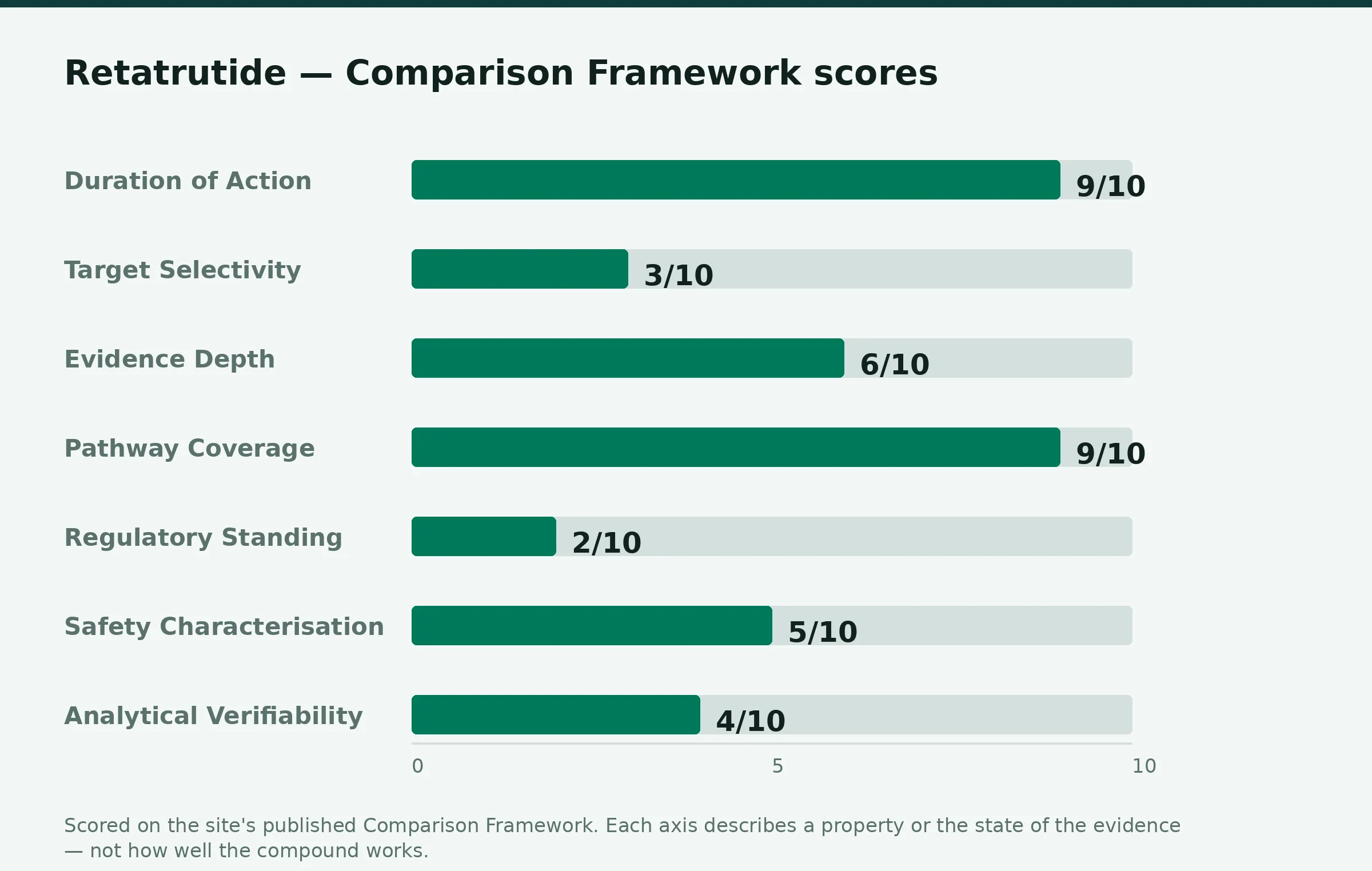
Scores follow the anchors in our Comparison Framework. No axis measures how well the compound works or whether anyone should use it — Safety Characterisation at 5/10 describes how much of the risk is written down, not how small it is.
How retatrutide compares
Against semaglutide and tirzepatide, the comparison has two halves. On the phase 2 numbers, retatrutide’s 24.2% mean weight reduction at 48 weeks is the largest reported in this class [1][8]. On everything else it is behind: no head-to-head randomised trial was verifiable here, no regulator has reviewed its dossier, and comparing percentages across trials with different populations and durations is not evidence of superiority.
The structural contrast is the useful one. Tirzepatide adds GIP to GLP-1; retatrutide adds glucagon on top, which brings both the energy-expenditure hypothesis and the chronotropic signal [1][2][13]. We take that apart in tirzepatide vs retatrutide.
Sourcing and quality: what to look for
There is no legitimate consumer supply route for retatrutide. The only lawful human exposure is inside a registered clinical trial, with characterised study drug and medical supervision [10][11]. Everything sold online as “research grade” sits outside that chain, and FDA has issued warning letters naming the compound to sellers using exactly that framing [16][17].
If you are assessing a research supplier’s paperwork anyway, the usual checks apply: a lot-specific certificate of analysis, identity by mass spectrometry, purity by HPLC with the chromatogram attached, and a named third-party laboratory. Our guide on how to read a peptide certificate of analysis covers what a real one contains. Note the ceiling here: with no approved product and no compendial monograph there is no official reference standard, so a certificate is checkable only against the vendor’s own claimed formula [20].
FAQ
Is retatrutide FDA-approved?
No. It is investigational, with no approval in any jurisdiction as of September 2026. FDA states it is not a component of any approved drug and has not been found safe and effective for any condition [15]. The EMA’s centrally authorised medicines database has no entry for it [18].
How much weight did people lose on retatrutide in trials?
In the 48-week phase 2 trial in 338 adults, mean body-weight reduction ran 8.7% to 24.2% depending on dose, versus 2.1% on placebo (human phase 2) [1][5]. In the type 2 diabetes trial, weight fell by up to 16.9% at 36 weeks (human phase 2) [7].
What does the glucagon receptor add?
It is what separates retatrutide from the dual and single agonists. The leading hypothesis is that chronic glucagon-receptor agonism raises energy expenditure, largely through sympathetic tone and brown adipose thermogenesis, and reduces hepatic fat [1][7]. No human trial has isolated that contribution, and the same receptor is the likeliest route for the heart-rate increase [13].
Does retatrutide raise heart rate?
Published review of the trial data reports a mean increase of about 6.7 beats per minute, more pronounced than with semaglutide or tirzepatide [2]. Mouse atrial experiments trace a comparable effect to glucagon-receptor signalling (animal) [13].
Is “research use only” retatrutide legal to buy?
FDA’s warning letters answer this directly: the disclaimer does not change what the product is. Where a seller’s website describes effects on appetite, glucose or body weight, FDA treats the product as an unapproved new drug intended for human use [16][17]. Nothing here should be read as suggesting an unapproved compound is safe or lawful to use.
References
- Belay KE, Jemal RH, Tuyizere A. Innovative Glucagon-based Therapies for Obesity. Journal of the Endocrine Society. 2024;8(12):bvae197. https://academic.oup.com/jes/article/8/12/bvae197/7877228
- Di Martino S, De Rosa M. Peptide-based therapeutics targeting GPCRs: recent applications in the treatment of metabolic disorders. Frontiers in Pharmacology. 2026. https://www.frontiersin.org/journals/pharmacology/articles/10.3389/fphar.2026.1930768/full
- Li W, Zhou Q, Cong Z, et al. Structural insights into the triple agonism at GLP-1R, GIPR and GCGR manifested by retatrutide. Cell Discovery. 2024;10:77. https://www.nature.com/articles/s41421-024-00700-0
- Retatrutide — A Game Changer in Obesity Pharmacotherapy. Biomolecules. 2025;15(6):796. https://www.mdpi.com/2218-273X/15/6/796
- Stanford FC. A new era in obesity management. Nature Reviews Gastroenterology & Hepatology. 2024;21(2):80–81. https://pmc.ncbi.nlm.nih.gov/articles/PMC10909397/
- Kaur M, Misra S. A review of an investigational drug retatrutide, a novel triple agonist agent for the treatment of obesity. European Journal of Clinical Pharmacology. 2024;80(5). https://link.springer.com/article/10.1007/s00228-024-03646-0
- Goldney J, Hamza M, Surti F, Davies MJ, Papamargaritis D. Triple Agonism Based Therapies for Obesity. Current Cardiovascular Risk Reports. 2025;19(1):18. https://link.springer.com/article/10.1007/s12170-025-00770-z
- Sanyal AJ, Kaplan LM, Frias JP, et al. Triple hormone receptor agonist retatrutide for metabolic dysfunction-associated steatotic liver disease: a randomized phase 2a trial. Nature Medicine. 2024;30:2037–2048. https://www.nature.com/articles/s41591-024-03018-2
- Efficacy and safety of retatrutide, a novel GLP-1, GIP, and glucagon receptor agonist for obesity treatment: a systematic review and meta-analysis of randomized controlled trials. Proceedings (Baylor University Medical Center). 2025. https://pmc.ncbi.nlm.nih.gov/articles/PMC12026077/
- Giblin JP, et al. Retatrutide for the treatment of obesity, obstructive sleep apnea and knee osteoarthritis: Rationale and design of the TRIUMPH registrational clinical trials. Diabetes, Obesity and Metabolism. 2026. https://pubmed.ncbi.nlm.nih.gov/41090431/
- Heerspink HJL, et al. Rationale, design and baseline characteristics of the TRANSCEND-CKD trial of retatrutide in patients with chronic kidney disease. Nephrology Dialysis Transplantation. 2025;41(6):1058–1068. https://pmc.ncbi.nlm.nih.gov/articles/PMC13218929/
- Neumann J, Ahlrep C, Hofmann B, Gergs U. Inotropic effects of retatrutide in isolated human atrial preparations. Naunyn-Schmiedeberg’s Archives of Pharmacology. 2026;399:317–327. https://link.springer.com/article/10.1007/s00210-025-04421-3
- Neumann J, et al. Contractile effects of retatrutide in isolated mouse atrial preparations. Naunyn-Schmiedeberg’s Archives of Pharmacology. 2025;398. https://link.springer.com/article/10.1007/s00210-025-04335-0
- Marathe S, et al. Incretin triple agonist retatrutide (LY3437943) alleviates obesity-associated cancer progression. npj Metabolic Health and Disease. 2025. https://www.nature.com/articles/s44324-025-00054-5
- FDA’s Concerns with Unapproved GLP-1 Drugs Used for Weight Loss. US Food and Drug Administration. Updated 1 September 2026. https://www.fda.gov/drugs/drug-alerts-and-statements/fdas-concerns-unapproved-glp-1-drugs-used-weight-loss
- Gram Peptides — Warning Letter 721806. US Food and Drug Administration. 31 March 2026. https://www.fda.gov/inspections-compliance-enforcement-and-criminal-investigations/warning-letters/gram-peptides-721806-03312026
- Royal Peptides LLC — Warning Letter 734884. US Food and Drug Administration. 24 August 2026. https://www.fda.gov/inspections-compliance-enforcement-and-criminal-investigations/warning-letters/royal-peptides-llc-734884-08242026
- Medicines — centrally authorised medicines database. European Medicines Agency. Checked September 2026. https://www.ema.europa.eu/en/medicines
- WADA’s 2026 Prohibited List is now in force. World Anti-Doping Agency. 2026. https://www.wada-ama.org/en/news/wadas-2026-prohibited-list-now-force
- Retatrutide (sodium salt), CID 171934787 — molecular formula C221H342N46O68. PubChem, National Library of Medicine. Checked September 2026. https://pubchem.ncbi.nlm.nih.gov/compound/Retatrutide-_sodium-salt
- Lilly’s triple agonist, retatrutide, delivered powerful weight loss in pivotal Phase 3 obesity trial (TRIUMPH-1). Eli Lilly and Company — company announcement, topline results, not peer-reviewed. 21 May 2026. https://investor.lilly.com/news-releases/news-release-details/lillys-triple-agonist-retatrutide-delivered-powerful-weight-loss
- Lilly’s triple agonist, retatrutide, successful in two additional Phase 3 obesity trials (TRIUMPH-2 and TRIUMPH-3). Eli Lilly and Company — company announcement, topline results, not peer-reviewed. 23 July 2026. https://investor.lilly.com/news-releases/news-release-details/lillys-triple-agonist-retatrutide-successful-two-additional