
Quick answer: Sermorelin is GHRH(1-29)-NH2, the shortest fragment of growth-hormone-releasing hormone that retains full biological activity [5]. Unusually for a peptide sold in the research market, it was once an approved US drug: two FDA approvals under the GEREF name, one for growth hormone deficiency in children and one for pituitary growth hormone stimulation testing, both withdrawn in 2009 after the manufacturer discontinued the products — a commercial decision, which FDA formally determined was “not withdrawn from sale for reasons of safety or effectiveness” [1]. Its human evidence base is therefore genuinely deeper than most compounds on this site, including a one-year multicenter pediatric trial and a randomized placebo-controlled study of a close analogue in older adults [3][4]. Its intravenous half-life is roughly 4.3 minutes [2].
| Spec | Detail |
|---|---|
| Also known as | GHRH(1-29)-NH2, GRF(1-29) amide, sermorelin acetate; formerly GEREF [1][5] |
| Class | Growth-hormone-releasing hormone analogue (GHRH receptor agonist) [5] |
| Sequence / length | The first 29 amino acids of human GHRH, C-terminally amidated — the shortest synthetic fragment with full GHRH activity [5] |
| Half-life | 4.3 ± 1.4 min after constant intravenous infusion in 10 healthy men — human observational [2] |
| Route in cited studies | Intravenous infusion or bolus for pharmacokinetics and stimulation testing; once-daily subcutaneous injection at bedtime in the pediatric trials [2][3][5] |
| Regulatory status (US) | No approved product; both GEREF approvals withdrawn 18 June 2009 for non-safety reasons. Absent from the 503A bulks categories and from the Category 2 safety-risk list; listed under 503B Category 1 “under evaluation” (checked September 2026) [1][9][10][11] |
| WADA status | Prohibited at all times, named in S2.2 growth hormone releasing factors, 2026 List in force 1 January 2026 (checked September 2026) [8] |
What is sermorelin?
Sermorelin is a 29-amino-acid peptide corresponding to the N-terminal portion of human growth-hormone-releasing hormone, with an amide cap at the C-terminus. The 1999 BioDrugs review describes it as “the shortest synthetic peptide with full biological activity of GHRH” — everything past residue 29 in the native 44-residue hormone can be removed without losing the ability to stimulate growth hormone release [5].
That single fact explains most of what follows. Sermorelin is not a novel designer molecule; it is a truncated copy of a hormone the body already makes, acting on the receptor that hormone already uses. Compared with the engineered analogues built on the same scaffold, it is the unmodified baseline. If you are new to how chain length and modification drive peptide behavior, our primer on what a peptide actually is covers the fundamentals.
The distinction that matters most on this page is between sermorelin the former approved drug and sermorelin the compounded or research-market product of 2026. The clinical evidence belongs almost entirely to the first. The marketing belongs almost entirely to the second.
How sermorelin works (mechanism)
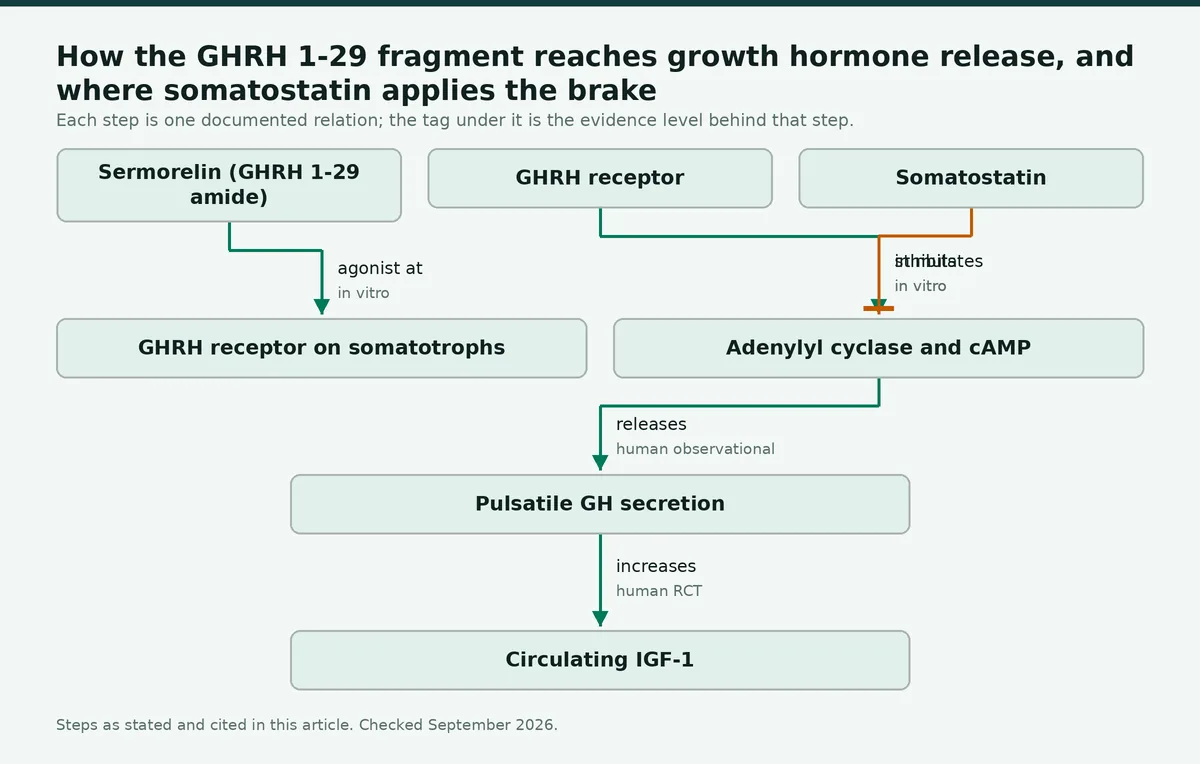
| Step | Relation | Target | Evidence |
|---|---|---|---|
| Sermorelin (GHRH 1-29 amide) | agonist at | GHRH receptor on somatotrophs | in vitro [6] |
| GHRH receptor | stimulates | Adenylyl cyclase and cAMP | in vitro [6] |
| Adenylyl cyclase and cAMP | releases | Pulsatile GH secretion | human observational [5] |
| Pulsatile GH secretion | increases | Circulating IGF-1 | human RCT [4] |
| Somatostatin | inhibits | Adenylyl cyclase and cAMP | in vitro [6] |
The receptor-level cascade is standard class-B GPCR pharmacology, characterized in pituitary cell and vertebrate models rather than in humans: GHRH binds a transmembrane G-protein-coupled receptor, the activated Gα subunit “stimulates the adenylyl cyclase (AC) activity”, cAMP rises, protein kinase A is activated, and the resulting phosphorylation of CREB drives Pit-1 and growth hormone transcription while increased cAMP “modulates the Ca2+ channels to increase calcium influx, thus facilitating the exocytosis and release of GH” — in vitro [6].
The brake is the part that distinguishes a GHRH analogue from injected growth hormone. Somatostatin, released from the periventricular nucleus, acts through an inhibitory Gαi subunit that “reduces the activity of AC” — the same enzyme GHRH stimulates — so the two inputs converge on one node and the output is pulsatile rather than continuous [6][7]. IGF-1 adds a long-loop negative feedback on the pituitary and on hypothalamic GHRH neurons — in vitro and animal [6].
The practical consequence is that a GHRH analogue works through a system that can say no. Exogenous growth hormone bypasses that architecture entirely; sermorelin does not. That is a mechanistic argument, not a safety finding, and it is worth keeping the two apart. The wider family, including the ghrelin-receptor agonists that act on a completely different receptor, is mapped in our hub on growth hormone secretagogues.
Key numbers: half-life in context
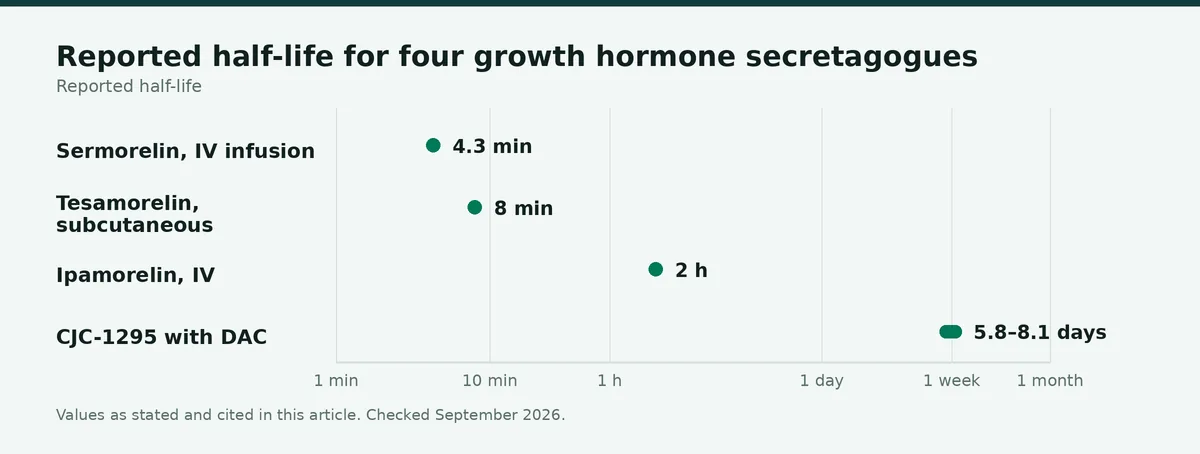
| Compound | Reported half-life |
|---|---|
| Sermorelin, IV infusion | 4.3 min [2] |
| Tesamorelin, subcutaneous | 8 min [12] |
| Ipamorelin, IV | 2 h [14] |
| CJC-1295 with DAC | 5.8–8.1 days [13] |
Sermorelin’s half-life comes from a 1994 Journal of Clinical Endocrinology & Metabolism study in 10 normal men given a 90-minute constant intravenous infusion at 25 ng/kg·min. The disappearance half-time of GHRH-(1-29)-NH2 was 4.3 ± 1.4 minutes, with a metabolic clearance rate of 39.7 ± 3.9 mL/kg·min; substituting D-Ala at position 2 raised the half-life to 6.7 ± 0.5 minutes and cut clearance to 21 ± 1.2 mL/kg·min — human observational [2].
Plotted against the rest of the class, the spread is roughly three orders of magnitude, and it is the single most informative number about how these compounds differ. Sermorelin and tesamorelin are minutes-scale molecules whose effect is a discrete pulse; CJC-1295 with its drug-affinity-complex modification persists for days, which is why CJC-1295 raises questions about continuous rather than pulsatile stimulation that sermorelin does not.
What the research shows
Human studies in children
The largest sermorelin trial is the Geref International Study Group’s one-year multicenter study, published in JCEM in 1996. It enrolled 110 growth-hormone-deficient children, of whom 86 were eligible for efficacy analysis, and gave 30 µg/kg of GHRH-(1-29) by subcutaneous injection at bedtime for 12 months [3]. Baseline height velocity of 4.1 ± 0.9 cm/year rose to 8.0 ± 1.5 cm/year at six months and 7.2 ± 1.3 cm/year at twelve, with roughly 74% classed as good responders at six months — human observational, because the published design is an open-label before-and-after comparison with no placebo arm [3].
The 1999 review that covered the pediatric program reached the conclusion that matters for context: sermorelin “induced catch-up growth in the majority of growth hormone-deficient children”, particularly slow-growing children with delayed bone age, but the height velocity increases were lower than those achieved with somatropin — recombinant growth hormone itself [5]. A GHRH analogue depends on a pituitary that still works, which is both its mechanistic elegance and its clinical ceiling.
Human studies in adults and older adults
The best-designed adult study used a close analogue rather than sermorelin itself, and the difference should be stated plainly. Khorram, Laughlin and Yen ran a single-blind, randomized, placebo-controlled trial of [Nle27]GHRH-(1-29)-NH2 — a norleucine-substituted version of the same 29-residue fragment — in 10 women and 9 men aged 55 to 71, at 10 µg/kg nightly by subcutaneous injection for 16 weeks after a 4-week placebo run-in [4].
The reported results were an acute GH release within 10 minutes of each injection lasting about two hours, significantly increased integrated nocturnal GH in both sexes, serum IGF-1 rising within two weeks and sustained through 12 weeks, increased skin thickness in both sexes, increased lean body mass in men only, and no change in bone mineral density in either sex — human RCT [4]. The only adverse effect reported was transient hyperlipidemia, which resolved by the end of the study [4].
That is a real randomized result, and it is also a small, short, single-blind one in 19 people, testing a substituted analogue at a dose no one has replicated at scale. A 2025 clinical review of growth hormone and aging is blunt about where this leaves the field: application “as an antiaging therapy continues to be controversial and requires further studies” [7]. The gap between that sentence and the claims made in the wellness market is the reason this page exists.
Diagnostic use
The 0.05 mg ampule presentation, approved under NDA 19-863, carried an indication for “evaluating the ability of the somatotroph of the pituitary gland to secrete growth hormone” [1]. The 1999 review describes the corresponding test as a single 1 µg/kg intravenous dose [5]. This was a measurement application rather than a therapeutic one, and it is the use with the cleanest rationale: a short-acting GHRH agonist is a natural probe of pituitary reserve.
Animal and in-vitro evidence
Unlike most compounds in this category, sermorelin’s animal and cell-culture literature is not where its case rests — the human data came first and is stronger. The in vitro and animal work that remains load-bearing is the receptor pharmacology in the mechanism table above: GHRH receptor coupling to adenylyl cyclase, the cAMP–PKA–CREB–Pit-1 route to GH transcription, calcium-dependent exocytosis, and somatostatin’s opposing Gαi signal [6].
Side effects and risks
The adverse events most consistently reported in the labeled pediatric program were local and vasomotor. The 1999 review states that “transient facial flushing and pain at injection site were the most commonly reported adverse events”, and characterized the drug overall as well tolerated, without giving percentages in the published abstract [5]. The 1996 multicenter trial reported no adverse changes in general biochemical or hormonal analyses over 12 months [3]. In the randomized older-adult study of the Nle27 analogue, the only adverse effect reported was transient hyperlipidemia that resolved by study end — human RCT [4].
Those are the documented findings, and they describe short-to-medium-term use at studied doses in studied populations. They do not describe multi-year use in healthy middle-aged adults, which is the modern use case and which has no published trial behind it. Stimulating the GH–IGF-1 axis is a real physiological intervention: IGF-1 is mitogenic, and the long-term oncological and metabolic consequences of sustained elevation in people without growth hormone deficiency have not been characterized in a controlled study of this compound.
A second risk sits with the material rather than the molecule. With no approved product on the US market, every sample in circulation is either compounded or sold for research use, and identity and purity depend entirely on documentation. FDA’s compounding enforcement makes the general point sharply: in a September 2025 warning letter, the agency wrote of a nominated peptide that it “is not the subject of an applicable USP or NF monograph, is not a component of an FDA-approved human drug, and does not appear on the 503A bulks list”, and concluded the resulting products were unapproved new drugs [16]. That three-part test is the whole legal question for any compounded peptide.
Regulatory and legal status (2026)
Sermorelin’s US history is unusually well documented, and the details matter.
Two applications held approval. NDA 20-443 covered GEREF injection at 0.5 mg and 1.0 mg base per vial, indicated for “treatment of idiopathic growth hormone deficiency (GHD) in children with growth failure”. NDA 19-863 covered GEREF injection at 0.05 mg base per ampule for pituitary growth hormone stimulation testing. EMD Serono notified FDA of discontinuation on 11 July 2008 for the 0.05 mg presentation and 2 December 2008 for the vials, and the approvals were withdrawn on 18 June 2009 [1].
In 2013, FDA published a formal determination that these products “were not withdrawn from sale for reasons of safety or effectiveness”, noting that the petitioner “has identified no data or other information suggesting” otherwise — the finding that allows abbreviated applications to reference the withdrawn products [1]. A December 2020 summary report prepared for FDA by the University of Maryland’s regulatory science center, evaluating a nomination by a compounding pharmacy and the Outsourcing Facilities Association, records the same conclusion: sermorelin acetate “was available as an FDA-approved injectable product that was discontinued, not for reasons of safety or efficacy” [15].
Where it sits now, all checked September 2026:
- 503A bulks categories: sermorelin does not appear in Category 1, 2 or 3 of FDA’s list of bulk drug substances nominated for compounding under section 503A, updated 14 May 2026 [10].
- Category 2 safety-risk list: sermorelin is absent from the 14 substances FDA lists as potentially presenting significant safety risks, page updated 22 April 2026 — a list that does include GHRP-2, GHRP-6, ipamorelin acetate and ibutamoren mesylate [9].
- 503B: sermorelin acetate appears in Category 1, “Bulk Drug Substances Under Evaluation”, in FDA’s 503B nominations document updated 21 March 2025, flagged there as a component of FDA-approved drugs [11]. It is not on the final 503B clinical-need bulks list, which as published contains five substances, none of them peptides [17].
Read together, that is a compound in regulatory limbo rather than a cleared one: formerly approved, withdrawn for commercial reasons, nominated for compounding, still under evaluation, and with no approved product to anchor the “component of an approved drug” pathway since 2009. Absence from a safety-risk list is not a clearance. The general US framework is set out in our guide to peptide legal status.
For sport, sermorelin is named explicitly on the WADA 2026 Prohibited List under S2.2, growth hormone releasing factors, alongside CJC-1293, CJC-1295 and tesamorelin, prohibited at all times and classified as a non-specified substance. The List came into force on 1 January 2026 [8].
Comparison Framework scores
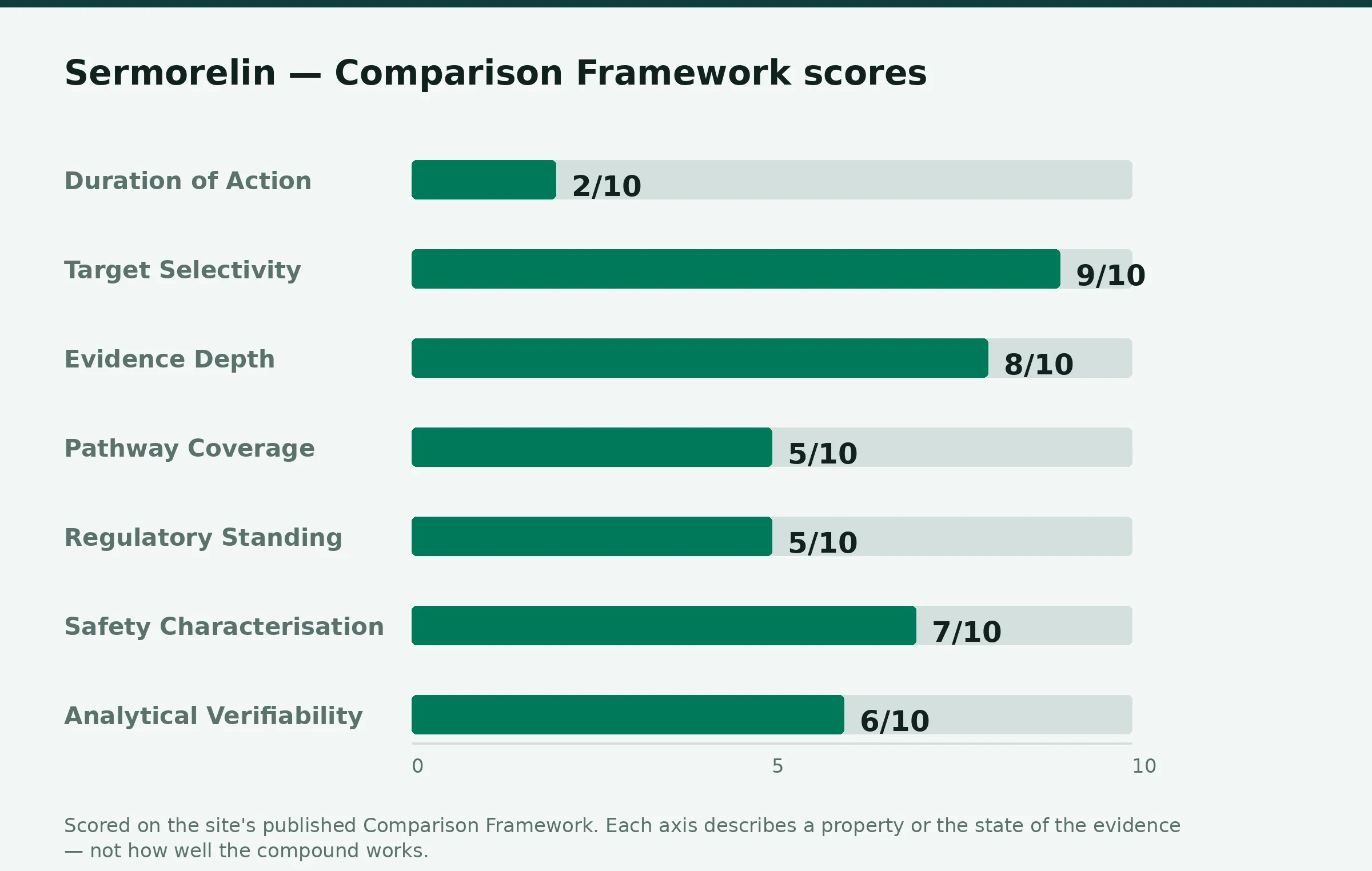
| Axis | Score | Why |
|---|---|---|
| Duration of Action | 2/10 | Disappearance half-time of 4.3 ± 1.4 minutes on intravenous infusion in 10 healthy men, with a metabolic clearance rate of 39.7 mL/kg·min — squarely in the framework’s under-30-minute band [2] |
| Target Selectivity | 9/10 | An unmodified fragment of the native ligand acting at its own receptor: GHRH(1-29)-NH2 is the shortest peptide retaining full GHRH activity, and the documented cascade runs through the GHRH receptor and adenylyl cyclase alone [5][6] |
| Evidence Depth | 8/10 | Two former FDA approvals, a 110-child multicenter one-year trial with 86 evaluable, and a randomized placebo-controlled trial of a close analogue in older adults — short of the top band only because the approvals were withdrawn in 2009 and the modern use has no trial [1][3][4] |
| Pathway Coverage | 5/10 | One pathway: GHRH receptor to cAMP to pulsatile GH to IGF-1, with somatostatin as the opposing input on the same node rather than a second route [6][7] |
| Regulatory Standing | 5/10 | Formerly approved and withdrawn for non-safety reasons, absent from the 503A bulks categories, and sitting in 503B Category 1 “under evaluation” rather than on the final list (checked September 2026) [1][10][11][17] |
| Safety Characterisation | 7/10 | Adverse events are described from labeled pediatric use and a randomized adult trial — facial flushing, injection-site pain, transient hyperlipidemia — but long-term use in healthy adults is uncharacterized, and what is known being well documented is the point here, not reassurance [3][4][5] |
| Analytical Verifiability | 6/10 | A defined 29-residue sequence with an amidated C-terminus that was manufactured as a commercial API under two NDAs, so identity by mass and sequence is straightforward; no current compendial monograph for the substance was located in September 2026 [1][5] |
The full anchors behind each of these numbers are published in our Comparison Framework. Note that Duration of Action at 2 is a description, not a criticism: a minutes-scale pulse is exactly what a GHRH analogue is for, and the long-acting members of the class score higher on that axis while raising questions sermorelin avoids.
How sermorelin compares
Tesamorelin is the useful contrast, because it is the GHRH analogue that is still approved. Its label describes a hexenoyl-modified copy of the full 44-residue GRF sequence that “binds and stimulates human GRF receptors” to induce “synthesis and pulsatile release of endogenous growth hormone”, with a mean elimination half-life of 8 minutes after a 1.4 mg subcutaneous dose in healthy subjects [12]. Same receptor, same pulsatile logic, similar duration — but a current approval, a defined indication, and a labeled safety section. The head-to-head is developed in sermorelin vs tesamorelin.
CJC-1295 takes the opposite design decision. Its drug-affinity-complex version binds albumin and carries an estimated half-life of 5.8 to 8.1 days in healthy adults [13] — a GHRH signal that persists for a week rather than minutes. That is a different pharmacological proposition from sermorelin, and the somatostatin brake in the mechanism diagram is the reason it is worth arguing about.
Ipamorelin is not a GHRH analogue at all. It acts at the ghrelin receptor, has a reported terminal half-life of about 2 hours in human volunteers [14], and — unlike sermorelin — appears by name on FDA’s Category 2 list of bulk substances that may present significant safety risks [9]. Two compounds marketed side by side in the same wellness category sit on opposite sides of that list.
Sourcing and quality: what to look for
Sermorelin has no approved US product, so nothing in circulation carries an FDA-reviewed label. Material reaches buyers either through a compounding pharmacy or through the research-chemical market, and in both cases the documentation is the only evidence of what is in the vial.
A 29-mer with a C-terminal amide is entirely tractable analytically: the expected mass is fixed by the sequence, and amidation is visible as a one-dalton difference from the free acid. A certificate that reports a purity percentage with no method, no lot number and no named laboratory is telling you almost nothing. What a usable certificate shows is identity by mass spectrometry, purity by a stated chromatographic method with the trace attached, the lot it applies to, the date, and the party that ran it. Our guide to reading a certificate of analysis works through a real one line by line.
FAQ
Was sermorelin ever FDA-approved?
Yes. Two applications held US approval under the GEREF name: NDA 20-443 for 0.5 mg and 1.0 mg vials indicated for idiopathic growth hormone deficiency in children with growth failure, and NDA 19-863 for a 0.05 mg ampule indicated for evaluating the pituitary somatotroph’s ability to secrete growth hormone [1]. Both approvals were withdrawn on 18 June 2009 after EMD Serono discontinued manufacturing, and FDA determined in 2013 that the products “were not withdrawn from sale for reasons of safety or effectiveness” [1].
Why was sermorelin taken off the US market?
The withdrawal was commercial, not regulatory. FDA’s 2013 Federal Register determination states that the petitioner “has identified no data or other information suggesting” the products were withdrawn for safety or effectiveness reasons, and the discontinuation notifications came from the manufacturer in July and December 2008 [1]. A 2020 summary report prepared for FDA records the same finding, describing sermorelin acetate as an FDA-approved injectable product “that was discontinued, not for reasons of safety or efficacy” [15]. It is worth separating these: a drug withdrawn for commercial reasons carries a very different evidentiary history from one pulled for harm.
What is sermorelin’s half-life?
About 4.3 minutes. A 1994 study in 10 normal men receiving a 90-minute constant intravenous infusion at 25 ng/kg·min reported a disappearance half-time for GHRH-(1-29)-NH2 of 4.3 ± 1.4 minutes and a metabolic clearance rate of 39.7 ± 3.9 mL/kg·min — human observational [2]. For comparison, tesamorelin’s approved label gives a mean elimination half-life of 8 minutes subcutaneously [12], and CJC-1295 with DAC was estimated at 5.8 to 8.1 days [13].
Can sermorelin be legally compounded in the US in 2026?
The position is unsettled rather than settled either way. Checked September 2026, sermorelin does not appear in Categories 1 to 3 of FDA’s 503A bulk substances nominations list, updated 14 May 2026 [10], and is absent from the Category 2 list of substances that may present significant safety risks, updated 22 April 2026 [9]. It does appear in Category 1, “under evaluation”, of the 503B nominations document updated 21 March 2025 [11], but it is not on the final 503B clinical-need list [17]. FDA’s own three-part test for a compounded bulk substance — a USP or NF monograph, a component of an FDA-approved drug, or a place on the 503A bulks list — is the framework the agency applies in enforcement [16], and sermorelin’s approved products have been withdrawn since 2009 [1].
Is sermorelin banned in sport?
Yes, at all times. Sermorelin is named explicitly in section S2.2 of the WADA 2026 Prohibited List under growth hormone releasing factors, alongside CJC-1293, CJC-1295 and tesamorelin, and is classified as a non-specified substance [8]. The 2026 List came into force on 1 January 2026 [8]. Athletes subject to testing should treat the entire GHRH-analogue and growth hormone secretagogue family as prohibited rather than checking compound by compound.
Does sermorelin work in healthy adults?
The closest evidence is a single-blind, randomized, placebo-controlled trial of [Nle27]GHRH-(1-29)-NH2 — a substituted analogue, not sermorelin itself — in 10 women and 9 men aged 55 to 71, given 10 µg/kg nightly for 16 weeks [4]. It reported increased nocturnal GH, IGF-1 rising within two weeks and sustained to 12 weeks, increased skin thickness in both sexes, increased lean body mass in men only, and no change in bone mineral density — human RCT [4]. That is a genuine randomized result in 19 people over four months, and it is not a basis for claims about long-term use; a 2025 clinical review concludes that application as an antiaging therapy “continues to be controversial and requires further studies” [7].
References
- US Food and Drug Administration. Determination That GEREF (Sermorelin Acetate) Injection, 0.5 Milligrams Base/Vial and 1.0 Milligrams Base/Vial, and GEREF (Sermorelin Acetate) Injection, 0.05 Milligrams Base/Amp, Were Not Withdrawn From Sale for Reasons of Safety or Effectiveness. Federal Register 78 FR 14100. 2013. https://www.federalregister.gov/documents/2013/03/04/2013-04827/determination-that-geref-sermorelin-acetate-injection-05-milligrams-basevial-and-10-milligrams
- Soule S, King JA, Millar RP. Incorporation of D-Ala2 in growth hormone-releasing hormone-(1-29)-NH2 increases the half-life and decreases metabolic clearance in normal men. The Journal of Clinical Endocrinology & Metabolism. 1994;79(4):1208–1211. https://academic.oup.com/jcem/article-abstract/79/4/1208/2653223
- Thorner M, Rochiccioli P, Colle M, et al. Once daily subcutaneous growth hormone-releasing hormone therapy accelerates growth in growth hormone-deficient children during the first year of therapy (Geref International Study Group). The Journal of Clinical Endocrinology & Metabolism. 1996;81(3):1189–1196. https://academic.oup.com/jcem/article-abstract/81/3/1189/2649680
- Khorram O, Laughlin GA, Yen SSC. Endocrine and Metabolic Effects of Long-Term Administration of [Nle27]Growth Hormone-Releasing Hormone-(1-29)-NH2 in Age-Advanced Men and Women. The Journal of Clinical Endocrinology & Metabolism. 1997;82(5):1472–1479. https://academic.oup.com/jcem/article-abstract/82/5/1472/2823341
- Prakash A, Goa KL. Sermorelin: A Review of its Use in the Diagnosis and Treatment of Children with Idiopathic Growth Hormone Deficiency. BioDrugs. 1999;12(2):139–157. https://link.springer.com/article/10.2165/00063030-199912020-00007
- Vélez EJ, Unniappan S. A Comparative Update on the Neuroendocrine Regulation of Growth Hormone in Vertebrates. Frontiers in Endocrinology. 2021;11:614981. https://www.frontiersin.org/journals/endocrinology/articles/10.3389/fendo.2020.614981/full
- Fernández-Garza LE, Guillen-Silva F, Sotelo-Ibarra MA, et al. Growth hormone and aging: a clinical review. Frontiers in Aging. 2025;6:1549453. https://www.frontiersin.org/journals/aging/articles/10.3389/fragi.2025.1549453/full
- World Anti-Doping Agency. The 2026 Prohibited List, World Anti-Doping Code, valid 1 January 2026 (copy published by the Jamaica Anti-Doping Commission). 2026. https://jadco.gov.jm/wp-content/uploads/2026/01/JADCO-Prohibited-List-2026.pdf
- US Food and Drug Administration. Certain Bulk Drug Substances for Use in Compounding that May Present Significant Safety Risks. FDA.gov, page last updated 22 April 2026. https://www.fda.gov/drugs/human-drug-compounding/certain-bulk-drug-substances-use-compounding-may-present-significant-safety-risks
- US Food and Drug Administration. Bulk Drug Substances Nominated for Use in Compounding Under Section 503A of the Federal Food, Drug, and Cosmetic Act. FDA.gov, updated 14 May 2026. https://www.fda.gov/media/94155/download
- US Food and Drug Administration. Bulk Drug Substances Nominated for Use in Compounding Under Section 503B of the Federal Food, Drug, and Cosmetic Act. FDA.gov, updated 21 March 2025. https://www.fda.gov/media/94164/download
- US Food and Drug Administration. EGRIFTA (tesamorelin for injection), for subcutaneous use — Prescribing Information. accessdata.fda.gov, NDA 022505. 2019. https://www.accessdata.fda.gov/drugsatfda_docs/label/2019/022505Orig1s010lbl.pdf
- Teichman SL, Neale A, Lawrence B, et al. Prolonged Stimulation of Growth Hormone (GH) and Insulin-Like Growth Factor I Secretion by CJC-1295, a Long-Acting Analog of GH-Releasing Hormone, in Healthy Adults. The Journal of Clinical Endocrinology & Metabolism. 2006;91(3):799–805. https://academic.oup.com/jcem/article-abstract/91/3/799/2843281
- Gobburu JVS, Agersø H, Jusko WJ, Ynddal L. Pharmacokinetic-Pharmacodynamic Modeling of Ipamorelin, a Growth Hormone Releasing Peptide, in Human Volunteers. Pharmaceutical Research. 1999;16(9):1412–1416. https://link.springer.com/article/10.1023/A:1018955126402
- University of Maryland Center of Excellence in Regulatory Science and Innovation. Summary Report: Sermorelin acetate — Prepared for the Food and Drug Administration. 2020. https://archive.hshsl.umaryland.edu/server/api/core/bitstreams/a2397a31-6114-4797-969e-f7709ac7cc57/content
- US Food and Drug Administration. Warning Letter: ASN-LABS. FDA.gov. 9 September 2025. https://www.fda.gov/inspections-compliance-enforcement-and-criminal-investigations/warning-letters/asn-labs-09092025
- US Food and Drug Administration. 503B Bulk Drug Substances List. FDA.gov. https://www.fda.gov/drugs/human-drug-compounding/503b-bulk-drug-substances-list