
Quick answer: Tesamorelin is a synthetic analogue of human growth hormone-releasing factor, and the only growth hormone secretagogue with an FDA-approved product behind it. The indication is narrow: “reduction of excess abdominal fat in HIV-infected adult patients with lipodystrophy”, approved in 2010 [1]. Two 26-week placebo-controlled phase 3 trials found visceral fat fell 18% and 14% against +2% and −2% on placebo (human RCT) [1]. The label warns of neoplasms, elevated IGF-1 and glucose intolerance; the European application was withdrawn in 2012 over IGF-1 [1][7].
| Spec | Detail |
|---|---|
| Also known as | TH9507; EGRIFTA, EGRIFTA SV, EGRIFTA WR [1][2][4] |
| Class | Synthetic growth hormone-releasing factor (GRF/GHRH) analogue [1][8] |
| Sequence / length | 44-amino-acid human GRF sequence, hexenoyl moiety on the N-terminal tyrosine [1] |
| Molecular formula / weight | C221H366N72O67S · x C2H4O2 (x ≈ 7); 5135.9 Da. CAS 901758-09-6 [1][8] |
| Half-life | Mean elimination 11 min (WR), 8 min (SV); bioavailability under 4% [1][2] |
| Regulatory status (US) | FDA-approved 2010, one indication (checked September 2026) [1] |
| Regulatory status (EU) | Application withdrawn 21 June 2012 (checked September 2026) [7] |
| WADA status | GHRH analogues including tesamorelin prohibited in sport [9] |
What is tesamorelin?
Tesamorelin is a stabilised copy of the hormone the hypothalamus uses to tell the pituitary to release growth hormone. The label describes a growth hormone-releasing factor analogue built from “the 44 amino acid sequence of human GRF and a hexenoyl moiety, a C6 chain with a double bond at position 3, attached to the tyrosine residue at the N-terminal part” [1]; LiverTox calls it “a synthetic 44 amino acid polypeptide analogue of growth hormone releasing hormone (GHRH)” [8].
That N-terminal modification is the design idea of the whole class: native GHRH is destroyed in minutes, and every analogue in our guide to growth hormone secretagogues exists to outlast it. Tesamorelin is the one that carried the idea to approval, which makes it the exception on this site. Most compounds in our peptide primer have no approved human use anywhere; this one has a label and a post-marketing history.
How tesamorelin works (mechanism)
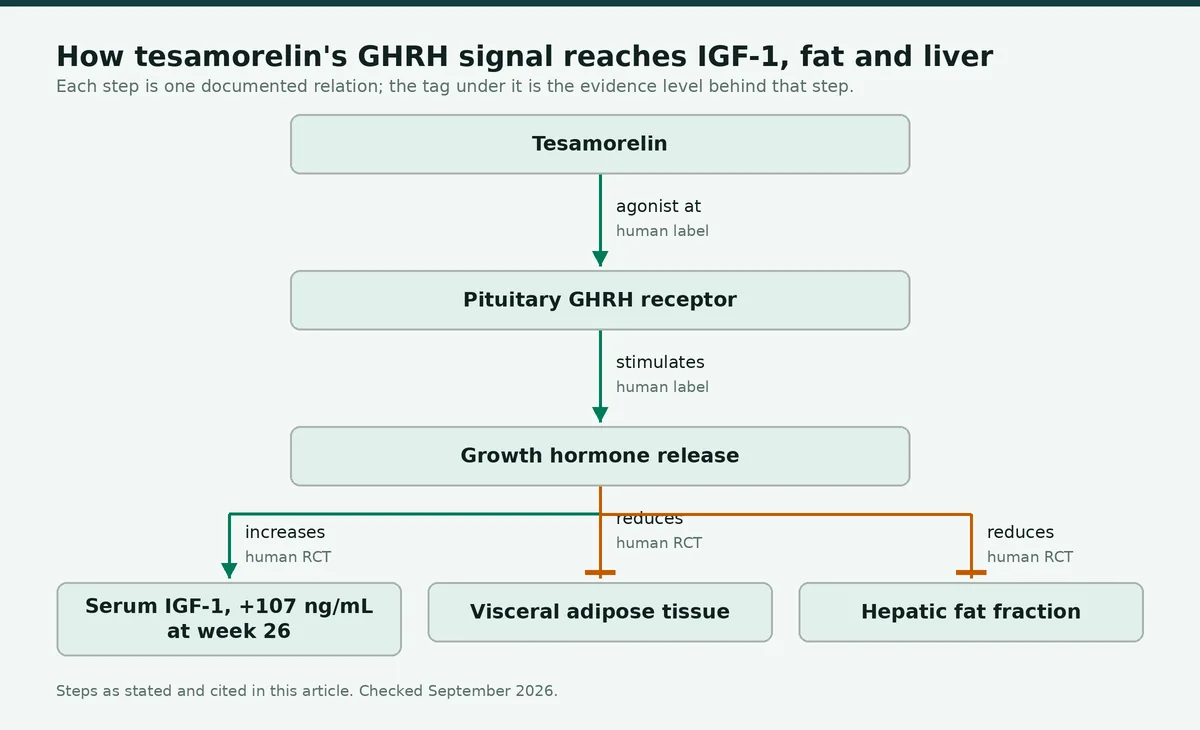
| Step | Relation | Target | Evidence |
|---|---|---|---|
| Tesamorelin | agonist at | Pituitary GHRH receptor | human label [1][8] |
| Pituitary GHRH receptor | stimulates | Growth hormone release | human label [1][8] |
| Growth hormone release | increases | Serum IGF-1, +107 ng/mL at week 26 | human RCT [1][4] |
| Growth hormone release | reduces | Visceral adipose tissue | human RCT [1][3] |
| Growth hormone release | reduces | Hepatic fat fraction | human RCT [5] |
The chain is short and, unusually for this site, almost entirely human. Tesamorelin stimulates the GHRH receptor on the anterior pituitary, the pituitary releases its own growth hormone, and the liver responds with IGF-1 [8]. The label quantifies that last step: mean IGF-1 rose 107 ng/mL against a 15 ng/mL fall on placebo in the first pivotal trial, 108 against +3 in the second [1].
What the molecule does not do is as informative. Its plasma residence is minutes — half-life 11 minutes (WR), 8 minutes (SV) [1][2]. What lasts through the day is the hormonal signal, not the peptide.
Key numbers
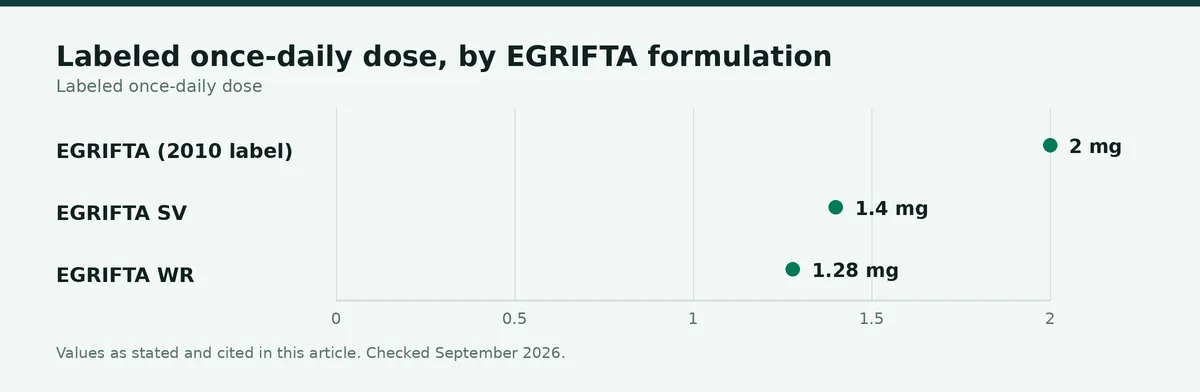
| Formulation | Labeled once-daily dose | Evidence level |
|---|---|---|
| EGRIFTA (2010 label) | 2 mg | label [8] |
| EGRIFTA SV | 1.4 mg | label [2] |
| EGRIFTA WR | 1.28 mg | label [1] |
This is the number most often quoted wrongly. The phase 3 programme and the liver-fat trial ran at 2 mg once daily, the amount on the original 2010 label [3][4][5][8]. It fell to 1.4 mg with EGRIFTA SV, revised February 2024, and to 1.28 mg with EGRIFTA WR, revised March 2025 [1][2]. One molecule, three labeled daily amounts — “tesamorelin 2 mg” in a 2007 paper does not describe what a pharmacy dispenses in 2026.
What the research shows
Human studies
The pivotal evidence is two 26-week randomised, double-blind, placebo-controlled trials in adults with HIV and excess abdominal fat, both summarised in the label [1]. The first (NCT00123253) randomised 412 patients, 273 to tesamorelin and 137 to placebo, 80% completing: visceral adipose tissue fell 27 cm² against a 4 cm² increase on placebo, −18% versus +2% (human RCT) [1]. The second (NCT00435136) randomised 404, 270 to tesamorelin and 126 to placebo, 74% completing: visceral fat fell 21 cm² against essentially no change, −14% versus −2% [1].
The published report of the first trial adds the metabolic detail: visceral fat down 15.2% against a 5.0% increase, triglycerides down 50 mg/dL against a 9 mg/dL rise, IGF-I up 81.0% against a 5.0% fall, all p<0.001, and “no significant differences were observed in glycemic measures” [3].
A pooled analysis — 806 patients randomised 2:1 to tesamorelin 2 mg or placebo for 26 weeks, plus a 26-week safety extension — reported a visceral adipose tissue “treatment effect, −15.4%” (P < 0.001), mean IGF-I “108 ± 112 vs. −7 ± 64 ng/ml (P < 0.001 vs. placebo)”, and “no clinically meaningful differences between groups in glucose parameters at wk 26 and 52” (human RCT) [4].
Liver fat was tested separately. A randomised, placebo-controlled trial at two US centres gave 2 mg daily to 30 participants with HIV and non-alcoholic fatty liver disease against 30 on placebo for 12 months. Hepatic fat fraction fell an absolute −4.1% (95% CI −7.6 to −0.7, p=0.018) and a relative −37% (95% CI −67 to −7, p=0.016); 35% of the tesamorelin group against 4% on placebo ended below 5% hepatic fat, p=0.0069; fibrosis progression was attenuated (human RCT) [5]. One 61-participant trial, not an approved use.
Cognition has been looked at, and the most recent published result is negative. A double-blind, placebo-controlled pilot gave 1 mg tesamorelin or placebo for 10 weeks to 22 adults ranging from normal cognition to mild cognitive impairment: “low-dose GHRH treatment was not directly linked with significant changes in study measures” (human RCT) [6].
Where the evidence stops
No animal or in-vitro dataset is cited here: setting cell-culture work beside two phase 3 trials would misrepresent the weight of evidence. The gaps are inside the human file. The label states that “long-term cardiovascular safety has not been established” and that no data support improved antiretroviral compliance [1]. Every efficacy number above comes from adults with HIV-associated lipodystrophy.
Side effects and risks
The label carries seven warnings and precautions: increased risk of neoplasms, elevated IGF-1 levels, fluid retention, glucose intolerance or diabetes mellitus, hypersensitivity reactions, injection site reactions, and increased mortality in acute critical illness [1]. That is the risk profile of sustained growth hormone axis stimulation, written down and reviewed by a regulator — which no research-use secretagogue has.
Adverse reactions above 5% were arthralgia, injection site erythema, injection site pruritus, pain in extremity, peripheral edema and myalgia [1]. In the controlled phase, arthralgia ran 13% against 11% on placebo, injection site reactions 17% against 6%, myalgia 6% against 2% [1].
IGF-1 is the signal regulators argued about: its elevation is both the mechanism of benefit and the mechanism of concern, and the pooled trials put the average increase at 108 ng/mL [4]. Glucose was reassuring inside the trial windows — no significant difference at 26 weeks, none judged clinically meaningful at 52 — yet it remains a labeled warning, because 52 weeks is not a lifetime [1][3][4].
Liver injury is not on the list. LiverTox scores tesamorelin “E (unlikely cause)” and reports that “tesamorelin therapy was not associated with de novo elevations in serum enzymes” [8].
Regulatory and legal status (2026)
United States, checked September 2026. Tesamorelin is FDA-approved, initial US approval 2010 [1]. The indication is one sentence, worth reading exactly: “EGRIFTA WR is indicated for the reduction of excess abdominal fat in HIV-infected adult patients with lipodystrophy” [1]. EGRIFTA SV carries the same wording [2]. The limitations of use rule out the readings people most often want: long-term cardiovascular safety is not established, and it is not indicated for weight loss [1].
European Union, checked September 2026. The application never became an authorisation. Ferrer Internacional withdrew it on 21 June 2012, with the CHMP’s provisional opinion that “the benefits of Egrifta did not outweigh its risks” [7]. The reasons were specific: the fat reduction “has not been shown to be clinically meaningful in terms of actual health benefits to patients”; the European HIV population differed from the trial population; long-term safety data were missing; and “high levels of IGF-1 may be associated with an increased risk of cancer and a potential worsening of diabetic eye disease” — a major safety concern in the committee’s words [7].
Sport. Growth hormone-releasing hormone and its synthetic analogues — the analytical literature names sermorelin/CJC-1293, tesamorelin and CJC-1295 together — “are prohibited in sports by WADA”, with validated urine methods detecting them at or below 0.5 ng/mL [9]. No Prohibited List section number is quoted, because that document could not be opened during this run.
Approved drug versus “research use only” tesamorelin
These are not the same thing, and the distinction carries most of the practical risk here.
The approved product is a finished drug: a defined formulation at a labeled amount per day, made under an FDA-reviewed application and monitored after marketing [1][2]. Every trial result above came from that kind of material, in a defined HIV population [3][4][5].
Material sold online as “tesamorelin, research use only” is not that product: no approved label, no reviewed specification behind its identity or purity, no pharmacovigilance. Compounded tesamorelin has drawn FDA attention of its own — an April 2020 warning letter acknowledged one facility’s “voluntary recall of tesamorelin products produced between July 6, 2018, and September 11, 2018, due to an incorrect beyond use date (BUD) on the vial labels” [10]. Our overview of US peptide legal status covers what research-use labelling permits.
Comparison Framework scores
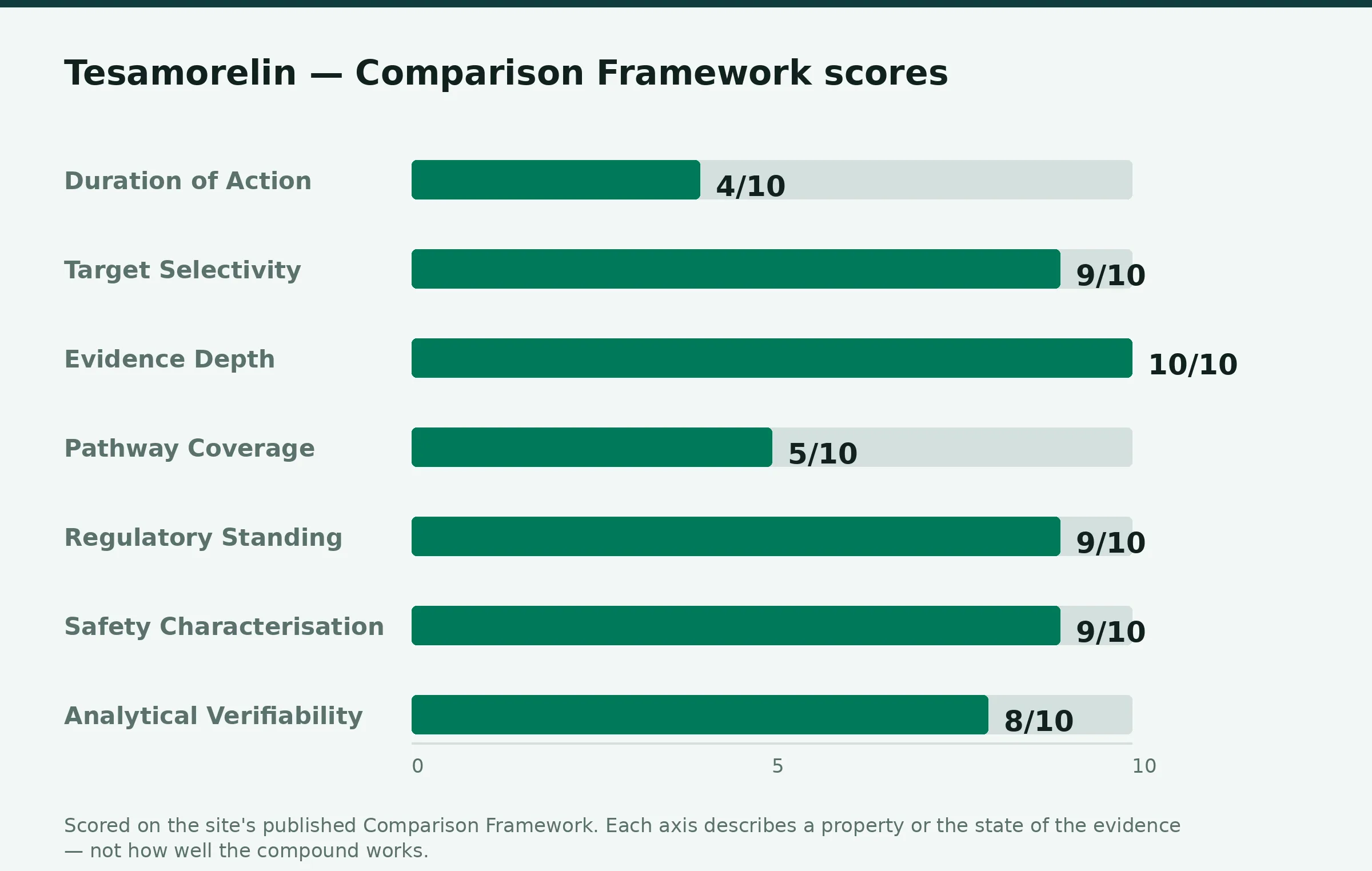
| Axis | Score | Why |
|---|---|---|
| Duration of Action | 4/10 | Half-life 11 min (WR), 8 min (SV); the downstream signal, not the peptide, carries once-daily dosing [1][2] |
| Target Selectivity | 9/10 | Acts at the pituitary GHRH receptor; labeled risks follow the GH axis, not off-target receptors [1][8] |
| Evidence Depth | 10/10 | Approval plus two 26-week phase 3 RCTs (816 randomised), a pooled 806-patient analysis, a liver-fat RCT [1][3][4][5] |
| Pathway Coverage | 5/10 | One pathway, the GHRH receptor; no second receptor by design [1][8] |
| Regulatory Standing | 9/10 | FDA-approved since 2010, one indication, three labeled formulations (checked September 2026) [1][2] |
| Safety Characterisation | 9/10 | Regulatory-grade labeling: seven warnings, rates quantified against placebo, 52-week extension [1][4] |
| Analytical Verifiability | 8/10 | Defined formula and 5135.9 Da mass, FDA-reviewed specifications, validated LC-MS methods at ≤0.5 ng/mL [1][9] |
A Safety Characterisation of 9 is not a statement that tesamorelin is safe. It means the risks are written down, quantified against placebo and reviewed — including a neoplasm warning and the IGF-1 concern that sank the European application [1][7]. Knowing precisely what can go wrong is what is scored. The anchors sit on our Comparison Framework page.
How tesamorelin compares
Tesamorelin’s position in this family is easy to state: it is the only member whose file ends in an approved indication and a current label [1]. Each comparison below points to the page carrying that compound’s own sources.
Against sermorelin, the other GHRH-receptor analogue with a regulatory history, the contrast is which clinical file is still live; our sermorelin versus tesamorelin comparison sets the two side by side.
Against CJC-1295 with DAC, the trade is duration for evidence: tesamorelin clears from plasma in minutes [1], where the CJC-1295 page documents a half-life measured in days and no approval anywhere.
Against ipamorelin, the comparison crosses arms of the axis. Ipamorelin acts at the ghrelin receptor rather than the GHRH receptor, and its own page sets out a clinical programme that stopped short of approval.
Sourcing and quality: what to look for
For the approved product the question barely arises: identity, purity and stability are a regulatory obligation, and the specification is reviewed rather than self-declared [1].
For anything else sold under the name, the checkable items are the usual ones. Identity should be confirmed by mass spectrometry against the expected 5135.9 Da, with acetate content stated, since the formula is the peptide plus roughly seven acetate equivalents [1]. Purity needs a stated HPLC method, not a bare percentage, and the certificate should name the lot and the laboratory. Our guide to peptide certificates of analysis walks each line.
One caution is specific here: a certificate can establish that a vial contains tesamorelin while saying nothing about the warnings on the approved drug’s label [1].
FAQ
Is tesamorelin FDA-approved?
Yes, for one narrowly worded indication: “reduction of excess abdominal fat in HIV-infected adult patients with lipodystrophy”, initial US approval 2010, checked September 2026 [1]. The same label states that long-term cardiovascular safety is not established and that the drug is not indicated for weight loss [1].
How much visceral fat did tesamorelin reduce in the trials?
In two 26-week randomised, placebo-controlled trials on the label, visceral adipose tissue fell 27 cm² (−18%) against a 4 cm² increase (+2%) on placebo in the first, and 21 cm² (−14%) against −2% in the second [1]. A pooled analysis of 806 randomised patients gave a treatment effect of −15.4%, P < 0.001 (human RCT) [4].
What is tesamorelin’s half-life?
Minutes, not hours: a mean elimination half-life of 11 minutes on the EGRIFTA WR label and 8 minutes on EGRIFTA SV, peak at a median 0.15 hours, bioavailability under 4% subcutaneously [1][2]. The hormonal effects downstream last far longer.
Why was tesamorelin not approved in Europe?
The applicant withdrew the marketing authorisation application on 21 June 2012, when the CHMP’s provisional opinion was that “the benefits of Egrifta did not outweigh its risks” [7]. The committee held that the fat reduction had not been shown to be clinically meaningful, that long-term safety data were lacking, and that elevated IGF-1 “may be associated with an increased risk of cancer and a potential worsening of diabetic eye disease” [7].
Is research-use tesamorelin the same as Egrifta?
No. The approved drug is made under an FDA-reviewed application and dispensed with a label carrying seven warnings, among them neoplasms, elevated IGF-1 and glucose intolerance [1]. Material sold as research use only has no approved label, no reviewed specification and no post-marketing surveillance, and every trial result on this page came from the approved product in adults with HIV-associated lipodystrophy [3][4].
Is tesamorelin banned in sport?
Yes. Growth hormone-releasing hormone and its synthetic analogues, tesamorelin among them alongside sermorelin/CJC-1293 and CJC-1295, “are prohibited in sports by WADA”, and validated urine methods detect them at or below 0.5 ng/mL [9].
References
- US Food and Drug Administration. EGRIFTA WR (tesamorelin) for injection, for subcutaneous use — full prescribing information. Revised March 2025. https://www.accessdata.fda.gov/drugsatfda_docs/label/2025/022505s020lbl.pdf
- DailyMed, US National Library of Medicine. EGRIFTA SV (tesamorelin) kit — label. Revised February 2024. https://dailymed.nlm.nih.gov/dailymed/drugInfo.cfm?setid=3d783378-b02d-4f19-99dd-0fc91a042224
- Metabolic effects of a growth hormone-releasing factor in patients with HIV. New England Journal of Medicine. 2007;357(23):2359–2370. https://pubmed.ncbi.nlm.nih.gov/18057338/
- Effects of tesamorelin (TH9507), a growth hormone-releasing factor analog, in human immunodeficiency virus-infected patients with excess abdominal fat: a pooled analysis of two multicenter, double-blind placebo-controlled phase 3 trials with safety extension data. Journal of Clinical Endocrinology & Metabolism. 2010;95(9):4291–4304. https://pubmed.ncbi.nlm.nih.gov/20554713/
- Stanley TL, Fourman LT, Feldpausch MN, et al. Effects of tesamorelin on non-alcoholic fatty liver disease in HIV: a randomised, double-blind, multicentre trial. The Lancet HIV. 2019;6(12):e821–e830. https://www.sciencedirect.com/science/article/abs/pii/S2352301819303388
- Stewart CE, French KP, Wright TJ, Wilhoit K, Randolph KM, Danesi CP, Gilkison CR, Karmonik C, Lu L, Dillon EL, Durham WJ, Urban RJ, Sheffield-Moore M, Masel BE. The effect of growth hormone-releasing hormone on cognition and brain connectivity in adults with cognition ranging from normal to mild cognitive impairment. eNeurologicalSci. 2026;44:100616. https://pubmed.ncbi.nlm.nih.gov/42382101/
- European Medicines Agency. Questions and answers on the withdrawal of the marketing authorisation application for Egrifta (tesamorelin). 2012. https://www.ema.europa.eu/en/documents/medicine-qa/questions-and-answers-withdrawal-marketing-authorisation-application-egrifta-tesamorelin_en.pdf
- LiverTox: Clinical and Research Information on Drug-Induced Liver Injury. Tesamorelin. National Institute of Diabetes and Digestive and Kidney Diseases, NCBI Bookshelf NBK548730. https://www.ncbi.nlm.nih.gov/books/NBK548730/
- Uçaktürk E, Nemutlu E. Analysis of growth hormone releasing hormone and its analogs in urine using nano liquid chromatography coupled with quadrupole/orbitrap mass spectrometry. Journal of Pharmaceutical and Biomedical Analysis. 2026;268:117207. https://www.sciencedirect.com/science/article/abs/pii/S0731708525005485
- US Food and Drug Administration. Warning Letter: Tailor Made Compounding LLC, 594743. 1 April 2020. https://www.fda.gov/inspections-compliance-enforcement-and-criminal-investigations/warning-letters/tailor-made-compounding-llc-594743-04012020